Ethanol-blended Petrol is here to stay, but forcing one blend on all vehicles hurts people: Multiple choices from E10 to E100 at different prices is the only fair way
From April 1, 2026, the government of India has made it compulsory for every petrol pump in India to sell only E20 petrol, that is, petrol mixed with 20 percent ethanol, with a minimum octane rating of 95. Pure petrol without any ethanol has almost disappeared from the market, except for some premium brands like Indian Oil XP100, a 100-octane super-premium petrol that costs over ₹150 per litter. This sudden and complete shift has created a lot of anger and worry among owners of cars and two-wheelers. While reducing our dependence on imported crude oil and helping farmers through ethanol production are good goals, the way this policy is being pushed, by removing all choice and making one single blend mandatory for everyone, is creating real problems for ordinary citizens who cannot afford to change their vehicles every few years. Older vehicles not built for higher ethanol content It is worth remembering that ethanol blending itself is not a completely new idea in India. The previous UPA government had introduced the E10 programme, mixing 10 percent ethanol in petrol. But at that time, it was not made compulsory like we see today. Pure petrol without any blending continued to be sold at pumps across the country. Because of this, owners of older vehicles, especially those made before 2011, could still buy 100 percent petrol if their vehicle was not comfortable with even 10 percent ethanol. Most vehicles sold in India after 2011 are E10 compliant, therefore such vehicles kept running on E10 without any issues. Now that E20 has become the only fuel available everywhere and pure petrol has been removed, the same older vehicles and even many made till 2022 or early 2023 are in difficulty, as the majority of E20-compliant vehicles started to enter the market from April 2023 only with the introduction of BS6 Phase 2 emission norms. This means that most vehicles that were made after 2011 and before April 2023 are E10 compatible, and they were not made to run on petrol with 20% added ethanol. Concern about damages and mileage It is feared that ethanol, even in small amounts, can slowly damage vehicles that were never built to handle it. Ethanol easily absorbs moisture from the air. This moisture causes rust and corrosion in metal fuel tanks, fuel lines, injectors and other parts in older systems. It also attacks rubber hoses, plastic parts, seals and gaskets. These materials can swell, become hard, crack or leak over time. In vehicles with carburettors or older fuel systems not calibrated for ethanol, the air-fuel mixture can turn leaner, leading to loss of power, rough idling, hard starting (especially in cold weather) and clogged filters. While the government has cited studies claiming that E20 does not cause harm to older vehicles, it has admitted to some damage. Mileage also drops because ethanol has less energy content than pure petrol, sometimes by 3 to 6 percent or more in older vehicles. While new vehicles made from April 2023 onwards are designed to handle E20, the large number of older cars, bikes and three-wheelers still running on Indian roads were mostly certified only up to E10 or lower. Forcing E20 on them is unfair and will lead to higher repair bills and earlier replacement of parts for many vehicle owners. No discount on blended petrol On top of these technical problems, the government’s decision not to give any discount or price reduction on blended petrol looks questionable. Ethanol is produced in India and is cheaper than imported crude. Blending it should bring down the overall cost for oil companies. Yet the price at the pump has not come down in a way that gives real relief to consumers. At the same time, because of lower mileage, people are now spending more money to travel the same distance. The common man is bearing the double burden, possible damage to his vehicle and higher effective cost per kilometre, without any compensation. This feels like the benefits are going elsewhere while the ordinary citizen pays the price. The Union Government has decided to waive excise duty on blended petrol, but surprisingly, it does not cover E20 petrol, which everyone is forced to buy at present. The exemption covers E22, E25, E27 and E30 fuel blends, which contain 22%, 25%, 27% and 30% blended ethanol. These blends are not available in the market yet, they are in the pipeline and will be introduced soon. However, there is no plan to reintroduce E10 petrol, which means that vehicles made before 2023 are forced to run on fuel they were never built for. This makes it a very uncertain situation for owners of such vehicles, as they have the constant fear that their vehicle may break down at any time, requiring costly repair. Consumers deserve options The right solution is simple and already working in other countries. The government should make different ethanol blends available in the market at the same time, like E10, E20, E30 and even higher grades for new f
From April 1, 2026, the government of India has made it compulsory for every petrol pump in India to sell only E20 petrol, that is, petrol mixed with 20 percent ethanol, with a minimum octane rating of 95. Pure petrol without any ethanol has almost disappeared from the market, except for some premium brands like Indian Oil XP100, a 100-octane super-premium petrol that costs over ₹150 per litter.
This sudden and complete shift has created a lot of anger and worry among owners of cars and two-wheelers. While reducing our dependence on imported crude oil and helping farmers through ethanol production are good goals, the way this policy is being pushed, by removing all choice and making one single blend mandatory for everyone, is creating real problems for ordinary citizens who cannot afford to change their vehicles every few years.
Older vehicles not built for higher ethanol content
It is worth remembering that ethanol blending itself is not a completely new idea in India. The previous UPA government had introduced the E10 programme, mixing 10 percent ethanol in petrol. But at that time, it was not made compulsory like we see today. Pure petrol without any blending continued to be sold at pumps across the country. Because of this, owners of older vehicles, especially those made before 2011, could still buy 100 percent petrol if their vehicle was not comfortable with even 10 percent ethanol.
Most vehicles sold in India after 2011 are E10 compliant, therefore such vehicles kept running on E10 without any issues. Now that E20 has become the only fuel available everywhere and pure petrol has been removed, the same older vehicles and even many made till 2022 or early 2023 are in difficulty, as the majority of E20-compliant vehicles started to enter the market from April 2023 only with the introduction of BS6 Phase 2 emission norms. This means that most vehicles that were made after 2011 and before April 2023 are E10 compatible, and they were not made to run on petrol with 20% added ethanol.
Concern about damages and mileage
It is feared that ethanol, even in small amounts, can slowly damage vehicles that were never built to handle it. Ethanol easily absorbs moisture from the air. This moisture causes rust and corrosion in metal fuel tanks, fuel lines, injectors and other parts in older systems. It also attacks rubber hoses, plastic parts, seals and gaskets. These materials can swell, become hard, crack or leak over time. In vehicles with carburettors or older fuel systems not calibrated for ethanol, the air-fuel mixture can turn leaner, leading to loss of power, rough idling, hard starting (especially in cold weather) and clogged filters.
While the government has cited studies claiming that E20 does not cause harm to older vehicles, it has admitted to some damage.
Mileage also drops because ethanol has less energy content than pure petrol, sometimes by 3 to 6 percent or more in older vehicles. While new vehicles made from April 2023 onwards are designed to handle E20, the large number of older cars, bikes and three-wheelers still running on Indian roads were mostly certified only up to E10 or lower. Forcing E20 on them is unfair and will lead to higher repair bills and earlier replacement of parts for many vehicle owners.
No discount on blended petrol
On top of these technical problems, the government’s decision not to give any discount or price reduction on blended petrol looks questionable. Ethanol is produced in India and is cheaper than imported crude. Blending it should bring down the overall cost for oil companies. Yet the price at the pump has not come down in a way that gives real relief to consumers. At the same time, because of lower mileage, people are now spending more money to travel the same distance.
The common man is bearing the double burden, possible damage to his vehicle and higher effective cost per kilometre, without any compensation. This feels like the benefits are going elsewhere while the ordinary citizen pays the price.
The Union Government has decided to waive excise duty on blended petrol, but surprisingly, it does not cover E20 petrol, which everyone is forced to buy at present. The exemption covers E22, E25, E27 and E30 fuel blends, which contain 22%, 25%, 27% and 30% blended ethanol. These blends are not available in the market yet, they are in the pipeline and will be introduced soon.
However, there is no plan to reintroduce E10 petrol, which means that vehicles made before 2023 are forced to run on fuel they were never built for. This makes it a very uncertain situation for owners of such vehicles, as they have the constant fear that their vehicle may break down at any time, requiring costly repair.
Consumers deserve options
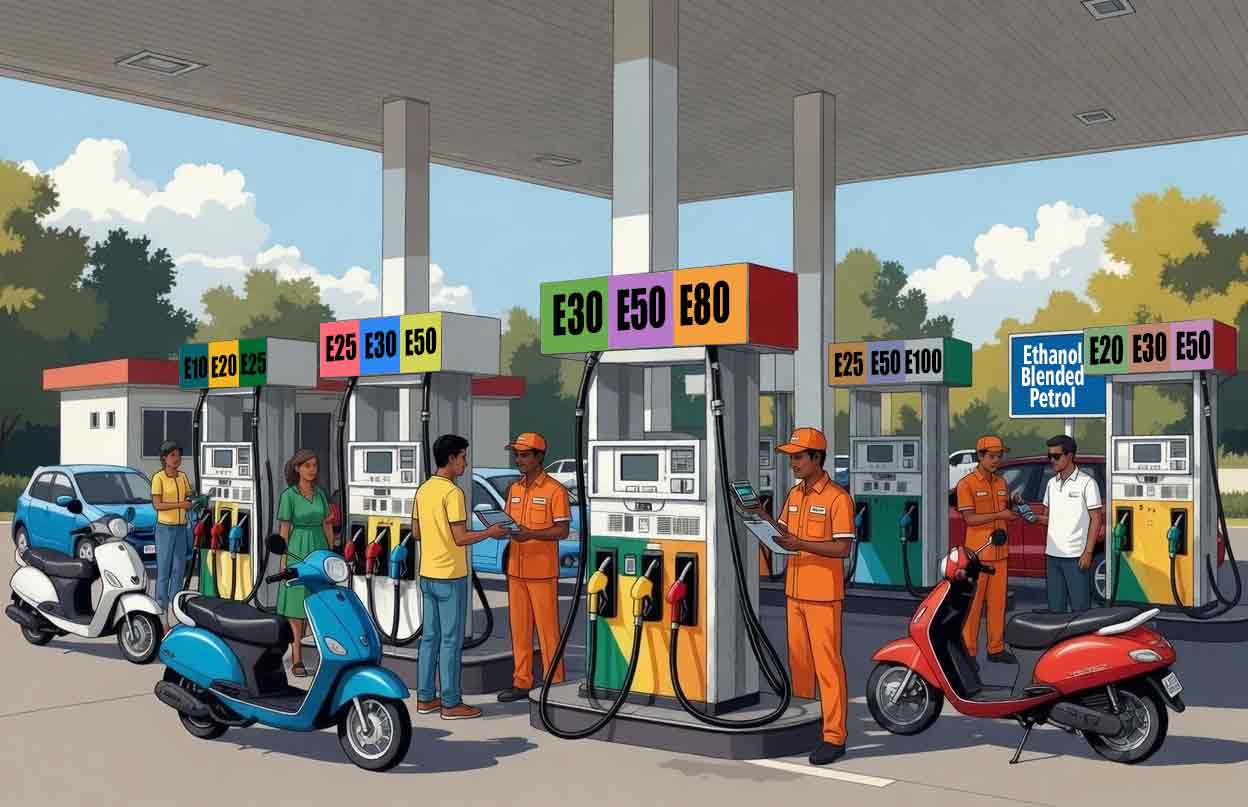
The right solution is simple and already working in other countries. The government should make different ethanol blends available in the market at the same time, like E10, E20, E30 and even higher grades for new flex-fuel vehicles. These should be sold through separate dispensers or clear options at petrol stations, with proper price differences. Just like people today choose between regular and premium petrol depending on their vehicle and budget, owners should be free to pick the blend that suits their car or bike.
Older vehicles should be able to continue on E10 or whatever lower blend is safe for them. Newer vehicles can use higher blends if they give better performance or if the price is attractive. Oil companies already manage multiple grades of petrol and diesel, adding a few more ethanol options is completely doable with some planning.
In many countries, people have the freedom to choose the right fuel for their vehicle. Different blends are available at the same petrol station at different prices, just like we have regular petrol, premium petrol and high-octane varieties today. In the United States, regular petrol is mostly E10, but E85 is widely available for flex-fuel vehicles, and drivers can also pick higher octane options. They decide what to fill based on what their car or bike can handle and what makes sense for their pocket. In Brazil, which pioneered the ethanol use in vehicles, fuel stations usually offer both regular gasoline blended with around 27 percent ethanol and nearly pure ethanol (E100).
Flex-fuel cars can run on any mix, and owners choose what they want according to price and suitability. Several other countries in Europe and Asia also keep lower blends like E5 or E10 alongside higher ones so that older vehicles are not forced into trouble. India should adopt the same practical system instead of a rigid one-size-fits-all rule.
The government has already notified standards for E22, E25, E27 and E30. As per reports, petrol pumps will offer multiple blends of petrol at the same time, and owners will be able to choose what is best for their vehicle. But there is no proposal for a lower blend like E10 for old vehicles. These higher blends should come as choices alongside lower ones, not as replacements that wipe out everything else. This will protect the millions of people who still drive older but perfectly serviceable vehicles.
It will also reduce unnecessary tension and repair costs on the roads. A flexible system will actually help achieve the bigger goals of lower oil imports and better use of domestic ethanol, because more people will accept the policy willingly instead of feeling forced.
Forcing one blend on everyone, especially when pure petrol has vanished, and older vehicles have no safe option left, is neither fair nor practical. The government should quickly move towards giving real consumer choice with multiple blends and sensible price points. That is how mature fuel markets work in other countries, and that is what will serve Indian vehicle owners best in the long run. The common man deserves that consideration.