Donald Trump and his family earned over $1.4 billion from crypto investments, US president claims he was ‘unaware’: Read how his massive wealth is linked to a Pakistani businessman
The bitcoin empire of United States President Donald Trump has come under attention after his financial declaration, which showed that digital assets have become the prime contributors and replaced his traditional real estate and golf businesses as main sources of personal wealth. On 30th June (Tuesday), he reported proceeds exceeding $1.4 billion ($1,430,390,415) from his family’s cryptocurrency endeavours in 2025 in the annual disclosure submitted to the US Office of Government Ethics. More importantly, the implication of this windfall stretches far out of its scope and has a very notable geopolitical connection with Pakistan. Trump firms reaped about $800 million from World Liberty Financial, a cryptocurrency company founded by him and US special envoy to the Middle East Steve Witkoff along with their sons. It included more than $520 million from the sale of cryptocurrency tokens and over $250 million from the sale of shares in the World Liberty business. The income is split between the Trump family. The 927-page mandatory financial submission revealed that $635 million were obtained in royalties from an entity named Celebration Coins, behind the Trump meme coin. A direct revenue of $594 million was generated from World Liberty Financial and nearly $197 million from an equity sale involving Stablecoin Holdco. The report highlighted the radical shift in Trump’s fortunes due to cryptocurrency. He unveiled $57.35 million from token sales at World Liberty in his statement from a year ago, which grew ninefold in the latest documents. His family has already minted at least $2.3 billion from cryptocurrency-related ventures in his second term, according to Reuters. Interestingly, Trump started to implement policies and efforts that the industry found advantageous, such as establishing federal regulations for stablecoins and reducing the intervention of US Justice Department and the Securities and Exchange Commission regarding its monitoring. According to reports, the filing indicated well over $580 million in crypto-related turnover, including around $515 million from World Liberty Financial token sales and $65 million from sales of equity in its parent entity. The Trump family is entitled to around 75% of the net outcome from the sale of World Liberty Financial tokens in addition to a fixed, recurring portion of transactional profits that are directly related to the platform’s own digital assets. Additionally, he informed to accumulate greater than $80 million from settlements with many media outlets and $52 million from his company’s licensing of his name to foreign real estate developers, primarily through Middle Eastern partnerships. Trump mentioned a 15% rise in revenue to slightly above $500 million at his golf and resort properties. His golf club in adjacent West Palm Beach experienced a 27% boost in revenue while his Mar-a-Lago club also known as the Winter White House in Florida’s Palm Beach underwent a sharp surge from $50 million in 2024 to $77 million. He celebrated the winners of his second annual meme coin competition there in April. Last year, Trump’s Los Angeles course suffered a decline in revenue. Trump received a loan of more than $50 million from Charles Schwab Bank last year, but the purpose was not disclosed. His profits from his real estate properties failed to register similar growth. He claimed income from a dozen substantial commercial real estate ownerships, mostly interests in projects he constructed or possessed decades ago. The paperwork provided income ranges rather than precise rent amounts for buildings such as Trump Tower in New York which were either lower or the same as the figures conveyed ten years ago. Trump also gathered millions from other business activities. He has gained at least $2.3 billion from his various properties after his return to the presidential office much beyond $600 million in 2024. Trump asserts that he was unaware of the massive size of cryptocurrency holdings, White house denies conflict of interest “The way I view crypto is a little differently. We have to be at the top, otherwise China is going to take it over. Like for instance AI. We’re leading substantially in AI over China and everybody else,” Trump stated while rejecting concerns over a potential conflict of interest while talking to CNBC. He cited federal conflict-of-interest statutes to allege that there was “nothing illegal” or “wrong” with the cryptocurrency investment and the president and vice president are not obligated to abstain from decisions that might have an impact on their financial interests. “No, but that was just something I could know about it, right? I mean, there’s nothing illegal. There’s nothing wrong with it,” Trump expressed while talking about his ignorance of his family’s whopping cryptocurrency operations. He proclaimed, “I’m a really good businessperson, I’ve always made money. I made a tremendous amount of money, mo
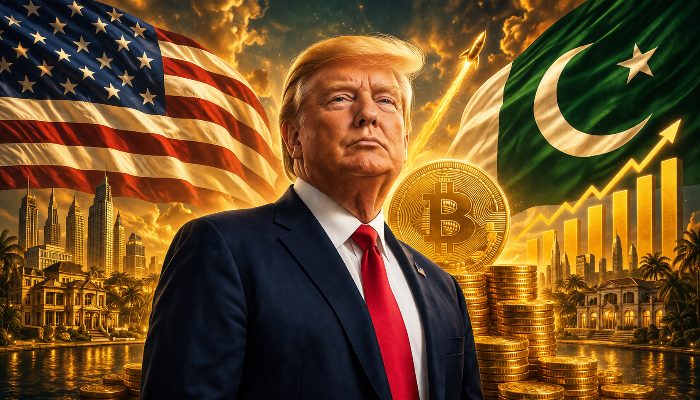
The bitcoin empire of United States President Donald Trump has come under attention after his financial declaration, which showed that digital assets have become the prime contributors and replaced his traditional real estate and golf businesses as main sources of personal wealth. On 30th June (Tuesday), he reported proceeds exceeding $1.4 billion ($1,430,390,415) from his family’s cryptocurrency endeavours in 2025 in the annual disclosure submitted to the US Office of Government Ethics.
More importantly, the implication of this windfall stretches far out of its scope and has a very notable geopolitical connection with Pakistan.
Trump firms reaped about $800 million from World Liberty Financial, a cryptocurrency company founded by him and US special envoy to the Middle East Steve Witkoff along with their sons. It included more than $520 million from the sale of cryptocurrency tokens and over $250 million from the sale of shares in the World Liberty business. The income is split between the Trump family.
The 927-page mandatory financial submission revealed that $635 million were obtained in royalties from an entity named Celebration Coins, behind the Trump meme coin. A direct revenue of $594 million was generated from World Liberty Financial and nearly $197 million from an equity sale involving Stablecoin Holdco.
The report highlighted the radical shift in Trump’s fortunes due to cryptocurrency. He unveiled $57.35 million from token sales at World Liberty in his statement from a year ago, which grew ninefold in the latest documents. His family has already minted at least $2.3 billion from cryptocurrency-related ventures in his second term, according to Reuters.
Interestingly, Trump started to implement policies and efforts that the industry found advantageous, such as establishing federal regulations for stablecoins and reducing the intervention of US Justice Department and the Securities and Exchange Commission regarding its monitoring.
According to reports, the filing indicated well over $580 million in crypto-related turnover, including around $515 million from World Liberty Financial token sales and $65 million from sales of equity in its parent entity. The Trump family is entitled to around 75% of the net outcome from the sale of World Liberty Financial tokens in addition to a fixed, recurring portion of transactional profits that are directly related to the platform’s own digital assets.
Additionally, he informed to accumulate greater than $80 million from settlements with many media outlets and $52 million from his company’s licensing of his name to foreign real estate developers, primarily through Middle Eastern partnerships.
Trump mentioned a 15% rise in revenue to slightly above $500 million at his golf and resort properties. His golf club in adjacent West Palm Beach experienced a 27% boost in revenue while his Mar-a-Lago club also known as the Winter White House in Florida’s Palm Beach underwent a sharp surge from $50 million in 2024 to $77 million. He celebrated the winners of his second annual meme coin competition there in April.
Last year, Trump’s Los Angeles course suffered a decline in revenue. Trump received a loan of more than $50 million from Charles Schwab Bank last year, but the purpose was not disclosed. His profits from his real estate properties failed to register similar growth. He claimed income from a dozen substantial commercial real estate ownerships, mostly interests in projects he constructed or possessed decades ago.
The paperwork provided income ranges rather than precise rent amounts for buildings such as Trump Tower in New York which were either lower or the same as the figures conveyed ten years ago. Trump also gathered millions from other business activities. He has gained at least $2.3 billion from his various properties after his return to the presidential office much beyond $600 million in 2024.
Trump asserts that he was unaware of the massive size of cryptocurrency holdings, White house denies conflict of interest
“The way I view crypto is a little differently. We have to be at the top, otherwise China is going to take it over. Like for instance AI. We’re leading substantially in AI over China and everybody else,” Trump stated while rejecting concerns over a potential conflict of interest while talking to CNBC.
He cited federal conflict-of-interest statutes to allege that there was “nothing illegal” or “wrong” with the cryptocurrency investment and the president and vice president are not obligated to abstain from decisions that might have an impact on their financial interests.
“No, but that was just something I could know about it, right? I mean, there’s nothing illegal. There’s nothing wrong with it,” Trump expressed while talking about his ignorance of his family’s whopping cryptocurrency operations. He proclaimed, “I’m a really good businessperson, I’ve always made money. I made a tremendous amount of money, more than I would have ever thought I would have made,” in his characteristic self-complimentary manner.
He further defended, “I let people invest it. I don’t even speak to – I don’t even know who they are. My son Eric handles it. I don’t talk to him about things such as this. I think I’d be allowed to, I’m not sure even what the status is, but I don’t.” He indicated that even if he had knowledge of their identities, it would not be considered a legal offence.
The Republican leader reiterated, “I didn’t. There’s nothing illegal with that. I could know,” and argued there was no legal compulsion “to recuse yourself on every decision running the country that could have anything to do with you. It just isn’t feasible to do it.”
According to him, his children were unable to fully distance themselves from the decisions he made as president due to the close-knit structure of the Trump organisation and complained that they were unfairly scrutinised just because they were pursuing their business interests during his time at the White House and pointed out that he has refused to take a government salary while serving there.
“You know why I’m profiting, because the stock market’s going up. Everybody’s profiting. I don’t get involved in my personal finances. We have funds that run my money. I’ve made a lot of money before I became president, and they invest my money, and I don’t talk to them,” Trump again told reporters.
White House deputy press secretary Anna Kelly hailed him for making US “the crypto capital of the world” and stated, “Neither the president nor his family has ever engaged – or will ever engage – in conflicts of interest.”
She contended, “All actions by him and his administration are taken in the best interest of the American people – and any so-called ‘reporters’ pushing otherwise are recycling the same, tired, false narrative that Democrats and the legacy media have been pushing for a decade.”
It is noteworthy that Trump put his assets in a family-managed trust that is supervised by his sons to prevent any clash of interests, but he continues to be the sole beneficiary. He has indirect control and the authority to dismiss trustees or dissolve the trust at any time.
Trump used to denounce cryptocurrencies and referred to Bitcoin as a “scam” and a “disaster waiting to happen” in 2021. He enphasised that it was “not money” and criticised it as “highly volatile and based on thin air” after becoming president. He even warned that cryptocurrency assets enabled illicit underground markets. “We have only one real currency in the USA, and it is stronger than ever. It is called the United States Dollar,” he wrote on social media in 2019.
However, he voiced his desire to crown the United States as the “crypto capital of the planet” in a startling U-turn during his presidential campaign three years later. An executive order to “support the responsible growth” of the cryptocurrency business constituted one of his first acts after he was voted to power.
How Pakistan entered the picture
World Liberty Financial was launched when Trump was looking for his political comeback in 2024 and is intertwined with Pakistan after years of strained relationship between the two countries. A Memorandum of Understanding (MOU) was inked between a WLF subsidiary and Pakistan’s Ministry of Finance and Virtual Assets Regulatory Authority to incorporate the company’s dollar-backed stablecoin into the country’s regulated payment system. The project envisages employing the stablecoin to facilitate billions of dollars in remittances and cross-border transactions.
Prime minister Shehbaz Sharif, finance minister Muhammad Aurangzeb, Pakistan army chief field marshal Asim Munir, Steve Witkoff and his son Zachary Witkoff who is WLF’s chief executive were present at the occasion. However, an intriguing presence at the gathering also attracted major coverage.
Bilal Bin Saqib, a British Pakistani businessman who served as WLF’s advisor before rising to the position of chairman of Pakistan’s cryptocurrency regulator was instrumental in uniting the two parties. He is also CEO of the Pakistan Crypto Council and was appointed as Special Assistant to the Prime Minister on Blockchain and Cryptocurrency previously.
Saqib who was largely unknown abruptly emerged as one of the most powerful persons in the Islamic Republic. He even joined Pakistan’s delegations to the US and was spotted with Trump at the Mar-a-Lago club. He developed ties with prominent names in the cryptocurrency field, including Changpeng Zhao alias CZ the controversial billionaire running Binance Holdings Limited.
Saqib presented Pakistan’s advancements in the cryptocurrency sector at a Las Vegas Bitcoin conference last year in May. Donald Trump Junior, Eric Trump and US Vice President JD Vance attended the event. A few days later, Saqib convened with Bo Hines, the director of the President’s Council of Advisers on Digital Assets during that period, at the White House.
However, Saqib’s meteoric ascent to the top has remained a dubious mystery, and he has also refrained from clarifying how he managed to carve out such an extraordinary space for himself.
The full 180-degree turnaround
The unforeseen changes have been occurring after Trump reassessed his stand towards Pakistan, akin to his decision regarding cryptocurrency after insisting that he was “not a fan.” He had frozen hundreds of millions of dollars in military funding, accused Pakistan of providing the US with “nothing but lies and deceit” and charged Islamabad with providing sanctuary to terrorists while securing billions of dollars in US aid.
Now, he has persistently showcased a renewed allegiance to the rogue state by hosting Munir at an official lunch and calling him his “favourite field marshal” while also designating Baloch rebels as terrorists and committing to energy partnership in oil reserves and development of rare-earth resources in Pakistan. Islamabad was also selected as the location for negotiations between Tehran and Washington.
At the same time, the ties between US and India have continually endured major challenges as a result of Trump’s actions including imposing 25% (of total 50%) tariffs for procuring Russian oil and blaming New Delhi for the war in Ukraine. On the other hand, the Modi government also firmly countered his claims of brokering the ceasefire during “Operation Sindoor” while Pakistan expressed gratitude and even nominated him for the Nobel Peace Prize.
Moreover, JD Vance recently remarked that Munir is as close to him as his wife Usha, adding that he has spoken to him more than anyone else over the last three months, in a display of the bond between the two nations.
Conclusion
These situations have emerged concurrently with the affairs involving Pakistan and the Trump family in the world of cryptocurrency, giving rise to reasonable suspicions regarding the peculiar happenings. It is a carefully coordinated geopolitical strategy which has introduced the formal and institutional assimilation of the Islamic Republic of Pakistan into the Trump family’s private decentralised finance (DeFi) framework.
Michael Kugelman, a resident senior fellow for South Asia at the Atlantic Council in Washington had shared, “Given how important personal connections are in the Trump White House’s policy process, Pakistan may well have bought itself some influence there that advantaged it when it pitched itself to Washington as a mediator. With this unconventional US administration, unconventional factors can help your cause, and that’s certainly the case with crypto.”
As the maxim goes, “In politics, there is no coincidence,” and definitely none in global politics or diplomacy. Thus, the bonhomie between Pakistan and the United States seems to be underpinned by deeper factors, particularly the business interests of the Trump family.
The proliferation of Trump’s cryptocurrency capital has once again highlighted the murky connections as well as the unpredictability and unreliability of a relationship with the US which is driven purely by self-interest.