Crowd, devotion and inner peace: My experience of the Bhavanath Mela on the occasion of Mahashivaratri
At the foothills of Mount Girnar, amidst forests rich in natural and spiritual energy, a unique fair is organised annually on the auspicious occasion of Mahashivratri at the Bhavnath Mahadev Temple. This fair is not merely a celebration, but a vibrant experience of devotion, penance, and spiritual union. I remember when I first arrived, I was full of questions. How would I find peace in such a huge crowd? How would I experience spirituality among the saints and monks? But as I immersed myself in the atmosphere, I realised that this fair was a wonderful confluence of external chaos and inner peace. Here, I am going to share my experience with you. I went there with many questions like an ordinary man, but returned with a mystical experience, spirituality, and embarked on an inner journey. The Journey Begins: From Junagadh to Bhavnath My journey to Bhavnath began after arriving in Junagadh from Bhavnagar. I had planned to travel in a bus packed with people to feel the hustle and bustle of life. The journey from Junagadh city to the foothills of Girnar isn’t very long, barely five or six kilometres. But as the bus moved on, the distance seemed more mental than physical. The usual bustle of the city is left behind, and the vast, serene, and solemn form of Girnar starts to appear. Some people sitting next to me on the bus were chanting “Har Har Mahadev” and “Jai Girnari.” An elderly couple was explaining to their grandson why this fair was special. I looked out of the window, and at a distance, I could see the shadow of Girnari in the darkness, which appeared like the form of a yogi with dreadlocks. Entering the Foothills As the bus approached the parking area, it became clear to me that it was no ordinary event. I saw long queues of vehicles, police presence, and volunteers running around. I continued the journey ahead on foot. Rows of temporary shops lined both sides of the road, selling Rudraksha, tridents, bhabhuti, saffron flags, and pictures of Lord Shiva. The aroma of hot puffed rice and jalebi wafted from pots. Amidst the beats of drums and chants of “Har Har Mahadev,” I was swept away by the crowd. It was crowded, but not chaotic. Everyone was heading in the same direction—toward Bhavnath Mahadev. A ritual was underway at the Bhavnath Mahadev temple, and saints and monks from various sects were gathering there. As I approached the temple complex, camps of monks became visible. Two rows of ‘Ravatis’ (tents) were arranged. Smoke emerged incessantly from the Ravatis, while monks sat quietly, chanting mantras. I stopped near a Ravati where Jerambapa’s ‘Girnari Utara’ (pilgrim idol) was kept. Food was being served there. Free meals were available in the morning, at noon, and in the evening. Tea was also being served. Someone gestured to me to sit. A short while later, conversations began; some had come from Rajkot, some from Kutch, and some from Maharashtra. It was not only saints and monks who had gathered there, but a large number of common devotees flocked to the fair. Many devotees from Kathiawar were also there observing ‘Sadavrat’ (sacred vows), such as the Toraniya Utra, Parba Utra, and Bhurabhagat Ravati. Food and drink were being arranged. Several dishes like ‘Khichdi’, ‘Kadi’, and ‘Faraali’ were being served. For the first time, I felt that this fair was not only a religious congregation but also a social gathering. I witnessed both service and devotion at the fair. As the night grew darker, the yellow light of the bulbs spread over Girnar, creating a unique experience, one that cannot be described in words. I made my way through the crowds towards the Bhavanath Temple. To the right of the temple were the huts of the saints, where they sat with their attendants. Some Naga sadhus were performing amazing feats, such as pulling a bullock cart with a phallus or sword fighting. I joined the queue at the temple. It was really long, but surprisingly, people were not impatient. Some were singing hymns, some were chanting, and some were handling their children. Slowly, we reached the main entrance of the temple. The temple’s spire shone in the light. When my turn came, and I reached the sanctum sanctorum, everything fell silent for a moment. There was a crowd all around me, but in that moment, time stopped. Seeing the ashes on the Shivalingam, my hands joined involuntarily. It was at that moment that I realised that darshan is not just about seeing a deity’s physical form, it is an inner experience. It touches something deep within. As midnight approached, the atmosphere began to change. People began to gather in one direction. “The Rawadi (procession of saints) is about to begin”—these words echoed repeatedly. Then suddenly, conch shells resounded. Naga sadhus appeared, with their bodies covered in ashes, dreadlocks, and carrying tridents. The sound of their cheers echoed off the Girnar hills. Some people were riding horses, some were on foot, and some were carrying

At the foothills of Mount Girnar, amidst forests rich in natural and spiritual energy, a unique fair is organised annually on the auspicious occasion of Mahashivratri at the Bhavnath Mahadev Temple. This fair is not merely a celebration, but a vibrant experience of devotion, penance, and spiritual union. I remember when I first arrived, I was full of questions. How would I find peace in such a huge crowd? How would I experience spirituality among the saints and monks?
But as I immersed myself in the atmosphere, I realised that this fair was a wonderful confluence of external chaos and inner peace. Here, I am going to share my experience with you. I went there with many questions like an ordinary man, but returned with a mystical experience, spirituality, and embarked on an inner journey.
The Journey Begins: From Junagadh to Bhavnath
My journey to Bhavnath began after arriving in Junagadh from Bhavnagar. I had planned to travel in a bus packed with people to feel the hustle and bustle of life. The journey from Junagadh city to the foothills of Girnar isn’t very long, barely five or six kilometres. But as the bus moved on, the distance seemed more mental than physical. The usual bustle of the city is left behind, and the vast, serene, and solemn form of Girnar starts to appear.
Some people sitting next to me on the bus were chanting “Har Har Mahadev” and “Jai Girnari.” An elderly couple was explaining to their grandson why this fair was special. I looked out of the window, and at a distance, I could see the shadow of Girnari in the darkness, which appeared like the form of a yogi with dreadlocks.
Entering the Foothills
As the bus approached the parking area, it became clear to me that it was no ordinary event. I saw long queues of vehicles, police presence, and volunteers running around. I continued the journey ahead on foot. Rows of temporary shops lined both sides of the road, selling Rudraksha, tridents, bhabhuti, saffron flags, and pictures of Lord Shiva. The aroma of hot puffed rice and jalebi wafted from pots.
Amidst the beats of drums and chants of “Har Har Mahadev,” I was swept away by the crowd. It was crowded, but not chaotic. Everyone was heading in the same direction—toward Bhavnath Mahadev. A ritual was underway at the Bhavnath Mahadev temple, and saints and monks from various sects were gathering there.
As I approached the temple complex, camps of monks became visible. Two rows of ‘Ravatis’ (tents) were arranged. Smoke emerged incessantly from the Ravatis, while monks sat quietly, chanting mantras. I stopped near a Ravati where Jerambapa’s ‘Girnari Utara’ (pilgrim idol) was kept. Food was being served there. Free meals were available in the morning, at noon, and in the evening. Tea was also being served. Someone gestured to me to sit. A short while later, conversations began; some had come from Rajkot, some from Kutch, and some from Maharashtra.
It was not only saints and monks who had gathered there, but a large number of common devotees flocked to the fair. Many devotees from Kathiawar were also there observing ‘Sadavrat’ (sacred vows), such as the Toraniya Utra, Parba Utra, and Bhurabhagat Ravati. Food and drink were being arranged. Several dishes like ‘Khichdi’, ‘Kadi’, and ‘Faraali’ were being served. For the first time, I felt that this fair was not only a religious congregation but also a social gathering. I witnessed both service and devotion at the fair.
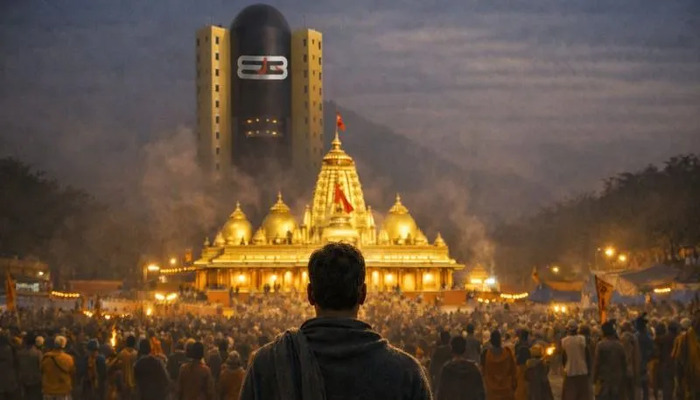
As the night grew darker, the yellow light of the bulbs spread over Girnar, creating a unique experience, one that cannot be described in words. I made my way through the crowds towards the Bhavanath Temple. To the right of the temple were the huts of the saints, where they sat with their attendants. Some Naga sadhus were performing amazing feats, such as pulling a bullock cart with a phallus or sword fighting. I joined the queue at the temple. It was really long, but surprisingly, people were not impatient. Some were singing hymns, some were chanting, and some were handling their children.
Slowly, we reached the main entrance of the temple. The temple’s spire shone in the light. When my turn came, and I reached the sanctum sanctorum, everything fell silent for a moment. There was a crowd all around me, but in that moment, time stopped. Seeing the ashes on the Shivalingam, my hands joined involuntarily. It was at that moment that I realised that darshan is not just about seeing a deity’s physical form, it is an inner experience. It touches something deep within.
As midnight approached, the atmosphere began to change. People began to gather in one direction. “The Rawadi (procession of saints) is about to begin”—these words echoed repeatedly. Then suddenly, conch shells resounded. Naga sadhus appeared, with their bodies covered in ashes, dreadlocks, and carrying tridents. The sound of their cheers echoed off the Girnar hills.
Some people were riding horses, some were on foot, and some were carrying flags of their Akharas. The crowd was thrilled. People captured the scenes with their mobile phone cameras. I, too, captured it all—but more with my own eyes than with my camera. This wasn’t just a spectacle. It was a majestic display of renunciation, discipline, and tradition. At that moment, I realised that calling this fair a mere festival wasn’t the accurate description.
Naga Sadhus, Aghoris, and saints from various Akharas departed for Mrigikund with great pomp and show, riding horses, bullock carts, buggies, or elephants. Some saints pulled the vehicles with their phalli, while others demonstrated skills like sword fighting and martial arts. With their robust physiques and long hair, they seemed to embody the Rudra form of Shiva.
The procession moved towards Mrigikund. I also reached there with the crowd. There was a huge crowd of devotees gathered around the pond. Monks were taking a bath in the pond one after another. The bath is special and is said to symbolise purity and determination.
I touched the water in the pond. It was cold, but I felt a different kind of shiver inside. For a moment, I couldn’t tell if it was the cold or a voice coming from within. This experience reminded me of what my grandfather once said: “Mrigikund is the heart of Lord Vishnu. That water is the nectar of accomplished yogis, and Lord Shiva himself bathes here in the guise of a Naga Sadhu.”
My grandfather had once told me that some Naga Sadhus never return after bathing in Mrigikund. No one knows where they go. Initially, these things appeared mythical and confusing to me. My mind could not find logic in the statement, and it seemed like a mere superstition or folk belief.
The touch of Mrigikund’s water brought me back to life. I sat down near Mrigikund with other devotees, and we set up our camp there. One devotee said, “Today, we must see when these Naga Sadhus will come out of the pond.” Some Naga Sadhus arrived dressed in royal robes, carrying tridents in their hands, and wearing Rudraksha beads and ashes smeared around their necks. There were about 35-40 of them. They bathed for about 45 minutes and then emerged from the pond. When they emerged, their numbers had dwindled; I could not count their exact number, but there were only 10-15 of them.
I became curious, wondering if some of the Sadhus were still diving or meditating. We stayed there for hours, but they were nowhere to be seen! No one could sit in the water for so long without holding their breath. Finally, I put my logic aside and, with folded hands, begged forgiveness, bowing towards the Bhavanath Temple. This experience taught me that some things surpass the limits of intellect and logic; the realisation of God is one of them.
I had heard in folk tales that Ashwatthama, the Pandavas, King Bharathari, and accomplished yogis came to bathe in Mrigikund disguised as Naga sadhus. Seeing those monks not emerging from the pool, I naturally wondered if these sadhus were also accomplished yogis like them? Who knows, maybe it was even Shiva himself. I meditated for a few hours and carried this unique experience as the best memory of my life, and treasured it in my heart.
The night was getting darker, but the fair remained vibrant. Bhajans and kirtans were being performed, recitations of the Santvanis were being presented, and folk artists were showcasing their art. The accommodation and food arrangements at the fair were excellent. The food included khichdi, kadhi, and farali dishes. Everything was offered free of charge and at a minimal price. These Ravatis, like the Ravati of Khodiyar Ras Mandal or the Utara of Chinubapu of Makhavad, give meaning to the distinctive style of the saints of Saurashtra – “Jahan Tukda, Wahan Hari Ka Thikana” (meaning wherever a piece of food is given to the hungry, there Lord Hari resides).
I was sitting in Laxman Barot’s hut, where bhajans and Santvanis were being held. Renowned artists from Saurashtra were singing bhajans. The beats of the dholak, the tunes of the harmonium, and the group singing created a distinct feeling of devotion in the atmosphere. People were tired, but they didn’t want to leave. This wasn’t just a religious ceremony, but also a cultural celebration.
Night was slowly turning into dawn. Some shopkeepers were packing up their goods. Others were looking for places to rest. I stood a short distance from the temple complex, looking towards Girnar. A few hours earlier, this same place was bustling with cheers. Now, there was peace. It was there that I understood the deeper meaning of this fair. Festivals are fleeting, but Shivatva is eternal. Crowds come and go, but Girnar remains forever.
As I returned, I looked back at the temple. I was returning with an invaluable experience. The Bhavanath Mela is not just an event. It reminds us that our traditions are alive. It teaches that spirituality doesn’t mean fleeing the crowds, but finding peace amidst them. It’s Shivaratri. The fair is ending. But the peace that remains within me will likely remain for a long time.
(This article is a translation of the original article published on OpIndia Gujarati.)