Congress approved Hanumangarh plant during its rule in Rajasthan, turned against it after losing election: Read how it has been anti-industry in the state
In a major setback for the economic growth of Rajasthan, the construction of a proposed ₹450 crore ethanol plant in Hanumangarh district has been discontinued. The project, to be set up by Chandigarh-based Dune Ethanol Private Limited, was once poised to be a model of Rajasthan’s industrial development. However, the Congress party’s destructive policies and political manoeuvring have mired it in controversy. The project was approved by the previous Congress government in 2022, led by Chief Minister Ashok Gehlot. The Congress party turned the project into a political weapon after losing the state assembly election to the BJP. The result was violent protests in the name of farmers, vandalism, and now this major investment has fled Rajasthan. This has not only shattered Hanumangarh’s dream of becoming an industrial hub but has also dealt a severe blow to the state’s development and economic progress. Congress’s politics forced the ₹450 crore project out of Rajasthan The ethanol plant was to be located on approximately 45 acres of land in Rathikheda village (Chak 5 RK Rathikheda) in the Tibbi area of Hanumangarh. The company planned to build a grain-based ethanol plant with a capacity of 1,320 kiloliters per day (KLPD) and a 24.5 MW power plant. This factory would produce ethanol from rice straw, which is beneficial for the environment as it is considered a cleaner alternative to petrol. The ethanol plant would have provided local farmers with a good price for their straw, created hundreds of jobs, and brought economic prosperity to the region. However, Congress’s petty politics ruined everything. Hanumangarh ethanol plant project approved by in-power Congress, forced to shut down due to Congress-backed hooliganism It all began in 2022, when Congress was in power in Rajasthan, and Ashok Gehlot was the Chief Minister. The Memorandum of Understanding (MoU) for this project was signed during the “Rising Rajasthan” campaign. In 2023, the Congress government completed all the legal formalities. Approvals were obtained from all departments, including industrial conversion, land registration, and the Pollution Control Board. Everything was going well. The company began preparing for the investment. But as soon as the BJP government came to power in late 2023, Congress began to show its true colours. The opposition Congress party launched protests, calling the project anti-farmer. Farmers began protesting in Rathikheda village in August 2024. However, these protests were motivated more by Congress politics than by the farmers’ legitimate concerns. Tensions escalated when the administration and police dispersed the protesters on November 19, 2025, and some were arrested. Subsequently, on December 10, 2025, a mahapanchayat was held in Tibbi, which turned violent. Protesters set vehicles on fire and vandalised them, leading to clashes with the police. An FIR was filed against 100 people, including a Congress MLA, MP, and a former CPI MLA. Congress leaders like Sangaria MLA Abhimanyu Poonia and Balwan Poonia attacked the BJP government, calling the incident a “government conspiracy.” They held a press conference and declared that the BJP was in thrall to corporations and was instigating the lathi charge on farmers. However, the truth is that Congress itself is behind this ethanol factory project. The Gehlot government approved it and then, after losing power, turned it into a political issue. External elements and Congress workers colluded to incite violence in the protest to discredit the BJP government. The water scarcity and air pollution concerns raised by farmers are valid, but solutions also exist Farmers cite water scarcity and the threat of pollution as the main reasons for their protests. Hanumangarh is a drought-prone region, with groundwater levels below 100 feet, and farmers rely on wells and canals. The factory requires 5-6 million liters of water daily. Rice-based ethanol plants consume a significant amount of water per litre of ethanol. Farmers fear this will dry up their fields and destroy crops. The second issue is pollution. The Pollution Control Board has placed ethanol plants in the “red category.” The process produces a toxic liquid called “spent wash,” which, if not properly treated, can harm groundwater and soil. Boilers emit smoke and ash, and fermentation creates a foul odour. Farmers claim the air will be poisoned, leading to an increase in respiratory diseases and cancer. They allege that the Environmental Impact Assessment (EIA) was erroneous. Neither agriculture will be affected, nor water will be contaminated, experts say – all that is needed is proper implementation of the schemes Experts, however, are of the view that issues are not so big that the whole project needs to be shut down, and that water scarcity and pollution-related issues can be resolved. The government has mandated Zero Liquid Discharge (ZLD) technology for ethanol plants. This me
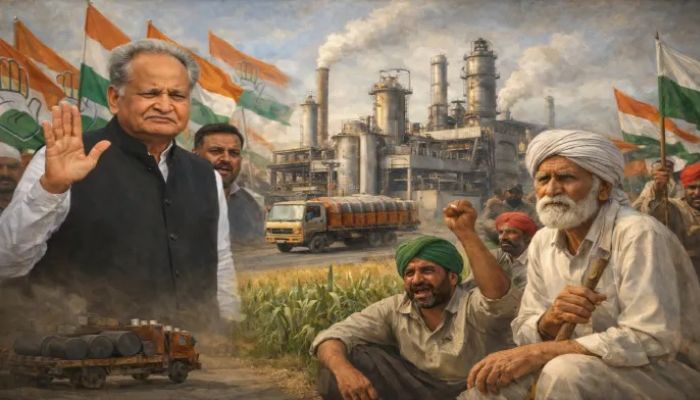

In a major setback for the economic growth of Rajasthan, the construction of a proposed ₹450 crore ethanol plant in Hanumangarh district has been discontinued. The project, to be set up by Chandigarh-based Dune Ethanol Private Limited, was once poised to be a model of Rajasthan’s industrial development. However, the Congress party’s destructive policies and political manoeuvring have mired it in controversy.
The project was approved by the previous Congress government in 2022, led by Chief Minister Ashok Gehlot. The Congress party turned the project into a political weapon after losing the state assembly election to the BJP. The result was violent protests in the name of farmers, vandalism, and now this major investment has fled Rajasthan. This has not only shattered Hanumangarh’s dream of becoming an industrial hub but has also dealt a severe blow to the state’s development and economic progress.
Congress’s politics forced the ₹450 crore project out of Rajasthan
The ethanol plant was to be located on approximately 45 acres of land in Rathikheda village (Chak 5 RK Rathikheda) in the Tibbi area of Hanumangarh. The company planned to build a grain-based ethanol plant with a capacity of 1,320 kiloliters per day (KLPD) and a 24.5 MW power plant.
This factory would produce ethanol from rice straw, which is beneficial for the environment as it is considered a cleaner alternative to petrol. The ethanol plant would have provided local farmers with a good price for their straw, created hundreds of jobs, and brought economic prosperity to the region. However, Congress’s petty politics ruined everything.
Hanumangarh ethanol plant project approved by in-power Congress, forced to shut down due to Congress-backed hooliganism
It all began in 2022, when Congress was in power in Rajasthan, and Ashok Gehlot was the Chief Minister. The Memorandum of Understanding (MoU) for this project was signed during the “Rising Rajasthan” campaign. In 2023, the Congress government completed all the legal formalities. Approvals were obtained from all departments, including industrial conversion, land registration, and the Pollution Control Board. Everything was going well. The company began preparing for the investment. But as soon as the BJP government came to power in late 2023, Congress began to show its true colours.
The opposition Congress party launched protests, calling the project anti-farmer. Farmers began protesting in Rathikheda village in August 2024. However, these protests were motivated more by Congress politics than by the farmers’ legitimate concerns. Tensions escalated when the administration and police dispersed the protesters on November 19, 2025, and some were arrested.
Subsequently, on December 10, 2025, a mahapanchayat was held in Tibbi, which turned violent. Protesters set vehicles on fire and vandalised them, leading to clashes with the police. An FIR was filed against 100 people, including a Congress MLA, MP, and a former CPI MLA.
Congress leaders like Sangaria MLA Abhimanyu Poonia and Balwan Poonia attacked the BJP government, calling the incident a “government conspiracy.” They held a press conference and declared that the BJP was in thrall to corporations and was instigating the lathi charge on farmers. However, the truth is that Congress itself is behind this ethanol factory project. The Gehlot government approved it and then, after losing power, turned it into a political issue. External elements and Congress workers colluded to incite violence in the protest to discredit the BJP government.
The water scarcity and air pollution concerns raised by farmers are valid, but solutions also exist
Farmers cite water scarcity and the threat of pollution as the main reasons for their protests. Hanumangarh is a drought-prone region, with groundwater levels below 100 feet, and farmers rely on wells and canals. The factory requires 5-6 million liters of water daily. Rice-based ethanol plants consume a significant amount of water per litre of ethanol. Farmers fear this will dry up their fields and destroy crops.
The second issue is pollution. The Pollution Control Board has placed ethanol plants in the “red category.” The process produces a toxic liquid called “spent wash,” which, if not properly treated, can harm groundwater and soil. Boilers emit smoke and ash, and fermentation creates a foul odour. Farmers claim the air will be poisoned, leading to an increase in respiratory diseases and cancer. They allege that the Environmental Impact Assessment (EIA) was erroneous.
Neither agriculture will be affected, nor water will be contaminated, experts say – all that is needed is proper implementation of the schemes
Experts, however, are of the view that issues are not so big that the whole project needs to be shut down, and that water scarcity and pollution-related issues can be resolved. The government has mandated Zero Liquid Discharge (ZLD) technology for ethanol plants. This means not a single drop of wastewater will be released from the factory. Water will be recycled, and the remaining solid waste will be converted into animal feed and sold. Electrostatic precipitators (ESPs) are installed for air purification, which trap ash. The central board directly monitors the production through an online monitoring system. If the rules are followed honestly, neither agriculture will be harmed nor will water get contaminated.
The problem is that Congress incited protests instead of discussing these solutions. If local people had formed a monitoring committee and demanded local jobs from the company, the project could have succeeded. But politics ruined everything.
Approval in power, protests in opposition: Congress’s double standards exposed
Ashok Gehlot’s Congress government granted full approval to this project in 2023. At the time, Congress touted it as a job-generator and symbol of development. However, after losing the election, their stance changed. Congress leaders now claim that the BJP is the enemy of farmers. However, the FIR names only Congress members. This clearly shows that Congress, in collusion with outside elements, incited the protest to violence. Their sole aim was to defame the BJP government, not development.
Due to this political backlash, the company has decided to relocate the factory. According to media reports, the project is now moving out of Rajasthan.
When one company leaves, others become sceptical about entering: Hanumangarh ethanol plant project shut down is a big loss for Rajasthan
The issue is not confined to one Hanumangarh ethanol plant; there is a saying in the industrial world that with one factory, ten more emerge. Hanumangarh could have become an industrial hub. It’s rich in agricultural residue, making it the perfect location for an ethanol plant. This would have created thousands of jobs, additional income for farmers, and revenue for the state. But Congress’s narrow politics has ruined those prospects.
The head of Tibbi claims that a major company like Coca-Cola or Pepsi was also planning to set up a factory at this very site. The Hanumangarh DM was contacted for this purpose. The ethanol factory project file also includes the head’s name and number. However, due to the ethanol factory controversy, the administration has abandoned its activities. Consequently, the companies that were supposed to come to Hanumangarh will no longer be able to do so. The departure of this one project will halt many other investments. This will deal a blow to the entire Rajasthan economy. As unemployment increases in the state, young people will be forced to migrate.
Prioritise progress, not politics
The Hanumangarh ethanol factory controversy has fallen victim to Congress’s political ambitions. Ashok Gehlot and his party approved the project while in power and instigated protests while out of power. As a result, an investment of ₹450 crore was lost. Rajasthan lost an opportunity for industrial growth.
Political parties need to address the legitimate problems of farmers, not incite them. Such projects can be made successful by establishing monitoring committees and ensuring strict adherence to regulations. But as long as myopic thinking like that of the Congress party remains powerful, Rajasthan’s industrial growth will continue to lag.
This incident serves as a lesson in ensuring that politics doesn’t hinder development. Hopefully, the state government will learn from this loss and safeguard such investments in the future.