Ceasefire yet to take effect? Kuwait, UAE being hit by Iranian missiles, Israel strikes Lebanon while Trump dreams of making ‘big money’ at the Strait of Hormuz
The two-week ceasefire announced by US President Donald Trump and confirmed by the Iranian regime is showing severe signs of collapse within hours. Israel, which though backed the ceasefire agreement, made it clear that the ceasefire does not apply to the Lebanon front, even as it is a part of Iran’s 10-point proposal, Trump described as “a workable basis for negotiations”. The UAE and Kuwait have also reported missile and drone attacks by Iran, alleging a blatant violation of the newly-agreed-upon ceasefire. While ‘mediator’ Pakistan is busy gloating over its ‘drafted’ role in the ceasefire and announced that cessation of hostilities will take immediate effect, Gulf countries targeted by Iran continue to grapple with the barrage of Iranian missiles and drones. This has raised questions over the credibility of Pakistan as a mediator and also over the seriousness of Iran in achieving lasting peace. UAE under attack from drones and missiles originating from Iran, confirms the defence ministry On 8th April, the Defence Ministry of the United Arab Emirates (UAE) confirmed that its air defence systems were engaging with ballistic missiles, cruise missiles, and drones fired by Iran despite a ceasefire announcement. “The UAE’s air defenses are currently engaging with missile and drone attacks originating from Iran. The Ministry of Defense confirms that the sounds heard in various parts of the country are the result of the UAE air defense systems intercepting ballistic missiles, cruise missiles, and drones. UAE Air Defences system are actively engaging with missiles and UAV threats MOD asserts that the sounds heard across the country are the result of ongoing engaging operations of missiles and UAV’s,” the Emirati Defence Ministry said in a statement. The UAE stated that its Habshan gas complex has been attacked, forcing the country to suspend gas production due to multiple fires at the facility caused by falling debris during the interception of an attack. It is reported that two Emirati and one Indian national suffered minor injury in the attack. In a more detailed statement, the Emirati Defence Ministry said, “UAE air defense engaged 17 ballistic missiles and 35 UAV’s launched from Iran.” UAE Air Defenses engaged 17 Ballistic Missiles and 35 UAV's.The Ministry of Defense announced that on April 8, 2026, UAE air defense engaged 17 ballistic missiles and 35 UAV's launched from Iran.Since the onset of the blatant Iranian attacks, UAE air defenses have engaged a… pic.twitter.com/5jxRODWF9p— وزارة الدفاع |MOD UAE (@modgovae) April 8, 2026 “Since the onset of the blatant Iranian attacks, UAE air defenses have engaged a total of 537 ballistic missiles, 26 cruise missiles, and 2,256 UAV’s. These attacks resulted in injuries to 3 individuals, all of whom sustained minor injuries, bringing the total number of injuries to 224, involving individuals of various nationalities, including Emirati, Egyptian, Sudanese, Ethiopian, Filipino, Pakistani, Iranian, Indian, Bangladeshi, Sri Lankan, Azerbaijani, Yemeni, Ugandan, Eritrean, Lebanese, Afghan, Bahraini, Comorian, Turkish, Iraqi, Nepalese, Nigerian, Omani, Jordanian, Palestinian, Ghanaian, Indonesian, Swedish, Tunisian, Moroccan, and Russian,” it added. It further confirmed that in the attacks post-ceasefire, no casualties have been reported. The MoD reiterated its commitment to protect its citizenry from Iranian attacks, and said, “The Ministry of Defence affirmed that it remains fully prepared and ready to deal with any threats and will firmly confront anything that aims to undermine the security of the country, in a manner that ensures the protection of its sovereignty, security and stability and safeguards its interests and national capabilities.” Kuwait confirms Iranian attacks on its oil facilities post ceasefire announcement Meanwhile, Kuwaiti Defence Ministry spokesperson Colonel Saud Abdulaziz al-Otaibi has confirmed that the country’s air defence systems intercepted 28 Iranian drones since 05:00 GMT. عاجل | الجيش الكويتي: تتعامل الدفاعات الجوية الكويتية منذ الساعة الثامنة من صباح اليوم ولغاية الآن، لموجة مكثفة من الهجمات الإيرانية المعادية الآثمة، حيث تم التعامل مع عدد (28) طائرة مسيّرة، استهدفت دولة الكويت• تمكنت القوات المسلحة الكويتية من اعتراض عدد كبير من الطائرات… pic.twitter.com/ISnffiZI7s— كويت نيوز (@KuwaitNews) April 8, 2026 Kuwait said that the attack was “an intense wave of hostile Iranian criminal attacks”, with “a large number of hostile drones” downed. According to al-Obaiti, some of the Iranian drones targeted Kuwait’s vital oil facilities and power stations in the south. The attacks have caused material damage to oil infrastructure facilities, power stations, and water desalination plants Sirens sounded in Bahrain and Saudi Arabia, Qatar intercepts missiles In Bahrain, sirens were sounded on Wednesday after Iran launched a fresh wave of attacks. These attacks came after Iran targeted houses in
The two-week ceasefire announced by US President Donald Trump and confirmed by the Iranian regime is showing severe signs of collapse within hours. Israel, which though backed the ceasefire agreement, made it clear that the ceasefire does not apply to the Lebanon front, even as it is a part of Iran’s 10-point proposal, Trump described as “a workable basis for negotiations”. The UAE and Kuwait have also reported missile and drone attacks by Iran, alleging a blatant violation of the newly-agreed-upon ceasefire.
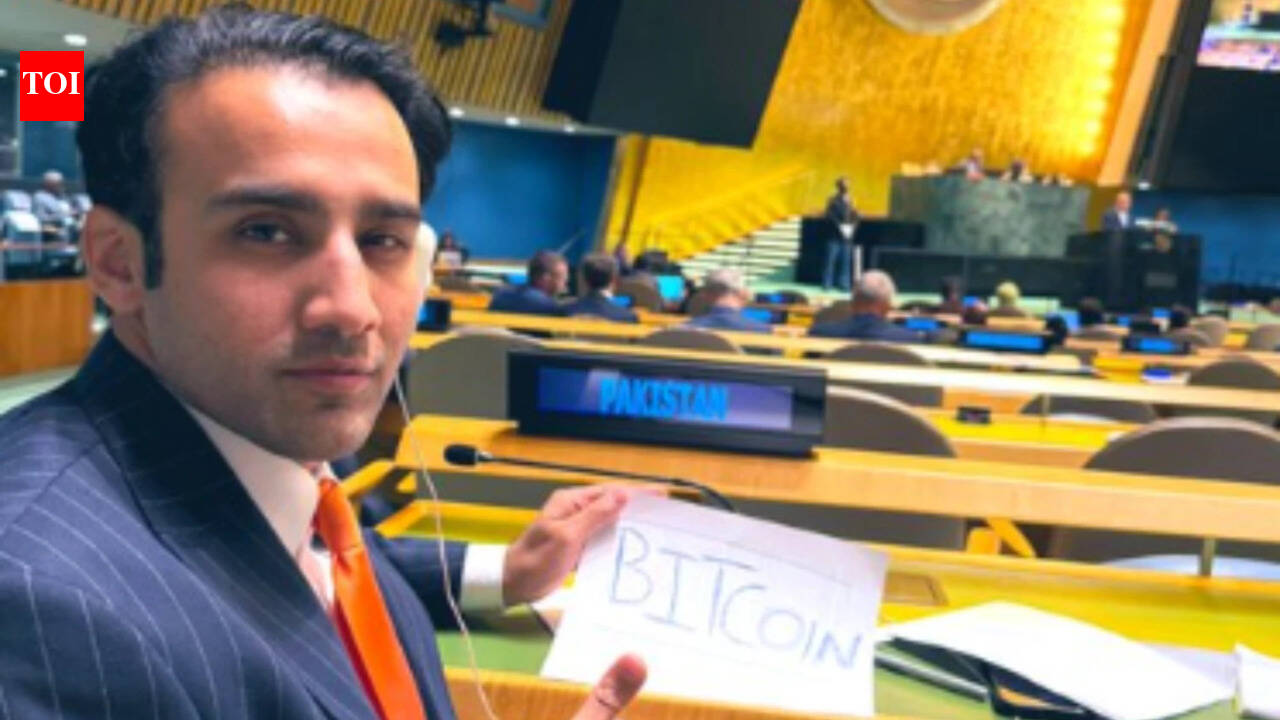
While ‘mediator’ Pakistan is busy gloating over its ‘drafted’ role in the ceasefire and announced that cessation of hostilities will take immediate effect, Gulf countries targeted by Iran continue to grapple with the barrage of Iranian missiles and drones. This has raised questions over the credibility of Pakistan as a mediator and also over the seriousness of Iran in achieving lasting peace.
UAE under attack from drones and missiles originating from Iran, confirms the defence ministry
On 8th April, the Defence Ministry of the United Arab Emirates (UAE) confirmed that its air defence systems were engaging with ballistic missiles, cruise missiles, and drones fired by Iran despite a ceasefire announcement.
“The UAE’s air defenses are currently engaging with missile and drone attacks originating from Iran. The Ministry of Defense confirms that the sounds heard in various parts of the country are the result of the UAE air defense systems intercepting ballistic missiles, cruise missiles, and drones. UAE Air Defences system are actively engaging with missiles and UAV threats MOD asserts that the sounds heard across the country are the result of ongoing engaging operations of missiles and UAV’s,” the Emirati Defence Ministry said in a statement.
The UAE stated that its Habshan gas complex has been attacked, forcing the country to suspend gas production due to multiple fires at the facility caused by falling debris during the interception of an attack. It is reported that two Emirati and one Indian national suffered minor injury in the attack.
In a more detailed statement, the Emirati Defence Ministry said, “UAE air defense engaged 17 ballistic missiles and 35 UAV’s launched from Iran.”
UAE Air Defenses engaged 17 Ballistic Missiles and 35 UAV's.The Ministry of Defense announced that on April 8, 2026, UAE air defense engaged 17 ballistic missiles and 35 UAV's launched from Iran.Since the onset of the blatant Iranian attacks, UAE air defenses have engaged a… pic.twitter.com/5jxRODWF9p— وزارة الدفاع |MOD UAE (@modgovae) April 8, 2026
“Since the onset of the blatant Iranian attacks, UAE air defenses have engaged a total of 537 ballistic missiles, 26 cruise missiles, and 2,256 UAV’s. These attacks resulted in injuries to 3 individuals, all of whom sustained minor injuries, bringing the total number of injuries to 224, involving individuals of various nationalities, including Emirati, Egyptian, Sudanese, Ethiopian, Filipino, Pakistani, Iranian, Indian, Bangladeshi, Sri Lankan, Azerbaijani, Yemeni, Ugandan, Eritrean, Lebanese, Afghan, Bahraini, Comorian, Turkish, Iraqi, Nepalese, Nigerian, Omani, Jordanian, Palestinian, Ghanaian, Indonesian, Swedish, Tunisian, Moroccan, and Russian,” it added.
It further confirmed that in the attacks post-ceasefire, no casualties have been reported.
The MoD reiterated its commitment to protect its citizenry from Iranian attacks, and said, “The Ministry of Defence affirmed that it remains fully prepared and ready to deal with any threats and will firmly confront anything that aims to undermine the security of the country, in a manner that ensures the protection of its sovereignty, security and stability and safeguards its interests and national capabilities.”
Kuwait confirms Iranian attacks on its oil facilities post ceasefire announcement
Meanwhile, Kuwaiti Defence Ministry spokesperson Colonel Saud Abdulaziz al-Otaibi has confirmed that the country’s air defence systems intercepted 28 Iranian drones since 05:00 GMT.
عاجل | الجيش الكويتي: تتعامل الدفاعات الجوية الكويتية منذ الساعة الثامنة من صباح اليوم ولغاية الآن، لموجة مكثفة من الهجمات الإيرانية المعادية الآثمة، حيث تم التعامل مع عدد (28) طائرة مسيّرة، استهدفت دولة الكويت• تمكنت القوات المسلحة الكويتية من اعتراض عدد كبير من الطائرات… pic.twitter.com/ISnffiZI7s— كويت نيوز (@KuwaitNews) April 8, 2026
Kuwait said that the attack was “an intense wave of hostile Iranian criminal attacks”, with “a large number of hostile drones” downed.
According to al-Obaiti, some of the Iranian drones targeted Kuwait’s vital oil facilities and power stations in the south. The attacks have caused material damage to oil infrastructure facilities, power stations, and water desalination plants
Sirens sounded in Bahrain and Saudi Arabia, Qatar intercepts missiles
In Bahrain, sirens were sounded on Wednesday after Iran launched a fresh wave of attacks. These attacks came after Iran targeted houses in the Sitra area, injuring two people from shrapnel falling after the interception of an Iranian drone on Tuesday night.
On Wednesday morning, Qatar’s Ministry of Defence announced that its armed forces intercepted a missile attack against its territory.
تعلن وزارة الدفاع القطرية أن قواتنا المسلحة "بفضل من الله" تصدت لهجمة صاروخية استهدفت دولة قطر.The Qatari Ministry of Defense announces that our armed forces, “by the grace of God,” successfully intercepted a missile attack targeting the State of Qatar. pic.twitter.com/Ng4gCYS7wk— وزارة الدفاع – دولة قطر (@MOD_Qatar) April 8, 2026
Saudi Arabia’s oil pipeline bypassing Hormuz targeted in Iranian attack
A Reuters report published on 8th April evening says that Saudi Arabia’s crucial East-West oil pipeline, currently its only outlet for crude exports, was damaged in an Iranian attack and other facilities in the country were also targeted despite a ceasefire in effect.
Earlier, the Civil Defence of Saudi Arabia issued an early warning on Wednesday of potential danger in the central governorate of Al-Kharj.
Iran launches ballistic missiles on Central and Northern Israel
In the wee hours of 8th April, the Israeli media reported that sirens sounded in southern Israel due to an Iranian ballistic missile attack. Later, early warnings are issued in central and northern Israel after the Israeli Defence Forces detected additional missile attacks originating from Iran.
Iran says its oil refinery in Lavan Island attacked after the ceasefire, state broadcaster confirms retaliatory attacks on UAE and Kuwait
Iran’s state media has claimed that its oil refinery in the Lavan Island was targeted in an “enemy attack” just hours after the Tuesday ceasefire announcement. The National Iranian Oil Refining and Distribution Company (NIORDC) stated that its facility was struck at around 10 a.m. (0630 GMT). The company said that no casualties have been reported; however, firefighters were deployed to douse the blaze.
In a statement, NIORDC said, “Fortunately, due to the timely evacuation of personnel, no casualties have been reported thus far. We request our dear compatriots to assist their servants in this industry by managing their fuel consumption, avoiding unnecessary travel, and utilizing public transportation.”
Iran’s state broadcaster, the Islamic Republic of Iran Broadcasting (IRIB), confirmed that the missile and drone attacks on the UAE and Kuwait were in retaliation for the attack on Iran’s Lavan Island.
Israel pounds southern Lebanon after saying that the ceasefire does apply on this front
While Israel has backed the Iran-US ceasefire, it has expressed discontent over the Lebanon point in Iran’s 10-point proposal, and said that Lebanon is not a part of the ceasefire agreement.
“In accordance with directives from the political echelon, the IDF has ceased fire in the operation against Iran, and is highly prepared to respond defensively against any violation. Overnight, the IDF conducted a wide-scale wave of strikes targeting missile launch sites and launchers across Iran, in order to significantly degrade its launching capabilities. Simultaneously, in Lebanon, the IDF is continuing to conduct targeted ground operations against Hezbollah. The IDF will continue to operate across all fronts to defend Israel,” the Israeli Defense Forces said.
In accordance with directives from the political echelon, the IDF has ceased fire in the operation against Iran, and is highly prepared to respond defensively against any violation.Overnight, the IDF conducted a wide-scale wave of strikes targeting missile launch sites and…— Israel Defense Forces (@IDF) April 8, 2026
Right after making it clear that Iran’s demand for discontinuation of Israeli attacks on Lebanon, on Iran-backed Hezbollah, to specific, is not acceptable to Tel Aviv, Israel launched a fresh wave of attacks in southern Lebanon.
Israeli PMO refuted Pakistan’s claim that the ceasefire it supposedly mediated also included cessation of hostilities in Lebanon, although Lebanese President Joseph Aoun welcomed the ceasefire between Iran and the US.
Hours after the ceasefire announcement, Israeli airstrikes targeted the Tyre and Nabatieh areas in southern Lebanon.
On Wednesday, Ibrahim Moussawi, a Hezbollah member of parliament, stressed that the Iran-US ceasefire would fall apart if the Lebanon-Israel conflict is not made a part of it. He said that if Iran does not comply with the ceasefire, both Hezbollah and Iran will launch fresh attacks.
Meanwhile, Israel has claimed that its forces targeted over 100 Hezbollah sites in 10 minutes in Lebanon on 8th April.
“In 10 minutes, the IDF completed the largest coordinated strike across Lebanon since the start of Operation Roaring Lion. The strike targeted 100+ Hezbollah headquarters, military arrays, & command-and-control centers in Beirut, Beqaa and southern Lebanon, including: • Intelligence command centers and central headquarters used planning terror attacks • Infrastructure of firepower and naval arrays, responsible for launching missiles • Assets of the Radwan Force, & the Aerial unit—Hezbollah’s elite units,” the IDF said.
In 10 minutes, the IDF completed the largest coordinated strike across Lebanon since the start of Operation Roaring Lion.The strike targeted 100+ Hezbollah headquarters, military arrays, & command-and-control centers in Beirut, Beqaa and southern Lebanon, including: •…— Israel Defense Forces (@IDF) April 8, 2026
Clearly, in the absence of neutral monitors and ironclad enforcement of the ceasefire, the warring nations are continuing to target each other, apparently in a bid to gain last-minute upper hand before full cessation of hostilities during the two-week reprieve. This, however, does not apply to Israel, as it does not even acknowledge any possibility of stopping the conflict in Lebanon under the US-Iran ceasefire agreement.
Gulf countries grapple with Iranian missile and drone attacks, Trump talks regime change in Iran, ‘big money’, and all things fun
While the Gulf countries have their air defence systems deployed to intercept Iranian missiles and drones despite Trump taking the “honour” of representing the Middle East, alongside representing the US, in the ceasefire engagement with Iran, the American President is busy announcing plans for making “big money” through a joint US-Iran venture in the Strait of Hormuz. Trump is talking about the same Strait of Hormuz and the Iranian nation that he wanted the “crazy bastards” to open and the civilisation he declared would “die”.
The American president described the potential Iran-US economic collaboration as the beginning of a “Golden Age” of the Middle East, akin to the one America is supposedly experiencing.
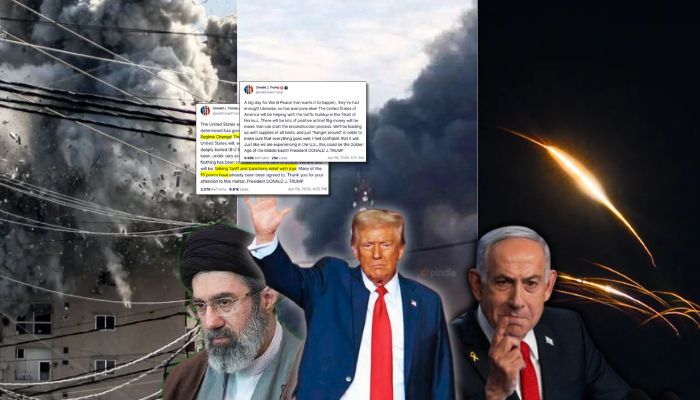
In a Truth Social post published at 9:31 AM (local time) on 8th April, Trump said, “A big day for World Peace! Iran wants it to happen, they’ve had enough! Likewise, so has everyone else! The United States of America will be helping with the traffic buildup in the Strait of Hormuz. There will be lots of positive action! Big money will be made. Iran can start the reconstruction process. We’ll be loading up with supplies of all kinds, and just “hangin’ around” in order to make sure that everything goes well. I feel confident that it will. Just like we are experiencing in the U.S., this could be the Golden Age of the Middle East.”
In another Truth Social post, Trump has claimed that there will be a “regime change” in Iran and that there will be “no enrichment of Uranium”, which is a key point in Iran’s 10-point peace proposal that Trump called “workable basis for negotiations” only hours back.
“The United States will work closely with Iran, which we have determined has gone through what will be a very productive Regime Change! There will be no enrichment of Uranium, and the United States will, working with Iran, dig up and remove all of the deeply buried (B-2 Bombers) Nuclear “Dust.” It is now, and has been, under very exacting Satellite Surveillance (Space Force!). Nothing has been touched from the date of attack. We are, and will be, talking Tariff and Sanctions relief with Iran. Many of the 15 points have already been agreed to,” Trump wrote.
This marks an interesting shift in tone and future action plan of the American President. While the original ceasefire announcement and Iranian Foreign Minister Seyed Araghchi’s statement emphasised Iran’s 10-point plan as the main framework for a ceasefire and peace talks, Trump has begun asserting Washington’s 15-point plan.
It remains to be seen how Iran and Israel would react to Trump’s claim that Iran will no longer indulge in enrichment of Uranium, essentially, giving up its nuclear ambition. While the core trigger of Israel-US joint attacks on Iran was the existential threat Iran would supposedly have posed to Israel if it acquired nuclear weapons, it seems that for Trump, Iranian oil was the main concern. Emboldened by the global silence over Trump’s takeover of the Venezuelan oil by abducting Nicholas Maduro, the American President perhaps attempted to pull off an even more spectacular show in Iran, though he seems to be failing miserably.
Trump, who wanted the Gulf countries to cover war expenses, is busy planning regime change in Iran, a joint venture for the operations in the Strait of Hormuz and beginning a ‘Golden Age’ in the West Asian nation. The Gulf countries continue to be on edge and endure Iranian attacks on their oil facilities.
The ceasefire is falling apart within hours of its announcement. Israel refuses to acknowledge a key point in Iran’s peace proposal and attacks Lebanon. Trump claims there will be no Uranium enrichment in Iran, while Iran maintains that it has “forced” the US to accept its 10-point plan and that any lasting peace would hinge on sweeping concessions outlined in its proposal.
Iran’s 10-point plan
The Iranian regime has proposed a 10-point plan to achieve a permanent resolution of the prevailing dispute and war. It is essentially maximalist and focuses on security guarantees, regional dominance, economic relief and most importantly, nuclear legitimacy. The 10 points of Iran’s proposal are:
A fundamental and binding US commitment to ensure no further acts of aggression against Iran.
Continued Iranian control over the Strait of Hormuz with a secure transit protocol under Iran’s armed forces’ coordination.
Acceptance of Iran’s uranium enrichment rights for its nuclear program.
Lifting of all primary sanctions.
Lifting of all secondary sanctions.
Termination of all resolutions targeting Iran by the UN Security Council.
Termination of resolutions by the International Atomic Energy Agency’s (IAEA) Board of Governors.
Full payment of damages to Iran for war losses.
Withdrawal of US combat forces from the bases and deployment points in the region.
Cessation of hostilities across all fronts, including Israel’s conflict with Hezbollah in Lebanon, as well as attacks on “Axis of Resistance” allies.
Iran has also demanded the release of all its frozen assets abroad and a UNSC resolution to make any final peace deal binding.
Trump’s ceasefire announcement, hours after prophesying the death of the Iranian civilisation, was embarrassing, considering he was portraying himself as a victor despite the reality being otherwise. Now, the ceasefire’s falling apart is further exacerbating this embarrassment, although this time, Pakistan too has a share in it.