Battle for India’s soul: Supreme Court’s 9-judge bench Sabarimala hearing is a doctrinal cleanup operation to establish a framework for deciding matters on religious freedom
The Sabarimala controversy is once again at the forefront of national legal discourse due to the Supreme Court’s current nine judge bench hearing. However, it would be completely missing the bigger constitutional point if the issue were reduced to a straightforward question of whether or not women were allowed to enter one temple. The underlying legal framework governing religious freedom, denominational rights, judicial examination of religious acts, and the definition of constitutional morality in India is currently being explored in addition to the long-standing Sabarimala dispute. Because of this, the current hearing affects not just Lord Ayyappa’s followers but the nation’s whole religious legal framework. Much of the discussion on social media following the first day of arguments has also been misleading. Justice B.V. Nagarathna made a comment that was taken out of context and turned into a cheap political slogan, as if the Court had somehow approved the notion that women were ‘untouchable’ by divine command. That interpretation is not only unfair, but also legally reckless. The discussion centred on the constitutional interpretation of Article 17, the particular historical extent of untouchability, and whether or not that clause can be expanded to include any kind of exclusion imposed by a religious practice. Put simply, the Court was being asked to accurately read the Constitution, not to endorse discrimination. What is the court actually hearing? The first crucial thing to grasp is that the current bench is not limited to hearing solely the Sabarimala entrance question. The nine-judge bench’s reference raises more significant issues about the relationship between the Constitution’s provisions of equality and dignity and Articles 25 and 26. The Court is examining what legal thresholds should be used when a custom seems to violate constitutional rights, how far religious communities can control their own practices, and how far the Court itself can examine those practices. CJI Surya Kant, along with Justices B.V. Nagarathna, M.M. Sundresh, Ahsanuddin Amanullah, Aravind Kumar, A.G. Masih, Prasanna B. Varale, R. Mahadevan, and Joymalya Bagchi, make up the bench currently unravelling this intricate web of religion and law. The following is a layman’s explanation of the seven major concerns they are reviewing: 1. The limits of religious freedom: Article 25 protects the freedom to profess, practice, and propagate religion. However, this privilege is contingent upon public order, morality, and health. Before the State can intervene, the Court must specify the precise boundaries of an individual’s rights. 2. The clash of rights (Art 25 vs Art 26) What happens when a person’s right to worship (Article 25) clashes with a religious denomination’s right to control its own internal affairs (Article 26)? Is it possible for an individual to force a community to change its traditions in order for them to take part? Critics contend that a denomination’s right to control its own places of worship cannot be superseded by an individual’s freedom of conscience. 3. The meaning of Constitutional Morality The 2018 judgment mainly relied on Constitutional Morality, a broad concept that judges are increasingly using to overturn legislation. Because they see them through a contemporary, Westernized lens. Traditionalists contend that constitutional morality cannot be a blank check for unelected judges to overrule thousands of years of established religious traditions. 4. Courts determining essential religious practice? Should courts, presided over by judges versed in modern law, have the authority to determine what constitutes a ‘essential religious practice’ for an ancient religion? The Center has consistently maintained that the Court should not function as priests and that the judiciary’s creation of the ERP test has flaws. 5. The scope of state interference Are a religious community’s rights limited to the particular restrictions of public order, morality, and health listed in Article 26, or are they also subject to other fundamental rights in the Constitution (such as Article 14 on Equality)? Every gender specific or tradition specific practice in India would become unlawful overnight if Article 14 were to apply strictly to sacred places. 6. Defining a religious denomination What does the Constitution say about a religious denomination or a ‘section of Hindus’? Advocate C.S. Vaidyanathan asked the Court to consider the Hindi translation of the Constitution, which employs the phrase Sampradaya, during the recent proceedings. He maintained that Hinduism is fluid and pluralistic, and that putting it into rigid, Western style organizational hierarchies (such as a Church) deprives native traditions of constitutional protection. This is important because many outsiders see the hearing as a replay of the 2018 issue. It isn’t. The Court is currently dealing with a reference
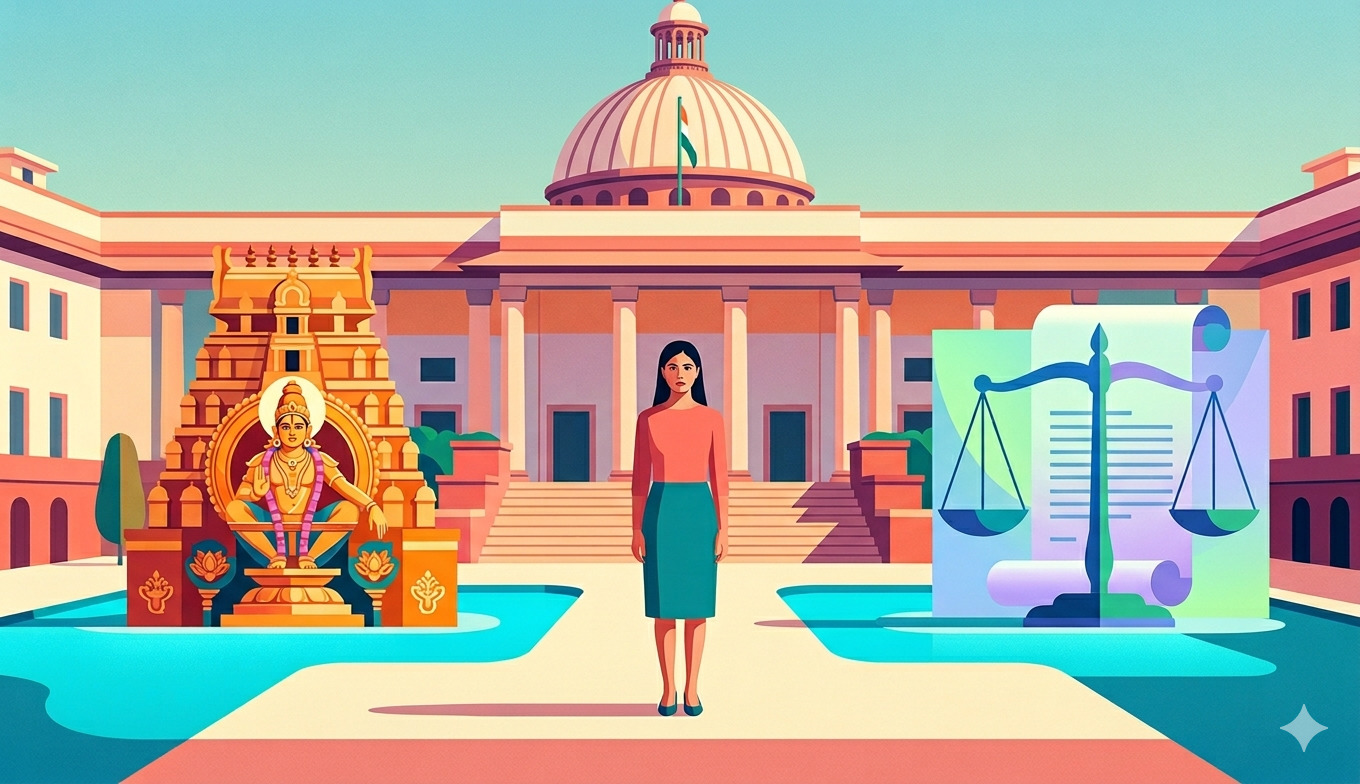
The Sabarimala controversy is once again at the forefront of national legal discourse due to the Supreme Court’s current nine judge bench hearing. However, it would be completely missing the bigger constitutional point if the issue were reduced to a straightforward question of whether or not women were allowed to enter one temple. The underlying legal framework governing religious freedom, denominational rights, judicial examination of religious acts, and the definition of constitutional morality in India is currently being explored in addition to the long-standing Sabarimala dispute. Because of this, the current hearing affects not just Lord Ayyappa’s followers but the nation’s whole religious legal framework.
Much of the discussion on social media following the first day of arguments has also been misleading. Justice B.V. Nagarathna made a comment that was taken out of context and turned into a cheap political slogan, as if the Court had somehow approved the notion that women were ‘untouchable’ by divine command. That interpretation is not only unfair, but also legally reckless. The discussion centred on the constitutional interpretation of Article 17, the particular historical extent of untouchability, and whether or not that clause can be expanded to include any kind of exclusion imposed by a religious practice. Put simply, the Court was being asked to accurately read the Constitution, not to endorse discrimination.
What is the court actually hearing?
The first crucial thing to grasp is that the current bench is not limited to hearing solely the Sabarimala entrance question. The nine-judge bench’s reference raises more significant issues about the relationship between the Constitution’s provisions of equality and dignity and Articles 25 and 26. The Court is examining what legal thresholds should be used when a custom seems to violate constitutional rights, how far religious communities can control their own practices, and how far the Court itself can examine those practices.
CJI Surya Kant, along with Justices B.V. Nagarathna, M.M. Sundresh, Ahsanuddin Amanullah, Aravind Kumar, A.G. Masih, Prasanna B. Varale, R. Mahadevan, and Joymalya Bagchi, make up the bench currently unravelling this intricate web of religion and law.
The following is a layman’s explanation of the seven major concerns they are reviewing:
1. The limits of religious freedom:
Article 25 protects the freedom to profess, practice, and propagate religion. However, this privilege is contingent upon public order, morality, and health. Before the State can intervene, the Court must specify the precise boundaries of an individual’s rights.
2. The clash of rights (Art 25 vs Art 26)
What happens when a person’s right to worship (Article 25) clashes with a religious denomination’s right to control its own internal affairs (Article 26)? Is it possible for an individual to force a community to change its traditions in order for them to take part? Critics contend that a denomination’s right to control its own places of worship cannot be superseded by an individual’s freedom of conscience.
3. The meaning of Constitutional Morality
The 2018 judgment mainly relied on Constitutional Morality, a broad concept that judges are increasingly using to overturn legislation. Because they see them through a contemporary, Westernized lens. Traditionalists contend that constitutional morality cannot be a blank check for unelected judges to overrule thousands of years of established religious traditions.
4. Courts determining essential religious practice?
Should courts, presided over by judges versed in modern law, have the authority to determine what constitutes a ‘essential religious practice’ for an ancient religion? The Center has consistently maintained that the Court should not function as priests and that the judiciary’s creation of the ERP test has flaws.
5. The scope of state interference
Are a religious community’s rights limited to the particular restrictions of public order, morality, and health listed in Article 26, or are they also subject to other fundamental rights in the Constitution (such as Article 14 on Equality)? Every gender specific or tradition specific practice in India would become unlawful overnight if Article 14 were to apply strictly to sacred places.
6. Defining a religious denomination
What does the Constitution say about a religious denomination or a ‘section of Hindus’? Advocate C.S. Vaidyanathan asked the Court to consider the Hindi translation of the Constitution, which employs the phrase Sampradaya, during the recent proceedings. He maintained that Hinduism is fluid and pluralistic, and that putting it into rigid, Western style organizational hierarchies (such as a Church) deprives native traditions of constitutional protection.
This is important because many outsiders see the hearing as a replay of the 2018 issue. It isn’t. The Court is currently dealing with a reference that surfaced during the review step and encompasses broader legal problems, many of which were never limited to Sabarimala alone. The truth is that a temple issue has turned into a constitutional test about equality, religion, and the role of the judiciary itself.
Why did Article 17 come up?
The social media outrage over Article 17 has disguised more than it has revealed. Article 17 eliminates untouchability. However, in constitutional and historical terms, that word has a very specific meaning rooted in caste oppression and social exclusion experienced by India’s untouchable communities. It was never intended to be a blanket term for all forms of exclusion, no matter how unjust or offensive they may be.
The Solicitor General’s remark to Article 17 makes sense because of this. His main argument was that the Court should exercise caution in equating a religious practice that is being contested with untouchability in the strict sense of the Constitution. That is also how Justice Nagarathna’s statement should be interpreted. She did not say that women should be excluded or that the deity wants them to be excluded. It was because the constitutional term ‘untouchability’ has a very definite legal history and cannot be stretched beyond recognition, making it impossible to casually state that women are ‘untouchable’ on some days and not on others.
That is an important distinction. The Court did not endorse discrimination. It clarified legal categories. A judge may reject a faulty constitutional comparison without endorsing the challenged behaviour. The online fury is thus based less on legal reading and more on selective clipping, which is unfortunately becoming the most popular approach of making constitutional arguments on social media.
The 2018 judgment in context
The 2018 Constitution Bench judgment in Indian Young Lawyers Association v. State of Kerala is necessary to fully understand the purpose of the current proceeding. In that judgment, the Sabarimala temple’s ban on women of menstrual age was overturned by a majority of the Supreme Court. The majority concluded that the practice was against the freedom of religion, equality, and dignity guaranteed by the constitution. It reasoned that the exclusion was not a fundamental religious practice worthy of constitutional protection and that the followers of Lord Ayyappa did not, for the purposes of Article 26, form a distinct religious denomination.
Supporters of the decision saw it as an essential remedy for a discriminatory custom. Critics saw it as a grave invasion of a living religious tradition’s internal affairs. That gap has never truly closed. The controversy around women’s admission to a single temple is still ongoing. It is a question of whether courts should act as final arbiters of what is vital in religion, or whether they should pay more attention to the tradition’s own understanding of its practices.
The 2018 judgment became historically significant since it dealt with more than just a temple entry controversy. It demonstrated the Court’s willingness to prioritize constitutional equality over long standing religious customs when they appear to contradict. That was a risky but contentious move. The current nine judge bench is effectively being asked whether that approach should be refined, curtailed, or articulated in a more principled manner.
The core concept: Sui generis and Naishtika Brahmacharya
The theology of Sabarimala, which SG Mehta and advocates like C.S. Vaidyanathan have masterfully presented in the 2026 hearings, is essential to understanding the justification of the practice. In Hinduism, a god in a temple is seen as a living, legal person with unique qualities, rights, and character, rather than just a symbol. Lord Ayyappa appeared in Sabarimala as a Naishtika Brahmachari, a god who observes strict, perpetual chastity.
Before the nine-judge panel, SG Mehta argued, “This unique attribute of the deity can’t be tested by the Supreme Court.” It doesn’t mean that women aren’t equal. In fact, as Mehta pointed out, India has always held women in higher regard. The only purpose of the restriction is to honour the principles, the religion, and the particular sampradaya (tradition) of that particular temple.
Why didn’t the review end the matter?
Following the 2018 decision, review petitions were filed, and the matter entered a new level of constitutional complexity. Rather than simply concluding the case at the review stage, the Court referred broader questions to a larger bench. That ruling is significant because it reveals that the Court acknowledged that the legal issues highlighted by Sabarimala were not isolated. They were linked to a broader set of cases involving religious autonomy, denominational rights, and the idea of essential religious practices.
This is where the nine-judge bench enters the picture. The Court did not assemble such a huge bench solely to debate who can enter a temple. It did so because the disagreement raised fundamental constitutional doctrines that had previously been invoked in cases but were now being questioned or disputed. In layman’s terms, when an legal concept causes problems in several cases, the Court frequently has to pause and define the concept itself. That is the actual significance of this hearing. It is a doctrinal cleanup operation, not a publicity gimmick. The Court is attempting to establish the appropriate framework for deciding religious freedom matters.
Conclusion
Sabarimala remains a significant and controversial case since it involves religion and constitutional reform. The 2018 decision altered the legal landscape by placing equality and dignity at the forefront of the argument. The subsequent review and reference broadened the argument to include questions concerning how Indian courts should interpret religious practice, denominational rights, and judicial action.
Because of this, the current nine judge bench is justified, and it would be deceptive to reduce the hearing to a social media catchphrase. Justice Nagarathna’s remark was not an endorsement of exclusion, and the Solicitor General’s allusion to Article 17 was not directed at women. Both were involved in a significant constitutional discussion regarding precision, history, and the legal process. Precision is not pedantry in a sensitive subject like religion, it is a need.
If anything, the hearing demonstrated that constitutional interpretation requires patience. Traditions deserve respect. And public discourse requires more seriousness than selective fury. The Court is currently attempting to clarify a problematic area of law that has persisted for years. That effort should be read carefully rather than dragged into a quarrel.