As the war in Middle East disrupts energy supply, focus shifts to Strategic Petroleum Reserves: Read what they are and how India prepares for oil crisis
The precarious situation in the Middle East, stemming from the fierce face-off between the United States and Israel on one side and Iran on the other, has created a critical security challenge there. Moreover, it has also triggered a stunning ripple effect, evolving into a potential risk to disrupt global fuel trade. Five of the top ten oil-producing nations, Saudi Arabia, the United Arab Emirates (UAE), Iraq, Iran and Kuwait, are located in the region, which produced 31% of the world’s oil in 2024. 38% of the global oil exports also came from West Asia in that year. On 2nd March (Monday), Qatar stopped producing liquefied natural gas at the biggest export unit worldwide after a drone attack by Iran. It has also been declared that refineries in other Gulf countries, including Saudi Arabia and Iraq, are going to cease operations. Oil and petrol prices have risen after the shutdown of the Strait of Hormuz, which transports 20% of the world’s oil supply from the Gulf. The majority, approximately 50%, of India’s gas and oil supplies pass through the crucial chokepoint. How is India addressing the crisis The Modi government has declared that it has fuel and crude oil reserves for six to eight weeks and is in a “reasonably comfortable” position to avoid any shortage of major fuels like petrol, diesel and liquefied petroleum gas (LPG) in the near future, despite an impending threat to the essential energy supply. A source quoted by The Hindu stated, “India is in a reasonably comfortable position as far as crude oil is concerned. It has crude oil in reserve for 25 days, alongside energy products (petrol, diesel and LPG) for 25 days as well.” The person highlighted that this does not incorporate the resources from the Special Petroleum Reserves (SPR) designated for emergencies, which takes the country’s crude oil sufficiency beyond 25 days. Around half of the crude oil stocks would be regularly renewed as the imports from non-Hormuz regions continue unabated. This inventory comprises oil aboard tankers in transit as well as in the storage tanks and pipes of refiners. The stockpiles will also change as refineries continually process crude, create fuels and import more oil from areas outside of West Asia, extending the coverage. The Ministry of Petroleum and Natural Gas (MoPNG) has also concluded several meetings with Indian companies in the past 48 hours to assess the situation and develop backup plans, including alternate crude oil supply regions, as part of its ongoing monitoring of the changing circumstances. “Other options besides the Strait of Hormuz are there, including cape of good hope which will increase insurance and freight costs,” disclosed an insider, reported Moneycontrol. India’s safety net is limited in terms of liquefied natural gas (LNG) because it is much harder to stockpile compared to crude oil and other petroleum products. Qatar, the largest provider of LNG to the country has closed its production after Iran assaulted its facilities. According to a MoPNG official cited by The Indian Express, the government does not anticipate any significant impact on the country’s LNG supplies despite a brief pause of a week or 10 days. However, other options, such as modifications at local levels, might be considered if the closure continues past that point. Indian oil and gas corporations are actively searching for more LNG cargoes from other markets in addition to actively looking for alternative supplies of crude oil and LPG. Increased sourcing from Russia, the US, West Africa, and Latin America are opportunities for diversification. India could be able to access Russian cargoes that are available in the Arabian Sea and Indian Ocean regions, including volumes in floating storage. Iran claims complete control of the Strait of Hormuz The strategically significant Strait of Hormuz, a narrow waterway that is employed for about one-fifth of the world’s oil and LNG supplies, has been at the centre of this issue. It is one of the key energy chokepoints globally and connects the Persian Gulf and the Gulf of Oman. Insurers discontinued coverage for ships operating in the region after Iranian media broadcast that Tehran would open fire on any ship trying to cross the strait. Hence, freight and insurance prices have increased while tankers and cargo ships have started to reroute. Guards Navy official Mohammad Akbarzadeh even announced, “Currently, the Strait of Hormuz is under the complete control of the Islamic Republic’s Navy,” in a formal release on Fars news agency. He warned that any vessel trying to sail through the area could encounter possible damage from missiles or stray drones, risking its safety. According to President Donald Trump, he instructed the United States Development Finance Corporation (DFC) to offer guarantees and political risk insurance to assure the financial stability of all marine trade, including petroleum shipments passing through the Gulf.
The precarious situation in the Middle East, stemming from the fierce face-off between the United States and Israel on one side and Iran on the other, has created a critical security challenge there. Moreover, it has also triggered a stunning ripple effect, evolving into a potential risk to disrupt global fuel trade.
Five of the top ten oil-producing nations, Saudi Arabia, the United Arab Emirates (UAE), Iraq, Iran and Kuwait, are located in the region, which produced 31% of the world’s oil in 2024. 38% of the global oil exports also came from West Asia in that year.
On 2nd March (Monday), Qatar stopped producing liquefied natural gas at the biggest export unit worldwide after a drone attack by Iran. It has also been declared that refineries in other Gulf countries, including Saudi Arabia and Iraq, are going to cease operations. Oil and petrol prices have risen after the shutdown of the Strait of Hormuz, which transports 20% of the world’s oil supply from the Gulf. The majority, approximately 50%, of India’s gas and oil supplies pass through the crucial chokepoint.
How is India addressing the crisis
The Modi government has declared that it has fuel and crude oil reserves for six to eight weeks and is in a “reasonably comfortable” position to avoid any shortage of major fuels like petrol, diesel and liquefied petroleum gas (LPG) in the near future, despite an impending threat to the essential energy supply.
A source quoted by The Hindu stated, “India is in a reasonably comfortable position as far as crude oil is concerned. It has crude oil in reserve for 25 days, alongside energy products (petrol, diesel and LPG) for 25 days as well.” The person highlighted that this does not incorporate the resources from the Special Petroleum Reserves (SPR) designated for emergencies, which takes the country’s crude oil sufficiency beyond 25 days.
Around half of the crude oil stocks would be regularly renewed as the imports from non-Hormuz regions continue unabated. This inventory comprises oil aboard tankers in transit as well as in the storage tanks and pipes of refiners. The stockpiles will also change as refineries continually process crude, create fuels and import more oil from areas outside of West Asia, extending the coverage.
The Ministry of Petroleum and Natural Gas (MoPNG) has also concluded several meetings with Indian companies in the past 48 hours to assess the situation and develop backup plans, including alternate crude oil supply regions, as part of its ongoing monitoring of the changing circumstances.
“Other options besides the Strait of Hormuz are there, including cape of good hope which will increase insurance and freight costs,” disclosed an insider, reported Moneycontrol. India’s safety net is limited in terms of liquefied natural gas (LNG) because it is much harder to stockpile compared to crude oil and other petroleum products. Qatar, the largest provider of LNG to the country has closed its production after Iran assaulted its facilities.
According to a MoPNG official cited by The Indian Express, the government does not anticipate any significant impact on the country’s LNG supplies despite a brief pause of a week or 10 days. However, other options, such as modifications at local levels, might be considered if the closure continues past that point. Indian oil and gas corporations are actively searching for more LNG cargoes from other markets in addition to actively looking for alternative supplies of crude oil and LPG.
Increased sourcing from Russia, the US, West Africa, and Latin America are opportunities for diversification. India could be able to access Russian cargoes that are available in the Arabian Sea and Indian Ocean regions, including volumes in floating storage.
Iran claims complete control of the Strait of Hormuz
The strategically significant Strait of Hormuz, a narrow waterway that is employed for about one-fifth of the world’s oil and LNG supplies, has been at the centre of this issue. It is one of the key energy chokepoints globally and connects the Persian Gulf and the Gulf of Oman.
Insurers discontinued coverage for ships operating in the region after Iranian media broadcast that Tehran would open fire on any ship trying to cross the strait. Hence, freight and insurance prices have increased while tankers and cargo ships have started to reroute.
Guards Navy official Mohammad Akbarzadeh even announced, “Currently, the Strait of Hormuz is under the complete control of the Islamic Republic’s Navy,” in a formal release on Fars news agency. He warned that any vessel trying to sail through the area could encounter possible damage from missiles or stray drones, risking its safety.
According to President Donald Trump, he instructed the United States Development Finance Corporation (DFC) to offer guarantees and political risk insurance to assure the financial stability of all marine trade, including petroleum shipments passing through the Gulf.
“Effective immediately, I have ordered the United States Development Finance Corporation (DFC) to provide, at a very reasonable price, political risk insurance and guarantees for the Financial Security of all Maritime Trade, especially energy, travelling through the Gulf. This will be available to all Shipping Lines,” he wrote on Truth Social on 3rd March (Tuesday).
View this post on Instagram A post shared by The White House (@whitehouse)
“If necessary, the United States Navy will begin escorting tankers through the Strait of Hormuz as soon as possible. No matter what, the United States will ensure the free flow of energy to the world,” Trump emphasised, adding that the country’s “economic and military might is the greatest on earth” alongside “more actions to come.”
Strategic Petroleum Reserves and their storage
Every industrialised economy is built on the foundation of energy security. A steady and dependable supply of crude oil is necessary for a nation whose energy needs are expanding swiftly. Strategic Petroleum Reserves (SPR), is an innovative step intended to protect the country’s energy flow and enable uninterrupted operations across core sectors to enhance its preparedness and ensure sustainability during unanticipated disruptions.
These are highly secure, specialised storage establishments developed to store crude oil for use in an emergency. They serve as a buffer, protecting the energy supply chain from temporary disruptions driven by outside variables like delays in transit, natural disasters or alterations in international markets.
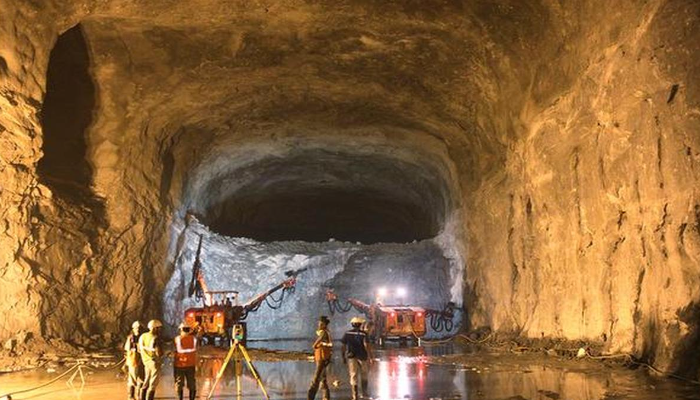
The majority of SPRs are housed in man-made, deep underground caverns with low environmental impact, low cost and maximum security. These structures often fall into one of two categories: hard rock caverns, which are excavated underground chambers and are common in India, or salt caverns, which are found in the United States and are formed by dissolving salt domes.
Image via drishtiias.com
Salt caverns take shape through the method of solution mining, which entails pumping water into geological formations containing substantial salt reserves to dissolve the salt. Crude oil can be stored in the area once the brine, water containing dissolved saltis removed from the deposit.
The procedure is less complicated, faster and less expensive than creating rock caverns in which large storage chambers are made by manually removing and digging rock. These are built by drilling, blasting and removing rock strata. Their ceilings and walls act as organic barriers to store the oil.
Salt cavern-based oil vaults are for rapid oil injection and extraction and are naturally well-sealed. According to a report by the Massachusetts Institute’s Environmental Solutions Initiative, this makes them a more desirable option than storing oil in other geological formations.
Image via Mint
The largest emergency oil storage facility in the world, the Strategic Petroleum Reserves of the United States, is dependent only on salt cavern-based structures. Rajasthan is believed to be the best place in India to build such reserves due to its profusion of salt deposits.
Strategic Petroleum Reserves of India
The practice is not exclusive to any country and has been widely accepted to promote long-term energy resilience, continuous operation and supply stability. The crisis in the Middle East involving OPEC (Organisation of the Petroleum Exporting Countries) member Iran and its detrimental impact on energy trade has further pointed out the importance of maintaining these stockpiles.
The Indian Strategic Petroleum Reserves Limited (ISPRL), a specific institution under the Ministry of Petroleum and Natural Gas, is in charge of managing the nation’s SPR network. The country has a 5.3 million ton crude oil reserve capacity spread over three locations: Vishakhapatnam (1.33 MMT), Mangaluru (1.5 Million Metric Ton or MMT) and Padur (2.5 MMT), all of which were constructed as components of the Strategic Petroleum Reserve (SPR) program’s phase I. Their aggregate capacity is 39.1 million barrels of crude oil.
On 9th February, Union Minister for Petroleum and Natural Gas Hardeep Singh Puri told the Rajya Sabha that in the event of a geopolitical shock, the nation’s strategic petroleum reserves could fulfil energy needs for 74 days. However, the number was extended to 90 days by the Indian Energy Agency.
Image via drishtiias.com
The purpose of these carefully positioned rock caves is to provide effective logistics, security and functional adaptability in close proximity to coastal refineries. In July 2021, the government authorised the installation of two more commercial-cum-strategic petroleum reserve centres with a combined storage capacity of 6.5 MMT at Chandikhol (4 MMT) in Odisha and Padur (2.5 MMT) in Karnataka through a Public-Private Partnership. This the second phase of development and is scheduled to be run via Public Private Partnership (PPP).
How the United States used its Strategic Petroleum Reserves
The largest emergency oil stockpile in the world is the United States, which is often used during critical times to regulate fuel prices for customers. The reserves have 415.4 million barrels of primarily sour crude with a high sulphur content that several refineries are prepared to process, reported Reuters. It is saved underground in hollowed-out salt caves on the gulf coasts of Louisiana and Texas. They can contain roughly 714 million barrels.
The facilities were utilised by Washington amid the war in Ukarine which started in 2022, attack by Yemen’s Houthi terrorists on Saudi Arabia in 2019, when the Libyan civil war broke out in 2011 and in 1990–1991 following the Iraqi invasion of Kuwait in “Opeartion Desert Storm.” The Trump administration is not talking about the sale of oil from these reserves, however, they would prove beneficial if the need arises.
What is the significance of Strategic Petroleum Reserves
The obstruction at the Strait of Hormuz is the latest in a series of restrictions on maritime trade routes that have previously resulted in trouble. The same situation arose in 2023 when Yemen-based Houthi militia attacked international shipping lanes. Two Houthi anti-ship ballistic missiles were fired into international trade routes in the Southern Red Sea from locations under Houthi control on 23rd December of that year.
They struck many ships travelling to and from Israel in the Red Sea and the Indian Ocean in response to the dispute in Gaza. Their threat to global maritime security looms as container shipping companies were compelled to abandon plans to return to the shorter Red Sea or Suez Canal route because of the violent confrontations between Isreal an Iran. The Suez Canal links the Mediterranean Sea to the Red Sea.
The sensitive global trade routes have grown even more susceptible to threats as diplomatic relations between different nations deteriorate, provoking open hostilities and strikes on each other. These halts can paralyse countries like India, which cannot afford to have its energy supplies compromised.
Thus, Strategic Petroleum Reserves are vital to ensure that oil flow remains uninterrupted despite the numerous upheavals endured by the supply chains. They are not just important for national security or economic health but also act as a lifeline in vulnerable times, particularly for nations that are heavily dependent on oil for their survival and development.