As mob holds judicial officers hostage in Malda’s Kaliachak, read how Muslims resorted to anti-Hindu riots in 2016 at the same place over Kamlesh Tiwari’s “blasphemy”
The 2016 Malda riots broke out in the same place in Kaliachak, where judicial officers were reportedly held hostage by a mob a few days back. The fresh tension has brought back memories of one of West Bengal’s most violent flare-ups, when a massive protest by Muslims in January 2016 turned into large-scale violence, leaving public property destroyed, police injured, and the entire region on edge. How a protest turned into a violent riot On 3rd January, 2016, thousands of people gathered in Kaliachak in Malda district to protest against controversial remarks made by political figure Kamlesh Tiwari. The rally had permission and was organised by Muslim groups demanding strict punishment against him. What began as a protest soon spiralled out of control. A section of the crowd became aggressive, broke barricades, and clashed with police and security forces. Within a short time, the situation turned into a full-blown riot. The Muslim mob attacked the Kaliachak police station, vandalised offices, and set vehicles on fire. The block development office was also ransacked. Government records, computers, and files were destroyed. Police personnel were chased away as the mob took over the premises. More than 30 policemen were injured during the clashes. Several vehicles, including those belonging to the Border Security Force and the North Bengal State Transport Corporation, were torched. Railway blockade and widespread disruption The violence did not remain limited to government buildings. Protesters moved towards Khaltipur railway station and blocked railway tracks for hours, bringing train services to a halt. National Highway 34 was also affected as vehicles were stranded after an NBSTC bus was set on fire. Passengers had to abandon vehicles to save themselves as the mob turned violent. Shops shut down, roads were blocked, and daily life came to a standstill. Fear spread across nearby areas as people stayed indoors. Reports of targeted attacks on Hindu properties Several reports from the time suggested that the violence also took a communal turn. Temples, including Shani Temple and Durga Temple in nearby areas like Baliadanga, were attacked. Around 25 houses and shops belonging to Hindus were vandalised. These incidents added to the tension, with claims that the riot had elements of anti-Hindu violence alongside the initial protest. What triggered the protest The root of the protest lay in remarks made by Kamlesh Tiwari in December 2015. His comments about Prophet Muhammad triggered outrage among Muslim groups across the country. This controversy itself came after remarks by Azam Khan, who had commented on RSS members in the context of the debate around homosexuality laws. At that time, the debate was linked to Section 377 of the Indian Penal Code, which had been reinstated by the Supreme Court in 2013 after being struck down earlier by the Delhi High Court. Tiwari’s statement led to nationwide protests, with many groups demanding strict punishment, including capital punishment. He was arrested in Lucknow under sections related to promoting enmity and hurting religious sentiments. Massive crowd and sudden escalation The rally in Malda reportedly saw participation ranging from tens of thousands to over two lakh people. Eyewitness accounts suggested that the turning point came when protesters encountered resistance from police and security forces while moving through the area. An altercation involving a bus and security personnel is also believed to have contributed to the escalation. Within minutes, the protest lost control and turned violent. Police had to fire around 40 rounds of blank shots to disperse the crowd. The Rapid Action Force was deployed to bring the situation under control. Police action and restrictions After the violence, authorities imposed Section 144 to prevent gatherings. Additional forces were deployed, and flag marches were conducted to restore normalcy. Political visits were restricted. A delegation led by BJP leaders, including Samik Bhattacharya and S. S. Ahluwalia, was stopped from entering the area, with officials citing concerns that their presence could worsen the situation. Several arrests were made in the days following the riot, and investigations were launched to identify those involved. Was there another motive behind the violence? While the immediate trigger was the protest against Tiwari’s remarks, later investigations suggested that the violence may not have been purely spontaneous. Police and security agencies indicated that criminal elements may have used the protest as a cover. One key angle was the destruction of records inside the police station. Kaliachak and the surrounding areas had long been under scrutiny for illegal activities such as fake currency circulation, drug trafficking, and illegal poppy cultivation. According to officials, enforcement agencies had recently taken action aga
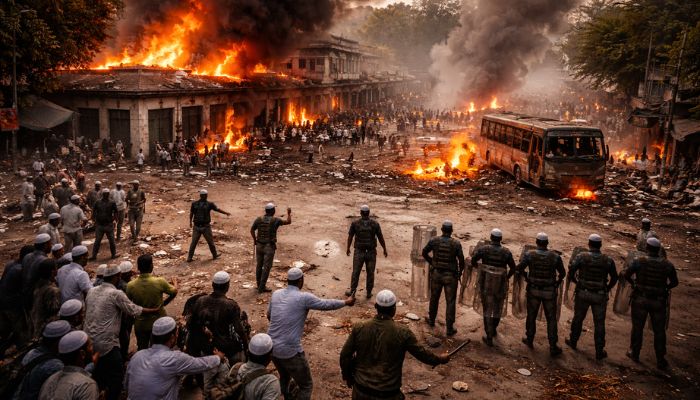
The 2016 Malda riots broke out in the same place in Kaliachak, where judicial officers were reportedly held hostage by a mob a few days back. The fresh tension has brought back memories of one of West Bengal’s most violent flare-ups, when a massive protest by Muslims in January 2016 turned into large-scale violence, leaving public property destroyed, police injured, and the entire region on edge.
How a protest turned into a violent riot
On 3rd January, 2016, thousands of people gathered in Kaliachak in Malda district to protest against controversial remarks made by political figure Kamlesh Tiwari. The rally had permission and was organised by Muslim groups demanding strict punishment against him.
What began as a protest soon spiralled out of control. A section of the crowd became aggressive, broke barricades, and clashed with police and security forces. Within a short time, the situation turned into a full-blown riot.
The Muslim mob attacked the Kaliachak police station, vandalised offices, and set vehicles on fire. The block development office was also ransacked. Government records, computers, and files were destroyed. Police personnel were chased away as the mob took over the premises.
More than 30 policemen were injured during the clashes. Several vehicles, including those belonging to the Border Security Force and the North Bengal State Transport Corporation, were torched.
Railway blockade and widespread disruption
The violence did not remain limited to government buildings. Protesters moved towards Khaltipur railway station and blocked railway tracks for hours, bringing train services to a halt.
National Highway 34 was also affected as vehicles were stranded after an NBSTC bus was set on fire. Passengers had to abandon vehicles to save themselves as the mob turned violent.
Shops shut down, roads were blocked, and daily life came to a standstill. Fear spread across nearby areas as people stayed indoors.
Reports of targeted attacks on Hindu properties
Several reports from the time suggested that the violence also took a communal turn. Temples, including Shani Temple and Durga Temple in nearby areas like Baliadanga, were attacked. Around 25 houses and shops belonging to Hindus were vandalised.
These incidents added to the tension, with claims that the riot had elements of anti-Hindu violence alongside the initial protest.
What triggered the protest
The root of the protest lay in remarks made by Kamlesh Tiwari in December 2015. His comments about Prophet Muhammad triggered outrage among Muslim groups across the country.
This controversy itself came after remarks by Azam Khan, who had commented on RSS members in the context of the debate around homosexuality laws.
At that time, the debate was linked to Section 377 of the Indian Penal Code, which had been reinstated by the Supreme Court in 2013 after being struck down earlier by the Delhi High Court.
Tiwari’s statement led to nationwide protests, with many groups demanding strict punishment, including capital punishment. He was arrested in Lucknow under sections related to promoting enmity and hurting religious sentiments.
Massive crowd and sudden escalation
The rally in Malda reportedly saw participation ranging from tens of thousands to over two lakh people. Eyewitness accounts suggested that the turning point came when protesters encountered resistance from police and security forces while moving through the area.
An altercation involving a bus and security personnel is also believed to have contributed to the escalation. Within minutes, the protest lost control and turned violent.
Police had to fire around 40 rounds of blank shots to disperse the crowd. The Rapid Action Force was deployed to bring the situation under control.
Police action and restrictions
After the violence, authorities imposed Section 144 to prevent gatherings. Additional forces were deployed, and flag marches were conducted to restore normalcy.
Political visits were restricted. A delegation led by BJP leaders, including Samik Bhattacharya and S. S. Ahluwalia, was stopped from entering the area, with officials citing concerns that their presence could worsen the situation.
Several arrests were made in the days following the riot, and investigations were launched to identify those involved.
Was there another motive behind the violence?
While the immediate trigger was the protest against Tiwari’s remarks, later investigations suggested that the violence may not have been purely spontaneous. Police and security agencies indicated that criminal elements may have used the protest as a cover. One key angle was the destruction of records inside the police station.
Kaliachak and the surrounding areas had long been under scrutiny for illegal activities such as fake currency circulation, drug trafficking, and illegal poppy cultivation.
According to officials, enforcement agencies had recently taken action against these networks, including destroying large areas of poppy fields. This crackdown is believed to have angered local criminal groups.
Poppy mafia and illegal trade
The Malda region, especially areas near the international border with Bangladesh, has been known for illegal activities. These include smuggling, fake currency operations, and narcotics production.
Poppy cultivation, which is used to produce opium and heroin, was widespread. Authorities had begun a major drive to destroy these crops just days before the riots.
Some reports suggested that the mob attack on the police station may have been aimed at destroying evidence linked to these illegal operations.
This theory was supported by the fact that records, files, and computers inside the police station were specifically targeted and destroyed.
Geography and demographic context
Malda district has a mixed population of Hindus and Muslims, with some areas like Kaliachak having a Muslim majority. According to the 2011 Census, both communities have significant presence in the district.
Its location bordering Bihar, Jharkhand, and Bangladesh makes it strategically sensitive. The border areas have often been used as transit routes for illegal trade.
This combination of demographic complexity and criminal networks has made the region vulnerable to sudden outbreaks of violence.
Civil society and differing views
Not everyone agreed that the violence was communal in nature. The Association for Democratic Rights (APDR), a civil rights group, stated that the incident should not be seen purely as communal.
Its representatives argued that the violence was more a sign of lawlessness and the involvement of miscreants rather than a planned communal clash.
However, political parties and local reports continued to debate the nature of the riot, with some calling it a deliberate attack driven by communal anger and others pointing to criminal motives.
Lasting impact and relevance today
The 2016 Malda riots left a deep mark on the region. It exposed weaknesses in law enforcement, the influence of illegal networks, and the fragile balance between communities.
Now, as reports emerge of judicial officers being held hostage in the same Kaliachak area, the memory of 2016 becomes even more relevant.
The recurrence of mob action in the same location raises serious questions about governance, law and order, and whether the underlying issues that led to the earlier violence were ever fully addressed.
A pattern of tension
The events of 2016 showed how quickly a protest can turn into large-scale violence when multiple factors religious sentiments, political tensions, and criminal interests intersect.
The recent hostage situation suggests that Kaliachak continues to remain sensitive and volatile.
As authorities respond to the current crisis, the lessons from the 2016 riots serve as a reminder of how fragile peace can be in such regions and how important it is to address both immediate triggers and deeper structural issues.