Anatomy of the IndiGo monopoly: How UPA’s lost decade, failure of competitors and a lack of aviation reforms paved way for the current mess
The “too big to fail” airline in India is currently experiencing its worst crisis to date. After failing to prepare for more stringent Flight Duty Time Limit (FDTL) regulations for pilots, IndiGo cancelled over 1,000 flights in a matter of days during the first week of December 2025. This led to chaos at airports, outrage on social media, and a government intervention that temporarily reversed the new fatigue regulations. This incident has shown how reliant India’s aviation sector has become on a single low-cost carrier and how risky it is when that carrier falters, with IndiGo currently holding about 65% of the country’s domestic market. It is crucial to understand how IndiGo became dominant and how the broader policy environment particularly between 2004 and 2014 gradually cleared the competitive field around it in order to comprehend why the current mess matters. Simply put, IndiGo’s astute strategy helped it rise, but many of its competitors fell due to UPA era policy blunders. How IndiGo built a fortress: Strategy, fleet choices and discipline (i) An audacious start Rahul Bhatia of InterGlobe Enterprises and aviation veteran Rakesh Gangwal established IndiGo in 2006. Prior to its first commercial flight, the airline startled the industry at the 2005 Paris Air Show by placing an order for 100 Airbus A320 aircraft, which at the time was unprecedented for a startup with no prior operational experience. On August 4, 2006, it made its debut on the Delhi-Mumbai route with a small fleet of A320s, but it was obvious that IndiGo was not going to be a boutique airline. From the beginning, it desired scale. The airline’s recent NDTV article highlights how this early mega order gave lessors, manufacturers, and airports confidence, enabling IndiGo to negotiate advantageous pricing and delivery windows. All 100 of the 2005 order’s aircraft (the final one was delivered in 2014) were delivered in less than ten years, and IndiGo had already scheduled its subsequent waves of capacity with orders for 250 A320neo-family aircraft in 2014 and 180 aircraft in 2011. In a high fuel cost climate, this aggressive forward ordering ensured a pipeline of new, fuel-efficient aircraft well into the 2020s and locked in manufacturer-level discounts. (ii) Single type fleet and sale and leaseback IndiGo adopted a strict low cost approach from the beginning, with a single class cabin, a highly standardized layout, and a single aircraft model (A320/A321, with ATRs added considerably later for regional routes). This “single type” option of simplified training, shared spare parts, unified maintenance procedures, and an interchangeable pilot pool is frequently cited in academic and business case studies as a key cost benefit. Its unrelenting employment of sale and leaseback was as significant. Usually, IndiGo would take brand new aircraft, sell them to lessors fast, and then lease them back for about six years. This produced upfront revenue from the sale, ensured that the fleet stayed relatively young (aircraft being cycled out every few years), and converted significant capital expenditure into predictable operational leases. This is a key component of IndiGo’s balance sheet strength, according to business studies of the company’s finances. Planes were continuously replaced, which kept maintenance costs low and reliability strong while freeing up cash that could be reinvested in expansion rather than being locked in metal. IndiGo’s uniform, youthful fleet became a silent structural advantage in a market where many competitors flew older, fuel-hungry, and maintenance-intensive aircraft. (iii) Ruthless cost discipline and the ‘on time’ brand The traditional low-cost carrier (LCC) business model used by IndiGo includes point-to-point routes, dense seating, paid meals, short turnaround times, and high daily aircraft utilisation. Quick turnaround times and high utilisation (many rotations per day per aircraft), lean staffing (fewer people per aircraft than many competitors), and a strong emphasis on punctuality and basic hygiene rather than frills are all frequently noted in strategy canvases and airline case studies. Punctuality was transformed into brand positioning rather than merely an internal metric. Reuters recently highlighted a well-known IndiGo commercial from 2011 that made the literal guarantee that “every time we fly, we will ensure you will land on time,” pointing out the irony of on-time performance plummeting to 3.7% during the 2025 crisis. By 2014, IndiGo had transported more than 80 million people since its founding, had inducted its 100th aircraft, and was running more than 500 daily flights to 36 domestic and foreign destinations. Price conscious middle class travelers who prioritized punctuality over a complimentary hot supper were drawn to its dependability and ease of use. (iv) Revenue management and ancillaries IndiGo made significant internal investments in revenue management, i
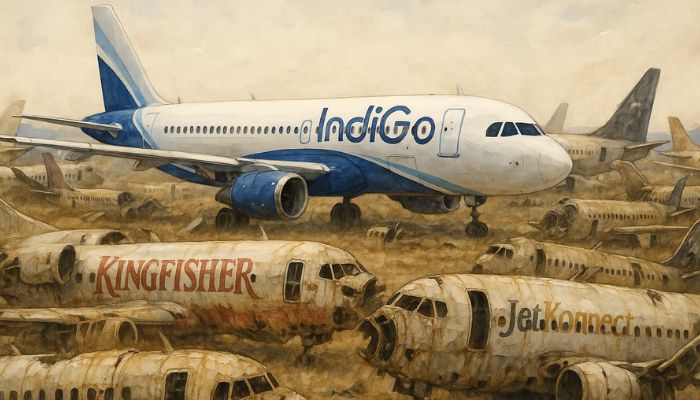

The “too big to fail” airline in India is currently experiencing its worst crisis to date. After failing to prepare for more stringent Flight Duty Time Limit (FDTL) regulations for pilots, IndiGo cancelled over 1,000 flights in a matter of days during the first week of December 2025. This led to chaos at airports, outrage on social media, and a government intervention that temporarily reversed the new fatigue regulations. This incident has shown how reliant India’s aviation sector has become on a single low-cost carrier and how risky it is when that carrier falters, with IndiGo currently holding about 65% of the country’s domestic market.
It is crucial to understand how IndiGo became dominant and how the broader policy environment particularly between 2004 and 2014 gradually cleared the competitive field around it in order to comprehend why the current mess matters. Simply put, IndiGo’s astute strategy helped it rise, but many of its competitors fell due to UPA era policy blunders.
How IndiGo built a fortress: Strategy, fleet choices and discipline
(i) An audacious start
Rahul Bhatia of InterGlobe Enterprises and aviation veteran Rakesh Gangwal established IndiGo in 2006. Prior to its first commercial flight, the airline startled the industry at the 2005 Paris Air Show by placing an order for 100 Airbus A320 aircraft, which at the time was unprecedented for a startup with no prior operational experience. On August 4, 2006, it made its debut on the Delhi-Mumbai route with a small fleet of A320s, but it was obvious that IndiGo was not going to be a boutique airline. From the beginning, it desired scale. The airline’s recent NDTV article highlights how this early mega order gave lessors, manufacturers, and airports confidence, enabling IndiGo to negotiate advantageous pricing and delivery windows.
All 100 of the 2005 order’s aircraft (the final one was delivered in 2014) were delivered in less than ten years, and IndiGo had already scheduled its subsequent waves of capacity with orders for 250 A320neo-family aircraft in 2014 and 180 aircraft in 2011. In a high fuel cost climate, this aggressive forward ordering ensured a pipeline of new, fuel-efficient aircraft well into the 2020s and locked in manufacturer-level discounts.
(ii) Single type fleet and sale and leaseback
IndiGo adopted a strict low cost approach from the beginning, with a single class cabin, a highly standardized layout, and a single aircraft model (A320/A321, with ATRs added considerably later for regional routes). This “single type” option of simplified training, shared spare parts, unified maintenance procedures, and an interchangeable pilot pool is frequently cited in academic and business case studies as a key cost benefit. Its unrelenting employment of sale and leaseback was as significant. Usually, IndiGo would take brand new aircraft, sell them to lessors fast, and then lease them back for about six years.
This produced upfront revenue from the sale, ensured that the fleet stayed relatively young (aircraft being cycled out every few years), and converted significant capital expenditure into predictable operational leases.
This is a key component of IndiGo’s balance sheet strength, according to business studies of the company’s finances. Planes were continuously replaced, which kept maintenance costs low and reliability strong while freeing up cash that could be reinvested in expansion rather than being locked in metal. IndiGo’s uniform, youthful fleet became a silent structural advantage in a market where many competitors flew older, fuel-hungry, and maintenance-intensive aircraft.
(iii) Ruthless cost discipline and the ‘on time’ brand
The traditional low-cost carrier (LCC) business model used by IndiGo includes point-to-point routes, dense seating, paid meals, short turnaround times, and high daily aircraft utilisation. Quick turnaround times and high utilisation (many rotations per day per aircraft), lean staffing (fewer people per aircraft than many competitors), and a strong emphasis on punctuality and basic hygiene rather than frills are all frequently noted in strategy canvases and airline case studies.
Punctuality was transformed into brand positioning rather than merely an internal metric. Reuters recently highlighted a well-known IndiGo commercial from 2011 that made the literal guarantee that “every time we fly, we will ensure you will land on time,” pointing out the irony of on-time performance plummeting to 3.7% during the 2025 crisis. By 2014, IndiGo had transported more than 80 million people since its founding, had inducted its 100th aircraft, and was running more than 500 daily flights to 36 domestic and foreign destinations. Price conscious middle class travelers who prioritized punctuality over a complimentary hot supper were drawn to its dependability and ease of use.
(iv) Revenue management and ancillaries
IndiGo made significant internal investments in revenue management, including dynamic pricing grids that fill seats starting with the lowest fare buckets, In order to reduce distribution costs, it made extensive use of ancillaries, such as paid meals, seat selection, additional baggage, priority boarding, and a strong direct-sales focus through its website and app.
In a market where headline fares were frequently maintained artificially low due to competition and customer expectations, academic research on IndiGo’s pricing indicates that supplementary services and strict yield management were essential to sustaining profitability. Compared to full service carriers or smaller LCCs, the airline was able to maintain price wars for a far longer period of time since it maintained one of the lowest cost bases in India. When competitors reduced fares, IndiGo could match them without suffering as much.
(v) Aggressive network build out
India’s domestic aviation sector grew quickly between 2006 and 2014, nearly exclusively during the UPA years, thanks to increased aspirations and GDP development. Instead than pursuing glamorous routes, IndiGo used this expansion to increase frequency on high-density metro and tier-II lines, like as Delhi–Mumbai, Delhi–Bengaluru, Mumbai–Hyderabad, and so on, while progressively adding secondary cities like Jaipur, Nagpur, and Coimbatore. IndiGo was able to take a disproportionate amount of the incremental passenger growth by consistently increasing capacity on routes with structurally strong demand. Without the brand confusion that afflicted some competitors that wavered between “premium” and “budget,” it provided what business travelers desired (frequency and reliability) and what pleasure travelers desired (cheap fares).
In conclusion, neither an accident nor a simple policy contribution contributed to IndiGo’s success. It was based on a tough-minded low cost strategy, a limited operational focus, and a purposefully conservative financial sheet. However, this is just half of the tale. The other half is that, despite IndiGo’s ascent, many other Indian airlines declined, and the 2004-2014 policy climate did little to sustain them.
A Market that emptied out: 2004-2014, Bankruptcies, and the UPA policy backdrop
(i) High taxes, High charges, weak reforms
Indian aviation was undergoing change when the UPA government took office in 2004. Private carriers like Jet Airways, Air Sahara, and the recently established low cost operators were quickly gaining market share, but public sector operators Indian Airlines and Air India continued to dominate. However, policy failed to adapt to this new competitive environment. Between 2004 and 2014, three structural problems emerged:
First, punitive aviation turbine fuel (ATF) taxation: States in India have traditionally levied value-added tax (VAT) on ATF, with rates ranging from about 4% to as much as 30%. Ajit Singh, the Civil Aviation Minister at the time, stated clearly in 2013 that “a major reason for airlines’ losses is the high cost of ATF,” which is caused by both “very high VAT imposed by state governments” and worldwide base pricing. According to industry associations, ATF is around 70% more expensive than in competing hubs and accounts for 40% of Indian carriers’ operating expenses, which directly reduces profitability.
Second, growing airport fees following privatization: The UPA government proceeded with the modernization and privatization of airports in Delhi and Mumbai through joint ventures, followed by greenfield private airports in Hyderabad and Bengaluru. Airlines and passenger organizations frequently complained that the regulatory formula permitted extremely high airport fees and user development fees at these hubs, making them among the most expensive in the area, even as infrastructure improved.
Third, sluggish structural reform and complicated regulations: Due to the sector’s operation under several overlapping administrations (DGCA, AAI, Ministry of Civil Aviation), there were delays and a complicated compliance regime. The Indian aviation industry was described as “high tax” and “hostile to investment” in studies conducted in the late 2000s and early 2010s. Foreign direct investment regulations were only gradually liberalized, and bankruptcy and exit procedures were difficult.
To break even in such a setting, airlines required extremely tight cost structures and financial discipline. IndiGo possessed both. Many others did not, and they suffered as a result.
(ii) The roll call of failures, 2004-14
A wave of domestic carriers shut down, merged, or essentially vanished as commercial competitors between 2004 and 2014, which coincided with UPA I and II. Although every airline made its own internal errors, they were all exacerbated by high fuel taxes, costly airports, and a lax regulatory framework, which made recovery much more difficult.
Air Deccan/ Simplify Deccan (ceased as a standalone brand 2008)
Air Deccan, India’s first real low cost carrier, was founded in 2003 by Captain G.R. Gopinath and catered to middle class and rail travellers with tickets that were up to 50% less than those of full-service airlines. In an era of skyrocketing petrol costs and high ATF taxes, it struggled with low profits despite pioneering no frills flying and growing quickly. Vijay Mallya’s Kingfisher Airlines successfully “rescued” a severely losing Deccan in 2007, rebranding it as Simplifly Deccan before it was completely absorbed and vanished as a distinct low-cost rival by 2008.
To put it another way, the first low cost carrier (LCC) that genuinely democratized flying for the average Indian was unable to withstand the regulatory and cost environment as a result, IndiGo lost a possible long-term competitor in the low-cost market.
Kingfisher Airlines and Kingfisher Red
The most striking casualty of the time was Kingfisher, a showy full service airline that debuted in 2005. It was left with a mixed fleet and an unclear dual-brand strategy (luxury Kingfisher vs. low cost Kingfisher Red) as a result of the merger with Air Deccan. Chronic losses, 100%+ cost to income ratios, and fuel costs which at times apparently accounted for an unusual portion of total expenses are all highlighted in case studies of its failure, which are further exacerbated by high borrowing rates and rupee depreciation.
Despite the seriousness of Mallya’s strategic mistakes, the macroenvironment provided little buffer. Once losses increased, there was virtually little chance of recovery due to high airport fees and ATF taxes. In October 2012, Kingfisher ceased operations, its license was suspended, and banks and staff were left with billions in unpaid debts. A major full service rival and its low cost subsidiary were destroyed in a chaotic collapse caused by the UPA government’s failure to provide a framework for quick resolution or significantly reduce cost pressures.
Paramount Airways
Paramount Airways, founded in 2005 and targeting premium business travelers in southern India using Embraer planes, suspended operations in 2010 due to protracted legal issues with lessors and financial strain. According to industry opinion, Paramount was unable to overcome the combined difficulties of high input costs and regulatory obstacles despite its specialized positioning. At a time when IndiGo was gradually expanding into Tier-II markets, its departure significantly diminished competition for regional connectivity.
MDLR Airlines
Based in Gurgaon and specializing in North Indian routes, MDLR Airlines began operations in 2007 but closed before the end of 2009. Poor load factors, managerial flaws, and most importantly a failure to maintain operations when oil prices and ATF costs skyrocketed are highlighted in reports from that time period. According to reports, DGCA officials advised MDLR (and Paramount) to cease flights due to noncompliance with operational and safety standards, illustrating how financially vulnerable carriers found it difficult to maintain compliance in an expensive environment.
Indus Air
Promoted by Mohan Meakins, Indus Air began scheduled service in December 2006 and ceased operations in early 2007, just three or four months later. The suspension was attributed by government sources to growing losses and a legal dispute over terminated lease agreements for its tiny fleet of two aircraft. The fragility of smaller entrants in the mid-2000s environment is exemplified by Indus Air’s failure to survive even one season.
Air Sahara/Jetlite and JetKonnect
Although not legally bankrupt between 2004 and 2014, Jet Airways’ low-cost experiments had the effect of eliminating substantial budget competition. Launched in 1993, Air Sahara was purchased by Jet in 2007 and relaunched as JetLite, a discount carrier designed to rival IndiGo and SpiceJet. As a result of JetLite’s merger with JetKonnect in March 2012, Jet declared that JetLite would “cease to operate separately,” recognizing its incapacity to manage several sustainable brands.
In 2014, Jet returned to a single full-service brand due to persistent losses and poor profitability, and within a few years, JetKonnect itself was discontinued. As a result, by the conclusion of the UPA period, a significant portion of private low cost capacity that could have counterbalanced IndiGo’s growth had either been severely diluted or removed from the market.
When combined, at least six domestic passenger carriers Air Deccan/Simplifly Deccan, Kingfisher and Kingfisher Red, Paramount Airways, MDLR Airlines, Indus Air, and the JetLite/JetKonnect value brands went bankrupt, closed, or vanished as significant rivals between about 2004 and 2014. High airport fees, a harsh fuel tax system, and a lack of prompt structural reform all contributed to management errors in nearly every instance.
How that environment unintentionally created space for IndiGo
Although IndiGo did not advocate for the demise of its competitors, it certainly profited from the void left by UPA era policy decisions.
First, only the airline with the lowest cost per available seat kilometer (CASK) could continuously expand without bleeding in a high cost environment. IndiGo was able to withstand fuel price increases that destroyed more complicated carriers like Kingfisher and Air Deccan because to its single type fleet, sale and leaseback business strategy, and strict cost control.
Second, airlines with weaker balance sheets reduced capacity or shut down completely as airports were privatized and fees increased. In contrast, IndiGo secured slots at important metro areas just as they were becoming scarce assets, especially in Delhi and Mumbai, by using its stronger cash position, which was partially due to sale-and-leaseback cash inflows and disciplined operations.
Third, the absence of a contemporary bankruptcy or turnaround structure for airlines meant that once a carrier began to falter, it just fell apart, its assets and slots were not seamlessly transferred to a new rival. Instead of inspiring new competitors, this strengthened established players like IndiGo. Even though more than 20 airlines had collapsed since liberalisation, policy studies from the mid-2010s found that India’s aviation regulations were reluctant to address withdrawal and restructuring.
Ultimately, UPA governments acknowledged the ATF issue, but they were unable or unwilling to implement a comprehensive national solution, such as putting jet fuel under a standard indirect tax system, leaving airlines vulnerable to state VATs at up to 30%. Only carriers with IndiGo-style cost discipline and negotiation power with lessors were able to survive thanks to this framework, which unfairly penalised weaker carriers.
From this perspective, IndiGo’s dominance by 2014 was not only a tale of one airline’s genius but also of a decade in which the competition was essentially eliminated by UPA-era governmental lethargy.
From poster child to systemic risk
Together, IndiGo and the Tata-led Air India group accounted for more than 90% of India’s domestic market by 2024-2025, with IndiGo holding over 65%. Because of the same lean, high-utilisation approach that previously allowed it to undercut competitors, any disruptions to engines, personnel availability, or regulatory changes have an impact on the entire system.
An example from a textbook is the current crisis. Stricter FDTL regulations for pilots went into effect in November 2025, lowering the allowed number of flying hours and raising the required rest period. Despite being aware of these standards for a long time, IndiGo was unable to recruit and staff a sufficient number of pilots, which resulted in a severe pilot shortage and widespread network cancellations once the regulations went into effect.
Over 2,000 flights were called off over the course of a few days, and on-time performance fell to about 3-4%, drawing parallels with Southwest Airlines’ notorious US collapse in 2022. The government intervened in response to popular outrage and worries about the potential economic consequences. It issued show cause warnings, temporarily suspended the new FDTL regulations for a few months, and even considered redistributing slots if IndiGo was unable to stabilise operations.
From a policy standpoint, it is noteworthy that while the market structure has altered, the same trend of “policy reacting late” persists. A high cost environment and inadequate changes silently eliminated several carriers between 2004 and 2014, with IndiGo emerging victorious. IndiGo is now a “too big to fail” company as a result of that earlier hollowing out. When it fails, tens of thousands of passengers become stranded, and the government feels forced to violate its own safety-driven regulations in order to keep the system operating.
It is reasonable to argue that the core of this disaster is IndiGo’s internal miscalculations, especially with regard to crew planning and rostering. However, tracing how we got to the point where one airline’s error could paralyze the network is as fair and politically significant. This vulnerability stems from the decade in which UPA regimes silently buried a long list of domestic carriers by failing to take effective action against ATF taxation, airport charges, and structural reform.
Conclusion
A fair evaluation of IndiGo’s narrative must simultaneously acknowledge two facts.
On the one hand, IndiGo is undeniably one of India’s most capable private sector success stories, a disciplined low-cost carrier that made a significant wager on a single family of aircraft, implemented a cunning sale and leaseback strategy, developed a culture of simplicity and punctuality, and employed sophisticated revenue management to maintain profitability in a notoriously challenging industry. Its rise cannot be attributed to luck or policy favouritism.
On the other hand, between 2004 and 2014, the broader environment played an important enabling role, not by actively supporting IndiGo, but by failing to keep its competitors alive. Airlines that lacked IndiGo’s cost discipline were squeezed by high and dispersed ATF taxes, costly privatized airports, a sluggish regulatory and bankruptcy framework, and little early investment reform. As a result, IndiGo had an increasingly uncontested runway due to the departure of local carriers such as Air Deccan, Kingfisher and Kingfisher Red, Paramount, MDLR, Indus Air, and Jet’s low cost brands.