Amidst outrage over Muslims doing Iftar and throwing bones in Ganga, TheWire attempts to secularise the sacred river for the old objective of shielding Islamists
From Tarun Kumar’s lynching by a Muslim mob in Delhi’s Uttam Nagar over Holi colours spilling over a Muslim woman to Muslim youths doing ‘Iftar’ with Chicken Biryani on the Ganga River in Varanasi and throwing chewed bones into its sacred waters, the Islamo-leftist coterie invokes syncretic cultural references, ‘Ganga-Jamuni Tehzeeb’, and whatnot to shield Islamist attacks and mockery against Hindus. Amidst outrage over Muslims throwing bones in the sacred waters of the Ganga, Islamo-leftist outlet The Wire, notorious for giving a Muslim victimhood spin to anti-Hindu crimes, has attempted to ‘secularise’ the Ganga River. In an opinion piece titled, “Who Owns the Ganga? A River of Many Faiths, Not One“, a Delhi-based writer, translator and researcher, Rakhshanda Jalil, offers family memories, Urdu poetry, and a dash of melodrama to establish a narrative that Ganga is a ‘secular’ river not owned only by Hindus, ironically, by saying that she belongs to many faiths. Jalil opens the piece with an affectionate memory of her husband introducing her to the Ganga River in his ancestral lands in eastern Uttar Pradesh with the folk song: Ganga maiya tohre piyari chadhaibo… (O Mother Ganga, I offer this yellow dhoti to you…). While the sentiment is beautiful and Rakshanda’s husband is free to express his admiration for the sacred river through the Bhojpuri song, the act of a Muslim man calling the Ganga River “Maiya” or mother is essentially un-Islamic. Rakhshanda Jalil soft-peddles the trigger, lamenting that now FIRs are being registered against 14 Muslim men “for taking a boat out on the river and opening their fast on the Ganga; they are being accused of hurting the sentiments of the majority community.” The usage of the term “majority community” here is essentially to push a subtle insinuation that the lodging of FIR against Muslim men for hurting Hindu religious sentiments is a case of arbitrary Hindu majoritarianism. What Jalil skipped mentioning is that the Muslim youths have not been booked for taking out a boat on the Ganga River or opening their Roza during Ramzan. The accused Muslims were eating non-vegetarian food in the holy Ganges River, and they even threw the chewed bones into the sacred waters of Mother Ganga right in front of the Bindu Madhav Dharhara Temple. She also did not highlight the fact that even Muslim clerics have said that, contrary to the picnic the accused Muslim youths were having, Iftar is a purely religious event, with Maghrib namaz to be performed. “But what of their sentiments? And that of their forefathers? What of those people, such as my husband’s family, who have lived beside the Ganga for generations and have nothing but the greatest affection and regard for this special river that has nurtured civilisation for millennia? In the New India that is Bharat we have already divided up colours (saffron is Hindu, green is Muslim), food (sattvic vs halal), etc, are we also going to decide who has first rights over rivers and mountains?” Jalil asks in the article published on 19th March 2026. The author deliberately avoided addressing the “hurting of the sentiments of the majority community” part properly, perhaps considering the sentiments of Hindus insignificant. Jalil proceeded directly towards doing what The Wire does best: giving a Muslim victimhood spin to incidents where Hindus are the victims and Muslims are the aggressors. She asks: “But what of their sentiments? And that of their forefathers? What of those people, such as my husband’s family, who have lived beside the Ganga for generations and have nothing but the greatest affection and regard for this special river that has nurtured civilisation for millennia? In the New India that is Bharat we have already divided up colours (saffron is Hindu, green is Muslim), food (sattvic vs halal), etc; are we also going to decide who has first rights over rivers and mountains?” How conveniently, The Wire flipped the aggressor-aggrieved dynamic, making Muslim sentiments a bigger issue in an incident wherein it is Muslims who have hurt the religious sentiments of Hindus. A river, believed to be sacred by one and not by others, does not discriminate and nurtures all living beings it touches. However, Muslims’ regard and affection for the Ganga River is not the same as Hindus’ worshipping the river as holy, a mother, and a living deity (Devi). If Hindus actually asserted exclusive ownership over the Ganga River, weaponising their religious sentiments, they would have demanded barring Muslims from accessing the river completely. The access to Ganga is universal, but deliberate defiling and mockery of its sanctity is not. Also, this assertion that in the New India, by which the Islamo-leftists usually mean Modi’s India or India after 2014, has become divided into saffron is Hindu, green is Muslim, and sattvic vs halal, is dishonest. These divisions have existed for decades and shall continue to
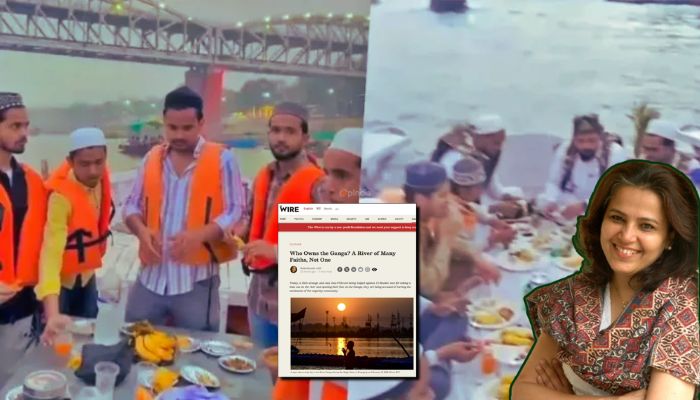
From Tarun Kumar’s lynching by a Muslim mob in Delhi’s Uttam Nagar over Holi colours spilling over a Muslim woman to Muslim youths doing ‘Iftar’ with Chicken Biryani on the Ganga River in Varanasi and throwing chewed bones into its sacred waters, the Islamo-leftist coterie invokes syncretic cultural references, ‘Ganga-Jamuni Tehzeeb’, and whatnot to shield Islamist attacks and mockery against Hindus. Amidst outrage over Muslims throwing bones in the sacred waters of the Ganga, Islamo-leftist outlet The Wire, notorious for giving a Muslim victimhood spin to anti-Hindu crimes, has attempted to ‘secularise’ the Ganga River.
In an opinion piece titled, “Who Owns the Ganga? A River of Many Faiths, Not One“, a Delhi-based writer, translator and researcher, Rakhshanda Jalil, offers family memories, Urdu poetry, and a dash of melodrama to establish a narrative that Ganga is a ‘secular’ river not owned only by Hindus, ironically, by saying that she belongs to many faiths.
Jalil opens the piece with an affectionate memory of her husband introducing her to the Ganga River in his ancestral lands in eastern Uttar Pradesh with the folk song: Ganga maiya tohre piyari chadhaibo… (O Mother Ganga, I offer this yellow dhoti to you…).
While the sentiment is beautiful and Rakshanda’s husband is free to express his admiration for the sacred river through the Bhojpuri song, the act of a Muslim man calling the Ganga River “Maiya” or mother is essentially un-Islamic.
Rakhshanda Jalil soft-peddles the trigger, lamenting that now FIRs are being registered against 14 Muslim men “for taking a boat out on the river and opening their fast on the Ganga; they are being accused of hurting the sentiments of the majority community.”
The usage of the term “majority community” here is essentially to push a subtle insinuation that the lodging of FIR against Muslim men for hurting Hindu religious sentiments is a case of arbitrary Hindu majoritarianism.
What Jalil skipped mentioning is that the Muslim youths have not been booked for taking out a boat on the Ganga River or opening their Roza during Ramzan. The accused Muslims were eating non-vegetarian food in the holy Ganges River, and they even threw the chewed bones into the sacred waters of Mother Ganga right in front of the Bindu Madhav Dharhara Temple.
She also did not highlight the fact that even Muslim clerics have said that, contrary to the picnic the accused Muslim youths were having, Iftar is a purely religious event, with Maghrib namaz to be performed.
“But what of their sentiments? And that of their forefathers? What of those people, such as my husband’s family, who have lived beside the Ganga for generations and have nothing but the greatest affection and regard for this special river that has nurtured civilisation for millennia? In the New India that is Bharat we have already divided up colours (saffron is Hindu, green is Muslim), food (sattvic vs halal), etc, are we also going to decide who has first rights over rivers and mountains?” Jalil asks in the article published on 19th March 2026.
The author deliberately avoided addressing the “hurting of the sentiments of the majority community” part properly, perhaps considering the sentiments of Hindus insignificant. Jalil proceeded directly towards doing what The Wire does best: giving a Muslim victimhood spin to incidents where Hindus are the victims and Muslims are the aggressors.
She asks: “But what of their sentiments? And that of their forefathers? What of those people, such as my husband’s family, who have lived beside the Ganga for generations and have nothing but the greatest affection and regard for this special river that has nurtured civilisation for millennia? In the New India that is Bharat we have already divided up colours (saffron is Hindu, green is Muslim), food (sattvic vs halal), etc; are we also going to decide who has first rights over rivers and mountains?”
How conveniently, The Wire flipped the aggressor-aggrieved dynamic, making Muslim sentiments a bigger issue in an incident wherein it is Muslims who have hurt the religious sentiments of Hindus.
A river, believed to be sacred by one and not by others, does not discriminate and nurtures all living beings it touches. However, Muslims’ regard and affection for the Ganga River is not the same as Hindus’ worshipping the river as holy, a mother, and a living deity (Devi).
If Hindus actually asserted exclusive ownership over the Ganga River, weaponising their religious sentiments, they would have demanded barring Muslims from accessing the river completely. The access to Ganga is universal, but deliberate defiling and mockery of its sanctity is not.
Also, this assertion that in the New India, by which the Islamo-leftists usually mean Modi’s India or India after 2014, has become divided into saffron is Hindu, green is Muslim, and sattvic vs halal, is dishonest. These divisions have existed for decades and shall continue to exist. India’s bloody partition was done because of the green’s intolerance of the saffron. Even after enduring the stab of partition, saffron tolerated and accommodated green, even at the cost of ceding its own rights to uphold the farce of ‘Hindu-Muslim unity’. All was hunky dory till the ‘minority’ was dominating and intimidating the majority. The society became divisive only when saffron began to pushback green’s intransigence, and sattvic resisted halal’s dominance.
One wonders if The Wire would defend Hindus if they ate pork inside a mosque complex and left its remnants there during the ‘holy’ month of Ramzan?
There is a glaring hypocrisy in this “river belongs to all faiths” narrative. This supposed ‘universalism’ is never extended in the reverse direction. Muslims maintain exclusivity of their religious sites, food choices, and lifestyle, even in localities where the Muslim community is in the majority, calling for boycott or Sar Tan Se Juda of those who supposedly hurt their religious sentiments. But Hindus are lectured to share their living deity, only for meat bones to be hurled in her sacred waters in a deliberate ‘picnic’ style. This is nothing but a blatant dilution of sacred Hindu geography and its unasked opening for reinterpretation in the name of composite culture, secularism and whatnot, all while Islamic exclusivity remains non-negotiable and sacrosanct to scrutiny.
Jalil asks if we are also going to decide who has first rights over rivers and mountains. She should ask this question to her co-religionists first. From Waqf Boards laying illegal claims over Hindu villages and temples, to Islamists in Tamil Nadu, who claim the ownership of the Thiruparankundram Hills and seek its renaming, even as the entire hill historically belonged to the Hindu temple there.
The author suggested that, amidst the controversy over Muslim youth doing an Iftar party and throwing bones in the sacred waters of the Ganga, it would be appropriate to revisit Urdu poetry written on the Ganga by Muslim poets.
Jalil could not find a better poet than Muhammad Iqbal to contend that since Muslims wrote Urdu poetry on the Ganga River, the river belongs to them as well.
“And the perfect place to start might be the vast ouvre of Iqbal, the poet we are constantly being taught to hate: the much-despised Muhammad Iqbal. Writing his Tarana-e-Hind (The Song of India) in 1904 as a patriotic song for children that went on to become one of the most popular songs for school choruses till its political baggage was discovered and it was promptly discarded, Iqbal begins with ‘Saare jahan se achha Hindostan hamara’ (Our India is the fairest in the entire world)…” Jalil writes.
Notice the subtle nuance in Jalil’s description of Muhammad Iqbal: “the poet we are constantly being taught to hate: the much-despised Muhammad Iqbal.”
Despite Iqbal deserving all the abhorrence he gets from Indian people aware of his literary, political, and Islamist activities, beyond ‘Saare jahan se acha’, nobody is being constantly taught to hate him. Ensuring that the Indian youth know who all were responsible for propagating the idea of Pakistan’s creation on Islamic lines is not the same as peddling hate.
Muhammad Iqbal was one of the main proponents of the two-nation theory that led to the creation of Pakistan in the first half of the 20th century. The famous composition ‘Sare Jahaan Se Achcha’ was published in 1904 by Muhammad Iqbal, a year before the Partition of Bengal in British India. The most famous lines of the composition, which form its sixth stanza, say, “Maẕhab nahīṉ sikhātā āpas meṉ bair rakhnā, Hindī haiṉ ham, wat̤an hai Hindositāṉ hamārā”.
In Independent India, liberals and Islamists masquerading as secularists have reduced Iqbal’s legacy to these two lines, ignoring almost entirely his contribution to the formation of Pakistan.
In Tarana-e-Milli, which the poet wrote in 1910 for children, Iqbal revealed his real Islamic fundamentalist nature. It was composed in the same meter and rhyme scheme as ‘Sare Jahaan Se Achcha’, contradicting the thought of unity with the call for division based on religion. The first stanza of this particular composition contrasted sharply with the sixth stanza of his prior composition. It said, “Cīn o-ʿArab hamārā, Hindūstāṉ hamārā, Muslim haiṉ ham, wat̤an hai sārā jahāṉ hamārā. tauhīd kī amānat sīnoñ meñ hai hamāre, āsāñ nahīñ miTānā nām-o-nishāñ hamārā.
Moving ahead, Jalil’s article cites poetry by Suroor Barabankvi, Nida Fazli, and Sardar Jafri, among others, wherein these poets appreciated the beauty and purity of the Ganga and admired the landscape as Indians. However, not one piece of poetry she cited revered Ganga as Mother or Devi, the divine, as Hindus do.
For those poets, and Muslims generally, Ganga could be a nurturing water body, a symbol of flowing beauty, and a philosophical metaphor, but never a deity, an object of Islamic worship, prayer or pilgrimage. Islam is alien to the concept of sacred feminine energy, let alone its worship.
Ganga is divine only for Hindus because Islam has no concept of sacred feminine or nature worship. The Urdu poetry Jalil highlights in her article only demonstrates cultural syncretism and not religious ownership of the Ganga.
Ganga is the cradle of the Sanatan Civilisation. The Ganga Valley nurtured Vedic, Puranic, and classical Hindu civilisation for millennia. Be it Varanasi, Gangotri, Haridwar, Prayagraj, or Kolkata’s ghats, they are all defined by Hindu pilgrimage, finding roots in Hindu religious scriptures. Be it medieval Islamic invaders and those they converted to Islam by the force of sword, or the British colonisers, none attached any religious sentimental value to Ganga, while Hindus, since times immemorial have revered and worshipped the sacred river as Maa Ganga, the giver of salvation who descended from the heavens in the matted locks of Mahadev, beautifully described by Maharishi Valmiki in this verse from Ramayana’s Bal Kand:
gaganaat shaMkara shiraH tato dharaNim aagataa || 1-43-15asarpata jalam tatra tiivra shabda puraskR^itam |
Maa Ganga is believed by Hindus to be the blessing, the reward of royal sage Bhagiratha’s Tapasya. Call it ‘New India’ or ‘Bharat’, this land is rooted in Hindu consciousness. Hindu civilisation will always be the OWNER of Bharat’s lands, rivers, mountains, and every nook and cranny.
While Muslim poets have described the beauty and serenity of Ganga, Maharishi Valmiki described her origins, her journey and her divinity.
tato haimavatii jyeShThaa sarva loka namaskR^itaa |tadaa saa ati mahat ruupam kR^itvaa vegam ca duHsaham ||1-43-4aakaashaat apatat raama shive shiva shirasy uta |
(Afterwards, she who is reverenced by all the worlds and who is the elder daughter of Himavanta, that Ganga, assuming an unendurable form and an insupportable rapidity, they say, then plunged from the sky onto the auspicious head of Shiva.)
acintayaH ca saa devii gaMga parama dur.hdharaa ||1-43-5vishaami aham hi paataalam strotasaa gR^ihya shaMkaram |
(She who is an extremely unendurable river that goddess Ganga even speculated, saying to herself, ‘let me enter netherworld, indeed whisking Shiva with my streams.)
Maharishi Valmiki describes how the Hladini, Paavani, and Nalini streams of Ganga cruised eastwards, Sucakshu, Seetha, and the river Sindhu streamed to the westward direction, while the seventh stream flowed towards the path of Bhageeratha’s chariot.
From Ramayana to Mahabharat, from Gaumukh to Bay of Bengal, from a nurturer to a giver of salvation, from Kumbh Mela to asthi-visarjan in accordance with Garud Purana, from a water body to a witness of history, Ganga spiritually and culturally belongs to the Sanatan Hindu civilisation that birthed, worshipped, and sustained it for thousands of years. Ganga is not anyone’s property to be legally owned, but alienating her from the historical and civilisational truth to ‘secularise’ the divine river and normalise its desecration by Muslims is unacceptable. There is no equivalence in the supposed poetic love Muslims have for Ganga and the devotion Hindus have. Secularising Ganga amounts to the erasure of its sanctity and divinity.