‘American consumers paying nearly all of the price’: Study finds the real casualties of US President Donald Trump’s tariff war
The United States President Donald Trump’s favourite foreign policy tool to dominate both allies and adversaries alike appears to have more profound effects on his own citizens than on the respective nations. On 19th January (Monday), a report released by the Kiel Institute for the World Economy found that Americans are paying nearly all of the costs associated with US tariffs. “America’s own goal: Americans are largely responsible for funding Trump’s tariffs” highlighted the tangible effects of this policy. The sweeping tariffs slapped by the Trump administration have been determined to empty the pockets of his country’s citizens in stark contrast to the bold declarations of “tens of billions of dollars flowing into America.” The strategy in reality hurts the US economy, despite the administration’s intention for the tariffs to go after foreign companies, the study suggest. Julian Hinz, who co-authored the report, stated, “The tariffs are an own goal. The claim that foreign countries pay these tariffs is a myth. The data show the opposite: Americans are footing the bill.” He is an economics professor at Germany’s Bielefeld University and research director at the institute. The tariffs function similarly to a consumption tax for imported items and simultaneously leave fewer options in terms of both variety and quantity. A lot has been said about the Greenland tariffs in the past couple of days. We've been looking at the broader picture: who actually pays the tariffs?We analyzed 25 million shipments worth nearly $4 trillion.The answer: Americans pay 96%. Foreign exporters absorb just 4%.1/n pic.twitter.com/xCBle5a2gp— Julian Hinz (@julianhinz) January 19, 2026 The research team examined over 25 million shipment records totalling nearly $4 trillion in US imports between January 2024 and November 2025. It uncovered that the customs income of the country rose by almost $200 billion in the last year “paid almost exclusively by Americans in additional tariff revenue.” According to Hinz, this will eventually lead to stronger inflation in the United States. Likewise, just 4% of the tariff burden was borne by foreign exporters as the remaining 96% was shifted to US consumers. Moreover, the export prices did not decline while trade volumes plummeted. “There is no such thing as foreigners transferring wealth to the US in the form of tariffs,” he reiterated. India reduced import volumes without any alteration in prices The analysis also looked into the unanticipated tariff spikes that were applied to Brazil and India in August of last year. The tariffs on Brazilian imports were unexpectedly hiked to 50%, while those on Indian imports reached 50% from 25% under the guise of trade imbalances and domestic manufacturing priorities. It also included the so-called penalty for ‘failing to halt the purchase of Russian oil’ and “aiding” the war in Ukraine. However, the information demonstrated that overseas exporters did not cut their prices to compensate for the higher duties. If exporters had absorbed the taxes, the rates in the US would have fallen in comparison to other markets but this did not happen. “We compared Indian exports to the US with shipments to Europe and Canada and identified a clear pattern. Both export value and volume to the US dropped sharply, by up to 24 per cent. But unit prices, the prices Indian exporters charged, remained unchanged. They shipped less, not cheaper,” Hinz outlined. These results indicated that US businesses have to deal with declining profit margins and eventually higher charges for consumers. There is going to be pressure on nations that export to the US to find other markets as their sales would shrink. “Tariffs ultimately disadvantage everyone,” Hinz noted. The findings are consistent with the latest results from economists at Harvard Business School and Yale’s Budget Lab. Furthermore, the tariffs represented as a leverage mechanism to cease hostilities in the name of trade deals to boost Trump’s self-proclaimed image as a “global peacemaker” or yield to US interests have left the Western power in a compromised position. It also raised the possibility that the US might be at a disadvantage in a potential trade war with Europe. The US has imposed 10% tariffs on eight European and NATO (North Atlantic Treaty Organisation) allies for opposing its control of Greenland. US Treasury Secretary Scott Bessent has warned against any retaliatory measures, calling them “very unwise.” What came out of Trump’s tariffs Trump repeatedly insisted that outsiders would pay the bill for his historic tariffs, which have been aggressively implemented over the past year as an instrument for both international policy and revenue-raising. These assertions even pushed some countries to enter into agreements with the United States. However, sovereign nations like India resisted the pressure and now another report has shattered the illusion of the inflated effect
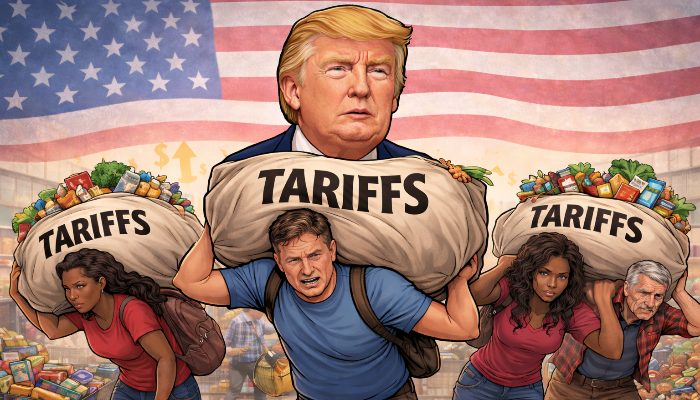

The United States President Donald Trump’s favourite foreign policy tool to dominate both allies and adversaries alike appears to have more profound effects on his own citizens than on the respective nations. On 19th January (Monday), a report released by the Kiel Institute for the World Economy found that Americans are paying nearly all of the costs associated with US tariffs. “America’s own goal: Americans are largely responsible for funding Trump’s tariffs” highlighted the tangible effects of this policy.
The sweeping tariffs slapped by the Trump administration have been determined to empty the pockets of his country’s citizens in stark contrast to the bold declarations of “tens of billions of dollars flowing into America.” The strategy in reality hurts the US economy, despite the administration’s intention for the tariffs to go after foreign companies, the study suggest.
Julian Hinz, who co-authored the report, stated, “The tariffs are an own goal. The claim that foreign countries pay these tariffs is a myth. The data show the opposite: Americans are footing the bill.” He is an economics professor at Germany’s Bielefeld University and research director at the institute. The tariffs function similarly to a consumption tax for imported items and simultaneously leave fewer options in terms of both variety and quantity.
A lot has been said about the Greenland tariffs in the past couple of days. We've been looking at the broader picture: who actually pays the tariffs?
— Julian Hinz (@julianhinz) January 19, 2026
We analyzed 25 million shipments worth nearly $4 trillion.
The answer: Americans pay 96%. Foreign exporters absorb just 4%.
1/n pic.twitter.com/xCBle5a2gp
The research team examined over 25 million shipment records totalling nearly $4 trillion in US imports between January 2024 and November 2025. It uncovered that the customs income of the country rose by almost $200 billion in the last year “paid almost exclusively by Americans in additional tariff revenue.” According to Hinz, this will eventually lead to stronger inflation in the United States.
Likewise, just 4% of the tariff burden was borne by foreign exporters as the remaining 96% was shifted to US consumers. Moreover, the export prices did not decline while trade volumes plummeted. “There is no such thing as foreigners transferring wealth to the US in the form of tariffs,” he reiterated.
India reduced import volumes without any alteration in prices
The analysis also looked into the unanticipated tariff spikes that were applied to Brazil and India in August of last year. The tariffs on Brazilian imports were unexpectedly hiked to 50%, while those on Indian imports reached 50% from 25% under the guise of trade imbalances and domestic manufacturing priorities. It also included the so-called penalty for ‘failing to halt the purchase of Russian oil’ and “aiding” the war in Ukraine.
However, the information demonstrated that overseas exporters did not cut their prices to compensate for the higher duties. If exporters had absorbed the taxes, the rates in the US would have fallen in comparison to other markets but this did not happen.
“We compared Indian exports to the US with shipments to Europe and Canada and identified a clear pattern. Both export value and volume to the US dropped sharply, by up to 24 per cent. But unit prices, the prices Indian exporters charged, remained unchanged. They shipped less, not cheaper,” Hinz outlined.
These results indicated that US businesses have to deal with declining profit margins and eventually higher charges for consumers. There is going to be pressure on nations that export to the US to find other markets as their sales would shrink. “Tariffs ultimately disadvantage everyone,” Hinz noted.
The findings are consistent with the latest results from economists at Harvard Business School and Yale’s Budget Lab. Furthermore, the tariffs represented as a leverage mechanism to cease hostilities in the name of trade deals to boost Trump’s self-proclaimed image as a “global peacemaker” or yield to US interests have left the Western power in a compromised position.
It also raised the possibility that the US might be at a disadvantage in a potential trade war with Europe. The US has imposed 10% tariffs on eight European and NATO (North Atlantic Treaty Organisation) allies for opposing its control of Greenland. US Treasury Secretary Scott Bessent has warned against any retaliatory measures, calling them “very unwise.”
What came out of Trump’s tariffs
Trump repeatedly insisted that outsiders would pay the bill for his historic tariffs, which have been aggressively implemented over the past year as an instrument for both international policy and revenue-raising. These assertions even pushed some countries to enter into agreements with the United States.
However, sovereign nations like India resisted the pressure and now another report has shattered the illusion of the inflated effect of the tariffs. On the other hand, India’s growth persisted at an unprecedented scale, even in the face of tariffs. India’s real GDP (Gross Domestic Product) climbed at the fastest pace in six quarters during the second quarter of FY (Fiscal Year) 2025-2026, attaining an outstanding high of 8.2%, greatly outpacing predictions of 7.3% growth.
The nation keeps retaining the title of major economy with the fastest rate of growth in the world which surged from 5.6% in the same time last year and 7.8% in the last quarter, highlighting its resilience despite encountering challenging circumstances.
China, which was also at the receiving end of the tariffs leading to a series of retaliatory moves and trade war also announced that it has achieved the highest trade surplus in history.
Beijing declared on 14th January that it had the largest trade surplus in history, with $1.19 trillion in goods and services sent outside compared to its imports which is a 20% increase from 2024 even after accounting for inflation. The country’s monthly export surpluses surpassed $100 billion seven times in 2025. It meant that its overall trade with the rest of the world was hardly hurt by Trump’s tariff push.
Trump has reduced foreign policy to weaponised tariffs, utilising them as devices of both punishment and reward. Any country that refuses to comply with his unreasonable and outrageous demands is subjected to them, while those that do comply receive reductions. However, the aforementioned research has established that Trump has seemingly harmed his own country while attempting to punish others, including New Delhi. Similarly, the tariffs did not significantly impact the trade or growth of its targets as they progressed beyond expectations.