Woman forced man’s signature to claim they are married: Read how the Hindu Marriage Act came to his rescue after he approached the Gujarat High Court
In a recent judgment, the Gujarat High Court refused to uphold an alleged marriage between a man and a woman, citing the absence of the essential Hindu rituals required under the Hindu Marriage Act to solemnise the marriage. A Bench of Justices Ilesh J. Vora and R T Vachhani struck down an order passed by the Family Court, Ahmedabad, ordering the trial of a dispute regarding the existence of a valid marriage. The judges stated that the Family Court should have passed an order declaring the marriage null and void instead of ordering a trial in the case. The Family Court had assumed the existence of a marriage after the defendant produced a marriage certificate to prove the marriage. The court was hearing an appeal filed by a man against the Family Court judgment order, which rejected his application seeking the passing of a decree based on admission and declaration of the alleged marriage as null and void as per the Hindu Marriage Act. According to the facts of the case, the man lives in the United Kingdom, where he studies and works. The woman, who claims to be his wife, resides in Ahmedabad, Gujarat. She met his parents and presented them with a marriage certificate, claiming that she was lawfully wedded to their son. The appellant denied the existence of a marriage, stating that no Hindu rituals were performed to solemnise the marriage and that he never lived with the defendant as husband and wife. He said that he used to work in the company of the defendant’s father and that his signature on the marriage documents was obtained fraudulently by inducement of promotion or threat of termination, without his free consent. Notably, the defendant had admitted before the Family Court that no essential Hindu rituals were performed, required under Section 7 of the Hindu Marriage Act. She also admitted that she never lived with the appellant as husband and wife. Hindu rituals are the foundation of a Hindu marriage: HC The High Court observed that the essential Hindu rituals, as required under the Hindu Marriage Act, form the foundation of a Hindu marriage. In the absence of the essential Hindu ceremonies, the marriage never came into existence and hence cannot be called valid. “When the very foundation of a Hindu marriage, namely the performance of the essential ceremonies, is admittedly absent, the spiritual, social, and legal status that Hindu law grants to marriage as a sacrament and samskara never came into existence,” the High Court said in the judgment dated June 23, 2026. Explaining the significance of Hindu rituals in a Hindu marriage, the High Court said, “A Hindu marriage facilitates procreation, strengthens the family unit, and promotes the spirit of fraternity among different communities. Above all, marriage is sacred because it creates a lifelong, dignified, equal, consensual, and healthy union between 2 individuals. It is also regarded as an event that helps an individual attain salvation, particularly when the prescribed rites and ceremonies are duly performed. The customary ceremonies, despite their geographical and cultural variations, are believed to purify and transform the spiritual being of an individual.” The Court referred to the Rig Veda to elucidate the concept of Saptapadi, the nature of Hindu marriage and the status of the wife in a Hindu marriage. “We observe that, in the context of Saptapadi in a Hindu marriage, the Rig Veda states that after the seventh step is completed, the bridegroom says to the bride: “With seven steps we have become friends (sakha). May I attain friendship with you, and may I never be separated from that friendship.” In Hindu tradition, a wife is regarded as one-half of her husband (ardhangini), while at the same time being recognised as an individual with her own identity and as an equal partner in the marriage. Under Hindu Law, marriage is considered a sacrament or samskara. It forms the foundation of a new family,” the High Court said. “We are of the considered opinion that, since the respondent herself has admitted that no marriage rites and ceremonies were performed, the basic and essential requirement of a Hindu marriage is absent in the present case. Therefore, the existence of a marriage certificate or its registration cannot override, contradict, or nullify the legal effect of her clear admission that no marriage was ever solemnised,” the Court held. The High Court said that the Family Court erred in presuming marriage based on the registration certificate and ordering a trial, while overlooking the defendant’s admission. “The learned Family Court committed an error by proceeding on the assumption that registration of the marriage, by itself, creates an irrebuttable presumption and therefore requires a full trial, without first examining whether the fundamental requirement of solemnization under Section 7 had been satisfied,” the High Court stated. The Supreme Court’s position regarding the Hindu marriage
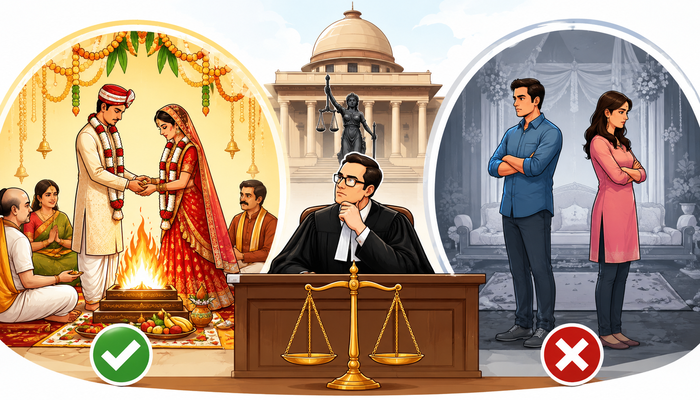
In a recent judgment, the Gujarat High Court refused to uphold an alleged marriage between a man and a woman, citing the absence of the essential Hindu rituals required under the Hindu Marriage Act to solemnise the marriage. A Bench of Justices Ilesh J. Vora and R T Vachhani struck down an order passed by the Family Court, Ahmedabad, ordering the trial of a dispute regarding the existence of a valid marriage.
The judges stated that the Family Court should have passed an order declaring the marriage null and void instead of ordering a trial in the case. The Family Court had assumed the existence of a marriage after the defendant produced a marriage certificate to prove the marriage.
The court was hearing an appeal filed by a man against the Family Court judgment order, which rejected his application seeking the passing of a decree based on admission and declaration of the alleged marriage as null and void as per the Hindu Marriage Act. According to the facts of the case, the man lives in the United Kingdom, where he studies and works. The woman, who claims to be his wife, resides in Ahmedabad, Gujarat. She met his parents and presented them with a marriage certificate, claiming that she was lawfully wedded to their son.
The appellant denied the existence of a marriage, stating that no Hindu rituals were performed to solemnise the marriage and that he never lived with the defendant as husband and wife. He said that he used to work in the company of the defendant’s father and that his signature on the marriage documents was obtained fraudulently by inducement of promotion or threat of termination, without his free consent. Notably, the defendant had admitted before the Family Court that no essential Hindu rituals were performed, required under Section 7 of the Hindu Marriage Act. She also admitted that she never lived with the appellant as husband and wife.
Hindu rituals are the foundation of a Hindu marriage: HC
The High Court observed that the essential Hindu rituals, as required under the Hindu Marriage Act, form the foundation of a Hindu marriage. In the absence of the essential Hindu ceremonies, the marriage never came into existence and hence cannot be called valid. “When the very foundation of a Hindu marriage, namely the performance of the essential ceremonies, is admittedly absent, the spiritual, social, and legal status that Hindu law grants to marriage as a sacrament and samskara never came into existence,” the High Court said in the judgment dated June 23, 2026.
Explaining the significance of Hindu rituals in a Hindu marriage, the High Court said, “A Hindu marriage facilitates procreation, strengthens the family unit, and promotes the spirit of fraternity among different communities. Above all, marriage is sacred because it creates a lifelong, dignified, equal, consensual, and healthy union between 2 individuals. It is also regarded as an event that helps an individual attain salvation, particularly when the prescribed rites and ceremonies are duly performed. The customary ceremonies, despite their geographical and cultural variations, are believed to purify and transform the spiritual being of an individual.”
The Court referred to the Rig Veda to elucidate the concept of Saptapadi, the nature of Hindu marriage and the status of the wife in a Hindu marriage. “We observe that, in the context of Saptapadi in a Hindu marriage, the Rig Veda states that after the seventh step is completed, the bridegroom says to the bride: “With seven steps we have become friends (sakha). May I attain friendship with you, and may I never be separated from that friendship.” In Hindu tradition, a wife is regarded as one-half of her husband (ardhangini), while at the same time being recognised as an individual with her own identity and as an equal partner in the marriage. Under Hindu Law, marriage is considered a sacrament or samskara. It forms the foundation of a new family,” the High Court said.
“We are of the considered opinion that, since the respondent herself has admitted that no marriage rites and ceremonies were performed, the basic and essential requirement of a Hindu marriage is absent in the present case. Therefore, the existence of a marriage certificate or its registration cannot override, contradict, or nullify the legal effect of her clear admission that no marriage was ever solemnised,” the Court held.
The High Court said that the Family Court erred in presuming marriage based on the registration certificate and ordering a trial, while overlooking the defendant’s admission. “The learned Family Court committed an error by proceeding on the assumption that registration of the marriage, by itself, creates an irrebuttable presumption and therefore requires a full trial, without first examining whether the fundamental requirement of solemnization under Section 7 had been satisfied,” the High Court stated.
The Supreme Court’s position regarding the Hindu marriage
The Supreme Court, through several judgments, has highlighted the significance of Hindu rituals and ceremonies for granting validity to a Hindu marriage. In a 2024 ruling, the Supreme Court held that a Hindu marriage must be performed in compliance with Hindu ceremonies such as the Saptapadi (seven circles around the sacred fire). “Where a Hindu marriage is not performed in accordance with the applicable rites or ceremonies, such as saptapadi, when included, the marriage will not be construed as a Hindu marriage,” the Supreme Court had said.