Why India temporarily blocked Telegram ahead of the NEET re-test: Inside the fraud networks, cybersecurity gaps, and the accountability crisis plaguing NEET
Just days before the NEET-UG 2026 re-examination scheduled for 21st June, the Central government took an unprecedented step that immediately sparked nationwide debate. Acting on a request from the National Testing Agency (NTA), the Centre temporarily blocked access to the messaging platform Telegram across India until 22nd June. The move was aimed at preventing cheating rackets from exploiting the platform to spread fake question papers and scam anxious NEET candidates. The restriction marked the first time that a messaging application of Telegram’s scale had been blocked in India by the Ministry of Electronics and Information Technology, even if only for a limited period. Within hours of the government’s order, several telecom operators had already disabled access to the service. Telegram’s app listing also disappeared from both Google’s Play Store and Apple’s App Store in India. Telegram access restricted in India for re- NEET following recommendations of NTA"Ministry of Electronics and Information Technology has issued notification a direction under Section 69 A of the Information Technology Act, 2000, restricting access to the Telegram platform in… pic.twitter.com/3TzJepOoej— ANI (@ANI) June 16, 2026 The NTA described the action as a response to the “organised use of the platform by cheating rackets to defraud candidates appearing for the NEET (UG) 2026 re-examination scheduled on 21st June 2026.” The agency maintained that the measure was temporary, targeted and necessary to protect students from fraud at a time when confidence in the examination process was already under severe strain following allegations of paper leaks and irregularities in the original examination conducted on 3rd May. Telegram founder Pavel Durov rants against the ban Telegram founder Pavel Durov publicly criticised the Indian government’s move, arguing that the ban punished millions of innocent users rather than the fraudsters responsible for the scams. In a statement, Durov said the blocking affected more than 15 crore ordinary Telegram users across India. “The leaks just moved to other apps,” Durov remarked, suggesting that shutting down Telegram would not eliminate the problem. India’s IT ministry banned Telegram for one week because some users shared leaked exam questions.This punishes 150M+ ordinary Telegram users in India — not the insiders who leaked the exam materials.And the ban hasn't stopped anything. The leaks just moved to other apps. https://t.co/CzQWN4mXfb— Pavel Durov (@durov) June 16, 2026 He also defended the platform’s recent efforts to tackle exam-related fraud. According to Durov, Telegram had already removed hundreds of channels that were sharing leaked examination material and running scams targeting Indian students. Telegram founder Durov says India has 'punished' more than 150 million people by banning Telegram https://t.co/bm3mePzV8D https://t.co/bm3mePzV8D— Reuters (@Reuters) June 16, 2026 “Over the past few weeks, we removed hundreds of channels sharing leaked exam materials and related scams in India. We’re also making the ‘edited’ label more visible to prevent backdating scams,” he said. Calling the temporary restriction a mistake, Durov added, “We’ve done a lot to fix the problem, even though the source is not Telegram.” NTA defends the decision, says students must be protected As criticism mounted, NTA Director General Abhishek Singh strongly defended the government’s decision. Speaking to ANI, Singh said the platform had become a major tool for fraudsters who were exploiting students’ fears and anxieties by selling fake question papers and false promises of guaranteed success. “We had to take this drastic step because the platform was continuously being misused by scamsters and fraudsters who were sharing fake question papers as genuine papers and trying to fool students and parents into paying for them,” Singh said. VPNs May Work, But Fraud Won't: NTA DG Abhishek Singh Explains Why#NEET #NEETNews #NEETPaperLeak #CyberFraud #NTA pic.twitter.com/2bpaJdILaZ— Business Today (@business_today) June 16, 2026 He acknowledged that some people might consider the move excessive but argued that protecting the interests of more than 22 lakh students justified tough action. “It may appear to be a sledgehammer, but when it is in the interest of the students, when it is in the interest of the careers of our 22 lakh young minds, every step will be taken,” he said. Singh also revealed that investigators had found some channels operating from countries that were “not the best friends of India.” While he admitted that certain operators could continue functioning through VPNs or overseas networks, he argued that restricting access would still cut off their audience and reduce the effectiveness of the fraud. The NTA further stated that nearly 200 such channels had already been identified and blocked. According to the agency, maintaining students’ trust in the
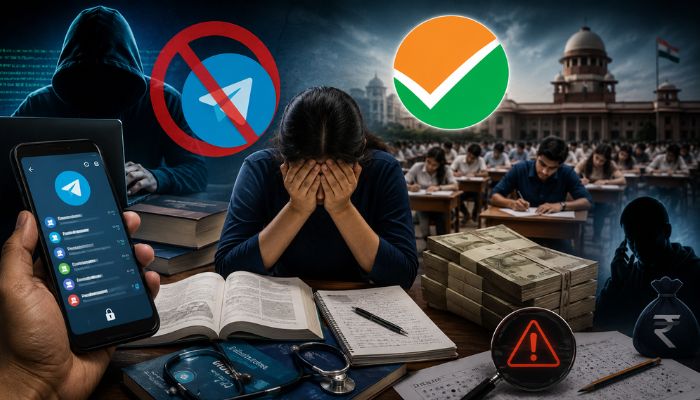
Just days before the NEET-UG 2026 re-examination scheduled for 21st June, the Central government took an unprecedented step that immediately sparked nationwide debate. Acting on a request from the National Testing Agency (NTA), the Centre temporarily blocked access to the messaging platform Telegram across India until 22nd June. The move was aimed at preventing cheating rackets from exploiting the platform to spread fake question papers and scam anxious NEET candidates.
The restriction marked the first time that a messaging application of Telegram’s scale had been blocked in India by the Ministry of Electronics and Information Technology, even if only for a limited period. Within hours of the government’s order, several telecom operators had already disabled access to the service. Telegram’s app listing also disappeared from both Google’s Play Store and Apple’s App Store in India.
Telegram access restricted in India for re- NEET following recommendations of NTA"Ministry of Electronics and Information Technology has issued notification a direction under Section 69 A of the Information Technology Act, 2000, restricting access to the Telegram platform in… pic.twitter.com/3TzJepOoej— ANI (@ANI) June 16, 2026
The NTA described the action as a response to the “organised use of the platform by cheating rackets to defraud candidates appearing for the NEET (UG) 2026 re-examination scheduled on 21st June 2026.”
The agency maintained that the measure was temporary, targeted and necessary to protect students from fraud at a time when confidence in the examination process was already under severe strain following allegations of paper leaks and irregularities in the original examination conducted on 3rd May.
Telegram founder Pavel Durov rants against the ban
Telegram founder Pavel Durov publicly criticised the Indian government’s move, arguing that the ban punished millions of innocent users rather than the fraudsters responsible for the scams.
In a statement, Durov said the blocking affected more than 15 crore ordinary Telegram users across India. “The leaks just moved to other apps,” Durov remarked, suggesting that shutting down Telegram would not eliminate the problem.
India’s IT ministry banned Telegram for one week because some users shared leaked exam questions.This punishes 150M+ ordinary Telegram users in India — not the insiders who leaked the exam materials.And the ban hasn't stopped anything. The leaks just moved to other apps. https://t.co/CzQWN4mXfb— Pavel Durov (@durov) June 16, 2026
He also defended the platform’s recent efforts to tackle exam-related fraud. According to Durov, Telegram had already removed hundreds of channels that were sharing leaked examination material and running scams targeting Indian students.
Telegram founder Durov says India has 'punished' more than 150 million people by banning Telegram https://t.co/bm3mePzV8D https://t.co/bm3mePzV8D— Reuters (@Reuters) June 16, 2026
“Over the past few weeks, we removed hundreds of channels sharing leaked exam materials and related scams in India. We’re also making the ‘edited’ label more visible to prevent backdating scams,” he said. Calling the temporary restriction a mistake, Durov added, “We’ve done a lot to fix the problem, even though the source is not Telegram.”
NTA defends the decision, says students must be protected
As criticism mounted, NTA Director General Abhishek Singh strongly defended the government’s decision.
Speaking to ANI, Singh said the platform had become a major tool for fraudsters who were exploiting students’ fears and anxieties by selling fake question papers and false promises of guaranteed success. “We had to take this drastic step because the platform was continuously being misused by scamsters and fraudsters who were sharing fake question papers as genuine papers and trying to fool students and parents into paying for them,” Singh said.
VPNs May Work, But Fraud Won't: NTA DG Abhishek Singh Explains Why#NEET #NEETNews #NEETPaperLeak #CyberFraud #NTA pic.twitter.com/2bpaJdILaZ— Business Today (@business_today) June 16, 2026
He acknowledged that some people might consider the move excessive but argued that protecting the interests of more than 22 lakh students justified tough action.
“It may appear to be a sledgehammer, but when it is in the interest of the students, when it is in the interest of the careers of our 22 lakh young minds, every step will be taken,” he said. Singh also revealed that investigators had found some channels operating from countries that were “not the best friends of India.” While he admitted that certain operators could continue functioning through VPNs or overseas networks, he argued that restricting access would still cut off their audience and reduce the effectiveness of the fraud.
The NTA further stated that nearly 200 such channels had already been identified and blocked. According to the agency, maintaining students’ trust in the fairness of the examination process was just as important as preventing cheating itself. “Not every student will qualify. We do not want students who fail to believe that they lost because someone else had access to a leaked paper. They should have confidence that the examination is based purely on merit,” Singh said.
Inside the Telegram racket: Fake papers, edited messages, and crores in fraud
According to the NTA, an organised network of fraudsters had been operating through Telegram channels for weeks before the re-examination.
These channels targeted worried students by claiming to have advanced access to the NEET question paper. Candidates were asked to pay anywhere between Rs 14,000 and Rs 25,000, while some channels reportedly demanded amounts running into several lakh rupees. In extreme cases, fraudsters were asking for as much as Rs 10 lakh for what they claimed was a genuine examination paper.
The NTA repeatedly emphasised that no paper leak existed and that these channels were simply exploiting students and parents.
“Channels demanding Rs 14,000 to Rs 25,000 – some even Rs 10 lakh – are claiming they’ll send you the re-exam paper. They won’t. There is no leaked paper for the re-exam,” the agency warned.
To every NEET candidate and parent – please watch this. A few minutes that could save you serious money and stress this week.Scammers on Telegram were running two rackets targeting you:1️⃣ Channels demanding ₹14,000 to ₹25,000 – some even ₹10 lakh – claiming they'll send you… pic.twitter.com/aqpickJLAv— National Testing Agency (@NTA_Exams) June 16, 2026
The scam did not stop at financial fraud. Students were often asked to share their admit cards, mobile numbers and personal details. Once obtained, these details were used to target more candidates and expand the scam network.
A particularly controversial feature involved Telegram’s message-editing function. According to the NTA, channel administrators could edit older messages while retaining the original timestamp. Fraudsters exploited this feature by uploading a question paper after the examination and then editing a previously posted message to make it appear as though the paper had been shared days earlier.
The resulting screenshots and videos were circulated online as “proof” of paper leaks, creating panic among students and further damaging trust in the examination process. “On Telegram, whoever runs a channel can edit any old message and change what’s inside it while the date on the message stays the same,” the NTA explained.
This tactic allowed scammers to manufacture fake evidence of leaks long after exams had already concluded.
The refund scam added another layer to the crisis
The Telegram racket was not the only fraud troubling the NEET ecosystem.
In another shocking revelation, Ahmedabad Police arrested a 19-year-old man from Bihar named Naveen Yadav for diverting refund amounts meant for NEET candidates into his own bank account.
According to investigators, Yadav exploited weak passwords and security vulnerabilities within the NEET portal. He used brute-force methods to gain access to student accounts and then altered banking details linked to those profiles. Officials said he targeted more than 350 students and successfully compromised around 150 accounts. Refund amounts of Rs 1,700 per student were subsequently transferred to his own account.
The case exposed serious concerns about cybersecurity safeguards surrounding one of India’s most important examinations. Investigators later traced the money trail with assistance from the NTA, leading to Yadav’s arrest in Bihar.
Following the incident, the NTA reportedly strengthened security measures and improved authentication systems within the portal.
Technical vulnerabilities raise fresh questions.
Even as authorities battled fraudsters, another controversy emerged from an unexpected source.
Sixteen-year-old Dubai-based student and ethical hacker Rylen Anil stunned many when he revealed that he had discovered significant vulnerabilities in the digital systems supporting both NEET and JEE Advanced.
Anil said it took him only a few hours to identify serious flaws. “It took me about three to four hours to get into both platforms. Once I did that, I reported the vulnerabilities to CERT-In, then posted about it on X,” he explained.
His findings revealed multiple security concerns. In the case of JEE Advanced, a cloud-storage misconfiguration exposed more than 179,000 result records and over 187,000 admit-card files. The NEET system, meanwhile, reportedly suffered from weak credentials on an administrative portal. “Through bypassing these vulnerabilities, I could see not only the sensitive information of students, but also their parents’,” Anil said.
JEE Advanced 2026 candidate/result infrastructure (https://t.co/6mBpjkxH01) had a public cloud storage misconfiguration exposing bulk candidate data without auth.This exposed ~179.6k result records and ~187.3k admit-card PDFs, including candidate names, DOBs and mobile numbers. pic.twitter.com/NUk4HGwqQP— Rylen Anil (@DarthKermi72747) June 2, 2026
Importantly, Anil did not misuse the data. Instead, he reported the vulnerabilities to CERT-In and shared limited technical details publicly after redacting personal information.
His actions received appreciation rather than criticism.
The NTA and technical teams associated with the examination systems contacted him, thanked him for his responsible disclosure and worked quickly to fix the vulnerabilities. IIT Roorkee publicly acknowledged the issue and confirmed that emergency corrective measures had been implemented. “So far, the response has been appreciative. They are now trying to resolve the issues,” Anil said.
When lakhs of middle-class families put their future on one examination
The NEET controversy is not merely about Telegram channels, cyber fraud or technical glitches. At its heart lies something much bigger: the hopes, sacrifices and anxieties of millions of Indian families.
Across middle-class India, a familiar sentence echoes every year: “Bas ek seat mil jaye”, just one seat.
For many parents, a medical seat is not simply an educational opportunity. It represents financial security, social mobility and the fulfilment of years of sacrifice. Families routinely spend lakhs of rupees on coaching institutes, test series, hostel fees, study material and mentoring programmes. Some parents save for years. Others take loans. Many cut back on personal expenses to fund their children’s preparation.
The competition is brutal. Around 22 lakh students appear for NEET every year, but only a fraction ultimately secure MBBS seats. Government medical seats are even fewer. This intense pressure has created a massive ecosystem where desperation often becomes a business opportunity.
Fraudsters exploit fear. Scamsters sell fake papers. Coaching centres market impossible dreams. And every controversy chips away at students’ confidence in the system. Perhaps the most tragic aspect is that honest students end up paying the price.
A student who spends years preparing should never have to wonder whether someone else received an unfair advantage. A parent investing precious savings should never have to fear that a scammer will exploit their anxiety. And young people chasing their dreams should never have to navigate a maze of paper leak rumours, cyber fraud and technical failures.
The NTA’s actions against Telegram, its crackdown on fake paper networks, and its efforts to improve cybersecurity reflect an attempt to restore confidence. But restoring trust requires more than temporary bans and arrests.
Students deserve examination systems that are secure, transparent and reliable from the beginning. Parents deserve assurance that merit, not manipulation, determines success. And a country that asks so much from its young people must ensure that the path to opportunity is protected from both criminals and institutional lapses.
For millions preparing for NEET, that is the real issue. The debate is no longer just about Telegram or paper leaks. It is about trust. And trust, once broken, takes much longer to rebuild than any examination schedule.