The Telegraph UK’s Samaan Lateef spins ‘colonial purge’ lie to demolition of 115-year-old Elphinstone Road Overbridge in Mumbai: Read about his pro-Pakistan shenanigans
The Telegraph, a UK-based media outlet, has for the past few years been consistently pushing anti-India narratives and platforming brown sepoys for the pursuance of this sinister agenda. In continuation of weaving a misleading narrative to tarnish India’s image, The Telegraph gave the demolition of Mumbai’s 112-115-year-old Elphinstone Road Overbridge a ‘British colonial legacy purge’ spin. The propaganda piece headlined, “India demolishes British-built bridge in purge of colonial legacy”, is authored by a Mumbai-based Kashmiri journalist, Samaan Lateef. An Indian bridge built by the British a century ago has been demolished to make way for a motorway.The Elphinstone Road Overbridge, which was built in Mumbai in 1913, was knocked down overnight as India continued to purge its colonial legacy.: https://t.co/x9RmecYmyx pic.twitter.com/xOVl6WxLWo— The Telegraph (@Telegraph) April 6, 2026 Telegraph UK peddles misinformation that the Elphinstone Bridge was demolished ‘overnight’ in a “purge of British Colonial legacy” In the article published on 6th April 2026, Samaan Lateef wrote, “The Elphinstone Road Overbridge, which was built in Mumbai in 1913, was knocked down overnight as India continued to purge its colonial legacy.” The tone of Lateef’s article suggests that the Indian authorities committed a sin by demolishing a century-old British colonial regime-built bridge by giving the excuse that it has “outlived its utility”. Built in 1911-1913, the Elphinstone Bridge was a British Colonial era road-over-rail structure connecting Parel and Prabhadevi in Central Mumbai. The bridge was named after John Elphinstone, the 19th-century governor of Bombay. The Elphinstone Bridge carried heavy traffic over Central Railway tracks. Due to continued usage, the bridge suffered from structural wear and corrosion, offered limited capacity, and required accommodation of the new elevated corridor, which drove the decision to demolish it. Notably, the bridge was demolished to make way for a modern four-lane double-decker flyover as part of the 4.5 km Sewri-Worli Elevated Connector project. This will link the iconic Bandra-Worli Sea Link and Atal Setu, forming a signal-free east-west corridor. It would widen the bridge, raise its height, and significantly improve traffic flow in one of Mumbai’s most congested areas. Contrary to The Telegraph and Samaan Lateef’s narrative that the British-era Elphinstone Bridge was “knocked down” overnight, the demolition process, in reality, was conducted in multiple phases, with the final stretch recently completed. In fact, the demolition process faced repeated delays owing to local residents’ protests in 2025 over the relocation and rehabilitation of families from nearby chawls and buildings. The Elphinstone Bridge was neither ‘knocked down’ overnight, nor was there any politics involved. Moreover, the project is executed by the Mumbai Metropolitan Region Development Authority (MMRDA) and MahaRail at an estimated cost of Rs 167 crore for the double-decker portion. Both MMRDA and MahaRail are Maharashtra state agencies, and the directive to demolish the Elphinstone Bridge did not directly come from the Modi government in the Centre, with specific instructions to erase colonial symbols. The British-era bridge’s demolition was nothing but a standard infrastructure renewal. Several countries have, in the past, demolished ageing bridges regardless of their historical origin and the supposed nostalgia attached, when they no longer align with modern capacity and safety standards. Samaan Lateef, however, serving as a true brown sepoy, inserted the “colonial purge” bogey into a routine traffic and connectivity project and related demolition. “Since Narendra Modi was elected prime minister in 2014, India has renamed many places and dismantled much infrastructure redolent of the British legacy,” Lateef wrote. The author also listed previous moves by the Modi government aimed at ending the unnecessary continuation of the British colonial legacy. Be it the removal of the bust of Edwin Lutyens (whom Telegraph article names Edward Lutyens), the chief architect of New Delhi, “purging” British military portraits from Rashtrapati Bhavan, scrapping colonial-era railway uniforms, renaming places, or the adoption of new ensign for the Indian Navy inspired by the seal of Chhatrapati Shivaji Maharaj, ‘erasing’ the St George’s cross, these changes were made with unambiguous declaration that they meant for shedding the unwarranted burden of British colonial legacy. However, Samaan Lateef decided to link the Elphinstone Bridge demolition with the Modi government’s justified decisions to shed the colonial past, in an apparent attempt at creating clickbait and stoking hatred and backlash against ‘Modi’s India’. Interestingly, if we go by The Telegraph’s logic of ‘colonial legacy purge’, even the UK has constructed multiple motorways, parkways be it M25 London Orbital Mo
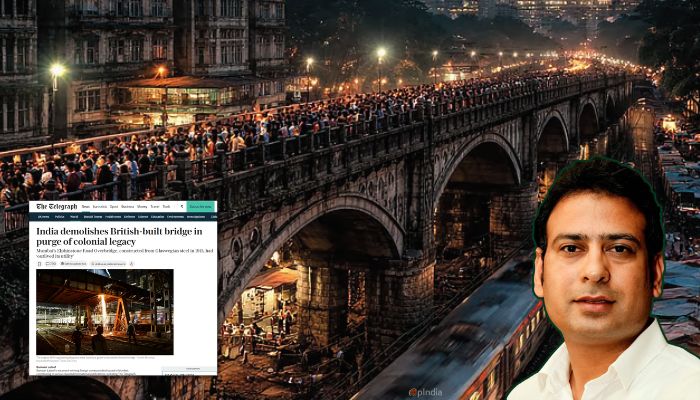
The Telegraph, a UK-based media outlet, has for the past few years been consistently pushing anti-India narratives and platforming brown sepoys for the pursuance of this sinister agenda. In continuation of weaving a misleading narrative to tarnish India’s image, The Telegraph gave the demolition of Mumbai’s 112-115-year-old Elphinstone Road Overbridge a ‘British colonial legacy purge’ spin. The propaganda piece headlined, “India demolishes British-built bridge in purge of colonial legacy”, is authored by a Mumbai-based Kashmiri journalist, Samaan Lateef.
An Indian bridge built by the British a century ago has been demolished to make way for a motorway.The Elphinstone Road Overbridge, which was built in Mumbai in 1913, was knocked down overnight as India continued to purge its colonial legacy.: https://t.co/x9RmecYmyx pic.twitter.com/xOVl6WxLWo— The Telegraph (@Telegraph) April 6, 2026
Telegraph UK peddles misinformation that the Elphinstone Bridge was demolished ‘overnight’ in a “purge of British Colonial legacy”
In the article published on 6th April 2026, Samaan Lateef wrote, “The Elphinstone Road Overbridge, which was built in Mumbai in 1913, was knocked down overnight as India continued to purge its colonial legacy.”
The tone of Lateef’s article suggests that the Indian authorities committed a sin by demolishing a century-old British colonial regime-built bridge by giving the excuse that it has “outlived its utility”.
Built in 1911-1913, the Elphinstone Bridge was a British Colonial era road-over-rail structure connecting Parel and Prabhadevi in Central Mumbai. The bridge was named after John Elphinstone, the 19th-century governor of Bombay. The Elphinstone Bridge carried heavy traffic over Central Railway tracks. Due to continued usage, the bridge suffered from structural wear and corrosion, offered limited capacity, and required accommodation of the new elevated corridor, which drove the decision to demolish it.
Notably, the bridge was demolished to make way for a modern four-lane double-decker flyover as part of the 4.5 km Sewri-Worli Elevated Connector project. This will link the iconic Bandra-Worli Sea Link and Atal Setu, forming a signal-free east-west corridor. It would widen the bridge, raise its height, and significantly improve traffic flow in one of Mumbai’s most congested areas.
Contrary to The Telegraph and Samaan Lateef’s narrative that the British-era Elphinstone Bridge was “knocked down” overnight, the demolition process, in reality, was conducted in multiple phases, with the final stretch recently completed.
In fact, the demolition process faced repeated delays owing to local residents’ protests in 2025 over the relocation and rehabilitation of families from nearby chawls and buildings. The Elphinstone Bridge was neither ‘knocked down’ overnight, nor was there any politics involved.
Moreover, the project is executed by the Mumbai Metropolitan Region Development Authority (MMRDA) and MahaRail at an estimated cost of Rs 167 crore for the double-decker portion. Both MMRDA and MahaRail are Maharashtra state agencies, and the directive to demolish the Elphinstone Bridge did not directly come from the Modi government in the Centre, with specific instructions to erase colonial symbols.
The British-era bridge’s demolition was nothing but a standard infrastructure renewal. Several countries have, in the past, demolished ageing bridges regardless of their historical origin and the supposed nostalgia attached, when they no longer align with modern capacity and safety standards.
Samaan Lateef, however, serving as a true brown sepoy, inserted the “colonial purge” bogey into a routine traffic and connectivity project and related demolition.
“Since Narendra Modi was elected prime minister in 2014, India has renamed many places and dismantled much infrastructure redolent of the British legacy,” Lateef wrote.
The author also listed previous moves by the Modi government aimed at ending the unnecessary continuation of the British colonial legacy. Be it the removal of the bust of Edwin Lutyens (whom Telegraph article names Edward Lutyens), the chief architect of New Delhi, “purging” British military portraits from Rashtrapati Bhavan, scrapping colonial-era railway uniforms, renaming places, or the adoption of new ensign for the Indian Navy inspired by the seal of Chhatrapati Shivaji Maharaj, ‘erasing’ the St George’s cross, these changes were made with unambiguous declaration that they meant for shedding the unwarranted burden of British colonial legacy.
However, Samaan Lateef decided to link the Elphinstone Bridge demolition with the Modi government’s justified decisions to shed the colonial past, in an apparent attempt at creating clickbait and stoking hatred and backlash against ‘Modi’s India’.
Interestingly, if we go by The Telegraph’s logic of ‘colonial legacy purge’, even the UK has constructed multiple motorways, parkways be it M25 London Orbital Motorway, A1139 Frank Perkins Parkway in Peterborough, Multiple A-roads and motorways, among other structures by destroying Roman-era roads, villas and settlements, as per the contemporary requirements. Would Telegraph apply the same lens in its home country and label such demolitions as Britain’s purge on Roman-era legacy?
Samaan Lateef pushing anti-India and pro-Pakistan narratives
Coming back to Samaan Lateef’s anti-India shenanigans, this is not the first time that Samaan Lateef has indulged in clickbait journalism to embarrass India globally and push anti-India narratives.
In January 2026, Lateef wrote an article for The Telegraph, headlined: The Pakistani Thunder fighter jet air forces are lining up to buy. Evident from the propaganda piece’s headline itself, Lateef’s article carried a certain amount of excitement in the imaginary surge in buyer interest in Pakistan’s JF-17 Thunder fighter jet.
Comparing it to India’s French-manufactured Rafale fighter jets, Lateef wrote, “Low in cost, high in performance, the jets were tested in combat against India as the two nuclear powers went to war in May. The JF-17 excelled against India’s French-made Rafales, and now other countries are lining up to buy their own.”
However, while Lateef claimed that Indonesia, Bangladesh, Iraq and Libya were interested in buying Pakistan’s JF-17, Indonesia denied any such commitment, while except Libya, none of the other countries named have demonstrated any explicit interest or given official confirmation regarding the finalisation of any deal to procure the Pakistani fighter jet.
Almost expressing glee over the 2019 capture of Wing Commander Abhinandan Varthaman by Pakistani forces during a short conflict, Lateef attributed his swift return to India to Chinese and American intervention. He even describes India’s Jammu and Kashmir as “Indian-administered Kashmir”.
This came even as a former Pakistani senator, Ayaz Sadiq, who also served as a member of the Pakistan National Assembly and a leader of the Pakistan Muslim League (N), admitted that Foreign Minister Makhdoom Shah Mahmood Qureshi had said that India would attack Pakistan if they don’t return Abhinandan.
Replying to the allegations of bowing before India in returning the captured IAF pilot, Minister of State for Parliamentary Affairs Ali Muhammad Khan said that leaders of all the parties had agreed to the decision. He said that he was also present in the meeting, which was attended by leaders of the Muslim League (Nawaj), Pakistan People’s Party’s Asif Ali Zardari, and other opposition parties. The minister didn’t deny the claims made by Ayaz Sadiq that Pakistan had feared an attack by India.
Lateef also cited the purchase of 3 JF-17 Thunder fighter jets by Nigeria; however, he did not mention the fact that Nigeria sidelined the Pakistani-manufactured jets due to “sluggish manoeuvrability, limited avionics, outdated radars, frequent glitches and maintenance nightmares.”
Similarly, while Lateef attributed the delay in the supply of JF-17 jets to Myanmar to the sanctions on the military junta, in reality, Myanmar received deliveries but reported technical faults and structural cracks, which, much to Pakistan’s embarrassment, Pakistani engineers could not fix. Myanmar then pivoted to Russian Su-30s.
The narrative concocted by Samaan Lateef in the British media outlet was then amplified by the Pakistani media and other ISPR-trained and planted Pakistani journalists in Western media outlets. The Telegraph article’s rapid, uncoordinated cascade of announcements, “countries lining up to buy Pakistani jets” bogey, reeked of classic state propaganda, perfectly timed to counter India’s Rafale acquisitions, and rising interest in purchase of India’s battle-tested weaponry post Operation Sindoor, wherein Indian forces pounded Pakistan in the aftermath of Pahalgam Islamic terror attack and stopped after achieving desired objectives.
Samaan Lateef’s limerence for Pakistan was also seen during Operation Sindoor in May 2025. Lateef has written a story for The Telegraph, which the newspaper had to retract. In the story headlined “India sends warships to Karachi after more clashes”, Lateef falsely claimed that New Delhi had deployed a large fleet targeting the Karachi port, which handles 60% of Pakistan’s foreign trade. It also stated that India had sent warships equipped with supersonic cruise missiles following border clashes between the two nuclear powers.
Several media outlets reported the Karachi port blast, and social media also readily picked it up. The Indian authorities had denied any such deployments.
In another article published on 10th May, Samaan Lateef claimed that “Pakistan ‘committed’ to ceasefire amid allegations of violations by both sides.” In another, he gave full credit for the ceasefire to the United States, writing, “How US helped pull India and Pakistan back from all-out war
This came even as the Indian government made it clear that the ceasefire agreement was arrived at between India and Pakistan only after Pakistan approached the Indian DGMO, and that no third-party involvement was heeded. Lateef’s reporting essentially attempted to undermine India’s credibility on the international stage.
In another anti-India article, Samaan Lateef described the torpedoing of Iran’s naval warship IRIS Dena by the US amidst the ongoing war in March this year, as the ‘shattering’ of the “illusion of Indian power.”
“When India bade them farewell, it appeared a successful gathering for the 18 foreign warships from 84 countries, exemplifying the event’s slogans “Bridges Through Friendship” and “United Through Oceans”. But one delegation was not there to make friends,” he wrote.
In sharp contrast to the reality, Samaan Lateef presented the sinking of IRIS Dena as India’s ‘betrayal’ against Iran. Throwing his weight behind ‘analysts’, Lateef wrote, “the brazen strike not only showed the vulnerability of Iranian assets around the world, but served as an affront to India after it graciously welcomed its guests, only for one of them to be blown up on the way home.”
Lateef portrayed the sinking of the IRIS Dena in the Indian Ocean as India’s ‘humiliating failure’ to protect the Iranian frigate that participated in India’s MILAN 2026 naval exercise. This alarming misrepresentation came even as the ship was operating approximately 20 nautical miles west of Galle, within the SAR region under Sri Lankan responsibility, nowhere near India’s territorial waters. Despite this, India had offered sanctuary to IRIS Dena three days before it was torpedoed by a US submarine. Just because IRIS Dena partook in an Indian naval exercise, the Indian Navy was not obliged to provide a safe escort to the Iranian warship all the way back home. India could only have extended a humanitarian hand in the form of search and rescue operations, which the Indian Navy was already conducting.
India has, since the war between the joint Israel-US front against Iran erupted, provided refuge to multiple Iranian warships and humanitarian assistance to the crew onboard. India is also among the few countries which have earned Iran’s gratitude and cooperation, as exemplified by the unrestricted access to the Strait of Hormuz, which the IRGC has blockaded for most of the countries as leverage, even at the cost of causing global energy supply disruptions and price hikes.
The Telegraph deploying an Indian Kashmiri ‘brown sepoy’ to push anti-India narratives is not surprising. The British newspaper has quite consistently been peddling propaganda vilifying India and the Modi government.
In February this year, The Telegraph platformed leftist ‘historian’ Ramachandra Guha, who wrote an op-ed contending that a supposed ‘Hindu majoritarianism’ is turning India into a ‘Hindu Pakistan’. OpIndia reported how the article was riddled with usual anti-Hindu narratives and equated the destructive and divisive Islamic fanaticism with Hindutva.
In July 2025, The Telegraph published an opinion piece authored by Tom Sharpe where he boldly declared India “an enemy, not a friend or a neutral” simply because India has energy, trade and military ties with Russia. The Telegraph’s outrage was triggered, in part, by the commissioning of INS Tamal, a stealth frigate built in Russia’s Yantar shipyard. The newspaper questioned India’s continued military ties with Russia, as if a warship being built abroad were a betrayal rather than a strategic decision. OpIndia exposed Britain’s hypocrisy, highlighting London’s long love affair with Russian wealth. We also called out their audacity to declare India an ‘enemy’ while it provides safe haven to Indian wanted fugitives like Vijay Mallya and Nirav Modi.
As is the trait of all Islamo-leftist propagandists, Samaan Lateef and The Telegraph have also been pushing a one-sided Muslim victimhood bogey, villainising Hindus as ‘extremists’ while no such coverage is given to incidents of Muslim mob violence against Hindus.
It’s worth noting that this is the same Saman Lateef who was nominated for the “Freelancer of the Year” award by the Society of Editors UK in September 2022. He was also invited to the awards ceremony in London. He is a Kashmiri journalist who has previously written for the UK’s Independent, Germany’s DW, and Israeli leftist rag Haaretz. Media publications changed, but Lateef’s anti-India agenda didn’t.