
The glaring hypocrisy of the US: Read how the nation has toppled governments in the name of ‘democracy’ while empowering dictators around the world
In the wee hours of Saturday (3rd January), Caracas woke up to the sound of fighter jets slicing through the night sky. By morning, it was clear that Venezuela had become the latest stage for a familiar American drama, one where military force is framed as a moral mission to “restore democracy.” US President Donald Trump confirmed that American forces had carried out multiple strikes in Venezuela and captured President Nicolás Maduro and his wife, Cilia Flores, flying them to the United States. Trump announced the operation on Truth Social, presenting it as a decisive blow against what he called “narcotic terrorism.” Soon after, US Attorney General Pamela Bondi revealed that Maduro and Flores had been indicted in New York on charges ranging from narco-terrorism conspiracy to cocaine importation and possession of heavy weapons. Trump accused the Maduro government of pushing migrants toward the US southern border, emptying prisons and mental institutions, and collaborating with drug cartels and terrorist groups. According to Trump, Venezuela had become a major transit route for cocaine entering the United States, with boats smuggling narcotics through the Caribbean and the Pacific. The justification sounded familiar. It has been for many years that Washington has branded hostile regimes as being guilty of crime, human rights abuses, or threatening international security. In the Venezuelan instance, matters were heightened by the Trump administration’s military campaign against reported drug-carrying boats in September of 2025 as it launched “a new war on drugs.” This is taking on military rather than law enforcement efforts. However, Maduro had always denied such charges, terming them a cover for the eventual control of Venezuela’s huge oil reserves. Notably, just days before the strikes, Maduro had offered cooperation with the US on migration and drug trafficking. That offer was ignored. Instead, American jets flew in without congressional approval, raising serious constitutional questions back home.. What unfolded in Venezuela fits a pattern the world has seen many times before, a regime change operation wrapped in the language of democracy, security, and moral responsibility. Regime change in the name of restoring democracy The US intervention in Venezuela did not emerge in a vacuum. It is part of a long and deeply troubling history of American-led regime change across the world. From Vietnam to Iraq, from Afghanistan to Syria, Washington has repeatedly justified military action as a way to remove “bad regimes” and replace them with democratic systems. The results, more often than not, have been chaos, violence, and long-term instability. In late 2001, US-backed forces entered Kabul, toppling the Taliban government within weeks. Hamid Karzai was installed as Afghanistan’s leader with strong American backing, and President George W. Bush confidently spoke of democracy taking root in Central Asia. Two decades later, US troops withdrew, and the Taliban returned to power almost overnight. The American-installed government collapsed with shocking speed, exposing how hollow and dependent it had always been. Iraq followed a similar path. In 2003, US troops removed Saddam Hussein, promising to transform Iraq into a democratic beacon for the Middle East. Instead, the dismantling of Iraq’s security apparatus left hundreds of thousands of armed men unemployed. The country descended into insurgency, sectarian violence, and civil war. Iran-backed militias gained influence, and the chaos eventually gave rise to the Islamic State, reshaping the region’s security landscape in ways that continue to haunt it today. Iraq December 2003: Saddam Hussein captured by the United States.Venezuela January 2026: Nicolás Maduro captured by the same powerWhen the United States can’t control a nation, it criminalizes its leader. pic.twitter.com/xWTV6lwcBq— Censored Humans (@CensoredHumans) January 3, 2026 Syria, Libya, and earlier Vietnam tell variations of the same story. The US steps in claiming moral urgency, dismantles existing power structures, and leaves behind fractured societies. Scholars describe this pattern as foreign-imposed regime change. Over the past 120 years, the United States has been responsible for the forced removal of around 35 foreign leaders, nearly one-third of all such interventions globally. Alarmingly, about one-third of these regime changes are followed by civil war within a decade. Even Trump, who built his political appeal on opposing America’s “endless wars,” seems unable to break free from this tradition. While he has repeatedly condemned the Iraq invasion and criticised neoconservative foreign policy, his Venezuela intervention sits uneasily with his own rhetoric of being a “peace President.” Bangladesh: A regime change backed by US without bombs While Venezuela saw fighter jets and missiles, Bangladesh offers a more subtle example of Ameri
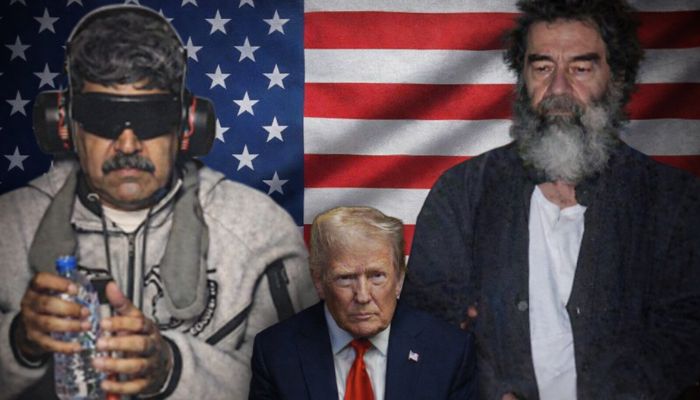

In the wee hours of Saturday (3rd January), Caracas woke up to the sound of fighter jets slicing through the night sky. By morning, it was clear that Venezuela had become the latest stage for a familiar American drama, one where military force is framed as a moral mission to “restore democracy.”
US President Donald Trump confirmed that American forces had carried out multiple strikes in Venezuela and captured President Nicolás Maduro and his wife, Cilia Flores, flying them to the United States. Trump announced the operation on Truth Social, presenting it as a decisive blow against what he called “narcotic terrorism.”

Soon after, US Attorney General Pamela Bondi revealed that Maduro and Flores had been indicted in New York on charges ranging from narco-terrorism conspiracy to cocaine importation and possession of heavy weapons.

Trump accused the Maduro government of pushing migrants toward the US southern border, emptying prisons and mental institutions, and collaborating with drug cartels and terrorist groups. According to Trump, Venezuela had become a major transit route for cocaine entering the United States, with boats smuggling narcotics through the Caribbean and the Pacific.
The justification sounded familiar. It has been for many years that Washington has branded hostile regimes as being guilty of crime, human rights abuses, or threatening international security.
In the Venezuelan instance, matters were heightened by the Trump administration’s military campaign against reported drug-carrying boats in September of 2025 as it launched “a new war on drugs.” This is taking on military rather than law enforcement efforts.
However, Maduro had always denied such charges, terming them a cover for the eventual control of Venezuela’s huge oil reserves. Notably, just days before the strikes, Maduro had offered cooperation with the US on migration and drug trafficking. That offer was ignored. Instead, American jets flew in without congressional approval, raising serious constitutional questions back home..
What unfolded in Venezuela fits a pattern the world has seen many times before, a regime change operation wrapped in the language of democracy, security, and moral responsibility.
Regime change in the name of restoring democracy
The US intervention in Venezuela did not emerge in a vacuum. It is part of a long and deeply troubling history of American-led regime change across the world. From Vietnam to Iraq, from Afghanistan to Syria, Washington has repeatedly justified military action as a way to remove “bad regimes” and replace them with democratic systems. The results, more often than not, have been chaos, violence, and long-term instability.
In late 2001, US-backed forces entered Kabul, toppling the Taliban government within weeks. Hamid Karzai was installed as Afghanistan’s leader with strong American backing, and President George W. Bush confidently spoke of democracy taking root in Central Asia. Two decades later, US troops withdrew, and the Taliban returned to power almost overnight. The American-installed government collapsed with shocking speed, exposing how hollow and dependent it had always been.
Iraq followed a similar path. In 2003, US troops removed Saddam Hussein, promising to transform Iraq into a democratic beacon for the Middle East. Instead, the dismantling of Iraq’s security apparatus left hundreds of thousands of armed men unemployed. The country descended into insurgency, sectarian violence, and civil war. Iran-backed militias gained influence, and the chaos eventually gave rise to the Islamic State, reshaping the region’s security landscape in ways that continue to haunt it today.

Related Posts




LG's 2026 Gram laptops look to dethrone the MacBook Air...
LG previewed its next-gen Gram models, combining updated hardware and vivid screens...
Who is Delcy Rodriguez? Venezuelan leader named interim...
Venezuela entered a period of uncertainty after President Nicolás Maduro was captured...

'India welcomes everyone': Harbhajan reacts as Bangladesh...
Former India spinner Harbhajan Singh commented on Bangladesh's request to relocate...
Michael B. Jordan reveals he had to go to therapy after...
In a candid moment, Michael B. Jordan, famed for his gripping performance as Erik...
VB-G RAM G Act not a rebrand of MNREGA, but rural jobs...
Uttarakhand's Chief Minister Pushkar Singh Dhami unveiled the VB-G RAM G Act. This...
'Dhurandhar' box office collection Day 32: Ranveer Singh...
Ranveer Singh and Akshaye Khanna's 'Dhurandhar' experienced its first notable slowdown...
Vijay Hazare Trophy: Shubman Gill to finally get game time...
Shubman Gill returns to the 50-over format for Punjab's Vijay Hazare Trophy match,...
Rourkela police arrest three in separate theft cases
Rourkela police apprehended three individuals in separate theft incidents. Two men...
India inaugurates world’s only 2nd such lab for testing...
India has launched its second National Environmental Standard Laboratory, aiming...

Mumbai: CA duped of Rs 29L in real estate scam, 1 held
Dahisar Police have arrested one individual from a four-member gang that posed as...
