The curious case of ‘Dhurandhar’: Here is why India’s highest grossing film film triggered a never-before-seen liberal meltdown
Two consequences after watching the movie, Dhurandhar, have become de jure—posting about or reviewing it, and making or sharing memes about it. I choose the former. As of this writing, the movie has grossed over a thousand crore rupees in the domestic market, making it the highest-grossing Hindi movie ever. The concluding part was released on the 18th of March. Set primarily in the criminal gang-infested locality of Lyari in the Pakistan town of Karachi, the movie follows the lives of gangsters, politicians, and policemen as they play a cat-and-mouse game of doing each other in. Among the gangsters is a plant, inserted by a character modelled after Ajit Doval, India’s National Security Advisor. The movie is punctuated with real-life episodes, like the Kandahar hijacking of 1999, the 26/11 terror attacks on Mumbai, and bookended by an actual police encounter that took place in Karachi. Dhurandhar is a taut, entertaining, fast-paced thriller that feels shorter than its 3.5-hour length. The sequel is a shade under four hours. It is backed by music that blends into and burnishes the movie, with at least two songs attaining chartbuster status, including one by Bahranian rapper, Flipperachi. It is an entertainer, well-made. That is its first sin. A movie should, first and foremost, entertain. Dhurandhar is a movie that unfolds like a good thriller, succeeds in entertaining, and succeeds spectacularly. Dhurandhar is a commercial blockbuster. It is mass market entertainment. It sates the appetite of the guilty cinegoer who seeks escape from the drudgery of real life and its quotidian frustrations in larger-than-life characters, picturesque getaways, and the vicarious pleasure of seeing justice being served. Having long given up on wrongs being righted in real life, the moviegoer settles for a measure of recompense on celluloid. And that is its second sin, and an unforgivable one at that. A ‘Pyaasa’ is a masterpiece as a lament of the primacy of commercialism over art. ‘Kaagaz ke Phool’ is cinematic perfection in its portrayal of the ephemeral nature of fame and the subtleties of relationships. A movie, like almost all art, is also an exercise in messaging. For the sake of argument, call it propaganda. When done well, propaganda informs and elevates, while also entertaining. Where matters get muddled is when one side of the ideological spectrum claims exclusivity over propaganda, denying the other side’s legitimacy to create it. A ‘Pathaan’ that depicts a rogue agent from R&AW, India’s external intelligence agency, as the antagonist; a ‘Main Hoon Naa’ painting an Indian Army officer as a terrorist, and an implacably hostile neighbour, Pakistan, as a peacenik, is supposed to be evaluated as entertainment, never as propaganda. A ‘Rang De Basanti’, that subverts themes and characters from India’s Independence struggle to score ideological and political points while also advocating, even justifying, and not subtly either, political assassinations as a legitimate response by the citizenry, is meant to be judged and accepted as a spectacular exercise in the melding of high-brow art and mass-market commercialism. If we, the people, call out such movies as subversive and partisan propaganda, it is distressing evidence of our cultural illiteracy and further evidence of our descent into intolerance. If this is meant to be good for the goose, what about the gander? An Indian Airlines flight was hijacked and taken to Kandahar in 1999. The hijackers had Pakistan connections. Pakistan also funded, trained, and armed terrorists who then proceeded to perpetrate the terror attacks of Mumbai 26/11 in 2008. Recordings of satellite phone communications between the terrorists and their handler in Karachi are also in the public domain. India chose not to retaliate, despite the armed forces declaring their capability and readiness to do so. All of this is an uncontested fact. Rahman Baloch ‘Dacait’ was a notorious gangster in Karachi, based out of its Lyari township. He was killed in an encounter with the Lyari Task Force, headed by policeman Aslam Chaudhary, in 2009. This is also a documented fact. Movies are often based on fact, embellished with fiction. ‘Deewar’, Yash Chopra’s grimy thriller, was loosely based on or inspired by the Mumbai don, Haji Mastan’s life. Dayavan, the 1988 Hindi remake of the Tamil movie Nayakan, was inspired by Mumbai gangster Varadarajan Mudaliar. Countless movies are based on, inspired by, or set in actual historical events. So, where is the problem? What explains the meltdown that self-proclaimed intellectuals and washed-out liberals had on Dhurandhar’s release, which degenerated into rabid bile-spewing invective once it became a blockbuster? One such person ran the movie down as a “tough sit”, “clunky”, “pushing a dangerous narrative”. It was not entirely out of character, though, as the same person’s website had called The Kashmir Files “defensive and dishonest”. Whe
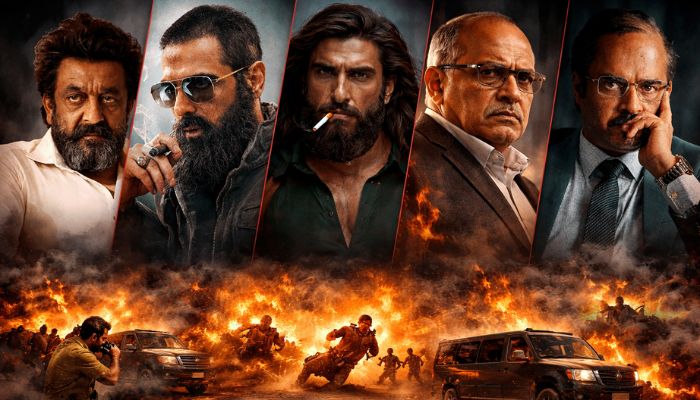
Two consequences after watching the movie, Dhurandhar, have become de jure—posting about or reviewing it, and making or sharing memes about it. I choose the former.
As of this writing, the movie has grossed over a thousand crore rupees in the domestic market, making it the highest-grossing Hindi movie ever. The concluding part was released on the 18th of March. Set primarily in the criminal gang-infested locality of Lyari in the Pakistan town of Karachi, the movie follows the lives of gangsters, politicians, and policemen as they play a cat-and-mouse game of doing each other in.
Among the gangsters is a plant, inserted by a character modelled after Ajit Doval, India’s National Security Advisor. The movie is punctuated with real-life episodes, like the Kandahar hijacking of 1999, the 26/11 terror attacks on Mumbai, and bookended by an actual police encounter that took place in Karachi.
Dhurandhar is a taut, entertaining, fast-paced thriller that feels shorter than its 3.5-hour length. The sequel is a shade under four hours. It is backed by music that blends into and burnishes the movie, with at least two songs attaining chartbuster status, including one by Bahranian rapper, Flipperachi. It is an entertainer, well-made. That is its first sin.
A movie should, first and foremost, entertain. Dhurandhar is a movie that unfolds like a good thriller, succeeds in entertaining, and succeeds spectacularly. Dhurandhar is a commercial blockbuster. It is mass market entertainment. It sates the appetite of the guilty cinegoer who seeks escape from the drudgery of real life and its quotidian frustrations in larger-than-life characters, picturesque getaways, and the vicarious pleasure of seeing justice being served. Having long given up on wrongs being righted in real life, the moviegoer settles for a measure of recompense on celluloid.
And that is its second sin, and an unforgivable one at that.
A ‘Pyaasa’ is a masterpiece as a lament of the primacy of commercialism over art. ‘Kaagaz ke Phool’ is cinematic perfection in its portrayal of the ephemeral nature of fame and the subtleties of relationships. A movie, like almost all art, is also an exercise in messaging. For the sake of argument, call it propaganda. When done well, propaganda informs and elevates, while also entertaining. Where matters get muddled is when one side of the ideological spectrum claims exclusivity over propaganda, denying the other side’s legitimacy to create it.
A ‘Pathaan’ that depicts a rogue agent from R&AW, India’s external intelligence agency, as the antagonist; a ‘Main Hoon Naa’ painting an Indian Army officer as a terrorist, and an implacably hostile neighbour, Pakistan, as a peacenik, is supposed to be evaluated as entertainment, never as propaganda. A ‘Rang De Basanti’, that subverts themes and characters from India’s Independence struggle to score ideological and political points while also advocating, even justifying, and not subtly either, political assassinations as a legitimate response by the citizenry, is meant to be judged and accepted as a spectacular exercise in the melding of high-brow art and mass-market commercialism.
If we, the people, call out such movies as subversive and partisan propaganda, it is distressing evidence of our cultural illiteracy and further evidence of our descent into intolerance. If this is meant to be good for the goose, what about the gander?
An Indian Airlines flight was hijacked and taken to Kandahar in 1999. The hijackers had Pakistan connections. Pakistan also funded, trained, and armed terrorists who then proceeded to perpetrate the terror attacks of Mumbai 26/11 in 2008. Recordings of satellite phone communications between the terrorists and their handler in Karachi are also in the public domain. India chose not to retaliate, despite the armed forces declaring their capability and readiness to do so. All of this is an uncontested fact.
Rahman Baloch ‘Dacait’ was a notorious gangster in Karachi, based out of its Lyari township. He was killed in an encounter with the Lyari Task Force, headed by policeman Aslam Chaudhary, in 2009. This is also a documented fact.
Movies are often based on fact, embellished with fiction. ‘Deewar’, Yash Chopra’s grimy thriller, was loosely based on or inspired by the Mumbai don, Haji Mastan’s life. Dayavan, the 1988 Hindi remake of the Tamil movie Nayakan, was inspired by Mumbai gangster Varadarajan Mudaliar. Countless movies are based on, inspired by, or set in actual historical events. So, where is the problem? What explains the meltdown that self-proclaimed intellectuals and washed-out liberals had on Dhurandhar’s release, which degenerated into rabid bile-spewing invective once it became a blockbuster? One such person ran the movie down as a “tough sit”, “clunky”, “pushing a dangerous narrative”. It was not entirely out of character, though, as the same person’s website had called The Kashmir Files “defensive and dishonest”.
Where is the problem? There are two, actually.
Liberal propaganda requires absolute monopoly, an uncontested space, and the complete silencing of dissent. Given its contradictions and intellectually incoherent underpinnings, liberal propaganda—call it alt-leftism, wokeism—needs the nourishment of totalitarianism to survive. Where none exists, it manufactures one, using censorship, legal bludgeons, ostracisation, lies, propaganda, and sometimes, even physical elimination of dissent. This much is also uncontestable, as seen over the decades in Soviet bloc countries, and lately in American universities and media, devastatingly documented in books as “The Coddling of the American Mind”, “The Cancelling of the American Mind”, “The Parasitic Mind”, and many others. The mere expression of a reasonable and uncontroversial opinion, if it runs counter to liberal dogma, is enough for a person to be tarred, labelled, and cancelled. This deliberately public and extreme censorship serves as a grim warning to others to stay in the herd and to not colour outside the line. Acts of retributive intolerance are cloaked in exculpatory language and words like ‘creating a safe environment’.
Most will be unfamiliar with the so-called Great Purge of the early 1970s, when broadcaster CBS cancelled most of its highly rated and popular rural-themed shows, replacing them with ‘edgier’ content, ostensibly to attract new sponsors. These ‘rural-themed’ shows often highlighted family values and stressed the importance of honesty. With these inconvenient shows out of the way, the space was cleared for liberal propaganda to get a clear, uncontested run that has lasted for over half a century, to the point where depicting a happy, unbroken family with a heterosexual couple is stigmatised as an expression of ‘privilege’.
A 1985 movie, Durga, had not only the heroine, Hema Malini, citing Indira Gandhi, Nehru family dynast and Prime Minister, as an exemplar of sacrifice, but also had a long clip of her last speech in Odisha, played verbatim. That was obviously not propaganda in the liberal dictionary. Doordarshan, India’s state-owned and controlled broadcaster, making a movie on Jawaharlal Nehru’s culinary habits was high art, not sickeningly sycophantic pandering. Farah Khan’s Main Hoon Naa, depicting a former officer of the Indian Army as a terrorist was entertainment.
Shahrukh Khan starrer Pathan’s antagonist as a R&AW agent and the protagonist is, of course, not propaganda. Having the heroine, playing the role of an ISI agent, gyrate to Shahrukh Khan “like a concrete mixer whose main bearing has conked out.” It is dubbed artistic liberty. Sriram Raghavan’s Ikkis preaching to audiences that it was war, and not Pakistan, that killed Param Vir Chakra First Lt. Arun Khetarpal, is cinematic acme, and most certainly not an insult to the braves who lay down their lives for the sake of their country.
Vivek Agnihotri’s The Kashmir Files was not only well-made but commercially successful, grossing several hundred crores. It was unremitting in its gaze on the pogrom that was inflicted on the Hindu Kashmiri Pandit community, resulting in their final exodus in 1990. Every single act of violence and brutality depicted in the movie was based on facts. But it was a difficult watch.
Dhurandhar is not The Kashmir Files. It is an entertainer, extraordinarily well executed, mounted on a grand canvas, unapologetic about its ambition to be the ultimate masala entertainer. It’s the kind of movie that people discussed, talked about, recommended to their friends, families, and extended social circle. It’s the movie that people watched a second, a third time. In other words, Dhurandhar packaged messaging in a spectacularly entertaining container.
Dhurandhar informed. It entertained. And it made money. In the cloistered world of liberal echo chambers, the first was an inconvenience. The second was an accidence. The third was unpardonable. Nationalist entertainment that succeeds on both artistic and commercial dimensions is unacceptable in the liberal world.
Dhurandhar 2 is 3 hours, 55 minutes long. Advance bookings are already through the roof. Some theaters are even arranging to screen the first movie for those who want to experience the closest to a binge watch, an eight-hour masala entertainment fest. ‘Alpha’, the latest in Yash Raj Film’s so-called ‘spyverse’ has already been postponed for fear of commercial failure and artistic ridicule should it go head-to-head against Dhurandhar 2. The liberals’ knives are not so much out, for they were never sheathed; they are being sharpened. The attacks on the movie will expectedly be novel and new, while also being trite and cliched at the same time.
Few people like unvarnished truths. But putrid dishonesty can also be unpalatable. Dhurandhar may not be without faults. But the cabal of intellectuals running it down needed to do a better job. A little honesty wouldn’t have hurt, either.