Swiss giant MSC to acquire 49% stake in Adani’s Vizhinjam Port in India’s largest ever foreign investment in port infra, Kerala govt objects: Read the significance of the deal
The world’s largest container shipping company has entered into a definitive agreement in relation to one of the biggest foreign investments in India’s port sector. Switzerland-based Mediterranean Shipping Company (MSC) Group is set to acquire 49% stake for $1.397 billion or nearly ₹13,220 crore in Adani Vizhinjam Port Private Limited (AVPPL), which is the private concessionaire and operating firm for the Vizhinjam International Seaport in Thiruvananthapuram of Kerala. The announcement was made by Adani Ports and Special Economic Zone Limited (APSEZ) on 30th June (Tuesday) in a filing to stock exchanges. It informed, “the Company has entered into Share Purchase and Subscription Agreement on June 29, 2026 with Mundi Limited (“Mundi”), pursuant to which Mundi will invest for 49% interest in Adani Vizhinjam Port Private Limited (“AVPPL”). Mundi Limited is the subsidiary of Terminal Investment Limited (“TIL”), which is the terminal arm of Mediterranean Shipping Company (“MSC”). The company added that “The transaction is subject to customary approvals, including regulatory ones.” The investment will be undertaken through MSC’s global port operating subsidiary, Terminal Investment Limited (TiL) under an accord inked between Adani Ports and Special Economic Zone Limited. “TIL is one of the world’s largest container terminal operators and part of the MSC Group comprising a portfolio of more than 100 container terminals across five continents and a throughput of more than 70 million TEUs per annum,” the official statement read. AVPPL has been valued at $2.85 billion or roughly ₹26,960 crore in the acquisition. TIL will invest $1.397 billion for the 49% stack. We were not consulted: Kerala government protests along with Left leaders On the other hand, the Indian National Congress-led United Democratic Front (UDF) government has raised objections and declared that its nod is mandatory to proceed forward with the project. “The Adani Group did not have any communication with the state government. As per the concession agreement, the concessionaire should not affect any change in ownership of the port without prior approval from the authority, which is the state government. Selling 49 per cent stake means there is ownership change, which is not possible without the consent from the state government,” Chief Minister V D Satheesan said in the assembly on 1st June (Wednesday). He added that Adani Ports has not yet obtained permission for the action, which he only became aware of through media reports and further claimed that clearance from Union Ministries of Ports, Shipping and Waterways and Home Affairs is required because “foreign investment involves national security.” He referred to the state as “active stakeholder” and insisted that it should have been included in the discussions, but authorities were not approached. According to Satheesan, MSC is more than just an investor, and his government will look into how its role will impact functions of the port, which is slated to be turned over to the state in 2080. He said, “Since the port is critical infrastructure, national security is a matter of concern. The deal will be allowed only after protecting the interest of the state and safeguarding the public interest. There should be space for fair competition, and we have to ensure that the deal does not lead to monopoly of a particular company in the port. There should be a competitive user facility where all stakeholders will be able to do business without any discrimination. The government would also ensure that the future development of the port would not be influenced with the recent development.” Satheesan emphasised that the matter will only be considered in light of the complete protection of the state’s revenue interests, long-term development aims, fair competition, national security and investment promotion. According to former Chief Minister Pinarayi Vijayan, it was unexpected that the government was oblivious of the MSC’s intentions to invest in the strategically crucial port. He conveyed that it was marked as an extremely important infrastructure every time there was a terror warning in the nation and hence, obtaining security clearance is essential. “The news about selling of the share up to 49 per cent is a matter of grave concern. When the shipping firm MSC and Adani group join hands, there is a danger of monopoly. That will be against the commercial interest of the state and port’s development. When one particular firm gains monopoly at the port, all others will have to go by their conditions. This will lead to financial anomalies and eliminate the situation in which the port should grow into a multi-operator venture,” argued the politburo member of the Communist Party of India (Marxist). What makes the partnership crucial It is anticipated that the alliance between the conglomerates will aid the port in increasing its services rapidly by bringing a consist
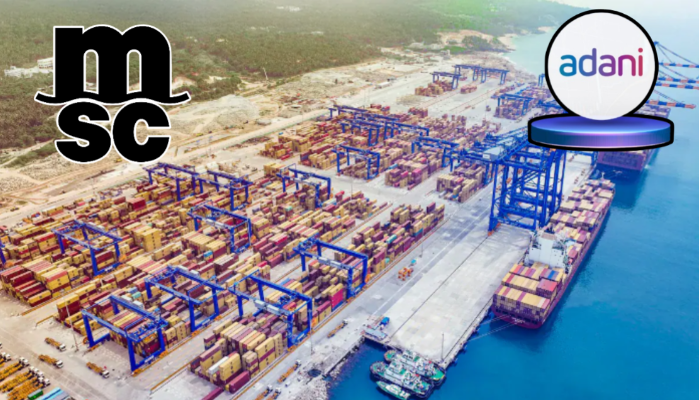
The world’s largest container shipping company has entered into a definitive agreement in relation to one of the biggest foreign investments in India’s port sector. Switzerland-based Mediterranean Shipping Company (MSC) Group is set to acquire 49% stake for $1.397 billion or nearly ₹13,220 crore in Adani Vizhinjam Port Private Limited (AVPPL), which is the private concessionaire and operating firm for the Vizhinjam International Seaport in Thiruvananthapuram of Kerala.
The announcement was made by Adani Ports and Special Economic Zone Limited (APSEZ) on 30th June (Tuesday) in a filing to stock exchanges. It informed, “the Company has entered into Share Purchase and Subscription Agreement on June 29, 2026 with Mundi Limited (“Mundi”), pursuant to which Mundi will invest for 49% interest in Adani Vizhinjam Port Private Limited (“AVPPL”).
Mundi Limited is the subsidiary of Terminal Investment Limited (“TIL”), which is the terminal arm of Mediterranean Shipping Company (“MSC”). The company added that “The transaction is subject to customary approvals, including regulatory ones.”
The investment will be undertaken through MSC’s global port operating subsidiary, Terminal Investment Limited (TiL) under an accord inked between Adani Ports and Special Economic Zone Limited. “TIL is one of the world’s largest container terminal operators and part of the MSC Group comprising a portfolio of more than 100 container terminals across five continents and a throughput of more than 70 million TEUs per annum,” the official statement read.
AVPPL has been valued at $2.85 billion or roughly ₹26,960 crore in the acquisition. TIL will invest $1.397 billion for the 49% stack.
We were not consulted: Kerala government protests along with Left leaders
On the other hand, the Indian National Congress-led United Democratic Front (UDF) government has raised objections and declared that its nod is mandatory to proceed forward with the project.
“The Adani Group did not have any communication with the state government. As per the concession agreement, the concessionaire should not affect any change in ownership of the port without prior approval from the authority, which is the state government. Selling 49 per cent stake means there is ownership change, which is not possible without the consent from the state government,” Chief Minister V D Satheesan said in the assembly on 1st June (Wednesday).
He added that Adani Ports has not yet obtained permission for the action, which he only became aware of through media reports and further claimed that clearance from Union Ministries of Ports, Shipping and Waterways and Home Affairs is required because “foreign investment involves national security.”
He referred to the state as “active stakeholder” and insisted that it should have been included in the discussions, but authorities were not approached. According to Satheesan, MSC is more than just an investor, and his government will look into how its role will impact functions of the port, which is slated to be turned over to the state in 2080.
He said, “Since the port is critical infrastructure, national security is a matter of concern. The deal will be allowed only after protecting the interest of the state and safeguarding the public interest. There should be space for fair competition, and we have to ensure that the deal does not lead to monopoly of a particular company in the port. There should be a competitive user facility where all stakeholders will be able to do business without any discrimination. The government would also ensure that the future development of the port would not be influenced with the recent development.”
Satheesan emphasised that the matter will only be considered in light of the complete protection of the state’s revenue interests, long-term development aims, fair competition, national security and investment promotion.
According to former Chief Minister Pinarayi Vijayan, it was unexpected that the government was oblivious of the MSC’s intentions to invest in the strategically crucial port. He conveyed that it was marked as an extremely important infrastructure every time there was a terror warning in the nation and hence, obtaining security clearance is essential.
“The news about selling of the share up to 49 per cent is a matter of grave concern. When the shipping firm MSC and Adani group join hands, there is a danger of monopoly. That will be against the commercial interest of the state and port’s development. When one particular firm gains monopoly at the port, all others will have to go by their conditions. This will lead to financial anomalies and eliminate the situation in which the port should grow into a multi-operator venture,” argued the politburo member of the Communist Party of India (Marxist).
What makes the partnership crucial
It is anticipated that the alliance between the conglomerates will aid the port in increasing its services rapidly by bringing a consistent flow of products. Cargo that is presently routed through rival transhipment hubs in Southeast Asia, particularly those connected to Bangladesh, will also be pulled to Vizhinjam due to MSC’s extensive worldwide shipping web. The joint effort has the potential to boost relay freight flow and improve the port’s connectivity with East Africa.
“Vizhinjam port has emerged as a premier trans-shipment hub and ramped up at an unprecedented pace, becoming the first Indian port to earn the unique distinction of crossing 2 million TEUs (Twenty-foot Equivalent Units) within 18 months of operations,” outlined Ashwani Gupta, Whole-time Director and Chief Executive Officer (CEO) of APSEZ.
He expressed, “I am delighted to expand our long-standing partnership with MSC to Vizhinjam as we prepare for the port’s next leg of journey. I am confident that our association will deliver enhanced supply chain efficiencies at a global scale and improve India’s access to key global mature and developing markets.”
Furthermore, the deal has strengthened the bond between MSC and APSEZ as Vizhinjam is the third cooperation between the two sides in the country. They currently jointly own container ports in Mundra and Ennore.
Why does the port hold great significance
The first deep-draft mega transhipment port in India, Vizhinjam, was put into service in December 2024 and has a capacity of 1.6 million TEU. It is being expanded to grow its capacity 3.5 times to 5.7 million TEUs by December 2028. It is also the first automated port in India and integrates state-of-the-art container handling technology, a top-notch IT platform and an AI-enabled domestic Vessel Traffic Management System (VTMS) to promote operational effectiveness, safety and dependability.
The port is well situated about 10 nautical miles from the East-West maritime route that links the Far East, the Persian Gulf and Europe. It is located next to one of the busiest sea trade routes in the world. It has an 800-metre berth, a 2.9-kilometre breakwater, an 18 to 20-metre natural draft alongside innovative facilities such as 24 fully automated yard cranes and 8 quay cranes.
Vizhinjam processed 1.3 million TEUs in the fiscal year (FY)26. It became the fastest port in the country to reach the 1 million TEU milestone in its first year of operation, handling the aforementioned number of TEUs and 615 vessels. It broke another national record in just 18 months when it reached 2 million TEUs and 950 boats.
Vizhinjam welcomed its 1,000th ship last month. The port has handled the most Ultra Large Container boats (ULCVs) of any Indian port, with over 70 ULCVs, 283 boats longer than 300 meters and 98 vessels with drafts longer than 16 meters. It was essentially created to minimise the country’s reliance on foreign ports for transshipment, which formerly accounted for 75% of such activities, retaining revenue domestically and opening up new economic opportunities for Kerala and its people.
The ongoing work
Adani Ports and SEZ Private Limited are using the design, construct, finance, operate and transfer (DBFOT) model to execute the first phase of the Rs 8,860-crore transhipment deepwater multipurpose seaport initiative. The contract is for 40 years with 20-year extensions. The accord was inked between the state’s Congress government and the Adani Group in 2015.
Adani Group provided ₹2,454 crore of the overall investment, while ₹1,635 crore was funded by the state and the centre to meet the viability gap embodying a public-private-partnership (PPP) mode. The 500 acres of area was donated by the state, which controls Vizhinjam International Seaport Limited (VISL), a special-purpose entity. It acts as both the project owner and the landlord.
Now, MSC’s involvement will benefit the infrastructure, draw in more container traffic and solidify Vizhinjam’s standing as a major transhipment hub in the Indian Ocean region.