Supreme Court turns to Manusmriti while granting widowed woman assets of her late father-in-law: Read how the ancient Hindu text became a guiding light for the Judiciary
The Supreme Court of India affirmed a widowed daughter-in-law’s maintenance rights from her late father-in-law’s assets in a historic decision delivered on 13th January this year. The court drew straight from the Manusmriti to underline familial duties under modern Hindu law. In addition to resolving a family dispute over inheritance, the ruling in Kanchana Rai vs. Geeta Sharma & Ors. (2026 INSC 54) demonstrated the continuing impact of ancient writings like the Manusmriti on India’s legal system, even as courts give precedence to constitutional principles. This ruling is an example of how judges interpret laws such as the Hindu Adoptions and Maintenance Act, 1956 (HAMA), using classical Dharmashastra as moral and historical guidelines rather than as legally obligatory. Family fued which sparked the legal battle The issue concerned the assets of Dr Mahendra Prasad, who passed away on December 27, 2021, and left behind properties in a registered will dated July 18, 2011. Prasad had three sons. Rajeev Sharma, Devinder Rai (pre-deceased, whose wife Kanchana Rai was declared executor and beneficiary for her boys), and Ranjit Sharma (died March 2, 2023). After Ranjit passed away, Geeta Sharma, Respondent No.1 and his widow, argued that she was a dependent and requested maintenance from her father-in-law’s estate under HAMA. Her husband outlived Prasad; she was not a widow at the time of his death, according to the family Court, which dismissed her case as unmaintainable. On August 20, 2025, the High Court overturned this on appeal, remanding the case for merits evaluation and designating Geeta as a dependant as she is Prasad’s son’s widow. This was contested in the Supreme Court by Kanchana Rai and Uma Devi, who claimed to have lived with Prasad for forty years. They framed the main question asking Does a daughter-in-law who is widowed following the death of her father-in-law qualify as a dependent under HAMA Section 21(vii)? Sharp statutory interpretation Writing for the bench alongside Justice S.V.N. Bhatti, Justice Pankaj Mithal used a literal interpretation of HAMA to cut through the objections. Timing is irrelevant because Section 21(vii) specifies dependents as “any widow of his son,” without qualifiers like “predeceased,” therefore, Geeta qualifies regardless. Heirs are required by Section 22 to provide for such dependents from the inherited estate, particularly if the dependent does not receive a succession share. Citing precedents such as Crawford v. Spooner (1846) for plain sense and B. Premanand v. Mohan Koikal (2011) against judicial rewriting of statutes, the bench rejected restricted readings. It cautioned that any more restrictive interpretation would violate Article 14’s equality by arbitrarily separating widows according to the time of their spouse’s death and having no logical connection to HAMA’s welfare objective. Purposive reading was also required to protect vulnerable women from poverty under Article 21’s right to a dignified life. Manusmriti’s invocation The court addressed the origins of Hindu law in a crucial paragraph, pointing out that where statutes leave gaps, HAMA’s Section 4 maintains uncodified principles. Manusmriti Chapter 8, Verse 389 was cited, ‘No wife, son, father, or mother should be abandoned. The king should impose a fee of six hundred units on anyone who deserts these innocent family members.’ This passage emphasised the need of the family head to provide for female relatives, obliging heirs both legally and ethically to help a widdaughter-in-lawn law who is unable to support herself. The reference confirmed that a father-in-law’s duty continues after death through estate heirs, aligning Manusmriti’s emphasis on familial piety with HAMA’s framework. Section 22 expanded Section 19, which covered maintenance for a live father-in-law, to include post death claims. The court maintained the High Court’s ruling and dismissed appeals, with no costs. Manusmriti’s shadow over modern law According to recent analysis, Manusmriti’s recurrent, non-binding function in Indian jurisprudence is mirrored in this invocation. Manusmriti appears in judicial discourse to invoke tradition, contrast reforms, or uphold morals in matters involving families, women’s dignity, and social reform, in contrast to the Constitution or statutes. In line with Dr B.R. Ambedkar’s subtle criticism, courts use it as an example, gaining authority from the law rather than scripture. During the 1927 Mahad protest against caste injustice, Ambedkar burned the Manusmriti, but during the Hindu Code Bill debates, he deliberately cited its egalitarian themes, such as women’s property rights. While acknowledging the complexithe ty of Dharmashastra, he attdiscriminatorynating texts about patriarchy and varna rigidity, creating codified regulations that eliminated injustices while preseManu-based based ideas like joint families and sapinda relationships. From the Dharamshastra
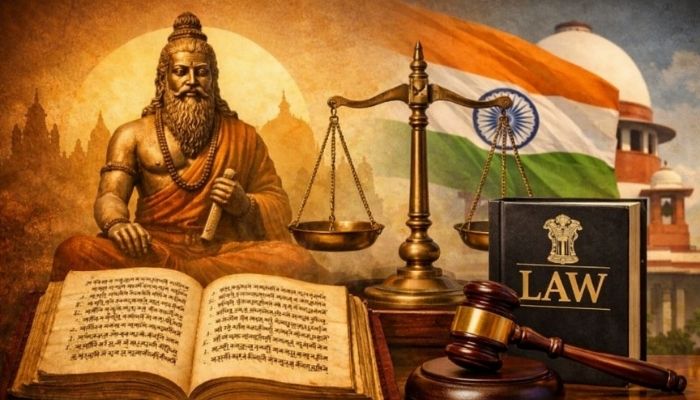

The Supreme Court of India affirmed a widowed daughter-in-law’s maintenance rights from her late father-in-law’s assets in a historic decision delivered on 13th January this year. The court drew straight from the Manusmriti to underline familial duties under modern Hindu law. In addition to resolving a family dispute over inheritance, the ruling in Kanchana Rai vs. Geeta Sharma & Ors. (2026 INSC 54) demonstrated the continuing impact of ancient writings like the Manusmriti on India’s legal system, even as courts give precedence to constitutional principles.
This ruling is an example of how judges interpret laws such as the Hindu Adoptions and Maintenance Act, 1956 (HAMA), using classical Dharmashastra as moral and historical guidelines rather than as legally obligatory.
Family fued which sparked the legal battle
The issue concerned the assets of Dr Mahendra Prasad, who passed away on December 27, 2021, and left behind properties in a registered will dated July 18, 2011. Prasad had three sons. Rajeev Sharma, Devinder Rai (pre-deceased, whose wife Kanchana Rai was declared executor and beneficiary for her boys), and Ranjit Sharma (died March 2, 2023). After Ranjit passed away, Geeta Sharma, Respondent No.1 and his widow, argued that she was a dependent and requested maintenance from her father-in-law’s estate under HAMA.
Her husband outlived Prasad; she was not a widow at the time of his death, according to the family Court, which dismissed her case as unmaintainable. On August 20, 2025, the High Court overturned this on appeal, remanding the case for merits evaluation and designating Geeta as a dependant as she is Prasad’s son’s widow. This was contested in the Supreme Court by Kanchana Rai and Uma Devi, who claimed to have lived with Prasad for forty years. They framed the main question asking Does a daughter-in-law who is widowed following the death of her father-in-law qualify as a dependent under HAMA Section 21(vii)?
Sharp statutory interpretation
Writing for the bench alongside Justice S.V.N. Bhatti, Justice Pankaj Mithal used a literal interpretation of HAMA to cut through the objections. Timing is irrelevant because Section 21(vii) specifies dependents as “any widow of his son,” without qualifiers like “predeceased,” therefore, Geeta qualifies regardless. Heirs are required by Section 22 to provide for such dependents from the inherited estate, particularly if the dependent does not receive a succession share.
Citing precedents such as Crawford v. Spooner (1846) for plain sense and B. Premanand v. Mohan Koikal (2011) against judicial rewriting of statutes, the bench rejected restricted readings. It cautioned that any more restrictive interpretation would violate Article 14’s equality by arbitrarily separating widows according to the time of their spouse’s death and having no logical connection to HAMA’s welfare objective. Purposive reading was also required to protect vulnerable women from poverty under Article 21’s right to a dignified life.
Manusmriti’s invocation
The court addressed the origins of Hindu law in a crucial paragraph, pointing out that where statutes leave gaps, HAMA’s Section 4 maintains uncodified principles. Manusmriti Chapter 8, Verse 389 was cited, ‘No wife, son, father, or mother should be abandoned. The king should impose a fee of six hundred units on anyone who deserts these innocent family members.’ This passage emphasised the need of the family head to provide for female relatives, obliging heirs both legally and ethically to help a widdaughter-in-lawn law who is unable to support herself.
The reference confirmed that a father-in-law’s duty continues after death through estate heirs, aligning Manusmriti’s emphasis on familial piety with HAMA’s framework. Section 22 expanded Section 19, which covered maintenance for a live father-in-law, to include post death claims. The court maintained the High Court’s ruling and dismissed appeals, with no costs.
Manusmriti’s shadow over modern law
According to recent analysis, Manusmriti’s recurrent, non-binding function in Indian jurisprudence is mirrored in this invocation. Manusmriti appears in judicial discourse to invoke tradition, contrast reforms, or uphold morals in matters involving families, women’s dignity, and social reform, in contrast to the Constitution or statutes. In line with Dr B.R. Ambedkar’s subtle criticism, courts use it as an example, gaining authority from the law rather than scripture.
During the 1927 Mahad protest against caste injustice, Ambedkar burned the Manusmriti, but during the Hindu Code Bill debates, he deliberately cited its egalitarian themes, such as women’s property rights. While acknowledging the complexithe ty of Dharmashastra, he attdiscriminatorynating texts about patriarchy and varna rigidity, creating codified regulations that eliminated injustices while preseManu-based based ideas like joint families and sapinda relationships.
From the Dharamshastra to codified Hindu law
Manusmriti, which served as the basis for the Dayabhaga and Mitakshara schools, had an impact on colonial Hindu personal law through commentators such as Vijnaneshwara. The Hindu Marriage Act, Succession Act, and HAMA, which were codified after the 1950s, corrected abuses while maintaining Manu’s categories for inheritance, coparcenary, and maintenance, subject to equality. As Law Minister, Ambedkar upheld organised family responsibilities while ensuring that oppressive features were subject to constitutional review.
Chapter 8, verse 389 in Kanchana Rai transformed a patriarchal passage into a shield of dignity by reiterating HAMA’s religious duty without accepting hierarchy. The Supreme Court cited Manu seven times before 2019 (e.g., Vimla Bai v. Hiralal Gupta on inheritance), and the recent POCSO rape of daughter denial of bail aligns withthe constitutional vision. This selective use matches the judicial trend.
High Court echoes the tradition
High Courts go further, citing Manu regarding upkeep. In Narang v. Narang, the Delhi High Court cited Chapter 9.108 on Karta’s obligation to dependents, including spouses. The passage ‘where women are miserable, family perishes’ was quoted by the Jharkhand High Court (2024) in its denial of a claim based on facts regarding spousal support. Husband and wife obligations were employed forpost-decreee maintenance in Chhattisgarh’s Das v. Das case.
Even outside of court, judges praise women’s ‘respectable position’ (Delhi HC Justice Prathiba Singh) or allude to the Manusmriti as a ‘holy book’ (Allahabad HC 2025 FIR refusal). Smritis like Manu were upheld in Sri Krishna Singh v. Mathura Ahir (1980) as authoritative for uncodified personal law, always subservient to statutes.
Balancing heritage and equality
Kanchana Raemphasises how Manusmriti evolved from a prescriptive code to a rhetorical instrument that was both absorbed and criticised in accordance with Ambedkar’s legacy. Courts use it to close gaps, denounce wrongdoings such as incest, or uphold obligations while adhering to Articles 14 and 15 of the Constitution. Through the Dharmashastra to HAMA, this legal heritage guarantees that traditional knowledge influences but never supersedes contemporary justice, defending widows like Geeta and promoting women’s rights.
In the midst of Manusmriti’s contentious patriarchy, criticscriticisee selective quotation, but rulings like these reduce hierarchies and support the reforms Ambedkar advocated. Such decisions confirm that Manu’s echoes are still there in India’s judicial DNA, albeit with modifications for democracy, as the country navigates tradition and progress.
Conclusion
The Supreme Court not only upheld a widow’s unwavering right to maintenance from her father-in-law’s inheritance in the final ruling of Kanchana Rai v. Geeta Sharma, but it also incorporated the ancient strands of Manusmriti into contemporary jurisprudence. Justice Pankaj Mithal reminded heirs of their eternal moral obligation by citing Chapter 8, Verse 389, ‘No mother, no father, no wife, and no son deserves to be forsaken,’ which goes beyond the strict deadlines of codified law. In accordance with Articles 14 and 21’s guarantee of equality and dignity, this decision eliminates artificial barriers under HAMA Section 21(vii), guaranteeing that no woman is abandoned due to the unfortunate death of her spouse.
However, the decision goes beyond the conflict within a single family. It highlights MManusmphoenix-likeix-likereturn, which Ambedkarcriticisedd for being patri,arcpatriarchalselectively used to support women’s vulnerabilities, from Jharkhand’s family welfare appeals to Delhi High Court maintenance approvals. Such citations reinforce legacy as a living guide, stripped of hierarchy to serve justice, in India’s legal evolution from Dharmashastra commentary to post 1950s reforms. The success of Geeta Sharma shows that the judiciary is not scared to clos2,000-yearar gaps and protect family piety from deterioration. Ancient echoes resound in 2026’s courtrooms, posing a question to society: Will we uphold Manu’s mandate or abandon the abandoned?