Russia offers LNG at 40% discount to South Asia amid global supply crunch caused by disruptions in the Strait of Hormuz: Read Moscow’s rationale behind the move and India’s stand on it
Russia is once again trying to turn global turmoil into an economic opportunity. In a significant development, Moscow has started offering liquefied natural gas (LNG) shipments at steep discounts, as much as 40% below prevailing spot market prices, to buyers in South Asia. The move comes on Wednesday, 8th April, at a time when global gas supplies are under severe strain, making cheaper alternatives highly attractive for countries like India and Bangladesh. #NewsAlert | Russia offers US-sanctioned LNG to Asian buyers at 40% discount (Agencies)#Russia #USA #IranWar #oil #crude pic.twitter.com/xzY0N27vea— ET NOW (@ETNOWlive) April 9, 2026 According to a report by Bloomberg, these discounted cargoes are being marketed through little-known intermediary firms based in China and Russia. The intermediaries are saying that they can provide paperwork to show that the shipments are from non-Russian sources, like Oman or Nigeria, and remove any traces of true origin. The move comes as disruptions in the Middle East have throttled roughly one-fifth of global LNG supply. Global crisis reshaped energy markets The backdrop to this development is a rapidly deteriorating geopolitical situation, particularly in West Asia. The effective closure of the Strait of Hormuz, combined with attacks on Qatar’s massive export facilities, has sent Asian spot LNG prices soaring, creating acute pressure on import-dependent economies across South Asia. Although a ceasefire was recently announced, it has failed to fully restore stability. The United States’ refusal to accept certain demands from Iran has meant that the Strait remains largely inaccessible, keeping energy flows restricted. As a result, countries heavily dependent on LNG imports, especially in South Asia, are facing mounting pressure to secure alternative supplies. Bangladesh, for instance, sourced nearly 60% of its LNG from Qatar last year. With those supplies disrupted, it has been forced to rely on expensive spot market purchases. Similarly, India has had to cut gas supply to key sectors like fertiliser production due to reduced availability and rising costs. In this scenario, Russian LNG, despite sanctions, has started to appear as a viable fallback option. Sanctions continue to complicate Russian exports However, Russia’s ability to fully capitalise on this opportunity remains constrained by Western sanctions. The European Union’s 19th sanctions package, announced in October 2025, includes a ban on importing Russian LNG, set to take effect from April 25, 2026. The sanctions also include asset freezes on major Russian companies. Similarly, the United Kingdom has imposed asset-freeze sanctions on key Russian oil giants like Rosneft and Lukoil. These measures are part of broader efforts to restrict Moscow’s revenue streams following its invasion of Ukraine. Due to the fear of these sanctions, most international companies refrain from buying Russian LNG for fear of being targeted with US-led sanctions. To date, only China remains a reliable importer of sanctioned Russian LNG via a fleet of shadow ships. Russian energy still finds buyers Despite these hurdles, Russian energy continues to find demand in the global market. The Kremlin recently stated that there has been a “huge number of requests” for Russian energy from different parts of the world amid the ongoing crisis. Russia has also been ramping up production from its sanctioned projects, including Arctic LNG 2 and Portovaya. Nevertheless, those projects have yet to achieve their full potential due to the lack of sufficient transportation means and potential consumers. On the other hand, the economic situation within Russia becomes more complicated. The state reported its budget deficit at 4.58 trillion roubles (about 1.9% of its GDP) in Quarter 1 of 2026. Additionally, Russia’s energy infrastructure faces further Ukrainian attacks that affect the output and revenue. Strategic opportunity behind the discount strategy Russia’s aggressive discounting strategy is not just about clearing excess supply; it is a calculated move shaped by shifting global dynamics. The disruption of energy flows through the Strait of Hormuz has created a significant gap in supply, particularly for Asian markets that rely heavily on Middle Eastern energy. An estimated 66% of LNG passing through the Strait is destined for Asia, making the region especially vulnerable to disruptions. For countries like India, where dependence on crude oil through the Strait reached as high as 55% in early 2026, securing alternative sources has become a top priority. This situation gives Russia a strategic edge. With Gulf supplies constrained, Moscow can position itself as an alternative supplier. Reports suggest that millions of tonnes of Russian crude were left without buyers earlier this year, and discounted LNG is now being used as a tool to attract new markets. Following recent geopolitica
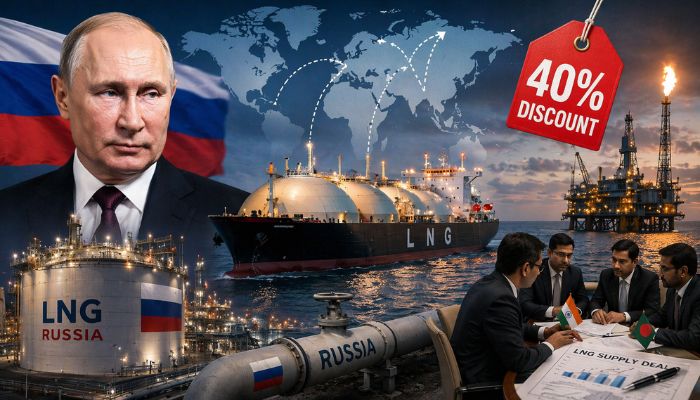
Russia is once again trying to turn global turmoil into an economic opportunity. In a significant development, Moscow has started offering liquefied natural gas (LNG) shipments at steep discounts, as much as 40% below prevailing spot market prices, to buyers in South Asia. The move comes on Wednesday, 8th April, at a time when global gas supplies are under severe strain, making cheaper alternatives highly attractive for countries like India and Bangladesh.
#NewsAlert | Russia offers US-sanctioned LNG to Asian buyers at 40% discount (Agencies)#Russia #USA #IranWar #oil #crude pic.twitter.com/xzY0N27vea— ET NOW (@ETNOWlive) April 9, 2026
According to a report by Bloomberg, these discounted cargoes are being marketed through little-known intermediary firms based in China and Russia. The intermediaries are saying that they can provide paperwork to show that the shipments are from non-Russian sources, like Oman or Nigeria, and remove any traces of true origin.
The move comes as disruptions in the Middle East have throttled roughly one-fifth of global LNG supply.
Global crisis reshaped energy markets
The backdrop to this development is a rapidly deteriorating geopolitical situation, particularly in West Asia. The effective closure of the Strait of Hormuz, combined with attacks on Qatar’s massive export facilities, has sent Asian spot LNG prices soaring, creating acute pressure on import-dependent economies across South Asia.
Although a ceasefire was recently announced, it has failed to fully restore stability. The United States’ refusal to accept certain demands from Iran has meant that the Strait remains largely inaccessible, keeping energy flows restricted. As a result, countries heavily dependent on LNG imports, especially in South Asia, are facing mounting pressure to secure alternative supplies.
Bangladesh, for instance, sourced nearly 60% of its LNG from Qatar last year. With those supplies disrupted, it has been forced to rely on expensive spot market purchases. Similarly, India has had to cut gas supply to key sectors like fertiliser production due to reduced availability and rising costs.
In this scenario, Russian LNG, despite sanctions, has started to appear as a viable fallback option.
Sanctions continue to complicate Russian exports
However, Russia’s ability to fully capitalise on this opportunity remains constrained by Western sanctions. The European Union’s 19th sanctions package, announced in October 2025, includes a ban on importing Russian LNG, set to take effect from April 25, 2026. The sanctions also include asset freezes on major Russian companies.
Similarly, the United Kingdom has imposed asset-freeze sanctions on key Russian oil giants like Rosneft and Lukoil. These measures are part of broader efforts to restrict Moscow’s revenue streams following its invasion of Ukraine.
Due to the fear of these sanctions, most international companies refrain from buying Russian LNG for fear of being targeted with US-led sanctions. To date, only China remains a reliable importer of sanctioned Russian LNG via a fleet of shadow ships.
Russian energy still finds buyers
Despite these hurdles, Russian energy continues to find demand in the global market. The Kremlin recently stated that there has been a “huge number of requests” for Russian energy from different parts of the world amid the ongoing crisis.
Russia has also been ramping up production from its sanctioned projects, including Arctic LNG 2 and Portovaya. Nevertheless, those projects have yet to achieve their full potential due to the lack of sufficient transportation means and potential consumers.
On the other hand, the economic situation within Russia becomes more complicated. The state reported its budget deficit at 4.58 trillion roubles (about 1.9% of its GDP) in Quarter 1 of 2026. Additionally, Russia’s energy infrastructure faces further Ukrainian attacks that affect the output and revenue.
Strategic opportunity behind the discount strategy
Russia’s aggressive discounting strategy is not just about clearing excess supply; it is a calculated move shaped by shifting global dynamics. The disruption of energy flows through the Strait of Hormuz has created a significant gap in supply, particularly for Asian markets that rely heavily on Middle Eastern energy.
An estimated 66% of LNG passing through the Strait is destined for Asia, making the region especially vulnerable to disruptions. For countries like India, where dependence on crude oil through the Strait reached as high as 55% in early 2026, securing alternative sources has become a top priority.
This situation gives Russia a strategic edge. With Gulf supplies constrained, Moscow can position itself as an alternative supplier. Reports suggest that millions of tonnes of Russian crude were left without buyers earlier this year, and discounted LNG is now being used as a tool to attract new markets.
Following recent geopolitical tensions, Russia’s fossil fuel export earnings have reportedly risen, with daily revenues increasing by 14% compared to February averages. This highlights how Moscow is leveraging the crisis to stabilise its energy sector.
Discounted LNG will give a major financial boost to Russia
Russia’s ongoing strategy to sell discounted LNG is also translating into a significant financial boost, despite Western sanctions and global pressure.
According to a report by Reuters, Russia is expected to see a sharp rise in revenue from its key oil-related taxes amid the ongoing global energy crisis. The report states that earnings from Russia’s biggest single oil tax are likely to double to around $9 billion in April.
Unlike export duties, which were scrapped in 2024 as part of Russia’s long-term tax reforms, the country now relies heavily on production-based taxes for revenue. The mineral extraction tax, a key source of income for the Russian government, is expected to rise significantly due to higher global prices and steady production levels.
As per Reuters’ calculations based on early production data and prevailing oil prices, Russia’s mineral extraction tax on oil output is projected to reach around 700 billion roubles (approximately $9 billion) in April. This is more than double the 327 billion roubles collected in March and also marks a roughly 10% increase compared to April last year.
For the full year 2026, Russia has already projected earnings of about 7.9 trillion roubles from this tax alone. This indicates how Moscow is still managing to benefit financially from global instability, even as sanctions continue to restrict its access to traditional markets.
India’s cautious yet flexible approach
India, one of the largest energy importers in the region, is treading carefully. The Indian government had earlier made it clear that it would not purchase any LNG from Russian projects, which were banned because of sanctions.
But then again, India’s policies with respect to energy tend to be quite flexible as well. For instance, India resumed oil imports from Iran recently due to a waiver eased by the US, marking a shift since 2019.
India’s need for cheap oil is obvious from the statistics, as it increased its imports of crude oil from Russia by 90% in March 2026 compared to February amid the ongoing conflict in the West Asian region. India is increasingly reliant on these discounted barrels to keep its economy afloat and expects the United States to extend waivers on Russian oil purchases to help stabilise global prices.
While Indian companies like Petronet LNG and GAIL remain vulnerable to rising input costs, the government’s ability to secure discounted energy is seen as a vital buffer against inflation.
As the global supply remains tight, the pressure on India to eventually accept discounted Russian LNG, perhaps through the very intermediaries and masked paperwork currently being offered, will only grow. For New Delhi, the challenge remains a delicate dance between maintaining strategic ties with the West and ensuring the lights stay on at home.
The global LNG market is currently in a state of flux, shaped by geopolitical tensions, supply disruptions, and shifting alliances. Russia’s move to offer discounted LNG highlights how energy is increasingly being used as a strategic tool in international relations.