NYT triggers outrage for using Father’s Day to push ‘trans dad’ narrative: How Western media is pushing transgender activism into mainstream culture
The New York Times has synonymised full-fledged activism with journalism. The NYT’s activism is so diverse that on one day, the newspaper humanises Islamists, on the other, it injects a woke agenda in days celebrating specific gender roles. On the occasion of Father’s Day this year, the New York Times published a guest essay normalising ‘trans dad’. The NYT’s trans activism on Father’s Day, however, did not sit well with many on social media. Written by Zach Ellams, a biological female who identifies as a ‘trans’ man, the article appears in illustrated comic-strip format with drawings from Hannah Jacobs. Zach Ellams, the author of the article headlined, “To My Daughter, My Gender Was Never Complicated”, is described as a London-based editor and motion designer. Ellams has lived as a trans man since the age of 18. In the NYT piece, Ellams recounted experiences parenting a daughter named Elliot, with his ‘wife’. The NYT piece published on 21st June not only normalises biological females identifying as men, parenting children as fathers, but also furthers a victimhood narrative. The article frames ‘fatherhood’ as aiding Zach Ellams overcome personal shaming about ‘transitioning’ from a biological female to a trans male by undergoing a gender-change procedure, and embracing his self-imposed identity fully. Ellams highlights how trans males need “thick skin” as a parent. The NYT piece portrays Ellams’s young daughter’s casual acceptance of her trans dad’s sexuality as supportive and progressive. The article includes anecdotes of public or everyday moments wherein Ellams’s daughter asks questions about or comments on Ellam’s body and past. The key conversations include: While walking down the street, the daughter asks, “How long did you have breasts, Dad?” At a pool: “How did you grow a moustache if you were a lady?” On a playground: The daughter says, “I want to grow a beard when I grow up.” Another child replies, “You can’t grow a beard. You’re a girl.” The daughter responds, “My dad did, and he was a girl.” While the New York Times emphasised the child’s supposed easy navigation of complex issues like gender transition or sex change procedures, and social acceptance of what is described as trans dads, people on social media questioned the timing and deliberate framing. Many called out the NYT for using a major traditional holiday to centre a biological woman’s “transgender” identity and parenting experience while redefining “dad”. The use of comic format for soft peddling “trans people are dads and moms too” is interesting. This format made the gender-related questions from the child made if look ‘fun’ and shareable among children for ‘gender-sensitisation’, because what could be better than convincing young children that it is normal and desirable to undergo Gender-Affirming Surgery (GAS). Criticising the NYT for bringing in transgender woke narratives into Father’s Day, End Wokeness wrote on X, “The New York Times on Father’s Day. We do not hate the media enough.” Author Alex Berenson blended criticism with sarcasm and wrote, “I want to congratulate @nytimes for perfectly catching how the cultural elite view men and fatherhood this Father’s Day – yes, to the Times, being a dad is something you do to feel better about having your tits cut off. Cannot make it up.” Popular podcaster Katie Miller wrote, “The New York Times published cartoons about being a trans dad for Father’s Day. This is how they envision corrupting our children.” Meanwhile, Charles Gasparino, journalist with Fox Business, wrote, “The gulf between the progressive left and the rest of the country (say around 80% of Americans) has never been wider based on this nonsense from @nytimes on Father’s Day, no less. And you wonder why Trump got elected. To My Daughter, My Gender Was Never Complicated.” Many others called the NYT’s piece an attempt at erasing men and turning Father’s Day into ‘Trans Dads Day’. The NYT has been joined by several other legacy media outlets in and outside the US, giving favourable coverage to non-biological/trans perspectives on Father’s Day. This is a blatant attempt by the New York Times at pushing and normalising the idea of ‘trans dad’, ‘trans mom’ or ‘trans parents’ into the mainstream by using traditional occasions associated with fatherhood or motherhood, essentially, days celebrating gender roles. While trans activists have aggressively been pushing these narratives in schools across the US and many European countries, their media allies platform gender confused mothers and wokes to establish the use of cross-sex hormone injections, puberty blockers, GAS, and ‘trans parenthood’ as something equivalent to and as normal as the real biological genders and relations, sometimes better. The strategy is to embed woke gender ideology into everyday cultural touchstones. Now the trans activists are using traditional holidays and roles as
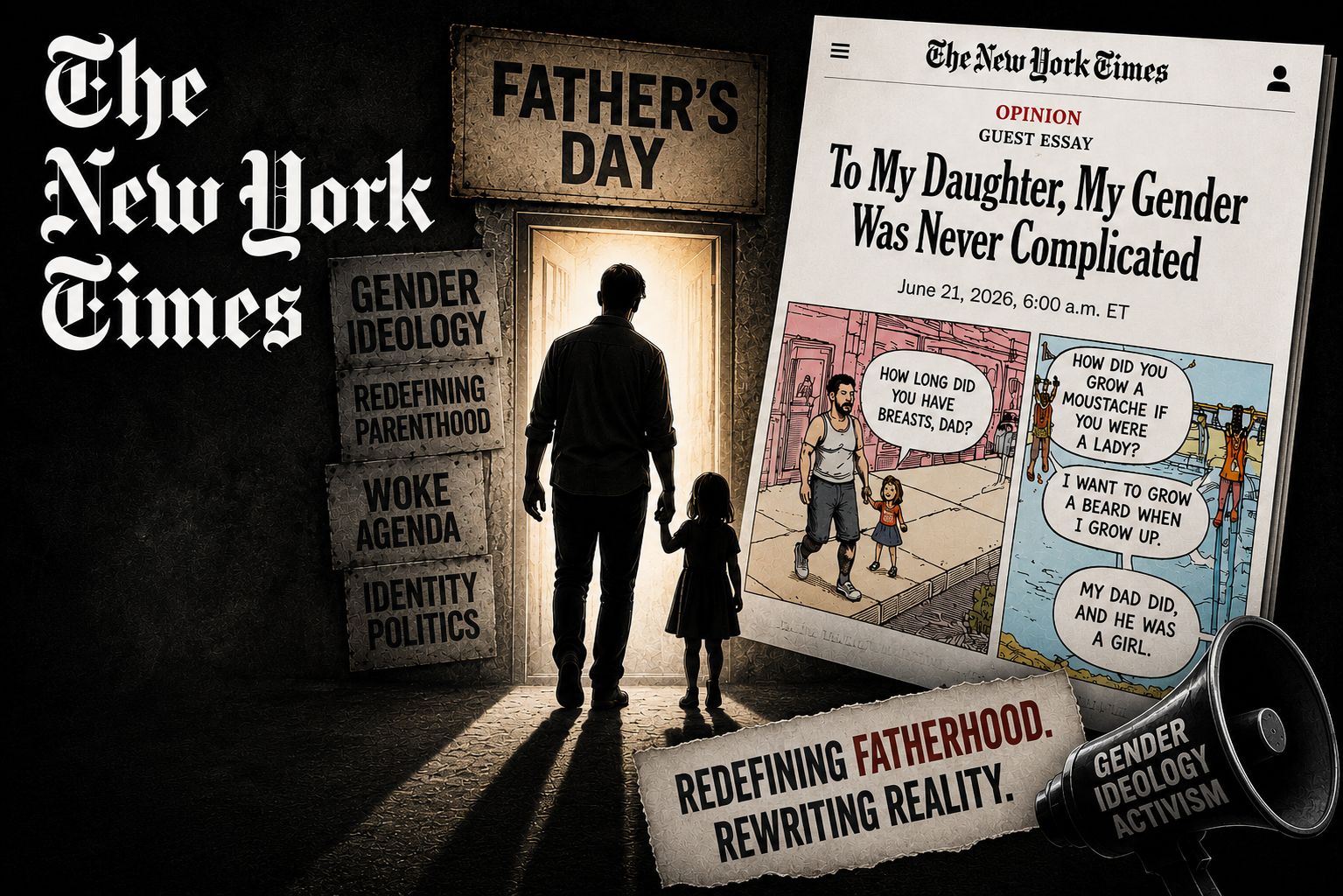
The New York Times has synonymised full-fledged activism with journalism. The NYT’s activism is so diverse that on one day, the newspaper humanises Islamists, on the other, it injects a woke agenda in days celebrating specific gender roles. On the occasion of Father’s Day this year, the New York Times published a guest essay normalising ‘trans dad’. The NYT’s trans activism on Father’s Day, however, did not sit well with many on social media.
Written by Zach Ellams, a biological female who identifies as a ‘trans’ man, the article appears in illustrated comic-strip format with drawings from Hannah Jacobs.
Zach Ellams, the author of the article headlined, “To My Daughter, My Gender Was Never Complicated”, is described as a London-based editor and motion designer. Ellams has lived as a trans man since the age of 18. In the NYT piece, Ellams recounted experiences parenting a daughter named Elliot, with his ‘wife’.
The NYT piece published on 21st June not only normalises biological females identifying as men, parenting children as fathers, but also furthers a victimhood narrative. The article frames ‘fatherhood’ as aiding Zach Ellams overcome personal shaming about ‘transitioning’ from a biological female to a trans male by undergoing a gender-change procedure, and embracing his self-imposed identity fully.
Ellams highlights how trans males need “thick skin” as a parent. The NYT piece portrays Ellams’s young daughter’s casual acceptance of her trans dad’s sexuality as supportive and progressive.
The article includes anecdotes of public or everyday moments wherein Ellams’s daughter asks questions about or comments on Ellam’s body and past. The key conversations include:
While walking down the street, the daughter asks, “How long did you have breasts, Dad?”
At a pool: “How did you grow a moustache if you were a lady?”
On a playground: The daughter says, “I want to grow a beard when I grow up.” Another child replies, “You can’t grow a beard. You’re a girl.” The daughter responds, “My dad did, and he was a girl.”
While the New York Times emphasised the child’s supposed easy navigation of complex issues like gender transition or sex change procedures, and social acceptance of what is described as trans dads, people on social media questioned the timing and deliberate framing.
Many called out the NYT for using a major traditional holiday to centre a biological woman’s “transgender” identity and parenting experience while redefining “dad”. The use of comic format for soft peddling “trans people are dads and moms too” is interesting. This format made the gender-related questions from the child made if look ‘fun’ and shareable among children for ‘gender-sensitisation’, because what could be better than convincing young children that it is normal and desirable to undergo Gender-Affirming Surgery (GAS).
Criticising the NYT for bringing in transgender woke narratives into Father’s Day, End Wokeness wrote on X, “The New York Times on Father’s Day. We do not hate the media enough.”
Author Alex Berenson blended criticism with sarcasm and wrote, “I want to congratulate @nytimes for perfectly catching how the cultural elite view men and fatherhood this Father’s Day – yes, to the Times, being a dad is something you do to feel better about having your tits cut off. Cannot make it up.”
Popular podcaster Katie Miller wrote, “The New York Times published cartoons about being a trans dad for Father’s Day. This is how they envision corrupting our children.”
Meanwhile, Charles Gasparino, journalist with Fox Business, wrote, “The gulf between the progressive left and the rest of the country (say around 80% of Americans) has never been wider based on this nonsense from @nytimes on Father’s Day, no less. And you wonder why Trump got elected. To My Daughter, My Gender Was Never Complicated.”
Many others called the NYT’s piece an attempt at erasing men and turning Father’s Day into ‘Trans Dads Day’. The NYT has been joined by several other legacy media outlets in and outside the US, giving favourable coverage to non-biological/trans perspectives on Father’s Day. This is a blatant attempt by the New York Times at pushing and normalising the idea of ‘trans dad’, ‘trans mom’ or ‘trans parents’ into the mainstream by using traditional occasions associated with fatherhood or motherhood, essentially, days celebrating gender roles.
While trans activists have aggressively been pushing these narratives in schools across the US and many European countries, their media allies platform gender confused mothers and wokes to establish the use of cross-sex hormone injections, puberty blockers, GAS, and ‘trans parenthood’ as something equivalent to and as normal as the real biological genders and relations, sometimes better.
The strategy is to embed woke gender ideology into everyday cultural touchstones. Now the trans activists are using traditional holidays and roles as vehicles for normalising transgender identities, gender fluidity, and what could have been a better occasion than Father’s Day to decouple “parent” from biological sex. This is forced inclusion.
Conventionally, the terms ‘gender’ and ‘sex’ have been used interchangeably, and it has been a scientifically and logically accepted fact that there are only two genders that could be considered normal. In contrast, transgender individuals are considered a deviation from the norm and anomalous. The non-binary and ‘gender fluid’ people claim that they are not comfortable with conventional pronouns since they are associated with gender identities. This led to the coining of new pronouns like “They/Them” and Xe/Xhrer.”
The US and Europe have been the centre of this gender-affirmation and related political debates; the rot has metastasised to several countries across the world.
Clearly, Donald Trump’s return to power may have slowed the trans activism wave in the US. The ‘wokeness’ has not died down; rather, it is simmering beneath the surface. Once the Republicans are voted out, the normalisation of transgender identities will resume in full swing.