NCERT textbook discussing corruption in the judiciary and case backlogs: Why it is important perspective, not political goal-scoring as Kapil Sibal implies
The National Council for Education Research and Training (NCERT) released the new textbook for Class 8 on Social Sciences on Monday. The book, titled ‘Exploring Society: India and Beyond Part-2’, includes a chapter on “The Role of Judiciary in Our Society”. The chapter includes a section on the major challenges before the Indian judiciary at present, corruption in the judiciary and the massive amount of case backlog are listed in that. The section starts with the subheading “Justice delayed is justice denied”, and lists the massive amount of case backlog that the Indian judiciary faces. Without laying unfair blame with political motivation, the paragraph lists real reasons behind the backlog, like the lack of an adequate number of judges, complicated judicial procedure and the poor judicial infrastructure. The problems facing the judiciary are covered in the revised chapter.(Source: The Indian Express) The subheading ‘corruption in the judiciary’ describes the importance of proper judicial conduct, the Bangalore Principles of Judicial Conduct and why it is important that judges are seen by the public as fair and impartial. The section also informs students that there is an established procedure to maintain accountability, the Centralised Public Grievance and Monitoring System (CPGRAMS). None of the above details are fictional, the issues mentioned, the backlogs, and the necessity of proper judicial accountability in a country are all facts. However, social media is as usual divided into two different major opinions. One group, like Kapil Sibal, suggests it’s unfair to highlight corruption in the judiciary without addressing similar issues in other government branches. The other group sees the inclusion of the section in the NCERT textbook as some sort of goal-scoring by the government against the judiciary. In reality, both claims miss the mark. The textbook simply presents verifiable facts with a balanced perspective on ongoing reforms, and including such content is a positive step toward fostering informed citizenship among students. Important perspective, not propaganda The book doesn’t paint a one-sided picture. It emphasizes accountability mechanisms, such as judges being bound by a code of conduct, internal complaint systems like the Centralised Public Grievance Redress and Monitoring System (CPGRAMS), which handled over 1,600 complaints between 2017 and 2021, and informs about parliamentary impeachment for serious allegations. It quotes former Chief Justice of India B.R. Gavai from July 2025, acknowledging instances of corruption and misconduct but stressing swift, decisive and transparent action to rebuild trust. The chapter also highlights positive efforts at state and union levels, including technology use, to enhance transparency. By no means this is a sensationalism or goal scoring of any kind. In fact, this aligns with broader NCERT revisions under NEP 2020, which aim to incorporate contemporary issues into curricula. Kapil Sibal’s argument overlooks the chapter’s scope: it’s dedicated to the judiciary. There are other chapters in the book, like chapters on Parliament and lawmaking, and so on. There is a chapter on social justice and its necessity, emphasising how government sometimes fails to benefit the marginalised communities. The textbook isn’t a comparative analysis of government branches; it’s an introduction to how the judicial system functions and its real-world challenges. Corruption isn’t unique to the judiciary. If a textbook informs students that corruption and backlogs are among the major challenges faced by the Indian judiciary today, it is telling facts and providing a crucial contemporary perspective, not disseminating propaganda. Kapil Sibal’s post Similarly wrong and misleading are the hyperventilating claims suggesting some sort of goal-scoring against the judiciary by the government. The content is evidence-based. Backlog statistics come from official sources, showing over 81,000 pending cases in SC, 62,40,000 pending cases in HCs, and a staggering 4,70,00,000 pending cases in lower courts, a figure that has doubled in a decade and could take centuries to clear at current rates. The corruption references draw from judicial leaders themselves, like CJI Gavai’s remarks, not partisan sources. NCERT operates as an autonomous body, and these updates stem from NEP 2020’s emphasis on critical thinking and real-world relevance, not political vendettas. The subtle pattern of change in how subjects are explained to students have been changing over the years, diverting from the cold mention of facts in old books to added perspectives and updated points of view in latest books. New-age students need new-age learning For example, take this mention of universal franchise in India. It is from the chapter ‘Universal Franchise and India’s Electoral System’ in Part 1 of the Social Sciences NCERT textbook. Going beyond just laying col
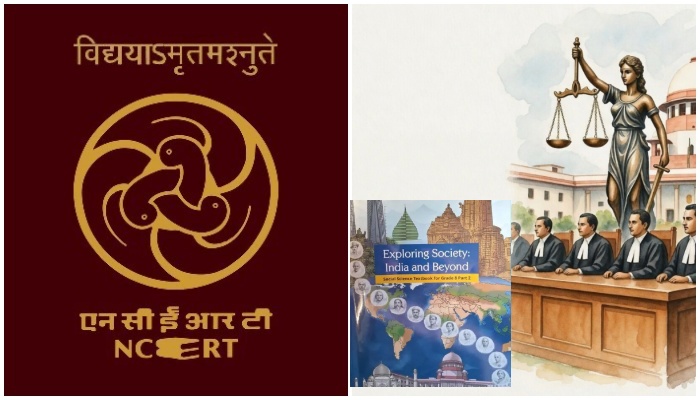
The National Council for Education Research and Training (NCERT) released the new textbook for Class 8 on Social Sciences on Monday. The book, titled ‘Exploring Society: India and Beyond Part-2’, includes a chapter on “The Role of Judiciary in Our Society”. The chapter includes a section on the major challenges before the Indian judiciary at present, corruption in the judiciary and the massive amount of case backlog are listed in that.
The section starts with the subheading “Justice delayed is justice denied”, and lists the massive amount of case backlog that the Indian judiciary faces. Without laying unfair blame with political motivation, the paragraph lists real reasons behind the backlog, like the lack of an adequate number of judges, complicated judicial procedure and the poor judicial infrastructure.
The problems facing the judiciary are covered in the revised chapter.(Source: The Indian Express)
The subheading ‘corruption in the judiciary’ describes the importance of proper judicial conduct, the Bangalore Principles of Judicial Conduct and why it is important that judges are seen by the public as fair and impartial. The section also informs students that there is an established procedure to maintain accountability, the Centralised Public Grievance and Monitoring System (CPGRAMS).
None of the above details are fictional, the issues mentioned, the backlogs, and the necessity of proper judicial accountability in a country are all facts. However, social media is as usual divided into two different major opinions.
One group, like Kapil Sibal, suggests it’s unfair to highlight corruption in the judiciary without addressing similar issues in other government branches. The other group sees the inclusion of the section in the NCERT textbook as some sort of goal-scoring by the government against the judiciary.
In reality, both claims miss the mark. The textbook simply presents verifiable facts with a balanced perspective on ongoing reforms, and including such content is a positive step toward fostering informed citizenship among students.
Important perspective, not propaganda
The book doesn’t paint a one-sided picture. It emphasizes accountability mechanisms, such as judges being bound by a code of conduct, internal complaint systems like the Centralised Public Grievance Redress and Monitoring System (CPGRAMS), which handled over 1,600 complaints between 2017 and 2021, and informs about parliamentary impeachment for serious allegations.
It quotes former Chief Justice of India B.R. Gavai from July 2025, acknowledging instances of corruption and misconduct but stressing swift, decisive and transparent action to rebuild trust.
The chapter also highlights positive efforts at state and union levels, including technology use, to enhance transparency.
By no means this is a sensationalism or goal scoring of any kind. In fact, this aligns with broader NCERT revisions under NEP 2020, which aim to incorporate contemporary issues into curricula.
Kapil Sibal’s argument overlooks the chapter’s scope: it’s dedicated to the judiciary. There are other chapters in the book, like chapters on Parliament and lawmaking, and so on. There is a chapter on social justice and its necessity, emphasising how government sometimes fails to benefit the marginalised communities. The textbook isn’t a comparative analysis of government branches; it’s an introduction to how the judicial system functions and its real-world challenges. Corruption isn’t unique to the judiciary. If a textbook informs students that corruption and backlogs are among the major challenges faced by the Indian judiciary today, it is telling facts and providing a crucial contemporary perspective, not disseminating propaganda.
Kapil Sibal’s post
Similarly wrong and misleading are the hyperventilating claims suggesting some sort of goal-scoring against the judiciary by the government. The content is evidence-based. Backlog statistics come from official sources, showing over 81,000 pending cases in SC, 62,40,000 pending cases in HCs, and a staggering 4,70,00,000 pending cases in lower courts, a figure that has doubled in a decade and could take centuries to clear at current rates.
The corruption references draw from judicial leaders themselves, like CJI Gavai’s remarks, not partisan sources.
NCERT operates as an autonomous body, and these updates stem from NEP 2020’s emphasis on critical thinking and real-world relevance, not political vendettas. The subtle pattern of change in how subjects are explained to students have been changing over the years, diverting from the cold mention of facts in old books to added perspectives and updated points of view in latest books.
New-age students need new-age learning
For example, take this mention of universal franchise in India. It is from the chapter ‘Universal Franchise and India’s Electoral System’ in Part 1 of the Social Sciences NCERT textbook. Going beyond just laying cold details that students find dry and unrelatable, the chapter makes a point to remind students why the universal franchise was important for a newly independent India. And how, the early leaders, displaying a more progressive and forward-thinking attitude than many European nations at that time, decided that women of India will also vote, granting them equal rights as citizens of this nation.
Books of the past told us about forest terrains, mountain terrains and deserts. But current books provide added context on how people live there, what kinds of difficulties they face, and how they earn a living. Past instances of blind glorification of certain rulers, like Babar and Aurangzeb, have also ‘evolved’, educating students about the other sides of their rule, like temple destructions, forced conversions and cruelty.
Times are changing. Students do not just need cold details and texts detached from real-world scenarios. They need perspectives and thinking points that explain the real-world implications and realities of our times.
Far from being problematic, including these perspectives is a smart evolution for NCERT. Traditional textbooks often stuck to “cold details”, structures, hierarchies, and ideals, leaving students disconnected from reality. By discussing challenges like corruption and backlogs, the book aligns with NEP’s goal of promoting analytical skills and civic awareness among children. It encourages discussions on reforms, such as technology-driven transparency or increasing judicial staffing, preparing young minds to engage with democracy’s imperfections.
In a country where judicial delays affect millions, with a real possibility that the families of some of the students who will read this book might be among them, this isn’t indoctrination or propaganda. This is empowerment. Students learn that institutions aren’t infallible but can improve through accountability. They learn that questioning the existing system is their democratic right and accountability, and corrections are as important as the institutions themselves.