Modi government presents a growth-oriented budget prioritising infrastructure, welfare, and industry with focus on fiscal discipline: An analysis of key numbers
The Modi government’s Union Budget 2026 has laid out an ambitious but fiscally cautious roadmap, with the government placing big numbers on the table for spending, taxation, borrowing and deficit reduction. In the budget designed to propel sustained high economic growth whilst prioritising people-centric development and structural reforms, the Indian government has projected total expenditure of ₹53,47,315 crore for the fiscal year 2026-27. Presented as a “Yuva Shakti-driven Budget” with a guiding ‘Sankalp’ to focus on the poor, underprivileged, and disadvantaged, the financial blueprint underscores the vision of ‘Sabka Sath, Sabka Vikas’. The budget 2026, the first one to be prepared at Kartava Bhawan on Central Vista, is structured around three key ‘Kartavyas’: accelerating and sustaining economic growth through enhanced productivity, competitiveness, and resilience to global volatility; fulfilling people’s aspirations by building their capacities and making them active partners in India’s prosperity; and ensuring equitable access to resources, amenities, and opportunities for every family, community, region, and sector. The budget estimates (BE) for 2026-17 indicate a 7.7% rise over the revised estimates (RE) for 2025-26, highlighting continued investment in infrastructure and welfare. A key feature of Budget 2026 is the sustained thrust on capital investment. The government has earmarked capital expenditure of ₹12.2 lakh crore, a sharp rise from the levels seen a decade ago, reflecting the priority being given to infrastructure creation, logistics, energy security and long-term economic capacity building. The budget, themed around transforming aspirations into achievements and balancing ambition with inclusion, projects India’s GDP at ₹3,93,00,393 crore for 2026-27, representing a 10% increase over the advance estimates of ₹3,57,13,886 crore for 2025-26. This optimistic forecast reflects the government’s confidence in attaining a robust growth rate of around 7%, bolstered by fiscal discipline, monetary stability, and comprehensive reforms. It aligns with the pillars of growth and development, including sustaining economic growth, strengthening foundations, people-centric initiatives, trust-based governance, ease of doing business and living, and fiscal matters. In India’s 2026-27 budget, revenue receipts are projected to reach approximately ₹35.33 lakh crore, primarily driven by tax revenue net to the Centre at around ₹28.67 lakh crore, while non-tax revenue stands at about ₹6.66 lakh crore. Income tax will contribute roughly ₹10.8 lakh crore, while corporation tax is estimated at about ₹9.9 lakh crore. Capital receipts are estimated at ₹18.14 lakh crore, including recoveries of loans and borrowings. After transferring a significant portion of tax revenues to states, the Centre’s net tax revenue is estimated at approximately ₹26.9 lakh crore. Maintaining fiscal prudence is central, with the fiscal deficit targeted at 4.3% of GDP, a reduction from 4.4% in 2025-26 RE. The deficit has been declining every year after reaching 9.2% in 2020-21 during the pandemic. This demonstrates the government’s commitment to lowering borrowing requirements whilst funding growth-oriented schemes. The fiscal deficit of ₹16.96 lakh crore (4.3% of GDP) includes revenue deficit of ₹5.92 lakh crore (1.5% of GDP) and primary deficit of ₹2.92 lakh crore (0.7% of GDP). These figures show a narrowing trend compared to prior years, with borrowings and other liabilities estimated at ₹16.96 lakh crore. Borrowings remain the dominant source of financing the deficit, accounting for nearly 24% of total receipts, while non-debt capital receipts contribute only around 2%. The Budget also show that the government is committed to reducing debt over the medium term. The debt-to-GDP ratio is estimated at 55.6% in 2026–27, compared with 56.1% in the revised estimates of 2025–26, with an eventual target of reaching 50±1% by 2030. The budget also notes an adjustment of ₹9,084 crore in 2025-26 RE owing to net receivables from states for previous years. Furthermore, the 16th Finance Commission has recommended retaining the vertical share of devolution at 41%, with ₹1.41 lakh crore allocated to states for FY27 as Finance Commission grants, including those for rural and urban local bodies and disaster management. A notable feature is the enhanced resource transfer to states and Union Territories with legislatures, totalling ₹25,43,769 crore in 2026-27 BE. This encompasses devolution of states’ share in taxes, grants/loans, and releases under Centrally Sponsored Schemes, marking an increase of ₹3,78,263 crore over 2024-25 actuals. For expenditure, 22% goes as share of states in taxes, while 20% will be spent on interest payment. Notably, transport sector has been allotted more money than defence sector, as the sector gets nearly ₹5.99 lakh crore against about ₹5.95 lakh crore allocated for defence. and. Oth
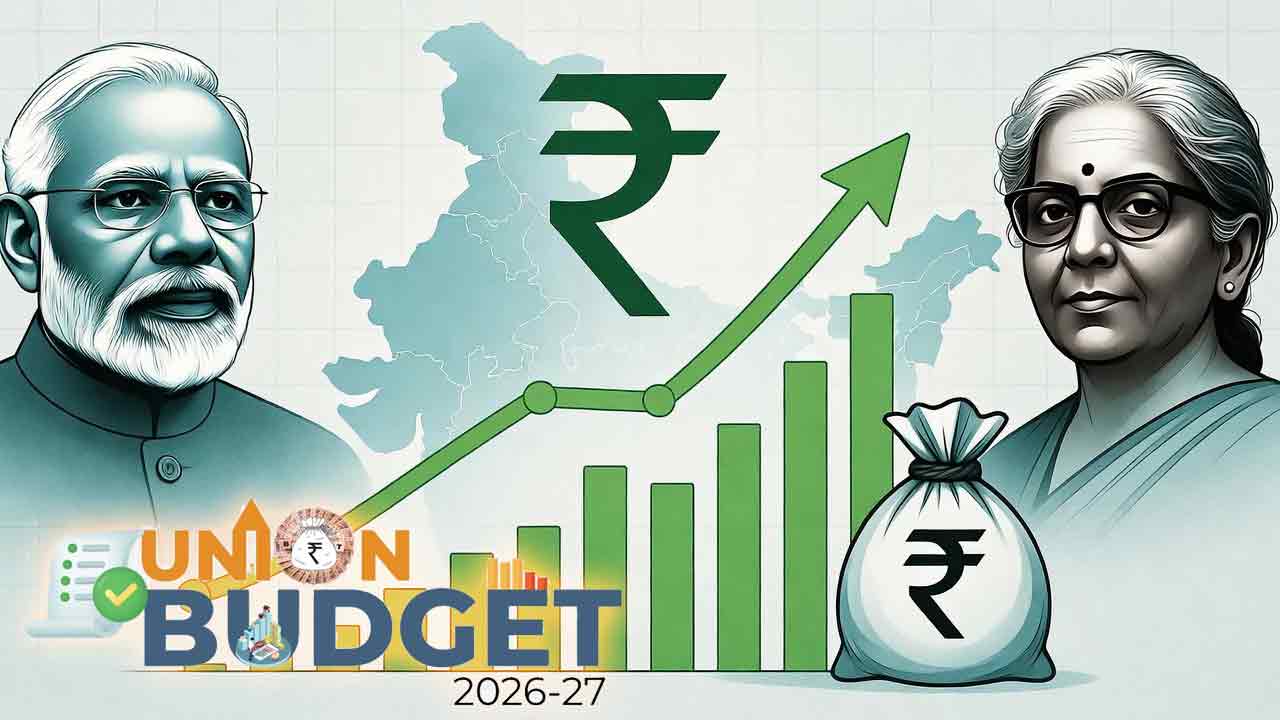

The Modi government’s Union Budget 2026 has laid out an ambitious but fiscally cautious roadmap, with the government placing big numbers on the table for spending, taxation, borrowing and deficit reduction. In the budget designed to propel sustained high economic growth whilst prioritising people-centric development and structural reforms, the Indian government has projected total expenditure of ₹53,47,315 crore for the fiscal year 2026-27. Presented as a “Yuva Shakti-driven Budget” with a guiding ‘Sankalp’ to focus on the poor, underprivileged, and disadvantaged, the financial blueprint underscores the vision of ‘Sabka Sath, Sabka Vikas’.
The budget 2026, the first one to be prepared at Kartava Bhawan on Central Vista, is structured around three key ‘Kartavyas’: accelerating and sustaining economic growth through enhanced productivity, competitiveness, and resilience to global volatility; fulfilling people’s aspirations by building their capacities and making them active partners in India’s prosperity; and ensuring equitable access to resources, amenities, and opportunities for every family, community, region, and sector.
The budget estimates (BE) for 2026-17 indicate a 7.7% rise over the revised estimates (RE) for 2025-26, highlighting continued investment in infrastructure and welfare.
A key feature of Budget 2026 is the sustained thrust on capital investment. The government has earmarked capital expenditure of ₹12.2 lakh crore, a sharp rise from the levels seen a decade ago, reflecting the priority being given to infrastructure creation, logistics, energy security and long-term economic capacity building.

The budget, themed around transforming aspirations into achievements and balancing ambition with inclusion, projects India’s GDP at ₹3,93,00,393 crore for 2026-27, representing a 10% increase over the advance estimates of ₹3,57,13,886 crore for 2025-26. This optimistic forecast reflects the government’s confidence in attaining a robust growth rate of around 7%, bolstered by fiscal discipline, monetary stability, and comprehensive reforms. It aligns with the pillars of growth and development, including sustaining economic growth, strengthening foundations, people-centric initiatives, trust-based governance, ease of doing business and living, and fiscal matters.
In India’s 2026-27 budget, revenue receipts are projected to reach approximately ₹35.33 lakh crore, primarily driven by tax revenue net to the Centre at around ₹28.67 lakh crore, while non-tax revenue stands at about ₹6.66 lakh crore. Income tax will contribute roughly ₹10.8 lakh crore, while corporation tax is estimated at about ₹9.9 lakh crore. Capital receipts are estimated at ₹18.14 lakh crore, including recoveries of loans and borrowings. After transferring a significant portion of tax revenues to states, the Centre’s net tax revenue is estimated at approximately ₹26.9 lakh crore.
Maintaining fiscal prudence is central, with the fiscal deficit targeted at 4.3% of GDP, a reduction from 4.4% in 2025-26 RE. The deficit has been declining every year after reaching 9.2% in 2020-21 during the pandemic. This demonstrates the government’s commitment to lowering borrowing requirements whilst funding growth-oriented schemes.
The fiscal deficit of ₹16.96 lakh crore (4.3% of GDP) includes revenue deficit of ₹5.92 lakh crore (1.5% of GDP) and primary deficit of ₹2.92 lakh crore (0.7% of GDP). These figures show a narrowing trend compared to prior years, with borrowings and other liabilities estimated at ₹16.96 lakh crore.

Borrowings remain the dominant source of financing the deficit, accounting for nearly 24% of total receipts, while non-debt capital receipts contribute only around 2%.
The Budget also show that the government is committed to reducing debt over the medium term. The debt-to-GDP ratio is estimated at 55.6% in 2026–27, compared with 56.1% in the revised estimates of 2025–26, with an eventual target of reaching 50±1% by 2030.
The budget also notes an adjustment of ₹9,084 crore in 2025-26 RE owing to net receivables from states for previous years. Furthermore, the 16th Finance Commission has recommended retaining the vertical share of devolution at 41%, with ₹1.41 lakh crore allocated to states for FY27 as Finance Commission grants, including those for rural and urban local bodies and disaster management.
A notable feature is the enhanced resource transfer to states and Union Territories with legislatures, totalling ₹25,43,769 crore in 2026-27 BE. This encompasses devolution of states’ share in taxes, grants/loans, and releases under Centrally Sponsored Schemes, marking an increase of ₹3,78,263 crore over 2024-25 actuals.
For expenditure, 22% goes as share of states in taxes, while 20% will be spent on interest payment. Notably, transport sector has been allotted more money than defence sector, as the sector gets nearly ₹5.99 lakh crore against about ₹5.95 lakh crore allocated for defence. and. Other significant outlays include home affairs at ₹2.55 lakh crore, rural development at ₹2.73 lakh crore, agriculture and allied activities at ₹1.63 lakh crore, education at ₹1.39 lakh crore, energy at ₹1.09 lakh crore, and health at ₹1.05 lakh crore, emphasising infrastructure, security, and social welfare.
Subsidies, especially on food and fertilisers, continue to form a substantial part of revenue expenditure, ensuring support for vulnerable households and farmers.

The budget allocates substantial funds to key sectors to sustain structural reforms. In sustaining economic growth, emphasis is placed on manufacturing through strategic and frontier sectors, including the India Semiconductor Mission (ISM) 2.0, Biopharma Shakti, high-tech tool rooms in CPSEs, schemes for rare earth permanent magnets, dedicated chemical parks for enhanced domestic production, electronics components manufacturing, strengthening domestic high-value and technologically advanced construction and infrastructure equipment, integrated programmes for textiles, reviving 200 legacy industrial clusters, and dedicated initiatives for affordable sports goods manufacturing.
The budget also proposes tax reforms to boost manufacturing, including five-year income tax exemptions for non-residents providing capital goods to bonded zones, safe harbour provisions for component warehousing, deferred duty payments for trusted manufacturers, increased duty-free import limits for seafood processing inputs, extensions for shoe upper exports, time extensions for garment and footwear exports, and exemptions from basic customs duty on parts for microwave ovens, aircraft manufacturing, and maintenance.
Renewed focus on the services sector includes a high-powered ‘Education to Employment and Enterprise’ Standing Committee, upgrades to allied health professional institutions, training 1.5 lakh multiskilled caregivers, schemes for five medical value tourism hubs, three new All India Institutes of Ayurveda with upgraded pharmacies and labs, enhancements to the WHO Global Traditional Medicine Centre, AVGC content creator labs in 15,000 schools and 500 colleges, a new National Institute of Design in the eastern region, and the Khelo India Mission for talent development, coaching, science integration, and sports infrastructure. Tax proposals for the financial sector involve raising securities transaction tax (STT) on futures to 0.05% and on options to 0.15%.
To strengthen foundations of growth, infrastructure initiatives feature an Infrastructure Risk Guarantee Fund for credit guarantees, recycling CPSE real estate assets into dedicated REITs, establishing new dedicated freight corridors connecting Dankuni in the East to Surat in the West, operationalising 20 new national waterways for mineral-rich areas, setting up ship repair ecosystems for inland waterways, launching coastal shipping from 6% to 12% by 2047, introducing a Seaplane VGF Scheme for indigenise manufacturing, ₹2 lakh crore support to states under SASCI Scheme, and Purvoday for East Coast development.
For long-term energy security, a ₹20,000 crore CCUS scheme, BCD exemptions on sodium antimonate for solar glass, capital goods for critical minerals processing, lithium-ion cells for battery storage, extensions for nuclear power project imports to 2035, and exclusion of biogas value from excise duty on blended CNG.
The budget also proposes seven high-speed rail ‘Growth Connectors’ linking Mumbai-Pune, Pune-Hyderabad, Hyderabad-Bengaluru, Hyderabad-Chennai, Chennai-Bengaluru, Delhi-Varanasi, and Varanasi-Siliguri as environmentally sustainable systems.
In people-centric development, the budget features a strong care ecosystem covering geriatric and allied services with 1.5 lakh caregiver training, Self-Help Entrepreneur (SHE) Marts as community-owned outlets, Divyangjan Kaushal Yojana for disability-specific training, Divyang Sahara Yojana for assistive devices, scaling ALIMCO with R&D and AI, strengthening PM Divyasha Kendras, establishing NIMHANS-2 and upgrading mental health institutes in Ranchi and Tezpur, and emergency trauma centres in district hospitals.
Trust-based governance enhancements include extending duty-deferral for AEOs to 30 days, warehouse operator-centric systems with self-declarations, five-year advance ruling validity, automated customs notifications for trusted importers, and risk system recognition for reliable supply chains.