India-US trade deal framework: Why the numbers involved tell a different story than the political noise
For the past few days, the interim India–US trade framework outlined in a joint statement has been portrayed as everything from a strategic ‘surrender’ to an economic sellout by the Opposition. Critics argue that India has been forced to commit to buying $500 billion worth of American goods, that Indian industry has been ‘exposed’ to risks, and that the government secretly bartered away leverage under duress. Even in Parliament, Rahul Gandhi and other opposition parties cried about how India’s interests have been ‘sold out’. In the midst of political fury and prime-time drama, the framework has been reduced to slogans rather than figures. However, when the rhetoric is removed and the facts are analysed, these statements disintegrate rapidly. A detailed assessment by SBI Research, grounded in tariffs, trade flows, sectoral impacts and macroeconomic consequences, paints a considerably more realistic picture of what India gained, what it gave up, and why the balance is decisively in India’s favour. The SBI research report tells a different story from the one being shouted by television or social media platforms. What was actually agreed upon in the joint statement Despite the claims, there is no full-fledged India-US trade agreement in place as of yet. What exists instead is an interim trade framework outlined in a joint statement, a limited understanding reached during ongoing trade talks, ahead of negotiations on a larger and more detailed bilateral trade agreement. Its scope is limited, specific, and clearly defined. At the centre of the interim trade framework is a reciprocal US tax of 18% on Indian goods, a significant reduction from the 50% tariff regime that had severely harmed export competitiveness. This reset places India among the lowest-tariffed Asian exporters to the United States, restoring parity with, and in some circumstances outperforming, regional counterparts. The often-repeated assertion that India has committed to purchasing $500 billion worth of American goods is false. The joint statement contains the phrase “India intends to purchase” over a five-year period, which indicates business aspiration rather than a legally enforceable commitment. The interim framework contains no penalties, binding timelines, or procurement mandates. Moreover, with a trade deal in place, bilateral trade is going to increase manyfold. The increase in purchases of US goods is going to be a natural outcome of increased bilateral trade, because exports are going to increase too. Why the 18% tariff is a strategic win The significance of the 18 per cent reciprocal tariff lies not in the number itself, but in where India stands in comparison to its competitors. Under the revised interim trade framework, India’s tariff rate is lower than or comparable to the major Asian exporters such as Vietnam (20%), Bangladesh (19%), and Indonesia (19%). In a market as price-sensitive as the United States, this tight band is important. Even a one or two percentage-point difference can determine sourcing contracts in textiles, electronics, footwear, and engineering goods. More notably, the revised tariff restores export competitiveness, which had been artificially depressed during the previous 50% system. Tariffs distorted relative prices, not inefficiency or cost overruns, causing Indian exporters to lose market share. The reset corrects the distortion and returns Indian goods to a level market footing. Finally, the 18% conclusion indicates that India avoided being assigned to a punitive tariff category intended for politically or strategically marginal partners. Instead, it bargained its way into the mainstream trading bracket, maintaining bargaining power for future discussions while immediately enhancing export viability. Export upside: Where India gains real money If the debate is to move beyond rhetoric, it must move toward arithmetic. The real question is simple: where does the money flow? Core export sectors The tariff reset directly benefits sectors that already anchor India’s export basket to the United States. Electronics and electrical machinery account for nearly half of India’s exports in that category to the US. Pharmaceuticals, particularly generics, derive over a third of their global export revenue from the American market. Textiles and apparel, including both knitted and non-knitted segments, send roughly 30–45 per cent of their output to the US. Gems and jewellery, chemicals, engineering goods and seafood similarly maintain deep exposure to US demand. Under the earlier 50 per cent tariff regime, these sectors were operating under artificial price suppression. With tariffs reset to 18 per cent under the interim framework, they regain pricing competitiveness without requiring structural cost reductions. This is not about discovering new sectors; it is about unlocking suppressed capacity in sectors that already exist at scale. The demand–supply gap The larger opportun
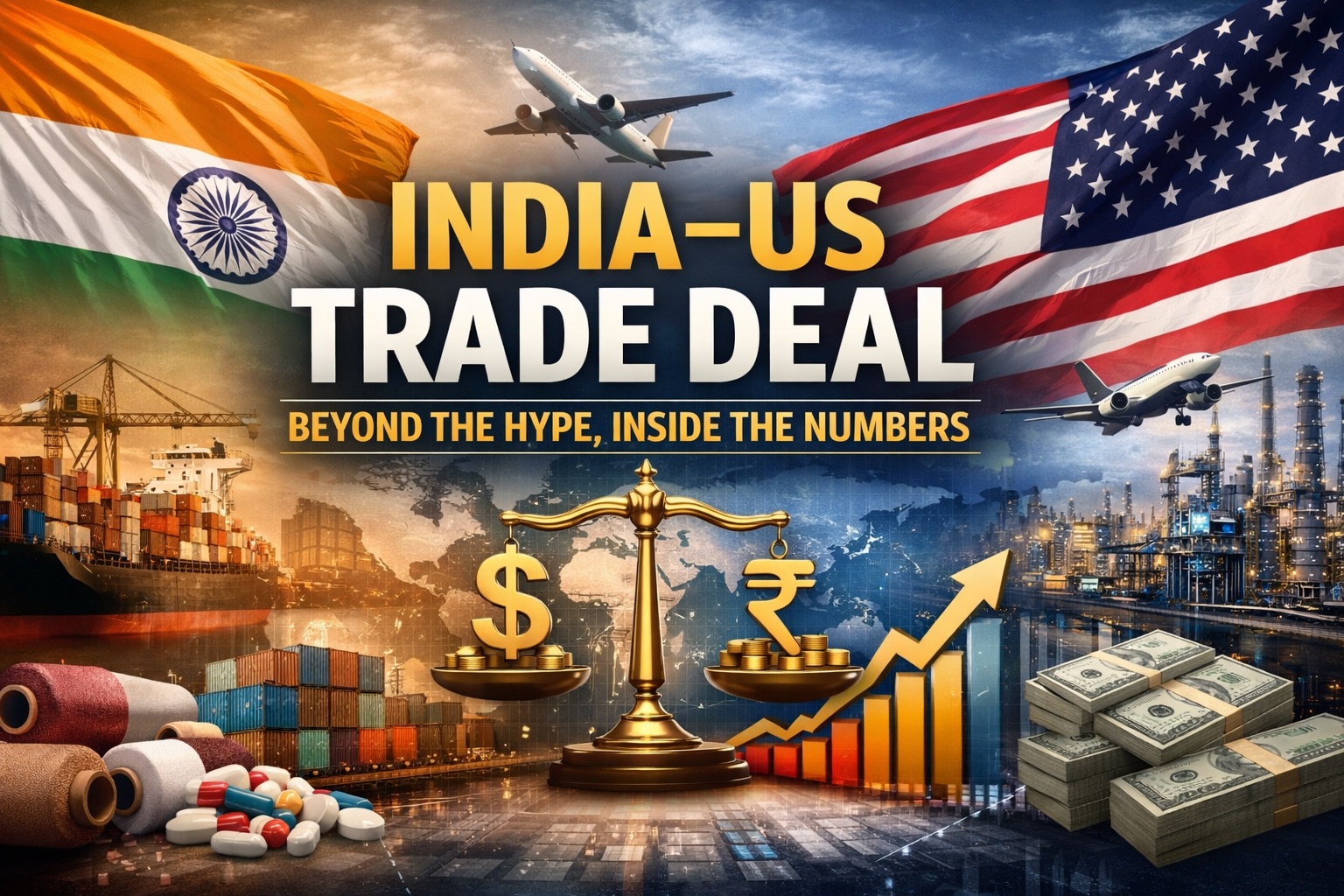

For the past few days, the interim India–US trade framework outlined in a joint statement has been portrayed as everything from a strategic ‘surrender’ to an economic sellout by the Opposition. Critics argue that India has been forced to commit to buying $500 billion worth of American goods, that Indian industry has been ‘exposed’ to risks, and that the government secretly bartered away leverage under duress.
Even in Parliament, Rahul Gandhi and other opposition parties cried about how India’s interests have been ‘sold out’. In the midst of political fury and prime-time drama, the framework has been reduced to slogans rather than figures. However, when the rhetoric is removed and the facts are analysed, these statements disintegrate rapidly.
A detailed assessment by SBI Research, grounded in tariffs, trade flows, sectoral impacts and macroeconomic consequences, paints a considerably more realistic picture of what India gained, what it gave up, and why the balance is decisively in India’s favour. The SBI research report tells a different story from the one being shouted by television or social media platforms.
What was actually agreed upon in the joint statement
Despite the claims, there is no full-fledged India-US trade agreement in place as of yet. What exists instead is an interim trade framework outlined in a joint statement, a limited understanding reached during ongoing trade talks, ahead of negotiations on a larger and more detailed bilateral trade agreement. Its scope is limited, specific, and clearly defined. At the centre of the interim trade framework is a reciprocal US tax of 18% on Indian goods, a significant reduction from the 50% tariff regime that had severely harmed export competitiveness. This reset places India among the lowest-tariffed Asian exporters to the United States, restoring parity with, and in some circumstances outperforming, regional counterparts.
The often-repeated assertion that India has committed to purchasing $500 billion worth of American goods is false. The joint statement contains the phrase “India intends to purchase” over a five-year period, which indicates business aspiration rather than a legally enforceable commitment. The interim framework contains no penalties, binding timelines, or procurement mandates.
Moreover, with a trade deal in place, bilateral trade is going to increase manyfold. The increase in purchases of US goods is going to be a natural outcome of increased bilateral trade, because exports are going to increase too.
Why the 18% tariff is a strategic win
The significance of the 18 per cent reciprocal tariff lies not in the number itself, but in where India stands in comparison to its competitors. Under the revised interim trade framework, India’s tariff rate is lower than or comparable to the major Asian exporters such as Vietnam (20%), Bangladesh (19%), and Indonesia (19%). In a market as price-sensitive as the United States, this tight band is important. Even a one or two percentage-point difference can determine sourcing contracts in textiles, electronics, footwear, and engineering goods. More notably, the revised tariff restores export competitiveness, which had been artificially depressed during the previous 50% system. Tariffs distorted relative prices, not inefficiency or cost overruns, causing Indian exporters to lose market share. The reset corrects the distortion and returns Indian goods to a level market footing.
Finally, the 18% conclusion indicates that India avoided being assigned to a punitive tariff category intended for politically or strategically marginal partners. Instead, it bargained its way into the mainstream trading bracket, maintaining bargaining power for future discussions while immediately enhancing export viability.
Export upside: Where India gains real money
If the debate is to move beyond rhetoric, it must move toward arithmetic. The real question is simple: where does the money flow?
Core export sectors
The tariff reset directly benefits sectors that already anchor India’s export basket to the United States. Electronics and electrical machinery account for nearly half of India’s exports in that category to the US. Pharmaceuticals, particularly generics, derive over a third of their global export revenue from the American market. Textiles and apparel, including both knitted and non-knitted segments, send roughly 30–45 per cent of their output to the US. Gems and jewellery, chemicals, engineering goods and seafood similarly maintain deep exposure to US demand. Under the earlier 50 per cent tariff regime, these sectors were operating under artificial price suppression. With tariffs reset to 18 per cent under the interim framework, they regain pricing competitiveness without requiring structural cost reductions. This is not about discovering new sectors; it is about unlocking suppressed capacity in sectors that already exist at scale.
The demand–supply gap
The larger opportunity is in size. The United States imports over $3 trillion worth of goods each year. India now supplies only about 3% of that market. The disparity between US demand and Indian supply in major areas is in the trillions. According to the SBI research report, Indian exports of the top 15 product categories alone could expand by nearly $97 billion annually under the revised tariff regime; including the broader export basket, the potential comfortably crosses $100 billion per year. Even partial realisation of this upside would significantly alter India’s external trade profile. This is not speculative optimism, but it is arithmetic based on existing demand patterns.
Trade surplus expansion
India’s trade surplus with the US stood at roughly $40.9 billion in FY25 and about $26 billion in FY26 (April–December). If the current interim trade framework progresses toward a broader bilateral agreement, it suggests that the surplus could exceed $90 billion annually if export expansion materialises alongside increased imports. In other words, even after accounting for higher imports from the US, the balance tilts decisively toward India. The surplus does not shrink, but it expands.
Farmers & Agri exports: The quiet winner
Trade arguments frequently assume that farmers will suffer collateral damage. The data suggests otherwise. India already has an agricultural trade surplus of almost $1.3 billion with the US. Under the revised tariff framework, over 75% of India’s agricultural exports to the US will be subject to zero reciprocal tariffs. Rice, in which India accounts for nearly a fifth of US imports, stands to benefit from improved pricing positioning. Tariff reductions support the export of spices, tea, and coffee by strengthening plantations. The fisheries sector, which had previously been under pressure from rising tariffs, has regained competitive access to a valuable market. Rather than undermining rural export chains, it boosts them by providing greater access to a premium consumption market. For agricultural exporters, scalability in the US market means bigger margins and greater resilience.
What India conceded and what it hasn’t
India agreed to reduce or eliminate tariffs on selected US industrial and agricultural products within the scope of interim trade framework. This includes categories such as energy imports, certain agricultural commodities like almonds and soybean oil, and industrial goods, including aircraft and advanced machinery. Increased imports from the US, particularly in energy, aviation and technology, are expected over time.
These are calculated trade-offs designed to balance negotiations and secure tariff relief on the export side. There is no binding obligation to purchase $500 billion worth of American goods. The language reflects intent, not enforceable procurement mandates. There is no blanket acceptance of free cross-border data flows.
Why the Bangladesh comparison is overhyped
The comparison with Bangladesh’s trade arrangement has generated more anxiety than evidence. India faces an 18 per cent tariff, while Bangladesh faces a 19 per cent tariff. The difference is marginal. Bangladesh does receive conditional zero-tariff access for certain textile categories, but this is tied to sourcing US cotton and man-made fibres inputs that are generally costlier than regional alternatives. Moreover, India’s textile exporters have secured zero-duty access to the European Union under a separate arrangement, opening a market far larger than the incremental US textile differential. The competitive equation remains broadly intact. Alarmism does not alter cost structures.
Macro impact: GDP, Forex, Credit Flow
At the macro level, the projections are measurable. SBI Research estimates that the net impact of export expansion under the interim trade framework could add roughly 1.1% to GDP. Reduced import duties on select US goods may yield approximately $3 billion in annual foreign-exchange savings. Export growth also has strong spillover effects. Historical correlation suggests that a 1% increase in exports leads to roughly a 1.28 per cent increase in export credit. As export volumes rise, credit flows to manufacturing sectors tend to strengthen, reinforcing job creation and industrial capacity. In this case, trade policy links directly to domestic credit expansion and production momentum.
Conclusion: From noise to numbers
Without political gimmicks, the interim trade framework presents a simple equation: enhanced tariff parity, increased export potential, expanding trade surplus, and preserved regulatory autonomy. Crucially, this framework does not constitute a signed trade agreement. It reflects the current state of negotiations as articulated in a joint statement, with several elements still subject to further discussion, clarification, and formalisation.
It does not indicate ideological affiliation with Washington. It symbolises the transactional advantage gained through negotiation. The outcome increases surplus, protects sovereignty, and broadens strategic alternatives in a changing global trade scenario. The real test now lies ahead. Much will depend on how negotiations evolve, what additional details emerge, and whether exporters, manufacturers, and policymakers are able to translate provisional tariff relief into a durable market share. In trade, as in economics, outcomes are ultimately measured in numbers, not narratives.