How India is countering China one move at a time: Military power, border infra, Taiwan links, and Japan alignment
The clash in the Galwan Valley in June 2020 was not just another episode in India-China border tensions, but it was a strategic rupture. For decades, New Delhi had managed Beijing through a mix of restraint, dialogue and confidence-building measures. The Galwan attack broke the framework. It revealed a harsh reality that China was no longer working within mutually agreed-upon boundaries but rather systematically upsetting the status quo through deliberate, below-the-threshold aggression. What followed was a planned shift toward overt conflict rather than an immediate one. India began to reconsider not only its response, but its entire strategy toward China. The emphasis shifted from reactive crisis management to a larger, long-term strategy, one capable of matching China’s methods while avoiding escalation. Today, that shift is increasingly visible. India is no longer merely responding to Chinese pressure; it is quietly pushing back across multiple domains, including the military, economic, and diplomatic, while carefully avoiding open conflict. In effect, New Delhi has entered the grey zone, adopting a calibrated counter-pressure strategy that mirrors China’s playbook but on its own terms. China’s Grey Zone playbook China’s approach towards India is not driven by the logic of decisive, large-scale conflict but by a far more calibrated strategy of incremental advantage. Rather than attempting to shift the balance of power through direct war, Beijing has relied on what is often described as “salami slicing”. It is a method described for small, controlled moves that individually appear insignificant but cumulatively reshape realities on the ground. On the Line of Actual Control, this has taken the form of limited intrusions, changes in patrolling patterns and the gradual establishment of a more persistent presence in contested areas. A key component of this strategy is infrastructure. The rapid construction of roads, airstrips, logistics hubs, and dual-use villages along the border is not merely developmental; it is a strategic move by China. These assets allow China the mobility, sustainment, and long-term deployments, and enhance its ability to project control without engaging in open conflict. Such developments over time create a structural advantage that is hard to reverse. The use of controlled military pressure is no less important. Events like Galwan, where Face-offs and non-lethal forces allow China to express hostility without risking escalation into traditional war. This creates a situation in which constant pressure is exerted on the other country without crossing the line, which ultimately escalates into a full military response. The objective of these measures is not immediate confrontation but rather the progressive redefining of the status quo. China’s aim is to build a “new normal” along the border by restricting access, seizing militarily advantageous sites, and normalising its presence. Economic and geopolitical levers, such as trade dependencies and supply chain influence, add to the pressure and expand it beyond the military domain. All of this together represents a coherent grey-zone playbook, one that prioritises sustained, multi-domain pressure over decisive engagement. It allows China to expand its influence, shape outcomes over time, and complicate its adversary’s response, all while remaining below the threshold of open war. India’s post-Galwan Grey Zone response This behavioural pattern is exactly what led to a reevaluation in New Delhi following Galwan. India realised that a policy intended to function consistently below the threshold of conflict would not be adequately countered by sporadic military or diplomatic actions. The challenge was a persistent form of pressure that called for an equally measured answer rather than a single provocation. Therefore, India’s post-Galwan approach has evolved into a multi-domain strategy that mirrors this logic, while remaining mindful of escalation risks. On the military front, India moved swiftly to match Chinese deployments along the Line of Actual Control, ensuring that any attempt to alter the balance would be met with immediate resistance. The occupation of key heights on the Kailash Range in 2020 demonstrated a willingness to seize tactical advantage when necessary, but also reflected restraint in not converting that advantage into broader escalation. At the same time, India hastened the construction of border infrastructure, such as roads, bridges, and forward logistics, which had long lagged behind China’s capabilities. This was a structural response intended to lessen imbalance over time rather than just a protective one. Building long-term capacity became more important than responding to specific occurrences. India’s response went beyond the military to include the economy. The banning of numerous Chinese Apps, tighter scrutiny of foreign investments, and efforts to diversify supply cha
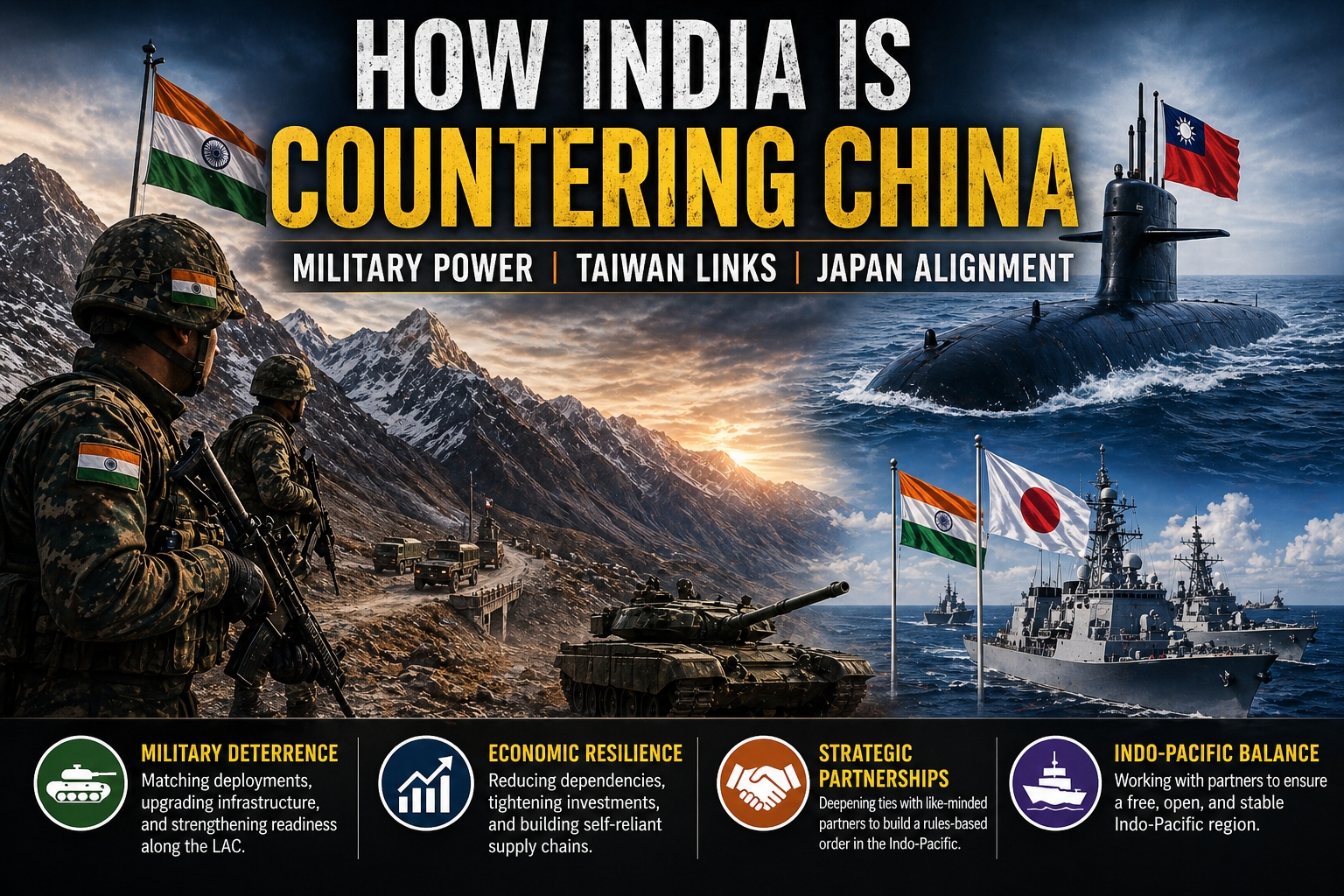
The clash in the Galwan Valley in June 2020 was not just another episode in India-China border tensions, but it was a strategic rupture. For decades, New Delhi had managed Beijing through a mix of restraint, dialogue and confidence-building measures. The Galwan attack broke the framework. It revealed a harsh reality that China was no longer working within mutually agreed-upon boundaries but rather systematically upsetting the status quo through deliberate, below-the-threshold aggression.
What followed was a planned shift toward overt conflict rather than an immediate one. India began to reconsider not only its response, but its entire strategy toward China. The emphasis shifted from reactive crisis management to a larger, long-term strategy, one capable of matching China’s methods while avoiding escalation.
Today, that shift is increasingly visible. India is no longer merely responding to Chinese pressure; it is quietly pushing back across multiple domains, including the military, economic, and diplomatic, while carefully avoiding open conflict. In effect, New Delhi has entered the grey zone, adopting a calibrated counter-pressure strategy that mirrors China’s playbook but on its own terms.
China’s Grey Zone playbook
China’s approach towards India is not driven by the logic of decisive, large-scale conflict but by a far more calibrated strategy of incremental advantage. Rather than attempting to shift the balance of power through direct war, Beijing has relied on what is often described as “salami slicing”. It is a method described for small, controlled moves that individually appear insignificant but cumulatively reshape realities on the ground. On the Line of Actual Control, this has taken the form of limited intrusions, changes in patrolling patterns and the gradual establishment of a more persistent presence in contested areas.
A key component of this strategy is infrastructure. The rapid construction of roads, airstrips, logistics hubs, and dual-use villages along the border is not merely developmental; it is a strategic move by China. These assets allow China the mobility, sustainment, and long-term deployments, and enhance its ability to project control without engaging in open conflict.
Such developments over time create a structural advantage that is hard to reverse. The use of controlled military pressure is no less important. Events like Galwan, where Face-offs and non-lethal forces allow China to express hostility without risking escalation into traditional war. This creates a situation in which constant pressure is exerted on the other country without crossing the line, which ultimately escalates into a full military response. The objective of these measures is not immediate confrontation but rather the progressive redefining of the status quo.
China’s aim is to build a “new normal” along the border by restricting access, seizing militarily advantageous sites, and normalising its presence. Economic and geopolitical levers, such as trade dependencies and supply chain influence, add to the pressure and expand it beyond the military domain. All of this together represents a coherent grey-zone playbook, one that prioritises sustained, multi-domain pressure over decisive engagement. It allows China to expand its influence, shape outcomes over time, and complicate its adversary’s response, all while remaining below the threshold of open war.
India’s post-Galwan Grey Zone response
This behavioural pattern is exactly what led to a reevaluation in New Delhi following Galwan. India realised that a policy intended to function consistently below the threshold of conflict would not be adequately countered by sporadic military or diplomatic actions. The challenge was a persistent form of pressure that called for an equally measured answer rather than a single provocation. Therefore, India’s post-Galwan approach has evolved into a multi-domain strategy that mirrors this logic, while remaining mindful of escalation risks. On the military front, India moved swiftly to match Chinese deployments along the Line of Actual Control, ensuring that any attempt to alter the balance would be met with immediate resistance. The occupation of key heights on the Kailash Range in 2020 demonstrated a willingness to seize tactical advantage when necessary, but also reflected restraint in not converting that advantage into broader escalation.
At the same time, India hastened the construction of border infrastructure, such as roads, bridges, and forward logistics, which had long lagged behind China’s capabilities. This was a structural response intended to lessen imbalance over time rather than just a protective one. Building long-term capacity became more important than responding to specific occurrences.
India’s response went beyond the military to include the economy. The banning of numerous Chinese Apps, tighter scrutiny of foreign investments, and efforts to diversify supply chains signalled a deliberate attempt to reduce strategic vulnerability. Even though these steps are small, taken together, they are part of a larger initiative to raise prices and reduce China’s power. Diplomatically, India increased engagement with like-minded partners. India revitalised the Quad, improved coordination with the United States, and deepened ties with Japan. This forms a new cooperative balancing framework in the Indo-Pacific. These partnerships stop short of formal alliances, so India still maintains strategic autonomy while improving its ability to counter China.
In essence, India’s response is not about matching China move for move. Instead, India adopts a logic of sustained, calibrated pressure. It combines military readiness, economic resilience and diplomatic outreach. New Delhi now operates in the same grey zone, shaping outcomes gradually while avoiding open confrontation.
Taiwan: The silent Grey Zone front
In the last few years, India’s interaction with Taiwan has gone beyond general diplomatic efforts and reflects a more concrete, though deliberately understated, form of strategic involvement. While New Delhi officially follows the “One China” policy and maintains no formal diplomatic or military ties with Taipei, its role in Taiwan’s Indigenous Defence Submarine (IDS) program highlights a different reality operating beneath the surface.
Image via Navalnews
The IDS program ‘s objective, which revolves around the Hai Kun-class submarine, is to develop domestic naval capacity through a “Non-Red Supply Chain”. It is a network of reliable partners that excludes China. It is a term used in political and economic discussions to describe supply chains designed to reduce reliance on the People’s Republic of China (PRC) for certain goods and technologies.
India’s contribution to this framework is technical rather than symbolic. It is believed that important mechanical assemblies and sub-components, including structural components and specialised internal systems necessary for submarine operation, were supplied by Indian defence companies. Although these are not the platform’s main weapon systems, they are essential inputs for the platform to function.
Beyond hardware, India’s role extends into technical expertise. It has been stated that retired Indian Navy engineers and staff have provided advice and support in areas including design integration, maintenance architecture, and operational planning, especially those with experience on Scorpene and Kilo-class submarines. This form of knowledge transfer is especially valuable for a country like Taiwan, which is transitioning toward indigenous submarine construction and requires high-level technical competence.
Moreover, India’s contribution places it within a larger, largely unreported network of nations that support Taiwan’s defence industry. India’s role as a mid-tier industrial and technical partner adds depth to this distributed supply chain architecture, while the United States provides combat systems and weapons integration, and nations like the United Kingdom and Japan provide specialised technology.More importantly, the logic of the grey-zone strategy underpins all of this. India’s participation is cautious and avoids any official recognition . Without crossing diplomatic red lines or inciting direct confrontation with China, New Delhi can support Taiwan’s defence readiness. India is effectively bolstering a significant regional player while beating China in its own game.
Military spending: The strategic foundation
India’s changing approach toward China must also be understood within the broader context of rising global military expenditure, reflecting an increasingly competitive, security-driven international environment. According to the SIPRI 2026 report, the global military spending reached $2.887 trillion in 2025. It was the highest level ever recorded and the 11th consecutive year of growth. This sustained increase signals a shift toward long-term strategic competition rather than isolated conflicts.
Asia has emerged as a central driver of this trend. In which China’s military expenditure rose to an estimated $336 billion. On the other hand, India has raised its defence budget by 8.9% to $92.1 billion, solidifying its place among the world’s top five military spenders. These patterns indicate a broader reevaluation of national security objectives, alongside regional concerns. Notably, the rise of military expenditure does not necessarily indicate an imminent shift towards open warfare, but it provides the foundation for grey-zone competition. It helps to enhance capabilities, whether in conventional forces, technology or logistics. It enables exerting pressure, building deterrence, and shaping outcomes without crossing the border or entering direct war.
For India, increased defence spending complements its post-Galwan strategy. In 2020, India’s military spending was $72.94 billion, which has now increased to $92.1 Billion, a 26% increase. It strengthens military readiness along the border, supports naval expansion in the Indo-Pacific, and underpins its ability to engage in multi-domain competition. In this sense, military expenditure is not merely about preparing for war, but about sustaining a long-term strategic posture that allows India to operate effectively in the grey zone while maintaining escalation control.
Japan factor: Expanding India’s strategic alignment
Alongside its quiet engagement with Taiwan, India has adopted a more open stance in supporting Japan’s evolving defence posture. In recent years, Tokyo has shifted away from its traditionally pacifist stance, most notably by easing restrictions on exporting lethal weapons. This marks a significant shift in Japan’s post-World War II security policy and reflects rising regional concerns, particularly regarding China.
Unlike its approach with Taiwan, India’s engagement with Japan is open and publicly acknowledged. However, it still fits within a broader grey-zone logic. India is building flexible partnerships that enhance collective deterrence without formally escalating tensions rather than forming rigid alliances. This approach allows India to increase pressure on China indirectly by strengthening regional actors and creating a more complex strategic environment. However, China views this development with concern. Beijing has warned that closer India–Japan cooperation could contribute to a containment framework in the Indo-Pacific. For India, the calculation remains clear that partnerships with technologically advanced and strategically aligned countries like Japan are essential for maintaining balance in a rapidly shifting regional order.
India’s emerging Grey Zone doctrine
While India does not have a formally declared “grey-zone doctrine,” its actions since the Galwan clash point to the emergence of a clear and identifiable strategic approach. Rather than relying on singular responses or direct confrontation, India has adopted a sustained, calibrated pressure strategy across multiple domains.
A few essential principles serve as the foundation for this evolving doctrine. First, India prioritises escalation management, responding decisively to Chinese activities while avoiding steps that could spark a full-scale conflict. Second, it employs a multi-domain strategy that combines military readiness with economic measures, technical progress, and diplomatic collaboration. Third, it employs strategic ambiguity, especially in sensitive areas like its relationship with Taiwan, where actions are meaningful but not overtly acknowledged.
Another important element is gradualism. India’s response is not designed to produce immediate results, but to build long-term advantage. Whether through strengthening border infrastructure, reducing economic dependence, or expanding regional partnerships, the approach reflects a shift toward continuous competition rather than episodic reaction. In the end, India’s grey-zone doctrine is defensive in nature. Unlike China’s expansionist use of grey-zone tactics to alter the status quo, India’s objective is to preserve balance, deter aggression, and prevent unilateral changes along the border. It is a strategy that prioritises stability while still allowing India to impose costs and shape outcomes.
Conclusion: From reaction to strategic competition
The transformation in India’s approach after Galwan is not merely tactical, but it is fundamentally strategic. For years, India sought to manage tensions with China through restraint and compartmentalisation, separating border disputes from broader engagement. That framework has now eroded.
What has emerged in its place is a more integrated and assertive approach. India is no longer reacting to individual incidents but adapting to a continuous form of competition. Through military preparedness, economic measures, diplomatic partnerships, and quiet strategic engagement with actors such as Taiwan, New Delhi has begun to operate effectively in the grey zone. This does not signal a move toward open confrontation. Instead, it reflects a recognition that modern geopolitical competition is rarely fought through declared wars. It unfolds through sustained, incremental actions that shape the strategic environment over time.
In this evolving landscape, India is no longer on the defensive. It is learning to compete with China on its own terms, carefully and deliberately, without crossing the threshold into full-scale conflict. Therefore, the real shift after Galwan is not just on the battlefield, but in how India understands and conducts strategy.