How a war between Israel and Arab nations more than 50 years ago had pushed Brazil to blend Ethanol with Petrol, with India and others getting inspired
India’s decision to roll out E20 petrol blended with 20% ethanol has triggered a heated debate. While the government says the move will reduce crude oil imports, improve energy security and cut pollution, many vehicle owners, especially those using older vehicles, have raised concerns over lower mileage, possible engine damage and higher running costs. The issue has even reached the Supreme Court, where a petition related to the country’s ethanol programme is being heard. The controversy grew after reports claimed that the Centre had described the E20 programme as an “ongoing experiment” before the Supreme Court. The government strongly rejected these reports, saying no such statement was made by the Attorney General and that the ethanol blending programme is a well-planned national policy, not an experiment. The Centre has also clarified that maintaining ethanol supplies is essential to continue the nationwide 20% blending target achieved earlier this year. Why the government is backing Ethanol blending The Centre says ethanol blending is not only about fuel but also about India’s long-term energy and economic strategy. According to the government, sugarcane-based ethanol produces around 65% lower greenhouse gas emissions than petrol, while maize-based ethanol cuts emissions by about 50%. It also says the programme has benefited farmers by increasing demand for sugarcane and maize, improving incomes and clearing long-pending sugarcane dues. Between the Ethanol Supply Year (ESY) 2014-15 and July 2025, India saved more than ₹1.44 lakh crore in foreign exchange, replaced 245 lakh metric tonnes of crude oil imports and reduced carbon emissions significantly. This year alone, the government expects farmers to earn nearly ₹40,000 crore through ethanol production, while the country could save about ₹43,000 crore in foreign exchange. Responding to concerns over vehicle performance, the government cited studies by Indian Oil Corporation (IOCL), the Automotive Research Association of India (ARAI) and the Society of Indian Automobile Manufacturers (SIAM), saying E20 fuel provides better acceleration, smoother driving in city traffic and lower emissions than E10 fuel. It also dismissed claims that E20 affects vehicle insurance or is unsafe, stating that Indian fuel and vehicle standards have been updated accordingly. At the same time, concerns remain. Vehicles manufactured before April 2023 were not originally designed for E20 fuel. Owners have reported lower fuel efficiency and worries about wear and tear in certain engine parts, even though the government says most vehicles made after 2009 can use E20 with only minor changes. Ethanol blending is not a new idea Although the current debate makes ethanol blending appear like a recent policy, many countries have been using ethanol in transport fuel for decades. Brazil is one of the earliest and most successful examples, while countries such as the United States, Japan and Sweden have also promoted ethanol to reduce dependence on fossil fuels and lower emissions. In fact, Brazil’s experience became a model that many countries, including India and China, closely studied while shaping their own blending programmes. Brazil’s ethanol journey began not because of climate concerns but because of an oil crisis triggered by war, first by World War II and then the Middle East war in 70s. Brazil started using sugarcane ethanol as a fuel in 1930s, with the introduction of the automobile in the country. In February 1931, the government issued a historic decree mandating a 5% ethanol blend for all imported gasoline. Later, the mandate was extended to dometic oil too. As a leader in sugarcane production, the country had lots of excess produce to be converted to ethanol. Use of ethanol fuel peaked during World War II, as the German submarine attacks threatened global oil supplies. The mandate had reached 50% at a point of time during the war. However, after the war, oil prices crashed due to abundant supply, and ethanol use as fuel in Brazil declined sharply. How the 1973 Middle East war changed Brazil’s fuel policy In 1973, the Arab-Israeli war led to an oil embargo by Arab nations, causing global oil prices to rise sharply. Brazil, which imported nearly 80% of its fuel at the time, was among the worst-affected countries. Within months, its economy slipped into recession, and almost 40% of its foreign exchange earnings were being spent on buying imported oil. Officials realised that depending almost entirely on imported fuel was no longer sustainable. As Eduardo Pereira de Carvalho, who served in Brazil’s finance ministry during that period, later recalled, the country faced one central question: How could Brazil continue to grow without relying on imported oil? To reduce the dependence, in 1975, Brazil’s military government under General Ernesto Geisel ordered petrol to be blended with 10% ethanol made from sugarcane. Over the next five
India’s decision to roll out E20 petrol blended with 20% ethanol has triggered a heated debate. While the government says the move will reduce crude oil imports, improve energy security and cut pollution, many vehicle owners, especially those using older vehicles, have raised concerns over lower mileage, possible engine damage and higher running costs. The issue has even reached the Supreme Court, where a petition related to the country’s ethanol programme is being heard.
The controversy grew after reports claimed that the Centre had described the E20 programme as an “ongoing experiment” before the Supreme Court. The government strongly rejected these reports, saying no such statement was made by the Attorney General and that the ethanol blending programme is a well-planned national policy, not an experiment. The Centre has also clarified that maintaining ethanol supplies is essential to continue the nationwide 20% blending target achieved earlier this year.
Why the government is backing Ethanol blending
The Centre says ethanol blending is not only about fuel but also about India’s long-term energy and economic strategy. According to the government, sugarcane-based ethanol produces around 65% lower greenhouse gas emissions than petrol, while maize-based ethanol cuts emissions by about 50%.
It also says the programme has benefited farmers by increasing demand for sugarcane and maize, improving incomes and clearing long-pending sugarcane dues. Between the Ethanol Supply Year (ESY) 2014-15 and July 2025, India saved more than ₹1.44 lakh crore in foreign exchange, replaced 245 lakh metric tonnes of crude oil imports and reduced carbon emissions significantly. This year alone, the government expects farmers to earn nearly ₹40,000 crore through ethanol production, while the country could save about ₹43,000 crore in foreign exchange.
Responding to concerns over vehicle performance, the government cited studies by Indian Oil Corporation (IOCL), the Automotive Research Association of India (ARAI) and the Society of Indian Automobile Manufacturers (SIAM), saying E20 fuel provides better acceleration, smoother driving in city traffic and lower emissions than E10 fuel. It also dismissed claims that E20 affects vehicle insurance or is unsafe, stating that Indian fuel and vehicle standards have been updated accordingly.
At the same time, concerns remain. Vehicles manufactured before April 2023 were not originally designed for E20 fuel. Owners have reported lower fuel efficiency and worries about wear and tear in certain engine parts, even though the government says most vehicles made after 2009 can use E20 with only minor changes.
Ethanol blending is not a new idea
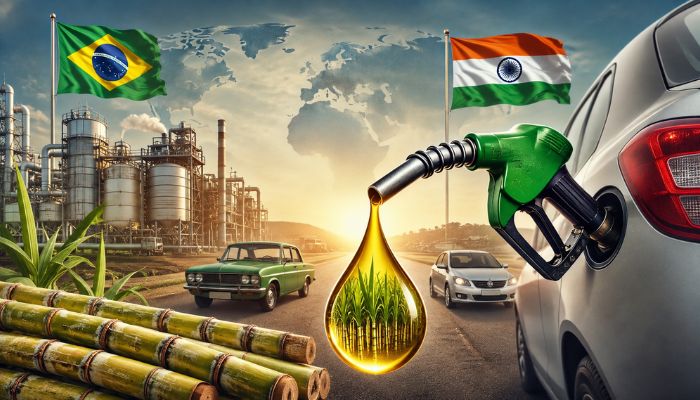
Although the current debate makes ethanol blending appear like a recent policy, many countries have been using ethanol in transport fuel for decades. Brazil is one of the earliest and most successful examples, while countries such as the United States, Japan and Sweden have also promoted ethanol to reduce dependence on fossil fuels and lower emissions.
In fact, Brazil’s experience became a model that many countries, including India and China, closely studied while shaping their own blending programmes. Brazil’s ethanol journey began not because of climate concerns but because of an oil crisis triggered by war, first by World War II and then the Middle East war in 70s.
Brazil started using sugarcane ethanol as a fuel in 1930s, with the introduction of the automobile in the country. In February 1931, the government issued a historic decree mandating a 5% ethanol blend for all imported gasoline. Later, the mandate was extended to dometic oil too. As a leader in sugarcane production, the country had lots of excess produce to be converted to ethanol.
Use of ethanol fuel peaked during World War II, as the German submarine attacks threatened global oil supplies. The mandate had reached 50% at a point of time during the war. However, after the war, oil prices crashed due to abundant supply, and ethanol use as fuel in Brazil declined sharply.
How the 1973 Middle East war changed Brazil’s fuel policy
In 1973, the Arab-Israeli war led to an oil embargo by Arab nations, causing global oil prices to rise sharply. Brazil, which imported nearly 80% of its fuel at the time, was among the worst-affected countries. Within months, its economy slipped into recession, and almost 40% of its foreign exchange earnings were being spent on buying imported oil.
Officials realised that depending almost entirely on imported fuel was no longer sustainable. As Eduardo Pereira de Carvalho, who served in Brazil’s finance ministry during that period, later recalled, the country faced one central question: How could Brazil continue to grow without relying on imported oil?
To reduce the dependence, in 1975, Brazil’s military government under General Ernesto Geisel ordered petrol to be blended with 10% ethanol made from sugarcane. Over the next five years, the blending ratio gradually increased to 25%. This allowed Brazil to stretch its petrol supplies while creating a steady market for domestic sugarcane farmers.
The government supported ethanol production through loans, investments in technology and expansion of fuel infrastructure. Car manufacturers also developed vehicles that could run on ethanol. Later, Brazil introduced flex-fuel vehicles that allowed drivers to switch between petrol and ethanol depending on which was cheaper. Today, ethanol forms a major part of Brazil’s transport fuel system and is often cited globally as one of the most successful biofuel programmes.
At present, no light vehicle is sold in Brazil that runs on pure petrol. At present, E25 fuel, 25% ethanol mixed with 75% petrol, is widely sold at fuel stations in the country. E100, or 100% ethanol, is also available for those who have compatible flex-fuel vehicles.
Due to these initiatives, Brazil was considered to be the world’s first “sustainable” biofuels economy and the biofuel industry leader, which became a role model for other countries.
India’s ethanol journey began long before E20
India’s ethanol blending policy also predates the current government by many years.
Government records accessed through an RTI show that the first formal push came during the Atal Bihari Vajpayee government. After pilot projects in Maharashtra and Uttar Pradesh showed encouraging results, the Centre issued a notification in September 2002, making 5 % ethanol blending mandatory in nine states and four Union Territories from January 2003. The objective was the same as today reduce pollution, support agriculture and lower dependence on imported fuel.
The programme expanded further under the Manmohan Singh-led UPA government. More states were brought under the blending programme in 2004 and 2006, and in 2013 the government directed oil marketing companies to supply petrol blended with up to 10 % ethanol, laying the foundation for nationwide expansion.
The Modi government accelerated the programme by implementing E10 across most of the country in 2019, legally recognising E100 fuel in 2021 and approving E20 blending the same year. The nationwide rollout of E20 followed in phases before becoming the standard fuel this year.
A policy shaped over decades
The current debate over E20 may focus on vehicle compatibility, fuel efficiency and consumer concerns, but the larger idea behind ethanol blending is neither new nor unique to India. Brazil adopted the policy nearly five decades ago after an international oil crisis exposed the risks of depending on imported fuel. India began moving in the same direction over two decades ago, with successive governments expanding the programme over time.
As India now aims to increase ethanol blending further in the coming years, the discussion is no longer about whether ethanol blending is a new experiment, but about how the country can balance energy security, environmental goals and consumer interests while continuing a policy that has evolved across governments and generations.