From shielding terror accused to protecting innocent Hindus: How governance in UP changed under CM Yogi’s rule of justice
The quality of leadership depends on the mindset of the person occupying the chair. The laws do not change, the system does not change, only the decisions change with the change in leadership. Uttar Pradesh offers a clear example of this contrast. When politics driven by the MY (Muslim-Yadav) equation dominates, decisions often tilt towards appeasement. When the same chair is occupied by a saffron-clad chief minister, the focus visibly shifts to law and order and justice. This difference becomes clear when past and present cases are placed side by side. Dadri lynching case: A decade of legal struggle In September 2015, Mohammad Akhlaq was beaten to death by a mob in Dadri for allegedly consuming beef. Uttar Pradesh was ruled by the Samajwadi Party with Akhilesh Yadav as the chief minister. Close to two dozen Hindu youths were arrested and imprisoned after this incident. The case dragged on for years, but even today, there is no clear legal conclusion on who actually killed Akhlaq. During the investigation, it later emerged that beef had been cooked inside Akhlaq’s house. Despite this, the arrested youths continued to face trial, spending years running from one court to another. Now, after almost a decade, the Yogi Adityanath-led government has approached the court to seek the withdrawal of cases against 18 Hindu youths, who are accused in the Dadri incident. The case is expected to be heard on 18th December. The withdrawal of cases will finally bring some respite to a family that has been waiting for almost a decade. Akhilesh Yadav government and the ‘Innocent Muslim Youth’ narrative To understand the political contrast, we must go back to 2012, when Akhilesh Yadav became chief minister. The Samajwadi Party’s thinking was already visible in its election manifesto, which promised to release what it called “innocent Muslim youths” arrested in terror-related cases. The party did not stop at release alone; it even spoke about providing compensation. After coming to power, the government began the process in April 2012 to withdraw cases against 19 Muslim accused. These were not minor offenders. Among them was Waliullah, a terrorist involved in the 2006 Sankat Mochan temple blast in Varanasi, which killed seven people. When other linked blasts were included, the total death toll reached 18. Investigating agencies had established that Waliullah had links with the Bangladesh-based terror group HuJI and had entered India after receiving training. Later, a court awarded him the death sentence. Yet, before that, the Samajwadi Party government was prepared to treat him as an “innocent” youth and push for his release. More cases, same pattern The same approach was seen in the Gorakhpur serial blast case. Accused Tariq Qasmi was also described as an ‘innocent youth’, and efforts were made to secure his release. He eventually died in jail, despite being found guilty by a court. Another name that surfaced was Sitara Begum, who had provided shelter to Pakistani spy Vakas Ahmed. Even her case was considered for withdrawal. At the same time, senior party leaders made statements from public platforms that strengthened the perception of appeasement. Remarks like “Muslim daughters are our daughters” sparked questions about whether the government’s priorities were justice and security or political calculations. Courts step in to stop case withdrawals The situation became so serious that even the judiciary had to intervene. In 2012, the Allahabad High Court openly criticised the Akhilesh Yadav government, stating that it was not the government’s job to decide who was a terrorist and who was innocent. In a sharp remark, the court even said that if the government continued like this, it might as well award Padma Bhushan honours to those accused of terrorism. Following the court’s strong words, the government was forced to step back. The cost paid by Dadri accused families While terror accused were being considered for release, the condition of Hindu youths accused in the Dadri case continued to worsen. Some families sold land, others sold their homes. Entire households were destroyed financially and emotionally. One accused, Ravi, died in jail. His land was sold, his family was pushed into poverty, and his wife was left widowed. Ravi’s mother later told media outlets that her son was subjected to severe torture in jail. There were also allegations that these actions were carried out under pressure from powerful figures, including senior political leaders like Azam Khan. The contrast was stark, on one side, efforts to free terror accused, and on the other, families like Ravi’s left to suffer with no relief. Yogi government’s legal route to Justice The Yogi Adityanath government has now taken a different approach. Instead of making political announcements, it has followed the constitutional path by approaching the court to withdraw cases against 18 Hindu youths in the
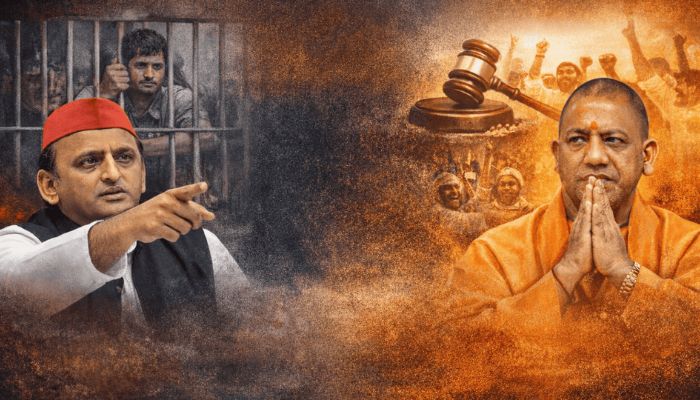

The quality of leadership depends on the mindset of the person occupying the chair. The laws do not change, the system does not change, only the decisions change with the change in leadership. Uttar Pradesh offers a clear example of this contrast. When politics driven by the MY (Muslim-Yadav) equation dominates, decisions often tilt towards appeasement. When the same chair is occupied by a saffron-clad chief minister, the focus visibly shifts to law and order and justice.
This difference becomes clear when past and present cases are placed side by side.
Dadri lynching case: A decade of legal struggle
In September 2015, Mohammad Akhlaq was beaten to death by a mob in Dadri for allegedly consuming beef. Uttar Pradesh was ruled by the Samajwadi Party with Akhilesh Yadav as the chief minister. Close to two dozen Hindu youths were arrested and imprisoned after this incident.
The case dragged on for years, but even today, there is no clear legal conclusion on who actually killed Akhlaq. During the investigation, it later emerged that beef had been cooked inside Akhlaq’s house. Despite this, the arrested youths continued to face trial, spending years running from one court to another.
Now, after almost a decade, the Yogi Adityanath-led government has approached the court to seek the withdrawal of cases against 18 Hindu youths, who are accused in the Dadri incident. The case is expected to be heard on 18th December. The withdrawal of cases will finally bring some respite to a family that has been waiting for almost a decade.
Akhilesh Yadav government and the ‘Innocent Muslim Youth’ narrative
To understand the political contrast, we must go back to 2012, when Akhilesh Yadav became chief minister. The Samajwadi Party’s thinking was already visible in its election manifesto, which promised to release what it called “innocent Muslim youths” arrested in terror-related cases. The party did not stop at release alone; it even spoke about providing compensation.
After coming to power, the government began the process in April 2012 to withdraw cases against 19 Muslim accused. These were not minor offenders. Among them was Waliullah, a terrorist involved in the 2006 Sankat Mochan temple blast in Varanasi, which killed seven people. When other linked blasts were included, the total death toll reached 18.
Investigating agencies had established that Waliullah had links with the Bangladesh-based terror group HuJI and had entered India after receiving training. Later, a court awarded him the death sentence. Yet, before that, the Samajwadi Party government was prepared to treat him as an “innocent” youth and push for his release.
More cases, same pattern
The same approach was seen in the Gorakhpur serial blast case. Accused Tariq Qasmi was also described as an ‘innocent youth’, and efforts were made to secure his release. He eventually died in jail, despite being found guilty by a court.
Another name that surfaced was Sitara Begum, who had provided shelter to Pakistani spy Vakas Ahmed. Even her case was considered for withdrawal.
At the same time, senior party leaders made statements from public platforms that strengthened the perception of appeasement. Remarks like “Muslim daughters are our daughters” sparked questions about whether the government’s priorities were justice and security or political calculations.
Courts step in to stop case withdrawals
The situation became so serious that even the judiciary had to intervene. In 2012, the Allahabad High Court openly criticised the Akhilesh Yadav government, stating that it was not the government’s job to decide who was a terrorist and who was innocent.
In a sharp remark, the court even said that if the government continued like this, it might as well award Padma Bhushan honours to those accused of terrorism. Following the court’s strong words, the government was forced to step back.
The cost paid by Dadri accused families
While terror accused were being considered for release, the condition of Hindu youths accused in the Dadri case continued to worsen. Some families sold land, others sold their homes. Entire households were destroyed financially and emotionally.
One accused, Ravi, died in jail. His land was sold, his family was pushed into poverty, and his wife was left widowed. Ravi’s mother later told media outlets that her son was subjected to severe torture in jail. There were also allegations that these actions were carried out under pressure from powerful figures, including senior political leaders like Azam Khan.
The contrast was stark, on one side, efforts to free terror accused, and on the other, families like Ravi’s left to suffer with no relief.
Yogi government’s legal route to Justice
The Yogi Adityanath government has now taken a different approach. Instead of making political announcements, it has followed the constitutional path by approaching the court to withdraw cases against 18 Hindu youths in the Dadri matter.
If the court accepts the plea, these youths may finally be able to live normal lives again after years of legal harassment. For them, it would mean an end to stigma, court visits, and financial ruin.
A shift in governance style
The difference between the two governments is evident. While the Akhilesh Yadav era is remembered for trying to tag terror suspects as ‘innocent’ when under pressure, it’s law, order, and accountability that define Yogi Adityanath’s government.
Yogi Adityanath has already reaffirmed that power is not to appease anyone but to take responsibility. In a state where governments used to falter with vote bank politics, his government has made it amply clear that the law is for all.
His firm stance against the mafia and gangs illustrates this strategy. His government has steered away from covering up for criminals and practice blatant appeasement. Rather, they focus on serving justice and the safety of society.