From sacred relic to subject of controversy: Why the Shroud of Turin fuels debates over authenticity, narrative building, and attempts to link it to India
The Shroud of Turin has once again become the centre of global attention after a fresh scientific claim triggered widespread discussion online. It all really kicked off following a viral discussion sparked by an NDTV tweet and subsequent reports highlighting a major scientific development. New DNA Analysis Suggests That Shroud Of Turin May Have Indian Origins https://t.co/Q95A5SHKCC pic.twitter.com/5A2x4Su5Fp— NDTV (@ndtv) March 31, 2026 Researchers have discovered DNA traces from India on the famous linen cloth, which many believe to be the burial shroud of Jesus Christ. Using advanced genetic testing, scientists found both human and plant DNA linked to India embedded deep within the cloth’s fibres. Researchers from Italy, analysed material collected from the shroud and found that nearly 40% of the human DNA on the cloth is from Indian lineages. The Shroud of Turin, a linen cloth believed by many to be the burial cloth of Jesus Christ. (New Scientist reported) pic.twitter.com/VzVHEVQv4m— Indian Infra Report (@Indianinfoguide) April 1, 2026 The study, published as a pre‑peer‑review paper on bioRxiv on 31st March, suggests that the shroud may have been woven in India or spent a considerable amount of time there centuries before it surfaced in medieval Europe. This has effectively reopened one of history’s most debated mysteries, blending faith, genetics, and global trade history into one viral moment. What is the Shroud of Turin? The Shroud of Turin is a long piece of ancient linen cloth that bears a faint, almost ghost-like image of a man who appears to have been crucified. For centuries, many Christians have believed this cloth to be the burial shroud of Jesus Christ. The cloth first appeared in Europe in the 14th century and has since been preserved at the Cathedral of Saint John the Baptist in Turin, Italy. Over time, it has become one of the most studied and controversial religious artefacts in the world. It was first located in France in 1354, and for nearly half a millennium, it has remained at the Cathedral of Saint John the Baptist in Turin, Italy, since the 16th century. What makes the Shroud unique is the image it carries. It shows the front and back of a man’s body, with visible marks that resemble injuries described in Biblical accounts of crucifixion. These include wounds on the hands, feet, and side, along with marks that look like scourging. The science behind the stains: What the latest study tells us The current wave of interest is driven by a study where scientists used Next Generation Sequencing (NGS) technology to examine tiny dust particles and fibres recovered from the Shroud. By extracting mitochondrial DNA from both human and plant remains, the team, led by Gianni Barcaccia at the University of Padova, found some startling things. The results showed clear genetic links to the Indian subcontinent. Specifically, they found human DNA lineages that are commonly found in South Asia and plant DNA from species like cowpea, which is native to India. According to the study, researchers analysed minute biological material originally collected during a 1978 scientific examination. By using modern genomic sequencing, they identified DNA fragments from a massive variety of sources, including humans, plants, animals, and even insects. This indicates that the cloth has been handled by many people and exposed to incredibly diverse environments over the centuries. Most notably, the researchers found that around 38% to 40% of the human mitochondrial DNA recovered could be traced back to lineages associated with India. The rest largely corresponded to populations from the Near East (like modern-day Israel and Syria), with a much smaller portion linked to Western Europe. These findings suggest two main possibilities: either the cloth was handled extensively by people of South Asian origin, or the linen yarn itself was manufactured in India, a region historically famous for high-quality textile production. The Shroud of Turin, a linen cloth believed by many to be the burial cloth of Jesus Christ, is claimed to contain about 40% human DNA traces linked to Indian lineages. – Researchers from the University of Padova, Italy. pic.twitter.com/GDSjt8pdjE— Indian Tech & Infra (@IndianTechGuide) April 1, 2026 Why is this cloth linked to Jesus? The narrative goes that after the crucifixion, Joseph of Arimathea wrapped Jesus’s body in a clean linen cloth before placing him in a tomb. The Shroud of Turin matches the Gospel descriptions of a “fine linen” cloth. It depicts the entire body of a middle-aged man with a moustache, beard, and long hair. One half shows the front of the body, and the other shows the back, as if a single long strip of cloth had been folded over the head and under the feet. The Shroud became a global sensation in 1898 when an Italian lawyer and photographer named Secondo Pia took the first official photographs of it. When he dev
The Shroud of Turin has once again become the centre of global attention after a fresh scientific claim triggered widespread discussion online. It all really kicked off following a viral discussion sparked by an NDTV tweet and subsequent reports highlighting a major scientific development.
New DNA Analysis Suggests That Shroud Of Turin May Have Indian Origins https://t.co/Q95A5SHKCC pic.twitter.com/5A2x4Su5Fp— NDTV (@ndtv) March 31, 2026
Researchers have discovered DNA traces from India on the famous linen cloth, which many believe to be the burial shroud of Jesus Christ. Using advanced genetic testing, scientists found both human and plant DNA linked to India embedded deep within the cloth’s fibres.
Researchers from Italy, analysed material collected from the shroud and found that nearly 40% of the human DNA on the cloth is from Indian lineages. The Shroud of Turin, a linen cloth believed by many to be the burial cloth of Jesus Christ. (New Scientist reported) pic.twitter.com/VzVHEVQv4m— Indian Infra Report (@Indianinfoguide) April 1, 2026
The study, published as a pre‑peer‑review paper on bioRxiv on 31st March, suggests that the shroud may have been woven in India or spent a considerable amount of time there centuries before it surfaced in medieval Europe. This has effectively reopened one of history’s most debated mysteries, blending faith, genetics, and global trade history into one viral moment.
What is the Shroud of Turin?
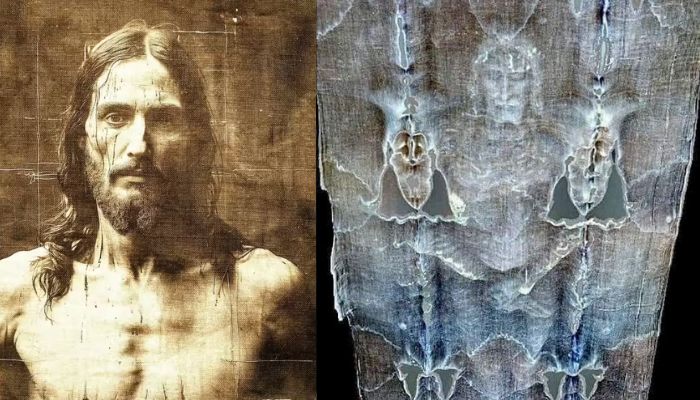
The Shroud of Turin is a long piece of ancient linen cloth that bears a faint, almost ghost-like image of a man who appears to have been crucified. For centuries, many Christians have believed this cloth to be the burial shroud of Jesus Christ.
The cloth first appeared in Europe in the 14th century and has since been preserved at the Cathedral of Saint John the Baptist in Turin, Italy. Over time, it has become one of the most studied and controversial religious artefacts in the world. It was first located in France in 1354, and for nearly half a millennium, it has remained at the Cathedral of Saint John the Baptist in Turin, Italy, since the 16th century.
What makes the Shroud unique is the image it carries. It shows the front and back of a man’s body, with visible marks that resemble injuries described in Biblical accounts of crucifixion. These include wounds on the hands, feet, and side, along with marks that look like scourging.
The science behind the stains: What the latest study tells us
The current wave of interest is driven by a study where scientists used Next Generation Sequencing (NGS) technology to examine tiny dust particles and fibres recovered from the Shroud.
By extracting mitochondrial DNA from both human and plant remains, the team, led by Gianni Barcaccia at the University of Padova, found some startling things. The results showed clear genetic links to the Indian subcontinent. Specifically, they found human DNA lineages that are commonly found in South Asia and plant DNA from species like cowpea, which is native to India.
According to the study, researchers analysed minute biological material originally collected during a 1978 scientific examination. By using modern genomic sequencing, they identified DNA fragments from a massive variety of sources, including humans, plants, animals, and even insects. This indicates that the cloth has been handled by many people and exposed to incredibly diverse environments over the centuries.
Most notably, the researchers found that around 38% to 40% of the human mitochondrial DNA recovered could be traced back to lineages associated with India. The rest largely corresponded to populations from the Near East (like modern-day Israel and Syria), with a much smaller portion linked to Western Europe. These findings suggest two main possibilities: either the cloth was handled extensively by people of South Asian origin, or the linen yarn itself was manufactured in India, a region historically famous for high-quality textile production.
The Shroud of Turin, a linen cloth believed by many to be the burial cloth of Jesus Christ, is claimed to contain about 40% human DNA traces linked to Indian lineages. – Researchers from the University of Padova, Italy. pic.twitter.com/GDSjt8pdjE— Indian Tech & Infra (@IndianTechGuide) April 1, 2026
Why is this cloth linked to Jesus?
The narrative goes that after the crucifixion, Joseph of Arimathea wrapped Jesus’s body in a clean linen cloth before placing him in a tomb. The Shroud of Turin matches the Gospel descriptions of a “fine linen” cloth. It depicts the entire body of a middle-aged man with a moustache, beard, and long hair. One half shows the front of the body, and the other shows the back, as if a single long strip of cloth had been folded over the head and under the feet.
The Shroud became a global sensation in 1898 when an Italian lawyer and photographer named Secondo Pia took the first official photographs of it. When he developed the negatives, he was shocked to find that the image on the cloth was actually a “positive” image, meaning the cloth itself acted like a photographic negative.
In these photos, the man’s features, the wounds, the swelling, and the bloodstains appeared much more clearly than they did to the naked eye. Worshippers and researchers point to the reddish stains that look like blood and wounds on the wrists, feet, and side. There are also markings consistent with a crown of thorns and bruises on the shoulders, which many believe were caused by carrying a heavy cross.
Religious importance for many Christians
For many Christians, the Shroud is more than just an artefact; it’s a “silent witness” to the central event of their faith. The Gospels of Mark, Matthew, and Luke all mention that Jesus was wrapped in “clean linen.” This specific piece of fabric, measuring roughly 4.36 meters long and 1.1 meters wide, is seen by some as that very wrap.
Its survival through fires, including a mid-16th-century fire in France that left dark streaks and diamond-shaped singe marks on the cloth, is viewed by some as miraculous.
Interestingly, the India connection isn’t entirely new to those who look at the Shroud through a historical or “alternative history” lens. Holger Kersten, in his controversial book Jesus Lived in India, argued that the cloth’s weave suggests an Eastern origin. The fibre is “twilled together in a ratio of 3:1, creating a fishbone weave.”
This kind of complex loom work was rare in Judea but was common in the Roman province of Syria and, more importantly, linked to the high-end textile trade coming out of India.
Even in the 1st century, India was the world’s hub for cotton and fine textiles. Roman historians like Pliny the Elder wrote about the massive amounts of gold leaving Rome to pay for Indian fabrics. So, the idea that a high-quality shroud used for a burial in Jerusalem could have originated in India is historically plausible, even if it remains scientifically unproven as the “actual” shroud of Jesus.
Scepticism and the “Medieval Fake” argument
Despite the deep reverence many hold for the Shroud, there is a massive mountain of scepticism. For many scientists and historians, the Shroud isn’t a 2,000-year-old miracle, but a very clever medieval fabrication.
The biggest blow to its authenticity came in 1988, when carbon-14 dating was performed by three independent labs. They concluded that the flax used to make the linen was grown somewhere between 1260 and 1390 CE. This date range coincides perfectly with when the Shroud first appeared in the historical record in France in 1354.
Recent studies have added more weight to the “artist” theory. A 3D digital analysis of 2025 by Brazilian expert Cicero Moraes suggests the image wasn’t created by a human body at all. When Moraes virtually draped a cloth over a 3D human model, the resulting image was warped and distorted, a phenomenon called the “Agamemnon Mask effect.”
However, when he draped the cloth over a low-relief sculpture (a shallow carving), the resulting imprint matched the Shroud’s image almost perfectly. This suggests the Shroud might have been created by an artist using a shallow wooden or stone mould, perhaps applying heat or pigment to create the faint image.
The early exposure a “Fraud”
The idea that the Shroud is a fake isn’t just a modern “atheist” take; it was a common belief even in the 14th century. Recent research into the writings of Nicole Oresme, a famous 14th-century scholar and bishop, shows that he denounced the Shroud as a “patent” example of clerical deception as early as the 1370s.
Oresme warned that many clergymen deceived the public to elicit offerings for their churches. He explicitly cited the Shroud in Lirey, France, as an example of a forged miracle.
Even the Church at the time was cautious. In 1389, the Bishop of Troyes, Pierre d’Arcis, wrote to the Pope claiming that the Shroud was a painted fake and that the artist who made it had been discovered. The Pope eventually allowed it to be displayed, but only on the condition that it was called a “representation” or an “icon” of the Shroud, rather than the “true” relic. It is one of the great ironies of history that an object so clearly labelled as a forgery by medieval thinkers has become the most famous holy relic of the modern age.
An attempt to “localise” Jesus
Critics argue that these scientific findings are being repurposed into a specific narrative. By finding DNA traces from India, some see an attempt to “localise” Jesus, portraying him as a figure with deep roots in the Indian subcontinent. This isn’t just about history; critics see it as an evangelisation strategy. If Jesus can be projected as a “local” figure or someone who had a physical connection to India, it makes the religion feel less “foreign” and helps expand its reach in the region.
This is where the “warfare” of information comes in. In the age of social media, these narratives spread like wildfire. A scientific paper about mitochondrial DNA gets boiled down to a headline like “Jesus’s Shroud Was Made in India,” which then gets shared thousands of times.
On social media platforms like X and WhatsApp, these claims take on a life of their own. Even supporters who mean well end up amplifying these narratives without fully understanding the scientific nuance.
The “India connection” is a powerful tool for those looking to bridge the gap between Western Christianity and Indian culture, but it is also a flashpoint for those who believe religious history is being subtly rewritten for modern gains.
Conclusion: The need for critical thinking
Ultimately, the Shroud of Turin remains a “choose your own adventure” of history. It is important to remember that differing views exist among the world’s top scholars and researchers, and no single study has “settled” the debate once and for all.
The viral nature of the Shroud’s recent “India connection” serves as a reminder that we live in an era where science and faith are often used to bolster cultural and religious narratives. While the discovery of South Asian DNA on the cloth is a fascinating scientific fact, what that fact means is still up for debate.
As these stories continue to pop up on our feeds, there is a growing need for scrutiny and critical thinking. We should enjoy the mystery, but we must be careful not to blindly share viral claims without looking at the full, complex picture of history, science, and the motivations behind the message.