From Punjab, not India: How Diljit Dosanjh’s response at ‘The Tonight Show’ feeds into problematic narratives and encourages Khalistani separatism
The global stage is never just about performance; it is about projection. Identity, politics, and symbolism travel with every word, every pause, and every omission. When someone like Diljit Dosanjh appears on a platform as influential as The Tonight Show Starring Jimmy Fallon, hosted by Jimmy Fallon, he is not merely entertaining, he is signaling. Diljit Dosanjh on The Tonight Show Starring Jimmy Fallon, He says I am from Punjab, Man proudly repped Punjab (as he should), talked about his roots, culture, music everything. But not once did he actually mention India. Not even in passing.If you are celebraty and appearing on… pic.twitter.com/5SMZxn1qL3— Chota Don (@choga_don) May 1, 2026 And increasingly, those signals demand scrutiny. At first glance, Dosanjh’s articulation of Punjab; its music, its culture, its energy, appears harmless. No one disputes the legitimacy of regional pride. India’s civilizational strength lies precisely in its layered identities. But what raises concern is not the celebration of Punjab. It is the systematic erasure of India from that celebration. On one of the most watched platforms globally, Dosanjh introduced himself simply as “from Punjab.” Not India. Not even in passing. This is not an isolated lapse; it is a pattern repeated across global appearances, from Coachella to Western media interviews. Patterns are rarely accidental. Punjab is not a sovereign entity. It is a state within India, with a history, identity, and contribution deeply intertwined with the Indian nation. To repeatedly present it as a standalone identity on global platforms, without contextual anchoring, is not just incomplete, it is politically loaded. No American popstar or celebrity refers to themselves from their respective states. They proudly wear their American identity on their sleeves, instead of foregrounding their regional identities. But in India, there are some sections of society for whom regional chauvinism takes precedent over national allegiance. Though it might appear as frivolous, the issue is deeply problematic. Because in today’s geopolitical reality, such framing does not exist in a vacuum. The Khalistan movement is not about cultural assertion; it is an explicitly political project with terror roots that seeks the territorial dismemberment of India. It constructs India as an adversary, calls for the balkanisation of the country, and has historically justified violent means to carve out a separate state. While marginal within India today, it continues to find resonance in pockets of the diaspora, where distance often amplifies distortion.And this ecosystem does not operate alone. There is a long-documented pattern of Pakistan, particularly through its intelligence apparatus like the ISI, seeking to exploit such fault lines to destabilize India. Cultural narratives, diaspora activism, and identity politics become instruments in that larger strategic play. This is where Dosanjh’s messaging becomes more than just artistic choice. By consistently foregrounding Punjab while omitting India, he is, whether consciously or not, contributing to a narrative architecture that separatist elements thrive on. His articulation aligns, uncomfortably, with the very framing that Khalistani groups have spent decades attempting to normalize: Punjab as distinct, detached, and politically separable from India. Not to mention Dosanjh has been accused of softballing Khalistani ideology, most notably with his support for the antisocial elements during the farmers’ protests and his spat with actor Kangana Ranaut back then. Nevertheless, intent, at this point, becomes secondary to effect. Defenders will argue that this is branding, that Dosanjh is simply globalizing “Punjab” as a cultural identity. But this argument collapses under scrutiny. Artists across the world do not erase their national belonging to amplify regional pride. They contextualize it. The sequence matters because it signals political belonging before cultural specificity. Dosanjh reverses or entirely omits that sequence. Why? The answer likely lies in his audience. His fandom is not limited to India. It spans a transnational Punjabi diaspora, including significant numbers of Pakistani-origin Punjabis who share linguistic and cultural ties but not Indian nationality. His concerts across the world routinely see participation from this cross-border demographic. By positioning himself as “Punjabi first,” Dosanjh taps into a market that transcends borders. Commercially, it is astute. Politically, it is deeply irresponsible. Because this very transnational Punjabi identity, detached from India, is a core ingredient in the Khalistani narrative mix. It blurs national boundaries, dilutes political belonging, and creates a cultural foundation upon which separatist ideology can be layered. What begins as branding can easily become ideological scaffolding. And in that ecosystem, even silence becomes
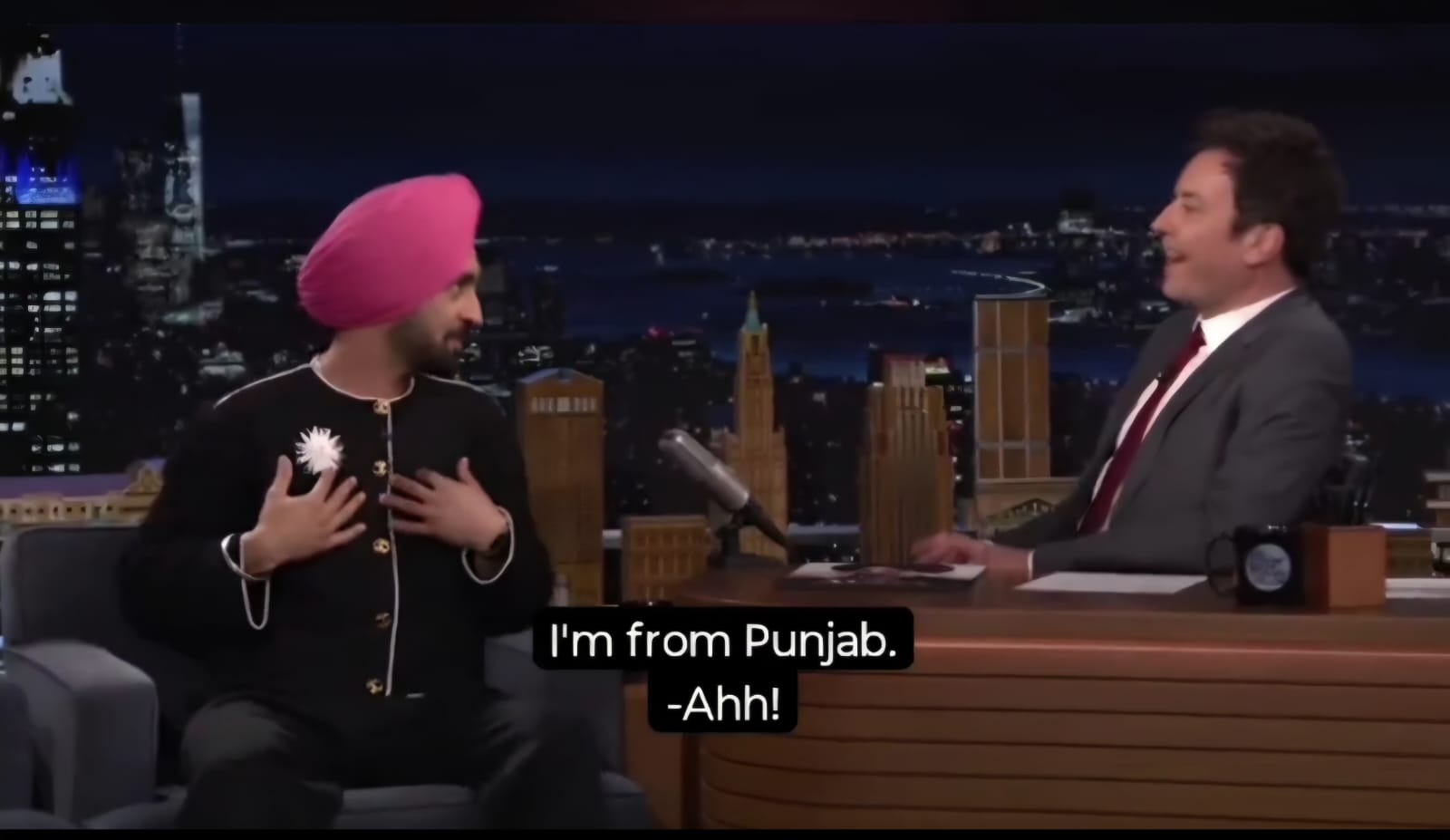
The global stage is never just about performance; it is about projection. Identity, politics, and symbolism travel with every word, every pause, and every omission. When someone like Diljit Dosanjh appears on a platform as influential as The Tonight Show Starring Jimmy Fallon, hosted by Jimmy Fallon, he is not merely entertaining, he is signaling.
Diljit Dosanjh on The Tonight Show Starring Jimmy Fallon, He says I am from Punjab, Man proudly repped Punjab (as he should), talked about his roots, culture, music everything. But not once did he actually mention India. Not even in passing.If you are celebraty and appearing on… pic.twitter.com/5SMZxn1qL3— Chota Don (@choga_don) May 1, 2026
And increasingly, those signals demand scrutiny. At first glance, Dosanjh’s articulation of Punjab; its music, its culture, its energy, appears harmless. No one disputes the legitimacy of regional pride.
India’s civilizational strength lies precisely in its layered identities. But what raises concern is not the celebration of Punjab. It is the systematic erasure of India from that celebration.
On one of the most watched platforms globally, Dosanjh introduced himself simply as “from Punjab.” Not India. Not even in passing. This is not an isolated lapse; it is a pattern repeated across global appearances, from Coachella to Western media interviews.
Patterns are rarely accidental.
Punjab is not a sovereign entity. It is a state within India, with a history, identity, and contribution deeply intertwined with the Indian nation. To repeatedly present it as a standalone identity on global platforms, without contextual anchoring, is not just incomplete, it is politically loaded. No American popstar or celebrity refers to themselves from their respective states. They proudly wear their American identity on their sleeves, instead of foregrounding their regional identities. But in India, there are some sections of society for whom regional chauvinism takes precedent over national allegiance. Though it might appear as frivolous, the issue is deeply problematic.
Because in today’s geopolitical reality, such framing does not exist in a vacuum.
The Khalistan movement is not about cultural assertion; it is an explicitly political project with terror roots that seeks the territorial dismemberment of India.
It constructs India as an adversary, calls for the balkanisation of the country, and has historically justified violent means to carve out a separate state. While marginal within India today, it continues to find resonance in pockets of the diaspora, where distance often amplifies distortion.And this ecosystem does not operate alone.
There is a long-documented pattern of Pakistan, particularly through its intelligence apparatus like the ISI, seeking to exploit such fault lines to destabilize India. Cultural narratives, diaspora activism, and identity politics become instruments in that larger strategic play.
This is where Dosanjh’s messaging becomes more than just artistic choice.
By consistently foregrounding Punjab while omitting India, he is, whether consciously or not, contributing to a narrative architecture that separatist elements thrive on. His articulation aligns, uncomfortably, with the very framing that Khalistani groups have spent decades attempting to normalize: Punjab as distinct, detached, and politically separable from India. Not to mention Dosanjh has been accused of softballing Khalistani ideology, most notably with his support for the antisocial elements during the farmers’ protests and his spat with actor Kangana Ranaut back then.
Nevertheless, intent, at this point, becomes secondary to effect.
Defenders will argue that this is branding, that Dosanjh is simply globalizing “Punjab” as a cultural identity. But this argument collapses under scrutiny. Artists across the world do not erase their national belonging to amplify regional pride. They contextualize it. The sequence matters because it signals political belonging before cultural specificity.
Dosanjh reverses or entirely omits that sequence. Why? The answer likely lies in his audience.
His fandom is not limited to India. It spans a transnational Punjabi diaspora, including significant numbers of Pakistani-origin Punjabis who share linguistic and cultural ties but not Indian nationality. His concerts across the world routinely see participation from this cross-border demographic. By positioning himself as “Punjabi first,” Dosanjh taps into a market that transcends borders.
Commercially, it is astute. Politically, it is deeply irresponsible.
Because this very transnational Punjabi identity, detached from India, is a core ingredient in the Khalistani narrative mix. It blurs national boundaries, dilutes political belonging, and creates a cultural foundation upon which separatist ideology can be layered. What begins as branding can easily become ideological scaffolding.
And in that ecosystem, even silence becomes a statement.
But beyond the geopolitical implications lies an even more glaring contradiction, the intellectual dishonesty that underpins this entire posture.
Figures like Diljit Dosanjh and others in similar cultural circuits are often quick to indulge in virtue signalling when politicians in India appeal to cultural or religious identities. Such appeals are routinely dismissed as divisive, regressive, or majoritarian. The argument is that identity-based mobilisation is inherently dangerous to a plural society.
Yet, on international platforms, the same individuals unapologetically foreground a hyper-specific regional identity, Punjab, while erasing the national context altogether.
This is hypocrisy of the highest order.
If identity assertion is problematic in principle, it should remain so regardless of geography. If it is legitimate as cultural expression, then that legitimacy must apply consistently, including when Indians assert broader national or civilizational identities.
Instead, what we see is selective validation. When identity aligns with certain ideological comfort zones, it is celebrated. When it doesn’t, it is condemned. Domestic discourse demands abstraction; global branding thrives on specificity. The principles shift with the audience.
That is not consistency; it is calibration. And in a sensitive context like Punjab, this calibration is not without consequence. Because the repeated decoupling of Punjab from India feeds into a narrative space already occupied by separatist ideologies seeking legitimacy.
The contradiction, therefore, is not just rhetorical; it is structural.
You cannot decry identity politics at home while practicing a refined version of it abroad. You cannot dismiss civilizational assertion as regressive in India and then market regional exceptionalism as progressive on the global stage.
At some point, this ceases to be about expression and becomes a question of intellectual honesty.
None of this negates Dosanjh’s artistic success. He has undeniably taken Punjabi music to global audiences and broken barriers that few before him could. But influence is not a selective privilege. It comes with responsibility, especially when operating in a contested narrative environment.
Because on the world stage, identity is not just what you say.
It is also what you choose to omit, and who benefits from that omission.
And in Diljit Dosanjh’s case, that omission is beginning to align far too conveniently with narratives that seek not cultural celebration, but political fragmentation.