From floods to landslides: How the Indian Army became the backbone of India’s Disaster Response
Whenever a major crisis strikes India, whether mountains collapse, rivers swell, cyclones wreak havoc, or communal violence disrupts a region, the Indian Army is the first to be called in any emergency. This is no coincidence, but the hallmark of a strong, reliable, and swift-responding organisation. The Indian Army’s mobility, engineering prowess, medical facilities, logistics, and disciplined command structure have made it the nation’s first responder. This has been the norm for several decades. From natural disasters to internal security crises, the military is always at the forefront. From Defence Ministry reports to ground realities, everything paints the same picture of the Indian Army coming to the rescue when civil administration capabilities are stretched to the limit. In challenging situations, the Indian Army becomes a strong support on which the entire state rests. The crisis-solving role of the army The Indian Army’s role as an “aid to civil authorities” is not a new development. Since independence, the Army has been called upon repeatedly to assist civil authorities in emergencies. The 2001 Gujarat earthquake is a prime example, where the Army rescued thousands of people from under the rubble and supplied relief material. However, this role has become more pronounced and institutionalised over the past two decades. Following the 2004 tsunami in the Indian Ocean, India strengthened its HADR (Humanitarian Assistance and Disaster Relief) capabilities. They were further enhanced after the 2013 Uttarakhand disaster. Since then, the Army’s role has expanded year by year. The Army is now emerging as a first responder not only within the country but also in neighbouring countries. India was the first to respond to incidents such as the Nepal earthquake, the Sri Lanka cyclone, the Turkey earthquake, and the Thailand earthquake. This transformation occurred because the military’s training and structure allow it to operate in even the most difficult conditions. While civilian agencies rely on infrastructure, the military brings everything with it: food, medicine, communications, engineering equipment, and discipline. Statistics reflect the reach of the military According to the Ministry of Defence’s Annual Review 2025, the Indian Army deployed its 141 columns, including Special Engineer Task Forces, across more than 80 locations in 10 states in 2025. In these operations, over 28,000 people were rescued, medical assistance was provided to over 7,000, and relief supplies were provided to thousands of affected people. A similar picture emerged in 2024, when more than 83 disaster relief teams were deployed across 14 states, rescuing over 30,000 civilians and providing relief to millions. Over the past ten years, this number has averaged over 100 columns annually. These columns are deployed to respond to various emergencies, including floods, landslides, avalanches, cyclones, and internal unrest. These statistics aren’t just numbers. They tell the story of a system that’s always prepared. Army units are pre-positioned in areas most prone to disasters—the Himalayas, the Northeast, and coastal regions. When a state government sends a requisition, columns are ready to move within hours. Wayanad Landslide 2024: The Most Recent and Poignant Example On July 30, 2024, a devastating landslide in Wayanad, Kerala, claimed hundreds of lives. Villages were buried under debris, roads and bridges were washed away, and the entire region was isolated. The state government immediately called for help, and the army was the first to arrive. Within hours, two flood relief columns departed from Kannur. Six larger HADR columns were subsequently deployed, comprising approximately 500 troops, medical teams, sniffer dogs, and heavy equipment. The army rescued nearly 1,000 people alive from the rubble, provided first aid, and evacuated them to safety. Dozens of bodies were also recovered. The biggest challenge was access. Rivers were overflowing, and bridges were broken. The Madras Engineer Group built a 190-foot-long Class-24 Bailey bridge, which connects Mundakkayi to the outside world. A temporary footbridge was constructed overnight. Helicopters transported heavy machinery across the rivers. The Army established a command-control centre in Kozhikode. More than 1,500 rescue workers worked in collaboration with the Navy, Air Force, Coast Guard, NDRF, and state police. But in the initial and most crucial hours, it was the Army that handled the situation. Sikkim Flash Flood 2023, Challenging High Altitude Expedition In October 2023, a flood caused by a glacial lake wreaked havoc in Sikkim. The Teesta River overflowed, washing away bridges and leaving 23 soldiers missing. The Army immediately launched a rescue operation, working with the NDRF to rescue thousands of tourists and locals. Army personnel were affected themselves, yet they set up relief camps, delivered relief supplies, and r
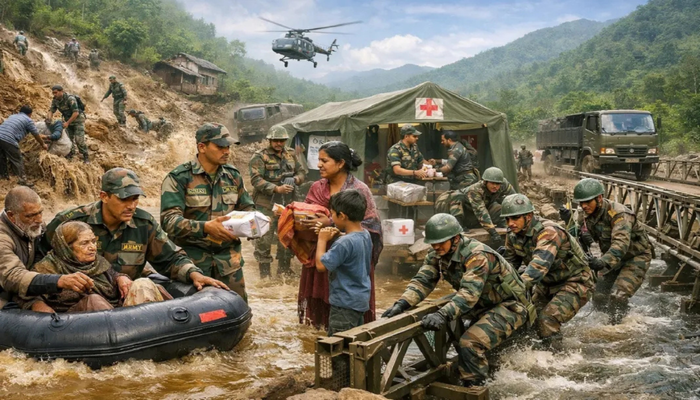

Whenever a major crisis strikes India, whether mountains collapse, rivers swell, cyclones wreak havoc, or communal violence disrupts a region, the Indian Army is the first to be called in any emergency. This is no coincidence, but the hallmark of a strong, reliable, and swift-responding organisation. The Indian Army’s mobility, engineering prowess, medical facilities, logistics, and disciplined command structure have made it the nation’s first responder.
This has been the norm for several decades. From natural disasters to internal security crises, the military is always at the forefront. From Defence Ministry reports to ground realities, everything paints the same picture of the Indian Army coming to the rescue when civil administration capabilities are stretched to the limit. In challenging situations, the Indian Army becomes a strong support on which the entire state rests.
The crisis-solving role of the army
The Indian Army’s role as an “aid to civil authorities” is not a new development. Since independence, the Army has been called upon repeatedly to assist civil authorities in emergencies. The 2001 Gujarat earthquake is a prime example, where the Army rescued thousands of people from under the rubble and supplied relief material. However, this role has become more pronounced and institutionalised over the past two decades.
Following the 2004 tsunami in the Indian Ocean, India strengthened its HADR (Humanitarian Assistance and Disaster Relief) capabilities. They were further enhanced after the 2013 Uttarakhand disaster. Since then, the Army’s role has expanded year by year. The Army is now emerging as a first responder not only within the country but also in neighbouring countries. India was the first to respond to incidents such as the Nepal earthquake, the Sri Lanka cyclone, the Turkey earthquake, and the Thailand earthquake.
This transformation occurred because the military’s training and structure allow it to operate in even the most difficult conditions. While civilian agencies rely on infrastructure, the military brings everything with it: food, medicine, communications, engineering equipment, and discipline.
Statistics reflect the reach of the military
According to the Ministry of Defence’s Annual Review 2025, the Indian Army deployed its 141 columns, including Special Engineer Task Forces, across more than 80 locations in 10 states in 2025. In these operations, over 28,000 people were rescued, medical assistance was provided to over 7,000, and relief supplies were provided to thousands of affected people.
A similar picture emerged in 2024, when more than 83 disaster relief teams were deployed across 14 states, rescuing over 30,000 civilians and providing relief to millions. Over the past ten years, this number has averaged over 100 columns annually. These columns are deployed to respond to various emergencies, including floods, landslides, avalanches, cyclones, and internal unrest.
These statistics aren’t just numbers. They tell the story of a system that’s always prepared. Army units are pre-positioned in areas most prone to disasters—the Himalayas, the Northeast, and coastal regions. When a state government sends a requisition, columns are ready to move within hours.
Wayanad Landslide 2024: The Most Recent and Poignant Example
On July 30, 2024, a devastating landslide in Wayanad, Kerala, claimed hundreds of lives. Villages were buried under debris, roads and bridges were washed away, and the entire region was isolated. The state government immediately called for help, and the army was the first to arrive.
Within hours, two flood relief columns departed from Kannur. Six larger HADR columns were subsequently deployed, comprising approximately 500 troops, medical teams, sniffer dogs, and heavy equipment. The army rescued nearly 1,000 people alive from the rubble, provided first aid, and evacuated them to safety. Dozens of bodies were also recovered.
The biggest challenge was access. Rivers were overflowing, and bridges were broken. The Madras Engineer Group built a 190-foot-long Class-24 Bailey bridge, which connects Mundakkayi to the outside world. A temporary footbridge was constructed overnight. Helicopters transported heavy machinery across the rivers.
The Army established a command-control centre in Kozhikode. More than 1,500 rescue workers worked in collaboration with the Navy, Air Force, Coast Guard, NDRF, and state police. But in the initial and most crucial hours, it was the Army that handled the situation.
Sikkim Flash Flood 2023, Challenging High Altitude Expedition
In October 2023, a flood caused by a glacial lake wreaked havoc in Sikkim. The Teesta River overflowed, washing away bridges and leaving 23 soldiers missing. The Army immediately launched a rescue operation, working with the NDRF to rescue thousands of tourists and locals. Army personnel were affected themselves, yet they set up relief camps, delivered relief supplies, and restored roads. This demonstrates the military’s ability to work under testing circumstances.
Operation Surya Hope during the 2013 Uttarakhand Disaster
Who can forget the Uttarakhand floods of June 2013? The entire region, including Kedarnath, was devastated. Thousands of pilgrims were stranded. The Army launched Operation Surya Hope. 2,223 sorties were flown, delivering 1,700 tons of relief supplies, 10,000 blankets, medicines, and food. Millions of lives were saved. The operation was praised worldwide and elevated the Army’s HADR role to new heights.
Assam struggles with floods every year
Assam faces floods every year. The Brahmaputra and its tributaries affect millions of people. The army deploys dozens of columns every year. Boats, helicopters, medical teams, everything is deployed by the army. In 2025, Assam was also allocated a large amount for flood relief, and the army played a key role.
No alternative to the institutional power of the military
Major General RPS Bhadauria (VSM-Retd), ADG of the Centre for Land Warfare Studies, said the Army’s greatest strength lies in its self-contained units. Each column consists of communications, logistics, engineers, and medical teams. Combat engineers can build Bailey bridges and temporary roads. Medical teams can set up field hospitals.
Logistics is so robust that supplies can be delivered by air, road, and river. The command structure is clear—mission-type orders are issued, and soldiers execute them without delay.
The army is always prepared for its role as a crisis rescuer
This remarkable capability to effectively respond during emergencies comes from rehearsals. A joint release exercise was conducted in Gujarat in 2024. A cyclone was simulated, and all agencies jointly tested plans. Indigenous technology was also demonstrated. Such exercises reduce inter-agency friction.
Civilian capacity needs to be enhanced
The dependence on the Indian Army should be looked at as a warning. The military’s primary responsibility is to defend the nation. The military cannot be allowed to become a universal fire brigade for every administrative shortcoming or structural weakness. Calling it in for every crisis could impact its combat readiness. Therefore, civilian capabilities must be strengthened, including expanding the NDRF, better equipping state forces, and strengthening infrastructure.
Indian Army’s disaster management capabilities are a matter of pride
The fact that the Indian Army is capable of acting as a first responder is a matter of pride for the country. It gives citizens the confidence that even in the darkest of times, there is someone to turn to. However, this confidence needs to be complemented by a strong civilian ecosystem, so that the Army can focus on its core responsibility and be the first to respond when needed.
When used properly, the military’s role as a first responder is a national asset. It assures citizens that when a disaster strikes, the state will send its most capable force to their defence. The challenge now is to build a comprehensive ecosystem with this assurance that is worthy of the uniformed personnel who are often the first to answer the call and the first to arrive.
(This article is a translation of the original article published on OpIndia Hindi.)