Does India also have military bases abroad? Here’s where they are and how many exist
Israel, supported by the United States, eliminated Iran’s Supreme Leader Ayatollah Ali Khamenei and other high-ranking officials on 28th February (Saturday), following a meticulously planned and precise operation. Afterwards, the enraged Islamic Republic launched a barrage of attacks aimed at the military facilities of the Western power dispersed throughout the region in retaliatory strikes. The rising tensions between the two sides have highlighted the network of American bases in the Middle East intended to protect its interests and reinforce its dominance. Likewise, other nations have also created a similar presence in multiple parts of the world to safeguard their strategic and national interests, deter foes, secure global trade routes and even project power by engaging in expeditionary warfare to have an impact on international events. They might serve as staging sites or offer logistical, communications and intelligence support, depending on their size and infrastructure. Hence, world powers have set up these buildings abroad as a result of numerous conflicts throughout modern history to facilitate their military and political goals. Interestingly, the only shared aspect between a friend and an enemy is their proximity to you. Therefore, these installations are essential not just for providing assistance to alliances but also for countering the latter and are constructed as part of diplomatic and defence ties for a strategic edge over a geographic area. Image via ssbcrackexams.com India has also formed a web of similar complexes in friendly states through strategic partnerships to expand its military capabilities and challenge its rivals. Furthermore, these are employed to train and equip the hosts in addition to using them for their own benefit. Thus, both parties have benefited greatly from them. Overseas Indian military bases: Tajikistan Farkhor Air Base was India’s first global military presence. It was built between the late 1990s and early 2000s and situated 130 kilometres southeast of Dushanbe, close to the Afghan border. It had a military hospital that catered to Afghan Northern Alliance fighters, a repair unit, and even helicopters. It functioned as a vital and strategic logistics hub that supported the alliance and kept an eye on regional security. India had access to Central Asia and strategic influence over Pakistan due to its proximity (about 20 kilometres) to Afghanistan’s Wakhan Corridor. Pervez Musharraf, then president of Pakistan, had expressed concerns to the Tajik government in 2003, voicing that Indian planes could reach his country in a matter of minutes via the base. Farkhor was later replaced by the Ayni base, constructed in 2008. There was no permanent fighter aircraft stationed, and it was never utilised for combat operations. India had placed Mi17 helicopters to support Tajikistani forces. Image via Jagran Josh According to other reports, it had begun using a small number of Su-30MKI since 2014. The Indian Air Force and the Tajik Air Force operated the facility together. Notably, India utilised both military and civilian aircraft to evacuate citizens and officials from Afghanistan during the fall of Kabul in 2021. However, India withdrew from it last year and ceased its active engagement. Mauritius 8 coastal surveillance radar systems, including North Agalega Island, have been erected by India in Mauritius. The island, which is in the Indian Ocean, had been leased to the Indian Army for the development of strategic assets as part of the Indo-Mauritius Military Cooperation. It currently functions as an outpost for India. The bases are under construction on the Agalega Island. Image via Jagran Josh It has a radar system for coastal monitoring, as well as an extended runway for aircraft. It helps the rapid detection of ship movements in the ocean. This has strengthened India’s cooperation with Mauritius and its marine security. It is important to note that New Delhi is always making investments to improve its operational skills, and the Integrated Coastal Surveillance System (ICSS) is a coastal surveillance system that swiftly finds out, locates and observes marine activity in the Indian Ocean to protect its coastline, maintain regional security and support allied fleets. Oman Oman is the first Gulf country to officially forge defence connections with India, which has four military establishments there: one air base and three naval bases. There is an Indian listening station at Ras al Hadd. These stations are set close to enemy lines to use sound to detect movement and intercept important electronic communications. India is even granted berthing privileges at the naval vessel in Muscat. This implies that they have unrestricted access to the facilities at the installation as well as the authority to enter and exit the same. Duqm, the port town of Oman on the Arabian Sea in the northeast, is home to an air force base and
Israel, supported by the United States, eliminated Iran’s Supreme Leader Ayatollah Ali Khamenei and other high-ranking officials on 28th February (Saturday), following a meticulously planned and precise operation. Afterwards, the enraged Islamic Republic launched a barrage of attacks aimed at the military facilities of the Western power dispersed throughout the region in retaliatory strikes.
The rising tensions between the two sides have highlighted the network of American bases in the Middle East intended to protect its interests and reinforce its dominance. Likewise, other nations have also created a similar presence in multiple parts of the world to safeguard their strategic and national interests, deter foes, secure global trade routes and even project power by engaging in expeditionary warfare to have an impact on international events.
They might serve as staging sites or offer logistical, communications and intelligence support, depending on their size and infrastructure. Hence, world powers have set up these buildings abroad as a result of numerous conflicts throughout modern history to facilitate their military and political goals.
Interestingly, the only shared aspect between a friend and an enemy is their proximity to you. Therefore, these installations are essential not just for providing assistance to alliances but also for countering the latter and are constructed as part of diplomatic and defence ties for a strategic edge over a geographic area.
Image via ssbcrackexams.com
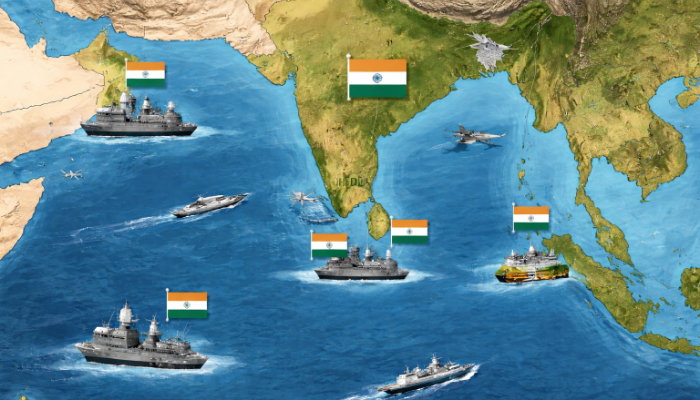
India has also formed a web of similar complexes in friendly states through strategic partnerships to expand its military capabilities and challenge its rivals. Furthermore, these are employed to train and equip the hosts in addition to using them for their own benefit. Thus, both parties have benefited greatly from them.
Overseas Indian military bases: Tajikistan
Farkhor Air Base was India’s first global military presence. It was built between the late 1990s and early 2000s and situated 130 kilometres southeast of Dushanbe, close to the Afghan border. It had a military hospital that catered to Afghan Northern Alliance fighters, a repair unit, and even helicopters. It functioned as a vital and strategic logistics hub that supported the alliance and kept an eye on regional security.
India had access to Central Asia and strategic influence over Pakistan due to its proximity (about 20 kilometres) to Afghanistan’s Wakhan Corridor. Pervez Musharraf, then president of Pakistan, had expressed concerns to the Tajik government in 2003, voicing that Indian planes could reach his country in a matter of minutes via the base.
Farkhor was later replaced by the Ayni base, constructed in 2008. There was no permanent fighter aircraft stationed, and it was never utilised for combat operations. India had placed Mi17 helicopters to support Tajikistani forces.
Image via Jagran Josh
According to other reports, it had begun using a small number of Su-30MKI since 2014. The Indian Air Force and the Tajik Air Force operated the facility together. Notably, India utilised both military and civilian aircraft to evacuate citizens and officials from Afghanistan during the fall of Kabul in 2021. However, India withdrew from it last year and ceased its active engagement.
Mauritius
8 coastal surveillance radar systems, including North Agalega Island, have been erected by India in Mauritius. The island, which is in the Indian Ocean, had been leased to the Indian Army for the development of strategic assets as part of the Indo-Mauritius Military Cooperation. It currently functions as an outpost for India. The bases are under construction on the Agalega Island.
Image via Jagran Josh
It has a radar system for coastal monitoring, as well as an extended runway for aircraft. It helps the rapid detection of ship movements in the ocean. This has strengthened India’s cooperation with Mauritius and its marine security.
It is important to note that New Delhi is always making investments to improve its operational skills, and the Integrated Coastal Surveillance System (ICSS) is a coastal surveillance system that swiftly finds out, locates and observes marine activity in the Indian Ocean to protect its coastline, maintain regional security and support allied fleets.
Oman
Oman is the first Gulf country to officially forge defence connections with India, which has four military establishments there: one air base and three naval bases. There is an Indian listening station at Ras al Hadd. These stations are set close to enemy lines to use sound to detect movement and intercept important electronic communications.
India is even granted berthing privileges at the naval vessel in Muscat. This implies that they have unrestricted access to the facilities at the installation as well as the authority to enter and exit the same. Duqm, the port town of Oman on the Arabian Sea in the northeast, is home to an air force base and a naval base. The announcement was made by India in February 2018.
The INS (Indian Naval Ship) Mumbai had earlier used the area as a port. Omar ports are used by the Indian Navy to combat piracy in the Gulf of Aden.
Maldives
The process of integrating the Maldives into India’s safety net commenced after it approached New Delhi in 2009. The country feared that terrorists would take control of its island resorts due to a lack of military resources and surveillance capabilities.
10 Coastal Surveillance Radar (CSR) stations are run by the Indian Navy in the atoll nation. The Indian Coastal Radar System has been connected with the Maldivian Coastal Radar Range. A central control room in India’s Coastal Command gets a seamless radar image once the two ranges are connected.
The Indian Navy constantly watches the waterways of the Muslim island’s neighbours to protect it. India’s Coastal Surveillance Radar station also guards against the threat of piracy in the nearby waterways. enhances local security and aids in protecting local shipping. India and the Maldives use this facility to work together on maritime security.
Iran
India assumed control of Chabahar Port, the only oceanic port, which is in southeast Iran on the Gulf of Oman, in December 2018. The two nations had signed a $2 billion rail cooperation agreement in January of that year. A $600 million memorandum of understanding for Iran to purchase goods wagons and locomotives from India was part of the deal.
Image via IMPRI Impact and Policy Research Institute
The port isn’t really a military installation, but it gives India the required shipping and logistical accessibility. It enables New Delhi to deliver products to Afghanistan and Central Asia without passing through Pakistan. Hence, the Indian government regularly contributes to the port’s construction and upkeep.
Seychelles
An agreement to build and run a joint military installation on Assumption Island of Seychelles was reached in 2015 between India and the archipelago nation. It is primarily aimed at thwarting Beijing’s String of Pearls strategy. A coast surveillance radar system constructed with help from New Delhi went into service a year later. The Seychelles has four other ICSS in addition to the two on the principal island. India gave Seychelles a Dornier aircraft and a $100 million credit line.
Bhutan
New Delhi runs an Indian Military Training Team (IMTRAT) in Bhutan. It was built in Haa Dzong, in the western part of the country, during 1961-62. Indian Army staff train the Royal Bhutan Army and the Royal Bodyguard there. The team helps Bhutan improve its defence abilities. It is the oldest training team sent by India to a friendly foreign nation.
Sri Lanka
India acquired control of Sri Lanka’s Hambantota Air Base in 2018 for regional stability, to aid in the monitoring of shipping lanes and respond to catastrophes. India can use the base to foil the strategic actions of other countries. This might be transformed into a fully functional facility, which could be leveraged to fight any possible threats from China.
India has also leased Colombo Port and is investing in its advancement. Six Coastal Surveillance Radar (CSR) stations are run by the Indian Navy in the neighbouring nation.
Madagascar
India established a Coastal Surveillance Radar (CSR) station in Madagascar in 2007. It serves as a place for gathering intelligence and tracking marine communications and ship movements. The position assists India in monitoring activity in the Mozambique Channel and the southwest Indian Ocean. It had been India’s first electronic surveillance station abroad.
Mozambique
Mozambique, a country in southeast Africa, and India have a robust military working partnership. During the 2003 World Economic Forum and African Union meeting, the Indian Navy was in charge of the country’s maritime security.
Nepal
The Indian Air Force has an airport in Surkhet to defend against aerial threats and train Nepalese soldiers in high-altitude warfare, hand-to-hand combat and weapons.
View this post on Instagram A post shared by Indian Army (@indianarmy.adgpi)
Singapore
On 29th November 2017, Singapore inked a naval cooperation deal with India in an effort to thwart Chinese expansionism in the Strait of Malacca. India has established its military footprint there owing to the arrangement. It is officially known as RSS Singapura-Changi Naval Base, which is at one end of the bustling Strait of Malacca.
It is very important because more than 70% of China’s trade passes via this route. The accord has allowed Indian Navy ships to use it for logistical support, including refuelling. They can also dock and obtain supplies. The base bolstered security along core sea routes and enhanced India’s position.
United States of America
India and the United States signed the Logistics Exchange Memorandum of Agreement (LEMOA) on 29th August 2016. According to this pact, the military of both countries can use each other’s bases for resupplying or carrying out repairs. It does not make the provision of logistical support binding on either side and requires individual clearance for each request.
Now, India is able to access many military facilities spread over 85 countries and territories pertaining to the United States of America. Thus, bases in Australia, Japan, Singapore, South Korea, Djibouti, Kuwait, Philippines, Seychelles, Thailand and the United Arab Emirates would be crucial in confronting China and Pakistan.
Japan
Japan and India have inked a logistics deal to allow the armed forces of both countries to closely coordinate supplies and services. As a result of this deal, India has access to Japan’s military installation in Djibouti to oppose China’s base there.
India has signed reciprocal military logistics deals with other like-minded nations to broaden its strategic and naval operational reach throughout the Indian Ocean Region (IOR) and beyond. Several nations, including South Korea, Australia and France, have formalised mutual logistical support agreements (MLSAs) with the country. This is in the wake of China’s aggressive Indo-Pacific expansionist moves.
Conclusion
India has continually participated in defence cooperation with friendly foreign nations as an element of its national security strategy. The process of building and preserving trust in the interests of mutual security includes visits, meetings, exchanges, exercises, port calls and training facilitation.
India also fostered relations with the strategically positioned island nations in the Indian Ocean region. The installation of military bases in these strategic areas is beneficial and necessary for safeguarding India’s military and commercial interests. This is particularly relevant concerning China’s foreign military base expansion agenda.