Delhi Riots verdict explained: Why the SC rejected bail for Umar Khalid and Sharjeel Imam, seeing it as a planned conspiracy and not spontaneous violence
The Supreme Court of India’s judgment in the Delhi Riots conspiracy case on January 5, 2026, established a precedent that fundamentally alters how democratic courts weigh individual freedom versus state security. This historic ruling, authored by Justice Aravind Kumar, distinguishes between criminal conspiracy and superficial activism while revealing the government’s case and the court’s clever reasoning. There are several levels of argument that the average reader cannot see to comprehend what the court deemed most convincing. The conspiracy that wasn’t spontaneous The central claim of the prosecution’s case is that the February 2020 Delhi riots were a well-planned conspiracy that was developed right after the Citizenship Amendment Bill was approved on December 4, 2019, rather than an unplanned outburst of intercommunal violence. This distinction is significant because, under the Unlawful Activities (Prevention) Act of 1967, it changes the legal landscape from spontaneous public disorder to premeditated terrorist activity. The timetable is devastating. The ‘Muslim Students of JNU’ WhatsApp group was established just hours after the Cabinet approved the CAB. In a matter of days, communally sensitive references to Kashmir and Babri Masjid were being printed in leaflets. In a matter of weeks, Sharjeel Imam gave talks at Jamia Millia Islamia advocating for Delhi to be ‘choked’ by traffic blockades, or chakka jams, which would interfere with supplies of milk and water. The court determined that this development was structural evidence of planning rather than accidental. Acid bottles, stones, and petrol bombs are not stored in homes weeks in advance of a spontaneous protest. Children from minority schools are not evacuated in advance during a spontaneous protest. The Umar Khalid: Strategic Direction vs. Physical Absence Umar Khalid’s absence from North-East Delhi during the actual rioting is one of the judgment’s most glaring features. His legal team took advantage of this that he cannot be held accountable if he wasn’t there when the riots took place. The court’s response is worth reading. According to Justice Aravind Kumar, once the fundamental plan is put into action, conspiracy legislation does not require actual presence at the scene of violence. As the ideological architect, Umar Khalid was responsible for conceptualisation and direction. The court discovered evidence of managerial responsibility in speech material, contemporaneous strategic discussions, and digital communication trails. More delicately, the decision emphasised that Khalid’s absence from riot areas actually strengthened the case against him, demonstrating that he worked as a coordinator rather than a street-level participant. A mastermind gives orders from a distance. What the court noted but never said clearly, Khalid’s status as a student activist at JNU gave him authority and a following that regular organisers do not have. This was viewed by the court as proof of command authority, the capacity to organise people both inside and outside of one’s immediate social circle. When an intellectual leader issues a call for disruption, followers carry it out. Conspiracy responsibility allows the leader to be held accountable for such execution. Sharjeel Imam: The Incitement through Indirection The case of Sharjeel Imam offered another perspective. He consistently denied wanting to use violence. However, the prosecution (as well as the court) found conspiracy in the structural inevitability of violence stemming from the objectives he outlined rather than in explicit appeals for violence. In words that few people understood, the court stated, ‘A conspirator may outwardly disavow violence while simultaneously engaging in acts designed to create conditions where violence becomes unavoidable.’ This is the legal equivalent of stating, Plan an event that you know will result in a confrontation with police, purposefully mobilise women and children to prevent police action, block arterial roads, and claim you didn’t intend violence. The court deemed this to be unlawful. You cannot later claim ignorance of anticipated repercussions when you plan a chakka jam knowing it would cause communal strife, when you specifically mention Babri Masjid and Kashmir in brochures, or when you collaborate with members of radical student groups like ‘Students of Jamia.’ According to the ruling, where effects are anticipated and structurally foreseeable, carelessness regarding them qualifies as conspiracy. Why delay arguments failed? The appellants made a strong case for the delay because they had been detained for years, the trial had not yet started, and around 1,000 witnesses had been called. Long-term confinement must be against Article 21 of the Constitution. The court’s response was skilfully crafted to both firmly reject the mechanical premise that time alone determines outcomes and avoid coming out as unconcerned with libe
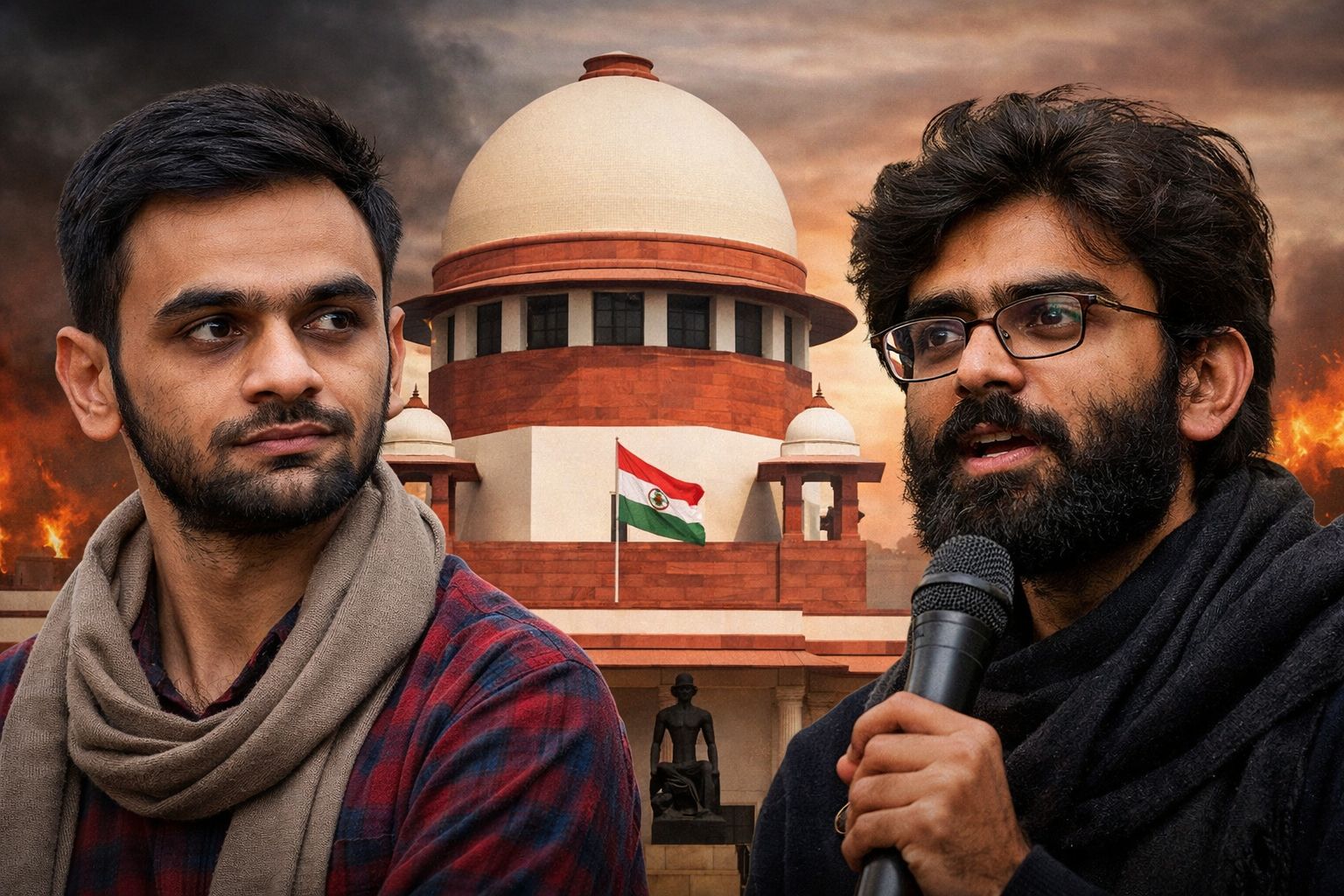

The Supreme Court of India’s judgment in the Delhi Riots conspiracy case on January 5, 2026, established a precedent that fundamentally alters how democratic courts weigh individual freedom versus state security. This historic ruling, authored by Justice Aravind Kumar, distinguishes between criminal conspiracy and superficial activism while revealing the government’s case and the court’s clever reasoning. There are several levels of argument that the average reader cannot see to comprehend what the court deemed most convincing.
The conspiracy that wasn’t spontaneous
The central claim of the prosecution’s case is that the February 2020 Delhi riots were a well-planned conspiracy that was developed right after the Citizenship Amendment Bill was approved on December 4, 2019, rather than an unplanned outburst of intercommunal violence. This distinction is significant because, under the Unlawful Activities (Prevention) Act of 1967, it changes the legal landscape from spontaneous public disorder to premeditated terrorist activity.
The timetable is devastating. The ‘Muslim Students of JNU’ WhatsApp group was established just hours after the Cabinet approved the CAB. In a matter of days, communally sensitive references to Kashmir and Babri Masjid were being printed in leaflets. In a matter of weeks, Sharjeel Imam gave talks at Jamia Millia Islamia advocating for Delhi to be ‘choked’ by traffic blockades, or chakka jams, which would interfere with supplies of milk and water. The court determined that this development was structural evidence of planning rather than accidental. Acid bottles, stones, and petrol bombs are not stored in homes weeks in advance of a spontaneous protest. Children from minority schools are not evacuated in advance during a spontaneous protest.
The Umar Khalid: Strategic Direction vs. Physical Absence
Umar Khalid’s absence from North-East Delhi during the actual rioting is one of the judgment’s most glaring features. His legal team took advantage of this that he cannot be held accountable if he wasn’t there when the riots took place. The court’s response is worth reading.
According to Justice Aravind Kumar, once the fundamental plan is put into action, conspiracy legislation does not require actual presence at the scene of violence. As the ideological architect, Umar Khalid was responsible for conceptualisation and direction. The court discovered evidence of managerial responsibility in speech material, contemporaneous strategic discussions, and digital communication trails.
More delicately, the decision emphasised that Khalid’s absence from riot areas actually strengthened the case against him, demonstrating that he worked as a coordinator rather than a street-level participant. A mastermind gives orders from a distance. What the court noted but never said clearly, Khalid’s status as a student activist at JNU gave him authority and a following that regular organisers do not have. This was viewed by the court as proof of command authority, the capacity to organise people both inside and outside of one’s immediate social circle. When an intellectual leader issues a call for disruption, followers carry it out. Conspiracy responsibility allows the leader to be held accountable for such execution.
Sharjeel Imam: The Incitement through Indirection
The case of Sharjeel Imam offered another perspective. He consistently denied wanting to use violence. However, the prosecution (as well as the court) found conspiracy in the structural inevitability of violence stemming from the objectives he outlined rather than in explicit appeals for violence. In words that few people understood, the court stated, ‘A conspirator may outwardly disavow violence while simultaneously engaging in acts designed to create conditions where violence becomes unavoidable.’
This is the legal equivalent of stating, Plan an event that you know will result in a confrontation with police, purposefully mobilise women and children to prevent police action, block arterial roads, and claim you didn’t intend violence.
The court deemed this to be unlawful. You cannot later claim ignorance of anticipated repercussions when you plan a chakka jam knowing it would cause communal strife, when you specifically mention Babri Masjid and Kashmir in brochures, or when you collaborate with members of radical student groups like ‘Students of Jamia.’ According to the ruling, where effects are anticipated and structurally foreseeable, carelessness regarding them qualifies as conspiracy.
Why delay arguments failed?
The appellants made a strong case for the delay because they had been detained for years, the trial had not yet started, and around 1,000 witnesses had been called. Long-term confinement must be against Article 21 of the Constitution. The court’s response was skilfully crafted to both firmly reject the mechanical premise that time alone determines outcomes and avoid coming out as unconcerned with liberty rights.
Judges genuinely concluded that delays caused by the accused themselves, such as requests for adjournments, different ways to submit documents, and disagreements over the order of witness examinations, cannot be used as leverage to get bail. The prosecution repeatedly said that it was prepared to move on while the defence cited procedural issues, according to the court’s review of trial order sheets.
More damningly, the judgment cited Tasleem Ahmed v. State (NCT of Delhi), a co-accused case from the same trial in which the trial court expressed distress at being unable to proceed, and the Delhi High Court had detailed how the defence caused delays. The appellants’ footing was severed by this precedent. You cannot participate in a delay and then argue that you are entitled to bail as a result. Subversively, the ruling distinguished between speedy trial and automatic bail.
The court will uphold the constitutional guarantee of a prompt trial by giving orders to speed up the procedures. However, constitutional courts are not obligated to issue bail only because the trial is taking a long time. Rather, the court has the authority (and has done so) to order prompt witness hearings and penalise those who cause additional delays.
The Section 43D(5) Gatekeeping Mechanism
A crucial technical detail that was overlooked in the media reportage is that bail is not strictly prohibited by Section 43D(5) of the UAPA. The court must be convinced that there are reasonable grounds for believing that the accusation against the accused is prima facie true. The court must then consider whether, in light of that prima facie case, liberty should be restrained. The government’s stance gets nuanced at this point.
Taken at face value, the prosecution’s evidence against Umar and Sharjeel reveals the following:
- Creating and managing WhatsApp groups as a collaboration tool
- Pamphlets that use poignant stories to inspire
- Speeches outlining a disruption tactic before acts of violence
- Participation in secret meetings when escalation was considered
- Pre-planning digital evidence from December 2019
- Statements from witnesses outlining their pivotal roles.
- They were at the top of a vertical chain of command.
The court determined that all of this information exceeded the level of prima facie plausibility. Defences can be examined during a trial, hence it is not proof of guilt. However, the court is asking if the claims are facially believable at the pre-bail stage rather than evaluating the evidence for conviction. The court determined that they were.
The differentiation doctrine (The sleeper issue)
One of Justice Aravind Kumar’s most important doctrinal decisions occurs almost casually in the judgment. Distinguishing between principal conspirators and facilitators even within the same FIR. Although this law is not new, the court’s articulation of it with clarity and power is noteworthy.
Umar Khalid and Sharjeel Imam stand on a ‘qualitatively different footing’ from the other accused, according to the court. In contrast to Gulfisha Fatima, Saleem Khan, Meeran Haider, and others, who are depicted as local-level facilitators carrying out orders, the prosecution’s own narrative characterises them as ideological drivers with intellectual and command involvement.
The court stated that even if everyone is charged in the same conspiracy, this distinction cannot be disregarded. This is important for the bail stage (as opposed to the trial stage) since different roles require different levels of custody. Detaining a local protest organiser is not justified in the same way as detaining a key conspirator in order to stop networks from reactivating and interfering with witnesses. This principle, according to the court, is ‘intrinsic to criminal adjudication’ and not an exception to conspiracy law, but a constitutional discipline imposed upon bail jurisdiction.
This goes unnoticed because the court claims that proportionality analysis is not eliminated by the UAPA’s statutory ban on bail. Although the statute states that ‘prima facie case closes the inquiry,’ proportionality is required by Article 21 of the Constitution. The court threaded this needle by stating that, although the statutory bar usually applies when a prima facie case exists, the constitutional requirement of proportionality may allow bail for peripheral players even if the bar technically applies when the prima facie case involves varying degrees of culpability.
Because of this, five of the accused, Gulfisha, Meeran, Shifa, Saleem, and Shadab, were granted bail even though all seven were initially charged. Their roles fell short of the level of prominence that warranted ongoing moderation.
The 12 Conditions: Glided Chains
The accused who are granted bail must execute bonds worth Rs. 2 lakh, stay in Delhi NCT, appear in court twice a week, refrain from contacting any co-accused, particularly the major plotter, avoid contacting witnesses, give up their passports, and refrain from discussing the case in public. Any violation results in an instant cancellation.
What’s noteworthy is that the court placed limitations so rigorous that those who were granted bail continue to be closely monitored without being physically detained. They can travel around Delhi, see relatives, and build defences, but their freedom is restricted. This is a compromise, supervised conditional release rather than incarceration or freedom. It responds to the underlying complaint that the court was treating certain people with mercy while treating others harshly. No benefit from bail is guaranteed by the terms.
The clause that specifically forbids communication with principal conspirators Umar Khalid and Sharjeel Imam is instructive. It implies that the court sees bail as a means of dividing networks. Although those freed may have served as operational facilitators, they are not capable of rekindling the conspiracies on their own. The court eliminated the possibility of additional cooperation by keeping them apart from key conspirators.
The Reopener Clause (Buried in Paragraph 432)
According to the court, Umar and Sharjeel are ‘ at liberty to renew their prayer for grant of bail before the jurisdictional Court’ when the protected witnesses have finished being questioned or after a year has passed, whichever comes first. This is a constitutional protection against incarceration without charge or trial. It is not mercy. ‘We accept the statutory bar for now, but not forever,’ the court stated. These limitations are lifted if the trial doesn’t make significant progress.
This is important because it demonstrates the court’s true stance, which is to temporarily accept the stringent bail regime of the UAPA in exchange for the trial moving forward. Prosecutors are warned under the reopener clause that if they continue to postpone the trial, the court will step in. This is constitutionalism through the back door, upholding parliamentary legislation while making sure that prosecutorial inaction doesn’t undermine constitutional principles.
Conclusion
The verdict conveys the Supreme Court’s stance on coordinated attempts to unsettle the capital under the pretence of protest in a straightforward, although carefully worded, manner. The court has unequivocally held that the statutory bar under Section 43D(5) of the UAPA must operate with full force, and bail cannot be granted simply because custody has been prolonged when the prosecution material, taken at face value, reveals a central, formative role in a conspiracy that allegedly threatens communal harmony and the security of the State.
Constitutional scrutiny of liberty will always be role-sensitive rather than rhetoric-driven, as the court has drawn a principled line between those who are said to have conceived and directed the design and those whose roles are described as derivative, logistical, or site specific. Importantly, the court has refused to let delay be used as a way to get around the UAPA framework, particularly in cases where the evidence indicates that procedural disputes and delays were not exclusively the fault of the prosecution or the court system.
The bench has taken a more stringent approach, preserving pre-trial detention for the accused prime conspirators while also requiring the trial court to proceed with due priority and reasonable expedition, especially about protected witnesses and crucial prosecution evidence. The message is clear: an expedited and closely monitored trial, rather than automatic discharge, is the solution for delays in severe national security prosecutions. This is where the judgment’s small but significant bias is found. On paper, it reiterates that Article 21 is still in effect and that the appellants may reapply for bail after protected witnesses have been questioned or after a year, whichever comes first.
However, in reality, it puts the actual burden on the accused and the trial court. Any further stalling will be seen through the prism of constitutional concern rather than tactical gain; the procedures must not be blocked, and adjournments must be extraordinary. In essence, the Supreme Court has maintained the State’s authority to detain individuals suspected of masterminding the conspiracy while tightening the trial schedule to ensure that questions of liberty, guilt, and national security are ultimately settled in court rather than through piecemeal bail litigation.