Delhi court upholds discharge of two Hindus accused in 2020 anti-Hindu Delhi riots case, expresses “grave suspicion” over the story of the police: Read details
The Karkardooma Sessions court in Delhi on Wednesday (8th April) upheld the discharge of two Hindus, named Ajay and Gaurav Panchal, who were accused in a case relating to the 2020 anti-Hindu riots. Expressing “grave suspicion” on the police investigation and the prosecution’s version of the case, Additional Sessions Judge (ASJ) Sameer Bajpai dismissed a criminal revision petition filed by the Delhi Police challenging the trial court order of discharge. Ajay and Gaurav Panchal were booked by the Delhi Police in connection with a rioting incident during the February 2020 anti-Hindu riots in Delhi. The Delhi Police filed an FIR against the accused in March 2020, alleging the commission of offences punishable under Sections 147, 148, 149, 427, 435, 323, 188 and 34 of the Indian Penal Code. While examining the facts of the case, the trial court had noted that the accused were arrested under the FIR in question based on the testimony of one Mohammed Aslam, whom the court treated as a stock witness. Notably, a stock witness usually appears as a witness in multiple cases, often on the side of the police or prosecution. Such a witness is relied on by an investigating agency to back its version of events. However, courts do not usually rely on the testimony of a stock witness and subject it to greater scrutiny. Contentions of the Delhi Police against the discharge of the accused In July 2022, the trial court discharged the accused, after which the Delhi Police approached the Sessions Court. The Delhi Police contended before the Sessions Court that the trial court made grave errors in discharging the accused. The prosecution challenged the trial court order both on the question of law and on the facts. It contended that the trial court failed to appreciate the evidence presented before it and erred in declaring Mohammed Aslam a stock witness, treating the delay in filing the FIR as a discrepancy, and raising suspicion on the statement of the complainant. Contentions of the accused against the prosecution’s case The respondents (accused) pointed out several discrepancies in the prosecution’s case. They argued that the prosecution’s case lacked merit and the investigation conducted by the Delhi Police was manipulative. “Further, the falsity of the case can be seen from the very fact that the respondents have been made accused persons in at least 5-6 FIRs of the same kind of incident, which was not possible,” the respondents emphasised in their submission before the Sessions Court. They also accused the police of picking innocent persons and implicating them while the actual culprits were roaming free. Observations made by the Sessions Court regarding the trial court’s decision While hearing the criminal revision petition of the Delhi police, the Sessions Court examined the trial court’s findings in detail and upheld its decision to discharge the two accused. The Additional Sessions Judge analysed the grounds relied on by the trial court in passing the impugned order. Here is a pointwise summary of the observations made by the Sessions Court regarding the discrepancies highlighted by the trial court: Unexplained delay in filing the FIR In its judgment, the trial court questioned the unexplained delay, first on the part of the complainant in informing the police about the alleged attack on him and the subsequent filing of the FIR by the police. The complainant was allegedly attacked by the accused on February 25, 2020, and he informed the police about the attack on March 3, 2020. The trial court was not satisfied with the Delhi Police’s explanation, which cited a shortage of staff at the Jyoti Nagar police station on the day of the incident. Agreeing with the trial court on the point of delay in the lodging of the FIR, the Sessions Court noted, “The Ld. Trial Court was correct in observing that the reason for the delay, i.e. the chaotic situation due to widespread protests, was left to the presumption of the Court, whereas a reasonable explanation about the delay should have been there on record.” Suspicion as to the injuries alleged by the complainant and the mismatch in the names stated in the MLC and the Complaint The trial court doubted that the injuries to the complainant were caused by the alleged attack by the accused. It also questioned the credibility of the medical report adduced by the complainant. The trial court pointed out the inconsistency in the Medico-Legal Certificate (MLC), dated February 25, 2020, submitted before it by the complainant. The MLC mentions Mohd. Ishaq S/o Mohd. Hanis R/o Maharajpur, Uttar Pradesh, was the injured, while the complaint to the police was made by Mohd. Tisam S/o Mohd. Anish R/o E-84/114, Rajeev Gandhi Camp, Chitra Vihar, Preet Vihar, Shakarpur, East Delhi. The complaint, in his initial statement, told the court that his name was inadvertently mentioned as Mohd. Ishaq in the MLC, but he could not explain why the name of the father and the
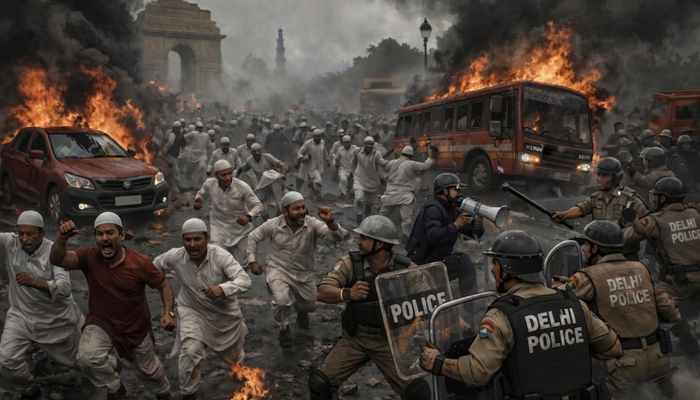
The Karkardooma Sessions court in Delhi on Wednesday (8th April) upheld the discharge of two Hindus, named Ajay and Gaurav Panchal, who were accused in a case relating to the 2020 anti-Hindu riots. Expressing “grave suspicion” on the police investigation and the prosecution’s version of the case, Additional Sessions Judge (ASJ) Sameer Bajpai dismissed a criminal revision petition filed by the Delhi Police challenging the trial court order of discharge.
Ajay and Gaurav Panchal were booked by the Delhi Police in connection with a rioting incident during the February 2020 anti-Hindu riots in Delhi. The Delhi Police filed an FIR against the accused in March 2020, alleging the commission of offences punishable under Sections 147, 148, 149, 427, 435, 323, 188 and 34 of the Indian Penal Code. While examining the facts of the case, the trial court had noted that the accused were arrested under the FIR in question based on the testimony of one Mohammed Aslam, whom the court treated as a stock witness. Notably, a stock witness usually appears as a witness in multiple cases, often on the side of the police or prosecution. Such a witness is relied on by an investigating agency to back its version of events. However, courts do not usually rely on the testimony of a stock witness and subject it to greater scrutiny.
Contentions of the Delhi Police against the discharge of the accused
In July 2022, the trial court discharged the accused, after which the Delhi Police approached the Sessions Court. The Delhi Police contended before the Sessions Court that the trial court made grave errors in discharging the accused. The prosecution challenged the trial court order both on the question of law and on the facts. It contended that the trial court failed to appreciate the evidence presented before it and erred in declaring Mohammed Aslam a stock witness, treating the delay in filing the FIR as a discrepancy, and raising suspicion on the statement of the complainant.
Contentions of the accused against the prosecution’s case
The respondents (accused) pointed out several discrepancies in the prosecution’s case. They argued that the prosecution’s case lacked merit and the investigation conducted by the Delhi Police was manipulative. “Further, the falsity of the case can be seen from the very fact that the respondents have been made accused persons in at least 5-6 FIRs of the same kind of incident, which was not possible,” the respondents emphasised in their submission before the Sessions Court. They also accused the police of picking innocent persons and implicating them while the actual culprits were roaming free.
Observations made by the Sessions Court regarding the trial court’s decision
While hearing the criminal revision petition of the Delhi police, the Sessions Court examined the trial court’s findings in detail and upheld its decision to discharge the two accused. The Additional Sessions Judge analysed the grounds relied on by the trial court in passing the impugned order. Here is a pointwise summary of the observations made by the Sessions Court regarding the discrepancies highlighted by the trial court:
Unexplained delay in filing the FIR
In its judgment, the trial court questioned the unexplained delay, first on the part of the complainant in informing the police about the alleged attack on him and the subsequent filing of the FIR by the police. The complainant was allegedly attacked by the accused on February 25, 2020, and he informed the police about the attack on March 3, 2020. The trial court was not satisfied with the Delhi Police’s explanation, which cited a shortage of staff at the Jyoti Nagar police station on the day of the incident. Agreeing with the trial court on the point of delay in the lodging of the FIR, the Sessions Court noted, “The Ld. Trial Court was correct in observing that the reason for the delay, i.e. the chaotic situation due to widespread protests, was left to the presumption of the Court, whereas a reasonable explanation about the delay should have been there on record.”
Suspicion as to the injuries alleged by the complainant and the mismatch in the names stated in the MLC and the Complaint
The trial court doubted that the injuries to the complainant were caused by the alleged attack by the accused. It also questioned the credibility of the medical report adduced by the complainant. The trial court pointed out the inconsistency in the Medico-Legal Certificate (MLC), dated February 25, 2020, submitted before it by the complainant. The MLC mentions Mohd. Ishaq S/o Mohd. Hanis R/o Maharajpur, Uttar Pradesh, was the injured, while the complaint to the police was made by Mohd. Tisam S/o Mohd. Anish R/o E-84/114, Rajeev Gandhi Camp, Chitra Vihar, Preet Vihar, Shakarpur, East Delhi.
The complaint, in his initial statement, told the court that his name was inadvertently mentioned as Mohd. Ishaq in the MLC, but he could not explain why the name of the father and the place of residence were also different in the MLC and the complaint. Additionally, the trial court took notice of the fact that the doctors who issued the MLC did not give a final opinion, as the complainant absconded from the hospital and never returned, when the Investigation Officer (IO) asked him to furnish the treatment papers from another hospital to which he had gone.
“The Ld. Trial Court further correctly observed that the MLC shows that the injured/complainant absconded from the Hospital and even on giving notice u/s 91 Cr.P.C., the complainant failed to provide the treatment papers from another Hospital and as such the injuries to the complainant cannot be attributed to the alleged act of the accused persons,” the Additional Sessions Judge said, agreeing with the trial court.
No details of the police official deployed at the place of occurrence of the incident, and no CCTV footage
The Sessions Court agreed with the trial court’s observations regarding the lapses on the part of the police in obtaining evidence, including the CCTV footage of the place of occurrence of the alleged attack, as well as the details of police officials who were deployed in the area. “The Ld. Trial Court was further correct in observing that the police did not make any effort to find out as to which officer was already present or deputed at the scene of occurrence after receiving the PCR calls, and further no attempt was made to find any witness, and further no photographer or videographer had been deputed by the police to capture the scene of occurrence,” the Sessions Court noted.
Criticising the police inaction, the Sessions Court further said that the failure of the police in collecting material evidence through CCTV footage, etc., had the effect of letting the real culprits go free.
Major discrepancies in the statements of the complainant
The trial court also noted that the statement of the complainant did not have the details about the identification of the persons who allegedly attacked him. The court further pointed out a contradiction in the statement made by the complainant in his complaint dated March 3, 2020, and the statement subsequently recorded by the IO under section 161 of the CrPC.
In the statement made in the complaint, the complainant said that when he returned from the hospital to the spot of occurrence of the incident, he found that his vehicle had been burnt, which meant that the vehicle was not burnt in his presence. But in the later statement recorded by the IO, the complainant said that he could identify the persons who set his vehicle on fire. Besides, in the statement given to the IO, while the complainant gave a general description of the rioters aged 20-25 years, he also said that he could identify them if they appeared before him in future.
Regarding the discrepancies pointed out by the trial court in the complainant’s statements, the Sessions Court said that such inconsistencies raise suspicion about the prosecution’s case. “…this is also a major contradiction in the two statements of the complainant and creates doubt in the story of the prosecution. The Court observes that these kinds of contradictions would come only when the manipulations are done, and the case is cooked up,” the Sessions Court stated.
Suspicious manner of identification by the complainant of the accused persons, who were arrested in a different case
The trial court was not convinced by the manner of identification of the accused persons by the complainant. The court noted that the accused were arrested and brought to the police station by HC Raj Kumar, in connection with a different FIR about two months after the incident. In a strange coincidence, the complainant was also present at the police station on the exact same date and time, without being called by the IO, to inquire about the progress in his case. He saw the accused in the police station and immediately identified them.
“It is also not convincing as to how could the complainant identify the accused persons after a gap of around two months between the date of the incident and the date of chance identification at the police station, considering firstly, the general nature of the description given by him in his supplementary statement recorded on 03.03.2020 and secondly, the fact that he would have had little opportunity to identify them as a part of the mob which attacked him, without attributing such specific role to them, as got so permanently and irrevocably etched in his memory,” the trial court noted.
Furthermore, the trial court examined the statement of HC Raj Kumar as recorded by the IO, where he explained how he came to arrest the accused. The court did not find the statement to be reliable. “… he (HC Raj Kumar) had stated that one Mohd. Aslam (stock witness) met him near Meet Nagar Flyover, and informed him that two persons “who were involved in the riots of 25.02.2022″ are sitting in bushes near the railway line beneath the Meet Nagar Flyover, and upon this information, dripping with the generality and casualness, the investigating officer proceeded to arrest both the accused persons, recorded their disclosure statements wherein they stated that they can get the weapons of offences, i.e. a danda and an iron pipe recovered, and upon this disclosure, again very conveniently, the investigating officer recovered both the aforesaid articles from the very place of arrest, which also was an open space, not hidden from the public and not within the possession of the accused persons, as is visible from the comparison of their disclosure statements in the FIR no. 60/20 PS Jyoti Nagar, with the statement of HC Raj Kumar in the present case,” the trial court said, raising suspicion on Kumar’s statement.
The trial court pointed out that HC Raj Kumar was not an eyewitness to the alleged incident and that Mohd. Aslam, named by him, was not mentioned in the list of prosecution witnesses. “A perusal of the initial complaint of the complainant police shall also reveal that the place of the incident, the place of arrest after around two months, and the place of the alleged recovery of the incriminating material are roughly the same, which speaks volumes about the manner in which the present investigation has been conducted by the police. It is also clear that even HC Raj Kumar is not an eyewitness to the commission of the alleged offences, and the person by the name of Mohd. Aslam, upon whose information he allegedly acted, has not been cited in the list of prosecution witnesses,” the trial court said.
The Sessions Court agreed with the doubts raised by the trial court about the manner of identification of the accused by the complainant and the circumstances surrounding the arrest of the accused and the recovery of the weapons. The Sessions Court said that the procedure of arrest and the recovery of weapons, as described by the police, was vitiated due to non-compliance with the law. “…the recovery of the articles, i.e. a Danda and an iron pipe, would not fall within the purview of Section 27 of the Indian Evidence Act and clearly hit by the bar as imposed by Sections 25 and 26 of the Act. It is observed that the police did not even take the police remand of the accused persons in order to recover the alleged weapons, i.e. Danda and iron rod and immediately after their arrest, judicial custody of the accused persons was obtained,” the Sessions Court observed.
While dismissing the criminal revision petition, the Additional Sessions Judge upheld the findings of the trial court and said that it was “difficult to believe the prosecution material at its face value”.