Beyond the abode of Lord Shiva: Learn how Somnath served as the financial engine and gateway for India’s ancient global trade networks
Modern geopolitics often refers to the idea put forward by Geopolitical theorist Nicholas Spykman that “Those who control the rimland, control the heartland.” While this theory is usually treated as a 20th-century concept, India had understood this reality much earlier. For ancient India, the sea was not separate from the land. Those who knew the sea could protect the land, grow wealth, and connect civilisations. The strongest symbol of this knowledge was the Somnath Temple, a place remembered today mainly for its destruction, but once known as the gateway to India’s maritime world. Somnath is often spoken about as a single tragic episode: Mahmud of Ghazni came, the temple was destroyed, and history moved on. This view misses the larger picture. The attack on Somnath was not an isolated act. It marked the beginning of a long and carefully unfolding process that weakened India’s control over the seas. If Somnath is not seen together with Kutch, Bharuch, Surat, the Konkan coast, and finally Goa, the deeper pattern of India’s maritime decline remains hidden. India before the 11th Century: A Civilisation of the Oceans Before the eleventh century, India was not only a land-based society. It was a strong maritime civilisation without colonies or overseas empires. Indian traders, sailors, monks, and pilgrims moved freely across the Arabian Sea and the wider Indian Ocean. They traded, taught, learned, and settled peacefully without fear. This reality is recorded in the Greek text “Periplus of the Erythraean Sea”, written in the first century, which clearly describes Indian trade routes reaching Oman, Yemen, Basra, and the eastern coast of Africa. These were not small or occasional journeys. They formed a regular and trusted network connecting ports, cultures, and economies. India’s relationship with the sea was not built on conquest but on confidence and knowledge. Navigation, astronomy, shipbuilding, and seasonal winds were well understood. This maritime wisdom did not vanish; it survived quietly in traditions, coastal communities, and temple records. A living memory: The voyage of INSV Koundinya This heritage is not only preserved in history books. It has been brought back to life in recent times. Economist and policy advisor Sanjeev Sanyal, who serves as an economic advisor to Prime Minister Narendra Modi, is currently undertaking a sea voyage aboard the INSV Koundinya. This ship is not a modern steel vessel. It has been built using the same method that Indian merchants used a thousand years ago. There is not a single iron nail in it. Coconut ropes stitch the wooden planks together, just as they once did when Indian ships sailed confidently across the Indian Ocean. The voyage began in Gujarat and covers nearly 1,400 kilometres to Oman, following ancient trade routes. The mission of the Indian Navy is not symbolic alone. It demonstrates that India’s maritime systems were practical, durable, and globally connected long before modern navies came into being. Temples as economic powerhouses One of the most misunderstood aspects of India’s maritime past is the role of temples. Between the tenth and twelfth centuries, especially during the Chola and Solanki periods, temples were not only religious centres. They functioned as financial, legal, and social institutions. Kings, traders, and common people donated wealth to temples. This wealth was not locked away. Temples acted like banks. They lent money at interest to merchant guilds, helping them fund risky overseas journeys to Sumatra, Java, Zanzibar, and East Africa. Sea trade involved dangers like storms, piracy, and shipwrecks, risks that individual traders could not bear alone. Temple treasuries could absorb losses, making long-distance trade possible. When voyages succeeded, merchants returned a share of their profits to the temple. In this way, religion, economy, and maritime trade formed a strong and balanced system. Guilds, Ships, and the central role of Somnath Indian maritime trade was organised through powerful guilds such as the Manigramam and the Ainnuruvar, also known as the Five Hundred Lords. These guilds maintained their own security forces and fleets to protect ships from pirates. They operated by rules, contracts, and shared responsibility. In western India, Somnath stood at the heart of this system. The port of Prabhas Patan had been active since Harappan times. Trade from the Roman world, West Asia, and Africa passed through this coast. The route from Dwarka to Somnath and Khambhat was not just a trade corridor. It was also a path of pilgrimage, culture, and social exchange. Somnath was therefore more than a shrine of Lord Shiva. It was a legal authority, a financial hub, and a cultural anchor for India’s maritime civilisation. Ghazni’s strike and the breaking of a network After the seventh century, Arab and Persian traders became active in the Indian Ocean. They formed trading gr

Modern geopolitics often refers to the idea put forward by Geopolitical theorist Nicholas Spykman that “Those who control the rimland, control the heartland.” While this theory is usually treated as a 20th-century concept, India had understood this reality much earlier.
For ancient India, the sea was not separate from the land. Those who knew the sea could protect the land, grow wealth, and connect civilisations. The strongest symbol of this knowledge was the Somnath Temple, a place remembered today mainly for its destruction, but once known as the gateway to India’s maritime world.
Somnath is often spoken about as a single tragic episode: Mahmud of Ghazni came, the temple was destroyed, and history moved on. This view misses the larger picture. The attack on Somnath was not an isolated act. It marked the beginning of a long and carefully unfolding process that weakened India’s control over the seas.
If Somnath is not seen together with Kutch, Bharuch, Surat, the Konkan coast, and finally Goa, the deeper pattern of India’s maritime decline remains hidden.
India before the 11th Century: A Civilisation of the Oceans
Before the eleventh century, India was not only a land-based society. It was a strong maritime civilisation without colonies or overseas empires. Indian traders, sailors, monks, and pilgrims moved freely across the Arabian Sea and the wider Indian Ocean. They traded, taught, learned, and settled peacefully without fear.
This reality is recorded in the Greek text “Periplus of the Erythraean Sea”, written in the first century, which clearly describes Indian trade routes reaching Oman, Yemen, Basra, and the eastern coast of Africa. These were not small or occasional journeys. They formed a regular and trusted network connecting ports, cultures, and economies.
India’s relationship with the sea was not built on conquest but on confidence and knowledge. Navigation, astronomy, shipbuilding, and seasonal winds were well understood. This maritime wisdom did not vanish; it survived quietly in traditions, coastal communities, and temple records.
A living memory: The voyage of INSV Koundinya
This heritage is not only preserved in history books. It has been brought back to life in recent times. Economist and policy advisor Sanjeev Sanyal, who serves as an economic advisor to Prime Minister Narendra Modi, is currently undertaking a sea voyage aboard the INSV Koundinya.

This ship is not a modern steel vessel. It has been built using the same method that Indian merchants used a thousand years ago. There is not a single iron nail in it. Coconut ropes stitch the wooden planks together, just as they once did when Indian ships sailed confidently across the Indian Ocean. The voyage began in Gujarat and covers nearly 1,400 kilometres to Oman, following ancient trade routes.
The mission of the Indian Navy is not symbolic alone. It demonstrates that India’s maritime systems were practical, durable, and globally connected long before modern navies came into being.
Temples as economic powerhouses
One of the most misunderstood aspects of India’s maritime past is the role of temples. Between the tenth and twelfth centuries, especially during the Chola and Solanki periods, temples were not only religious centres. They functioned as financial, legal, and social institutions.
Kings, traders, and common people donated wealth to temples. This wealth was not locked away. Temples acted like banks. They lent money at interest to merchant guilds, helping them fund risky overseas journeys to Sumatra, Java, Zanzibar, and East Africa. Sea trade involved dangers like storms, piracy, and shipwrecks, risks that individual traders could not bear alone. Temple treasuries could absorb losses, making long-distance trade possible.
When voyages succeeded, merchants returned a share of their profits to the temple. In this way, religion, economy, and maritime trade formed a strong and balanced system.
Guilds, Ships, and the central role of Somnath
Indian maritime trade was organised through powerful guilds such as the Manigramam and the Ainnuruvar, also known as the Five Hundred Lords. These guilds maintained their own security forces and fleets to protect ships from pirates. They operated by rules, contracts, and shared responsibility.
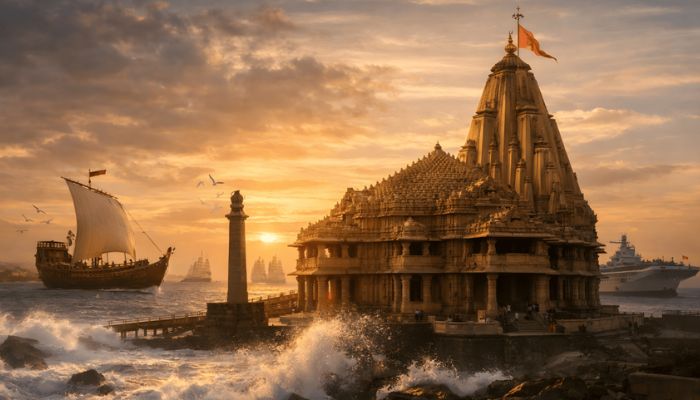
In western India, Somnath stood at the heart of this system. The port of Prabhas Patan had been active since Harappan times. Trade from the Roman world, West Asia, and Africa passed through this coast. The route from Dwarka to Somnath and Khambhat was not just a trade corridor. It was also a path of pilgrimage, culture, and social exchange.
Somnath was therefore more than a shrine of Lord Shiva. It was a legal authority, a financial hub, and a cultural anchor for India’s maritime civilisation.
Ghazni’s strike and the breaking of a network
After the seventh century, Arab and Persian traders became active in the Indian Ocean. They formed trading groups such as the Anjuvannam, based around mosques and markets. Over time, these networks grew faster than the temple-based Hindu system.
When Mahmud of Ghazni attacked Somnath in the eleventh century, the aim was not simply religious destruction. The plunder of wealth, said to be worth around 20 million dinars, struck at the financial backbone of the maritime system. No mosque was built on the site because the purpose was not conversion. Destroying the Shivalinga symbolised the destruction of a legal and economic institution.
For Islamic empires, trade was a tool of power. When they saw that India’s maritime system could not be easily controlled or conquered, they focused on breaking its centres instead. Somnath was the first major and symbolic target.
Losing the Sea, One coast at a time
The fall of Somnath damaged more than a temple. It shook India’s maritime confidence. Slowly, ocean crossings began to be discouraged, later becoming known socially as “kala pani.” What began as a strategic defeat slowly turned into a social habit.
This decline was not uniform across India. While Ghazni attacked in the west, Rajendra Chola was leading powerful naval campaigns in the east, reaching Sri Lanka, Sumatra, and Southeast Asia. Gujarat’s rulers also valued the sea for defence and trade. As a result, India’s maritime civilisation did not collapse overnight. It was weakened piece by piece.
The Ban Stambh, or arrow pillar, at Somnath still stands as evidence of ancient Indian knowledge of astronomy and geography. It states that there is no land obstruction from that point to the South Pole, a claim later confirmed by modern science.
From sultanates to the Mughals: A land-based turn
After Somnath, pressure increased along the western coast. Bharuch, Konkan, and Saurashtra gradually fell under new powers. The Delhi Sultanate and later the Mughal Empire were largely land-focused. Their strength lay in agriculture, forts, and armies, not navies.
Even during the Mughal period, rulers depended on foreign sailors to protect pilgrim ships going for Hajj. The sea was not seen as a space of power. This distance from the ocean slowly disconnected India from its maritime roots.
By the time Vasco da Gama reached India in 1498, the once-busy Indian seas were largely empty of Indian fleets. European powers came not just to trade, but to dominate. By the sixteenth century, Hindu-led maritime networks had been nearly wiped out.
Somnath rebuilt and memory revived
The reconstruction of Somnath in 1951 was more than an architectural project. It was an attempt to restore a civilisational memory. Sardar Vallabhbhai Patel saw it as the return of national confidence, while Jawaharlal Nehru feared its political meaning.
Yet the rebuilding signalled that India’s connection to the sea, though weakened, was never erased. As Al-Biruni once observed, kingdoms may fall, but memories endure.
India and the Indo-Pacific: An unfinished journey
India’s growing role in the Indo-Pacific today is not a sudden shift. It is the continuation of a journey paused centuries ago. While many see the Indo-Pacific only through global power rivalry, for India, it is a familiar space of old trade routes and cultural ties.
India’s naval partnerships, participation in QUAD, and investments in naval strength are part of this return. When Prime Minister Narendra Modi spoke at the Shangri-La Dialogue in 2018, he described a free, open, and inclusive Indo-Pacific, echoing India’s ancient maritime values.
India’s approach is not about domination but balance. It recalls a time when the sea was a space of rules, trust, and shared prosperity.
Somnath marked the moment India began to drift away from the sea. Today, India’s return to the Indo-Pacific marks the revival of a forgotten habit of civilisation. What is coming back is not just naval power, but memory, confidence, and continuity.
The civilisation that once shaped the Indian Ocean cannot remain on the shore forever. From Somnath to the Indo-Pacific, India is slowly completing a story that was left unfinished for nearly a thousand years.