Beyond outrage without strategy: Here is a 10-step roadmap that the Indian govt can follow to protect Hindus in Bangladesh
When Hindus are subjected to atrocities anywhere in the world, be it Bangladesh, Pakistan, Afghanistan, or even in distant corners of the diaspora, India’s civil society instinctively responds. We speak out. We express solidarity. We condemn violence. We amplify the pain of victims whose only “crime” is their faith, identity, or civilisational inheritance. That moral instinct is neither new nor negotiable. It is rooted in a civilisation that has, for millennia, internalised the idea that suffering anywhere matters everywhere. Yet alongside this instinctive solidarity, a familiar accusation often follows: “The Indian government is not doing enough to save Hindus in Bangladesh.” It is a powerful line. It is emotionally satisfying. It also deserves a serious question in response: What exactly should the government do? Spell out the roadmap. Because outrage without strategy may comfort the outraged, but it rarely protects the victim. The Reality of Atrocities: This Is Not Imagination or Exaggeration Before discussing policy, let us be clear: atrocities against Hindus in Bangladesh are not a figment of imagination, nor are they isolated aberrations. Over the past decades, and with worrying regularity in recent years, there has been a pattern: Targeted attacks during political instability: Hindu neighbourhoods and temples are often attacked during periods of unrest, elections, or regime transitions, when law enforcement weakens and mobs act with impunity. Temple vandalism and desecration: Durga Puja pandals attacked, idols destroyed, temples burned or occupied. Mob violence triggered by allegations of blasphemy, often later found to be fabricated, leading to arson, lynching, and displacement. Land grabbing and forced migration: Violence followed by systematic seizure of Hindu property, pushing families to flee permanently. Sexual violence against women used as a tool of humiliation and terror. Selective policing where victims are arrested or silenced, while perpetrators melt back into political or radical networks. These are not anecdotes floating on social media. They are patterns acknowledged by human rights groups, journalists, diplomats, and even Bangladeshi civil society voices, many of whom risk their own safety to speak up. To deny this reality is dishonest. To exaggerate it into reckless calls for war is irresponsible. Both extremes harm the very people we claim to care about. The Easy Anger Trap In moments of communal violence, anger feels like action. Hashtags trend. Videos circulate. Demands escalate. “Why doesn’t India send troops?” “Why not break relations?” “Why not teach them a lesson?” These questions sound strong. They collapse under scrutiny. Because geopolitics is not cinema, and governments do not operate on adrenaline. A reckless move by India does not punish mobs; it puts minorities at greater risk. History across regions has repeatedly shown that external escalation often leads to retaliatory targeting of minorities inside the affected country. The first casualty of emotional geopolitics is the weakest citizen on the ground. That is why serious states act through graduated pressure, not impulsive theatre. If Not Silence, Then What? The Need for a Real Roadmap Criticism of government action is legitimate. But legitimacy demands specificity. If someone claims “the government isn’t doing enough,” they must answer three questions: What should be done? In what sequence? With what acceptable risks to the victims themselves? Let us therefore outline what a realistic, actionable roadmap actually looks like. 1. Step One: Define Clear, Measurable Objectives. A government cannot operate on moral outrage alone. It must define achievable goals, such as: (a) Immediate cessation of mob violence in identified districts. (b) Deployment of security forces to minority-dense areas. (c) Arrest and prosecution of named perpetrators. (d) Protection of temples, homes, and livelihoods. (e) Compensation, reconstruction, and safe return of displaced families. (f) Establishment of monitoring and reporting mechanisms. Without defined outcomes, diplomacy degenerates into noise. 2. Step Two: Build an Evidence-Backed Atrocity Dossier. No sovereign state acts on forwarded videos alone. India must, and does, compile verified dossiers that include: (a) Incident timelines (b) Locations and patterns (c) Victim identities (d) Forensic corroboration (e) Political or radical linkages, where established This documentation is crucial not just for bilateral talks, but for international credibility. It ensures that denial becomes difficult and that pressure rests on facts, not emotion. 3. Step Three: Quiet but Firm Diplomacy with Deadlines. Public megaphone diplomacy may satisfy domestic audi
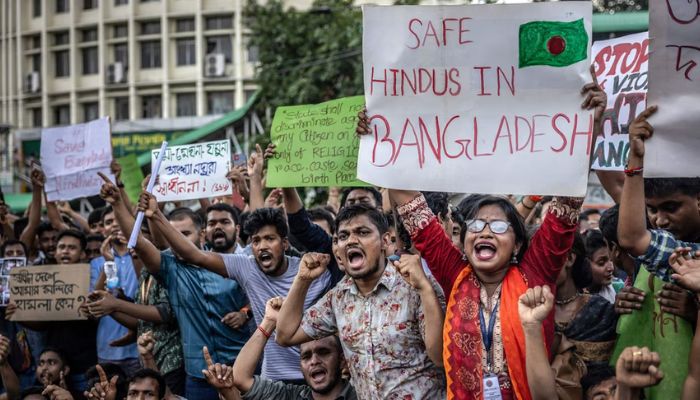

When Hindus are subjected to atrocities anywhere in the world, be it Bangladesh, Pakistan, Afghanistan, or even in distant corners of the diaspora, India’s civil society instinctively responds. We speak out. We express solidarity. We condemn violence. We amplify the pain of victims whose only “crime” is their faith, identity, or civilisational inheritance.
That moral instinct is neither new nor negotiable. It is rooted in a civilisation that has, for millennia, internalised the idea that suffering anywhere matters everywhere. Yet alongside this instinctive solidarity, a familiar accusation often follows: “The Indian government is not doing enough to save Hindus in Bangladesh.”
It is a powerful line. It is emotionally satisfying. It also deserves a serious question in response: What exactly should the government do?
Spell out the roadmap. Because outrage without strategy may comfort the outraged, but it rarely protects the victim.
The Reality of Atrocities: This Is Not Imagination or Exaggeration
Before discussing policy, let us be clear: atrocities against Hindus in Bangladesh are not a figment of imagination, nor are they isolated aberrations.
Over the past decades, and with worrying regularity in recent years, there has been a pattern:
Targeted attacks during political instability: Hindu neighbourhoods and temples are often attacked during periods of unrest, elections, or regime transitions, when law enforcement weakens and mobs act with impunity.
Temple vandalism and desecration: Durga Puja pandals attacked, idols destroyed, temples burned or occupied.
Mob violence triggered by allegations of blasphemy, often later found to be fabricated, leading to arson, lynching, and displacement.
Land grabbing and forced migration: Violence followed by systematic seizure of Hindu property, pushing families to flee permanently.
Sexual violence against women used as a tool of humiliation and terror.
Selective policing where victims are arrested or silenced, while perpetrators melt back into political or radical networks.
These are not anecdotes floating on social media. They are patterns acknowledged by human rights groups, journalists, diplomats, and even Bangladeshi civil society voices, many of whom risk their own safety to speak up.
To deny this reality is dishonest.
To exaggerate it into reckless calls for war is irresponsible.
Both extremes harm the very people we claim to care about.
The Easy Anger Trap
In moments of communal violence, anger feels like action. Hashtags trend. Videos circulate. Demands escalate.
“Why doesn’t India send troops?”
“Why not break relations?”
“Why not teach them a lesson?”
These questions sound strong. They collapse under scrutiny.
Because geopolitics is not cinema, and governments do not operate on adrenaline.
A reckless move by India does not punish mobs; it puts minorities at greater risk. History across regions has repeatedly shown that external escalation often leads to retaliatory targeting of minorities inside the affected country.
The first casualty of emotional geopolitics is the weakest citizen on the ground.
That is why serious states act through graduated pressure, not impulsive theatre.
If Not Silence, Then What? The Need for a Real Roadmap
Criticism of government action is legitimate. But legitimacy demands specificity.
If someone claims “the government isn’t doing enough,” they must answer three questions:
What should be done?
In what sequence?
With what acceptable risks to the victims themselves?
Let us therefore outline what a realistic, actionable roadmap actually looks like.
1. Step One: Define Clear, Measurable Objectives. A government cannot operate on moral outrage alone. It must define achievable goals, such as:
(a) Immediate cessation of mob violence in identified districts.
(b) Deployment of security forces to minority-dense areas.
(c) Arrest and prosecution of named perpetrators.
(d) Protection of temples, homes, and livelihoods.
(e) Compensation, reconstruction, and safe return of displaced families.
(f) Establishment of monitoring and reporting mechanisms.
Without defined outcomes, diplomacy degenerates into noise.
2. Step Two: Build an Evidence-Backed Atrocity Dossier. No sovereign state acts on forwarded videos alone. India must, and does, compile verified dossiers that include:
(a) Incident timelines
(b) Locations and patterns
(c) Victim identities
(d) Forensic corroboration
(e) Political or radical linkages, where established
This documentation is crucial not just for bilateral talks, but for international credibility. It ensures that denial becomes difficult and that pressure rests on facts, not emotion.
3. Step Three: Quiet but Firm Diplomacy with Deadlines. Public megaphone diplomacy may satisfy domestic audiences, but quiet diplomacy saves lives faster. This includes:
(a) Formal demarches to Dhaka.
(b) Direct engagement with civilian and military leadership.
(c) Clear timelines for action: arrests, deployments, prosecutions.
(d) Explicit communication that inaction will have consequences.
This stage is critical because it allows the host state to act without losing face, which often determines whether it acts at all.
4. Step Four: Make Protection Operational, Not Rhetorical. Statements condemning violence mean little without boots on the ground. India’s focus must be on:
(a) Static police pickets near vulnerable clusters.
(b) Night patrols and rapid response teams.
(c) Protection of religious sites during festivals.
(d) Witness protection for those willing to testify.
(e) Fast-track judicial processes.
Where invited, India can even offer technical assistance in riot control, forensics, or cyber-tracking of instigators, support that strengthens institutions without breaching sovereignty.
5. Step Five: Smart Internationalisation, Not Loud Internationalisation. The objective is not to embarrass Bangladesh publicly, but to increase the cost of inaction. This involves:
(a) Briefing select global partners privately.
(b) Coordinated messaging focused on minority rights and rule of law.
(c) Leveraging forums where Bangladesh values reputation and trade.
Ensuring this is framed as law vs mob, not India vs Bangladesh. Selective pressure is more effective than universal shouting.
6. Step Six: Targeted Leverage, Not Collective Punishment. If violence continues despite engagement, pressure must escalate, but intelligently. Options include:
(a) Visa restrictions on identified instigators and enablers.
(b) Financial scrutiny of radical funding networks.
(c) Conditional cooperation in specific sectors.
(d) Support for international sanctions against individuals, not the state.
Blanket economic punishment often rebounds on minorities themselves. Precision matters.
7. Step Seven: Humanitarian and Legal Support Pipelines. Even without violating sovereignty, India can:
(a) Support humanitarian NGOs.
(b) Facilitate medical aid and trauma care.
(c) Fund legal assistance for victims.
(d) Support reconstruction through permitted channels.
Relief is not intervention. It is civilisation in action.
8. Step Eight: Refugee Preparedness Without Panic. If violence triggers displacement, pretending it won’t happen is negligence. A serious state prepares:
(a) Temporary humanitarian facilities near borders.
(b) Medical care and registration mechanisms.
(c) Case-based long-term visas for the most vulnerable.
(d) Robust security screening to prevent infiltration.
Preparation prevents chaos. Chaos helps no one.
9. Step Nine: Counter-Disinformation and Narrative Warfare. Many riots are sparked or amplified by lies. Governments must:
(a) Verify and debunk fake content quickly.
(b) Expose manufactured blasphemy allegations.
(c) Prevent retaliatory rumours from spreading.
(d) Keep the focus on protection, not revenge.
Information discipline is as important as physical security.
10. Step Ten: Long-Term Deterrence Through Institutions. Lasting safety does not come from episodic outrage. It comes from:
(a) Police accountability.
(b) Judicial certainty.
(c) Property restitution.
(d) Political costs for enablers.
(e) Continuous monitoring, not episodic attention.
Institutions protect minorities far more reliably than hashtags.
What not to do, and why it matters
Calls for:
- Military intervention,
- Sudden diplomatic rupture,
- Total trade embargoes,
- Or permanent outrage mode
may feel satisfying, but often increase the vulnerability of minorities on the ground.
States that act emotionally often lose leverage. States that lose leverage lose the ability to protect.
A Fair Question to the Critics
So, to those who say “the government is not doing enough”, a reasonable response is not dismissal, but a challenge:
Which of these steps do you want the government to take, and which risks are you prepared to own?
Because real policy is not about sounding angrier than the mob.
It is about saving lives quietly, steadily, and sustainably.
Solidarity is essential.
Condemnation is necessary.
But protection demands a strategy.
Anything less may satisfy our conscience, but it will not save the next family when the mob arrives.