Bengal needs a regime change: Decades of Communist rule and 3-terms of Mamata govt have taken the state on a rapid decline across all sectors
‘Somewhere between living and dreaming, there is Kolkata’ When we talk of a 4,000 year-old civilization that flourished between Ganges and Brahmaputra, that once held the keys to ‘Silk Route’ commercial hub, and that saw luminaries arise during the Renaissance of 19th and 20th Centuries, we speak of a Bengal that was once the doyen of Indian culture and trade. In 1960, 2 of the 3 richest States in India happened to be Maharashtra and West Bengal, with former’s per capita income about 5% lower. Back then, the State had a vibrant manufacturing sector too. Then, CPI(M) happened. By 1993, Bengal’s per capita had fallen almost 35% below that of Maharashtra. 2 states, similar geographies, almost similar population, and alike business opportunities; however, the divergence in growth got stark. The State’s share in manufacturing also fell from 22% to 15% (1970 – 1993), while Maharashtra’s notched up remarkably. Violent politics, vested use of State power and institutions by CPI(M) had led to the undoing. When TMC stormed into power in 2011 on the back of severe anti-incumbency and the more immediate Singur episode, citizens heaved a sigh of relief. Bengal CM was quick to promise that Kolkata will soon be like London. Headline in 2011, Deccan Herald The closest that the State came to that promise was the installation of a look-alike of the famed Big Ben clock that adorns London’s northern end of the Houses of Parliament. Progress made. Sectoral performance Physical infrastructure: Share of State expenditure on physical infrastructure declined from an already low of 5.27% in 2018-19 to 2.95% in 2022-23. Reasons have been the TMC government’s poor maintenance of existing infrastructure, corruption within bureaucracy, and administrative hurdles. Roads infrastructure had already seen leakages under 34 years rule of CPI(M). That got exacerbated with the arrival of TMC. In 2013, a section of Ultadanga flyover collapsed. 3 years later, a section of an under-construction bridge in Girish Park crumbled. On 31st March 2016, the under-construction Vivekananda flyover caved in, leading to loss of 26 lives. The collapse of Majerhat bridge followed in 2018. Bribes and cut money by ruling dispensation from contractors have been blamed for the poor state of infrastructure in the State. Water quality has been a serious issue for households in Bengal, in particular access to clean drinking water. In 2019, only 1.22% of households had tap water connections. The rapid decline of groundwater level in Kolkata and S-24 Pgs in particular has pressed the alarm button, with Kolkata experiencing a 2.1 m decrease (18.6%) and S-24 Pgs a 2.5 m decline (27.8%). While these are alarming figures, unchecked withdrawals of water from residential areas in Kolkata and agricultural sectors in districts have only aggravated the situation. The levels of pesticides and toxins in drinking water have also been found at above-permissible levels. The commoners are to bear the consequential health hazards of this. Source: The Hindu Poor sanitation has plagued Bengal for a long time. In the Swachh Survekshan Awards for 2023, 4,447 urban local bodies participated, and over 12 crore responses from citizens were received from across India. Howrah was declared the dirtiest city in India, and more strikingly, all 10 dirtiest cities having a population exceeding 1 lakh were voted from Bengal. Howrah, Kolkata among the dirtiest cities in India: Top 10 dirtiest cities with a population over 1 lakh all from West Bengal, finds surveyhttps://t.co/hxVcpaXEi4— OpIndia.com (@OpIndia_com) January 12, 2024 Social Infrastructure: Healthcare has been a sore point for TMC government. Poor recruitment policies has led to dearth of skilled healthcare professionals, compounded further by inadequate training. This has left citizens at the mercy of a struggling healthcare in the State. Rural Health Statistics 2021-22 mentioned that while WB has 915 Public Healthcare Centres (PHCs), only 229 out of them, which is a paltry 25%, were functioning on a 24 X 7 basis. 13,194 sub-centres had been sanctioned, but only 10,357 are in place, marking a shortfall of 22%. The story is equally grim for Community Healthcare Centres (CHCs), with 348 out of a total of 542 sanctioned being active (36% shortfall). As per guidelines, one PHC for 30,000 population is to be present, whereas in Bengal, one PHC covers around 50,000 population. That is a staggering loophole in the State’s healthcare system! Cases of poor people dying on roads due to poor infrastructure have repeatedly maligned the State’s once-glorious image of having robust health infrastructure. 10th Dec 2023 proved a Black day for the State’s health infrastructure, as 14 children died in 3 days in Berhampur’s medical college hospital in Murshidabad district. With construction work going at Jangipur Subdivision Hospital, babies were shifted from SNCU (Special Newbor
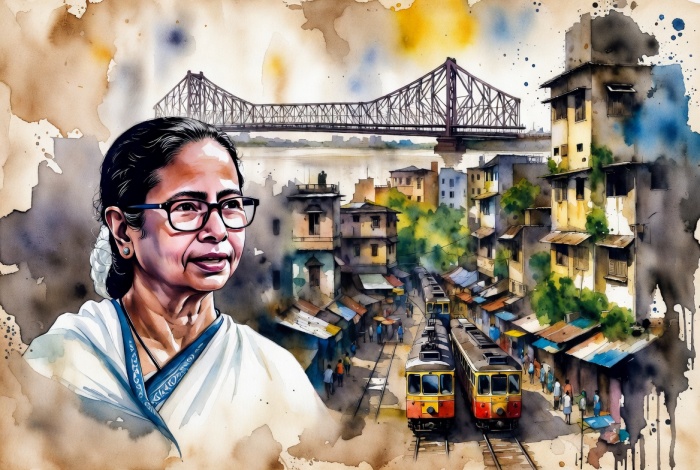
‘Somewhere between living and dreaming, there is Kolkata’
When we talk of a 4,000 year-old civilization that flourished between Ganges and Brahmaputra, that once held the keys to ‘Silk Route’ commercial hub, and that saw luminaries arise during the Renaissance of 19th and 20th Centuries, we speak of a Bengal that was once the doyen of Indian culture and trade. In 1960, 2 of the 3 richest States in India happened to be Maharashtra and West Bengal, with former’s per capita income about 5% lower. Back then, the State had a vibrant manufacturing sector too.
Then, CPI(M) happened.
By 1993, Bengal’s per capita had fallen almost 35% below that of Maharashtra. 2 states, similar geographies, almost similar population, and alike business opportunities; however, the divergence in growth got stark. The State’s share in manufacturing also fell from 22% to 15% (1970 – 1993), while Maharashtra’s notched up remarkably. Violent politics, vested use of State power and institutions by CPI(M) had led to the undoing.
When TMC stormed into power in 2011 on the back of severe anti-incumbency and the more immediate Singur episode, citizens heaved a sigh of relief. Bengal CM was quick to promise that Kolkata will soon be like London.
Headline in 2011, Deccan Herald
The closest that the State came to that promise was the installation of a look-alike of the famed Big Ben clock that adorns London’s northern end of the Houses of Parliament. Progress made.
Sectoral performance
Physical infrastructure: Share of State expenditure on physical infrastructure declined from an already low of 5.27% in 2018-19 to 2.95% in 2022-23. Reasons have been the TMC government’s poor maintenance of existing infrastructure, corruption within bureaucracy, and administrative hurdles.
Roads infrastructure had already seen leakages under 34 years rule of CPI(M). That got exacerbated with the arrival of TMC. In 2013, a section of Ultadanga flyover collapsed. 3 years later, a section of an under-construction bridge in Girish Park crumbled. On 31st March 2016, the under-construction Vivekananda flyover caved in, leading to loss of 26 lives. The collapse of Majerhat bridge followed in 2018. Bribes and cut money by ruling dispensation from contractors have been blamed for the poor state of infrastructure in the State.
Water quality has been a serious issue for households in Bengal, in particular access to clean drinking water. In 2019, only 1.22% of households had tap water connections. The rapid decline of groundwater level in Kolkata and S-24 Pgs in particular has pressed the alarm button, with Kolkata experiencing a 2.1 m decrease (18.6%) and S-24 Pgs a 2.5 m decline (27.8%). While these are alarming figures, unchecked withdrawals of water from residential areas in Kolkata and agricultural sectors in districts have only aggravated the situation.
The levels of pesticides and toxins in drinking water have also been found at above-permissible levels. The commoners are to bear the consequential health hazards of this.
Source: The Hindu
Poor sanitation has plagued Bengal for a long time. In the Swachh Survekshan Awards for 2023, 4,447 urban local bodies participated, and over 12 crore responses from citizens were received from across India. Howrah was declared the dirtiest city in India, and more strikingly, all 10 dirtiest cities having a population exceeding 1 lakh were voted from Bengal.
Howrah, Kolkata among the dirtiest cities in India: Top 10 dirtiest cities with a population over 1 lakh all from West Bengal, finds surveyhttps://t.co/hxVcpaXEi4— OpIndia.com (@OpIndia_com) January 12, 2024
Social Infrastructure:
Healthcare has been a sore point for TMC government. Poor recruitment policies has led to dearth of skilled healthcare professionals, compounded further by inadequate training. This has left citizens at the mercy of a struggling healthcare in the State.
Rural Health Statistics 2021-22 mentioned that while WB has 915 Public Healthcare Centres (PHCs), only 229 out of them, which is a paltry 25%, were functioning on a 24 X 7 basis. 13,194 sub-centres had been sanctioned, but only 10,357 are in place, marking a shortfall of 22%. The story is equally grim for Community Healthcare Centres (CHCs), with 348 out of a total of 542 sanctioned being active (36% shortfall). As per guidelines, one PHC for 30,000 population is to be present, whereas in Bengal, one PHC covers around 50,000 population. That is a staggering loophole in the State’s healthcare system!
Cases of poor people dying on roads due to poor infrastructure have repeatedly maligned the State’s once-glorious image of having robust health infrastructure.
10th Dec 2023 proved a Black day for the State’s health infrastructure, as 14 children died in 3 days in Berhampur’s medical college hospital in Murshidabad district. With construction work going at Jangipur Subdivision Hospital, babies were shifted from SNCU (Special Newborn Care Unit) to Murshidabad Medical College, which put stress on the already shaky infrastructure at the College, leading to the terrible deaths.
The National Family Health Survey-5 (NFHS-5) had thrown up some concerning statistics about Bengal’s healthcare too. It reported that 32.4% of children under 5 were underweight. More alarming is the fact that 72.1% of children aged 6 to 59 months were anaemic. The survey also showed that 66.7% of pregnant women aged 15 – 49 were anaemic, and 77.6% of all women aged 15 – 49 were anaemic.
Dengue has been another ailing point for the State. For 2025, nearly 2,500 cases were recorded till July, with 1,000 cases nearabouts being recorded in just one month.
Health insurance is a key instrument for the middle, lower-middle class, and poor/vulnerable sections of society to manage rising healthcare costs. In 2019, Bengal took a decision to move away from the Centre’s Ayushman Bharat scheme, putting 60 lakh families in jeopardy. While Ayushman Bharat covered almost 1.11 Crore, or 55% of the State’s families, Swasthya Sathi had a coverage of just 50 lakh families. On such a flimsy point as having only PM’s picture on the insurance letters and not her too, Bengal CM moved away9 from Centre’s much-helpful scheme! That was a case of avoidable politics to downscore Center, all the while being oblivious to the mammoth heathcare needs of its poor citizens.
One other practical challenge of the Swasthya Sathi scheme is the very low rates for treatments and surgeries of patients under the scheme, which has led to reluctance of a lot of private hospitals in the State to empanel themselves with this scheme. Also, reimbursement of bills raised by hospitals to the State Government usually takes around 21 days, which increases to 45 or 60 days at times. These deter private hospitals from joining the scheme.
The horrific rape and murder of a 31-year-old trainee doctor at RG Kar Medical College in Kolkata on 9th August, 2024, had sparked widespread outrage and protest across medical and civil fraternities all over India. While on one hand, the case brought to the fore an acute lack of safety for women, it also highlighted a rampant net of corruption in healthcare colleges and facilities in the State, which often function under the blessings of the State’s political leadership.
Education sector
The education sector in Bengal has seen a steady decline over the last decade and a half. In 2023, about 6.99 lakh candidates appeared for Class X Madhyamik (Board) exam, marking a 36% drop from 2022.
State gov in 2024 had directed the shutdown of 8,207 primary and secondary schools, which comprised almost 10% of government-controlled schools. Notable to point out that between 2012 and 2022, around 7,000 schools had vanished in the State. The State has also been missing on the Central funds as it is yet to join the PM Schools for Rising India (PM-SHRI) Scheme.
School dropout rates for the State at the secondary level are at 2X the national average, which is worrisome. This gets more concerning as we figure the downward slide Y-o-Y. In 2022-23, the dropout rate was 6.6% for boys and 4% for girls. In 2024-25, those figures have shot up to 23% for boys and 17.8% for girls.
Bengal needs to analyze why the ‘Funnel Collapse’ from upper primary to higher secondary is so stark.
(Source: UDISE + Booklets for 2024-25)
The problem is compounded by the fact that a lot of teaching posts go vacant. In 2022, it was found that 13,842 posts of teachers in Classes X and XII, and 5,527 posts in XI and XII were lying vacant. Teachers’ recruitment has been a point of contention for the State too. Recruitment in primary, upper primary, and secondary has been under question with allegations of corrupt practices and nepotism. On 22nd April, 2024, the Kolkata High Court had ordered cancellation of 25,753 teachers and non-teaching staff made through State Level Selection Test – 2016 (SLST) in Govt-sponsored and aided schools, declaring the process as “null and void”.
The fangs of corruption have reached nutritional schemes like mid-day meals, too.
Looking ahead
Tagore had once yearned for ‘Banglar mati, Banglar jol’ to get sanctified under the blessings of the Supreme. As Bengal gears up to send legislators to it’s 294 member Assembly yet again, it is time to revisit those words. 4th May will decide if the State’s skyline gets smeared with green ‘abir’ yet again, or it will be saffron laddoos all the way, with a dash of ‘jhal muri’ alongside!