Bangladesh’s silent surrender: How secrecy, speed, and foreign pressure are rewriting the state
Bangladesh is set to sign a tariff agreement with the United States on February 9, just three days before the country’s national elections. However, the content of the agreement aimed at reducing tariffs on Bangladeshi exports to the USA will not be made public; it will be a secret deal signed by a government not elected democratically. This is because the deal will come under a non-disclosure agreement signed by the interim government with the US. On 13 June 2024, Bangladesh’s interim government under Dr Muhammad Yunus signed the non-disclosure agreement (NDA) with the United States. The justification was familiar and deliberately vague: urgency, economic pressure, and the need to ease so-called “reciprocal taxes” imposed during the Donald Trump administration. But in politics, how something is done often matters more than why. And in this case, the manner of the agreement tells a far more troubling story than the official explanations ever did, as explained by Aminul Hoque Polash, a Bangladeshi political activist, researcher and former government official, in an article published on News18. The NDA was rushed through without meaningful consultation with Parliament, industry stakeholders, or the public. Because it was classified as a non-disclosure agreement, citizens were told they had no right to know what was promised, traded, or quietly conceded. The interim government repeated a single defensive line, nothing in the deal goes against national interest, while carefully avoiding the obvious question: if there was truly nothing to hide, why hide it at all? That claim collapsed when a draft leaked from Bangladesh’s National Board of Revenue. The 20-page document did not read like a routine confidentiality instrument. It was expansive, intrusive, and asymmetrical. Page after page diluted Bangladesh’s policy autonomy. Decision-making authority linked to national security, trade policy, natural resources, and even foreign relations appeared, in effect, subordinated to the preferences of a foreign state. This was not secrecy for efficiency; it was secrecy to avoid accountability. What followed makes the pattern unmistakable. At the time the NDA was signed, media reports suggested that Bangladesh had committed to buying 25 Boeing aircraft and importing wheat from the United States. In August, Commerce Adviser Sheikh Bashir Uddin publicly claimed that US officials did not seem serious about selling Boeing planes. Biman Bangladesh Airlines echoed that it was unaware of any such plan. And yet, just four months later, on 30 December 2025, Biman’s board approved the purchase of 14 Boeing aircraft. This was no coincidence. Under the interim government, a massive and arguably unnecessary procurement valued at around Tk 37,000 crore taka, or roughly 3 billion dollars, is now being fast-tracked. To grease the wheels, Sheikh Bashir Uddin was appointed Chairman of Biman on 27 August 2025. Soon after, Dr Yunus’s closest associates — Security Adviser Khalilur Rahman, Special Assistant Faiz Ahmed Taiyeb (with the rank of State Minister), and senior bureaucrat Akhtar Ahmed — were inducted into Biman’s board. Institutional independence gave way to personal loyalty, and procurement decisions followed accordingly. The purchase of US Black Hawk helicopters for the armed forces fits neatly into the same pattern. Food security tells a similarly grim story. In July 2025, the interim government signed an MoU with the US Wheat Exporters Association to import 3.5 million tonnes of wheat over five years at a base price of 308 dollars per tonne. This would be defensible only if global prices were comparable. They are not. Wheat is currently available on the international market for around 226–230 dollars per tonne. Bangladesh has already imported 220,000 tonnes under this deal, locking in inflated costs that will inevitably push up flour prices. That increase will cascade across food markets, hitting the poorest households first and hardest. Then there is the absurdity of the shipping deal. On 12 August 2025, the interim government approved the purchase of two bulk carrier ships from a US firm for nearly 1,000 crore taka. The United States is not even among the world’s top shipbuilding nations. The punchline is cruel: both ships will be built in China. Bangladesh is effectively buying Chinese-made ships through an American intermediary at above-market prices, a perfect metaphor for policy capture disguised as diplomacy. Energy decisions under the interim government may prove even more damaging. A 15-year LNG purchase agreement with Excelerate Energy, worth around 1 lakh crore taka, has handed effective control of Bangladesh’s LNG imports to a single US company. Under previous governments, Bangladesh diversified supply through competitive long-term contracts with Qatar and Oman. Excelerate was initially meant to introduce competition. Instead, after August 2024, it became dominant. The sequence is revealing
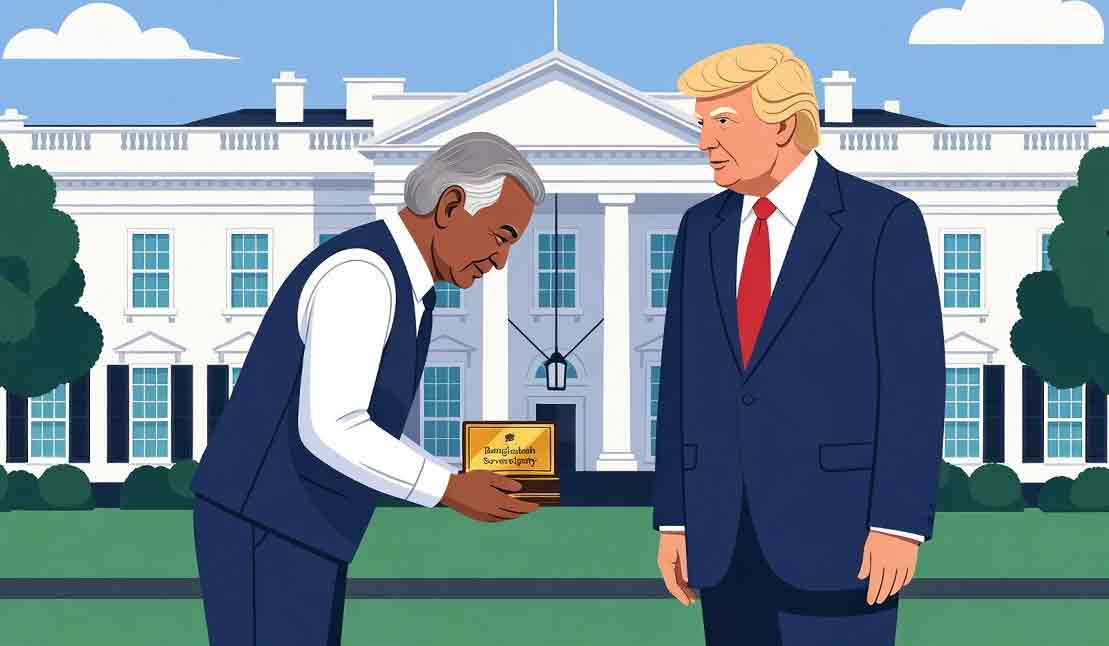

Bangladesh is set to sign a tariff agreement with the United States on February 9, just three days before the country’s national elections. However, the content of the agreement aimed at reducing tariffs on Bangladeshi exports to the USA will not be made public; it will be a secret deal signed by a government not elected democratically. This is because the deal will come under a non-disclosure agreement signed by the interim government with the US.
On 13 June 2024, Bangladesh’s interim government under Dr Muhammad Yunus signed the non-disclosure agreement (NDA) with the United States. The justification was familiar and deliberately vague: urgency, economic pressure, and the need to ease so-called “reciprocal taxes” imposed during the Donald Trump administration. But in politics, how something is done often matters more than why. And in this case, the manner of the agreement tells a far more troubling story than the official explanations ever did, as explained by Aminul Hoque Polash, a Bangladeshi political activist, researcher and former government official, in an article published on News18.
The NDA was rushed through without meaningful consultation with Parliament, industry stakeholders, or the public. Because it was classified as a non-disclosure agreement, citizens were told they had no right to know what was promised, traded, or quietly conceded. The interim government repeated a single defensive line, nothing in the deal goes against national interest, while carefully avoiding the obvious question: if there was truly nothing to hide, why hide it at all?
That claim collapsed when a draft leaked from Bangladesh’s National Board of Revenue. The 20-page document did not read like a routine confidentiality instrument. It was expansive, intrusive, and asymmetrical. Page after page diluted Bangladesh’s policy autonomy. Decision-making authority linked to national security, trade policy, natural resources, and even foreign relations appeared, in effect, subordinated to the preferences of a foreign state. This was not secrecy for efficiency; it was secrecy to avoid accountability.
What followed makes the pattern unmistakable.
At the time the NDA was signed, media reports suggested that Bangladesh had committed to buying 25 Boeing aircraft and importing wheat from the United States. In August, Commerce Adviser Sheikh Bashir Uddin publicly claimed that US officials did not seem serious about selling Boeing planes. Biman Bangladesh Airlines echoed that it was unaware of any such plan. And yet, just four months later, on 30 December 2025, Biman’s board approved the purchase of 14 Boeing aircraft.
This was no coincidence. Under the interim government, a massive and arguably unnecessary procurement valued at around Tk 37,000 crore taka, or roughly 3 billion dollars, is now being fast-tracked. To grease the wheels, Sheikh Bashir Uddin was appointed Chairman of Biman on 27 August 2025. Soon after, Dr Yunus’s closest associates — Security Adviser Khalilur Rahman, Special Assistant Faiz Ahmed Taiyeb (with the rank of State Minister), and senior bureaucrat Akhtar Ahmed — were inducted into Biman’s board. Institutional independence gave way to personal loyalty, and procurement decisions followed accordingly. The purchase of US Black Hawk helicopters for the armed forces fits neatly into the same pattern.
Food security tells a similarly grim story. In July 2025, the interim government signed an MoU with the US Wheat Exporters Association to import 3.5 million tonnes of wheat over five years at a base price of 308 dollars per tonne. This would be defensible only if global prices were comparable. They are not. Wheat is currently available on the international market for around 226–230 dollars per tonne. Bangladesh has already imported 220,000 tonnes under this deal, locking in inflated costs that will inevitably push up flour prices. That increase will cascade across food markets, hitting the poorest households first and hardest.
Then there is the absurdity of the shipping deal. On 12 August 2025, the interim government approved the purchase of two bulk carrier ships from a US firm for nearly 1,000 crore taka. The United States is not even among the world’s top shipbuilding nations. The punchline is cruel: both ships will be built in China. Bangladesh is effectively buying Chinese-made ships through an American intermediary at above-market prices, a perfect metaphor for policy capture disguised as diplomacy.
Energy decisions under the interim government may prove even more damaging. A 15-year LNG purchase agreement with Excelerate Energy, worth around 1 lakh crore taka, has handed effective control of Bangladesh’s LNG imports to a single US company. Under previous governments, Bangladesh diversified supply through competitive long-term contracts with Qatar and Oman. Excelerate was initially meant to introduce competition. Instead, after August 2024, it became dominant.
The sequence is revealing. Former US ambassador Peter D. Haas left the State Department in September 2024 and joined Excelerate as a strategic adviser. In October, Excelerate’s CEO met Dr Yunus in Dhaka. Soon after, the interim government revised the agreement, fixing LNG prices at 15.69 dollars per MMBtu, at least 2.5 dollars higher than prevailing spot rates, and dramatically higher than the 9.5–9.93 dollars Bangladesh paid in April 2024. Competition was replaced by dependency, and consumers will pay the price for years.
The December decision to buy short-term LNG from SOCAR Trading S.A. adds another layer of concern. The deal followed a personal intervention by Dr Yunus after a high-profile visit by Azerbaijan’s president’s daughters. Once again, national energy policy appeared to hinge not on transparent evaluation but on personal networks and opaque diplomacy.
This spree is not confined to the United States. The interim government has announced or explored an astonishing range of defence and industrial procurements: JF-17 jets from Pakistan, Eurofighter Typhoons from Europe, J-10CE jets and drone factories with China, submarines from South Korea, T-129 ATAK helicopters from Turkey, and even a defence agreement with Japan. For an unelected interim administration, this is strategic overreach on a historic scale, commitments that will bind future elected governments for decades.
Ports and terminals, the arteries of sovereignty, are being signed away with equal haste. A 33-year deal with APM Terminals for Laldiya, a 30-year handover of the New Mooring Container Terminal to DP World, and a 22-year lease of the Pangaon inland terminal to Medlog SA together lock Bangladesh into long-term dependencies that future governments may find impossible to unwind.
Taken together, these decisions form a coherent picture. Dr Yunus has concentrated governing authority and used it to serve two masters at once: personal networks and foreign interests. The costs will not be abstract. They will appear as higher food prices, costlier energy, reduced policy autonomy, and a weakened economy. Ordinary Bangladeshis will bear the burden.
The final act is political insurance. A referendum-style electoral exercise is being prepared to manufacture a “Yes” mandate, followed by constitutional changes designed to make these decisions irreversible. Western powers, far from objecting, appear comfortable with this outcome, which secures influence, contracts, and strategic leverage.
The purpose for which Dr Yunus took control of Bangladesh’s governance has now been fully executed. The staged election on the 12th is meant to seal the deal. What remains is a country locked into agreements it never consented to, carrying costs it never approved, and living with consequences that will last far beyond the tenure of an interim government.