Bahraich violence: Shot at close range, body riddled with 40 wounds, toes burnt; court awards death penalty in Ram Gopal Mishra murder case – Read what the judgment says
On 11th December, the Bahraich Court awarded the death sentence to one and life imprisonment to ten others in the brutal murder case of Ram Gopal Mishra. The incident, which took place on 13th October 2024 during the Durga idol immersion procession, had shaken the nation. The judgment was pronounced by First Additional District and Sessions Judge Pawan Kumar Sharma. In the judgment, the court not merely recorded the guilt or innocence of the accused but reconstructed, step by step, how a religious procession was attacked and turned into a scene of extreme brutality, terror, and prolonged breakdown of law and order across the district. OpIndia accessed judgment in the case. As there were videos of Ram Gopal Mishra tearing down a green flag from a rooptop, Islamists had justified the murder. However, the court also made it clear that even if, for the sake of argument, it was assumed that Ram Gopal had removed or interfered with a religious flag installed at Abdul Hamid’s house, such an act could never confer any right upon the accused to unleash brutal and barbaric violence. The judgment underlined that the licensed firearm issued to Abdul Hamid was meant strictly for self-defence, and its use by his son constituted a clear violation of law. The court observed that the legal system provides remedies for any such grievance, and no individual or group is entitled to take the law into their own hands by resorting to lynching or murderous retaliation. Source: Bahraich District Court Ram Gopal Mishra had gone to Maharajganj market in the evening to watch the Durga idol immersion procession. He was accompanied by his brother Harimilan Mishra and other relatives and villagers. The procession consisted of multiple village idols mounted on tractors and vehicles and proceeded through the market area in the usual course. As the procession reached in front of the house of Abdul Hamid in Maharajganj, objections were raised regarding the songs that were being played on the DJ accompanying the procession. The court also recorded that a Ganesh Chaturthi immersion procession had earlier been stopped at the same location. However, that incident did not turn violent, as the procession was allowed to move ahead after locals intervened. According to witnesses’ testimonies, demands were made to stop the music. When Hindus refused to stop the DJ, the wire of the DJ was pulled, which triggered an immediate confrontation. Source: Bahraich District Court The court recorded that the confrontation soon turned into chaos. Stones, bricks, and bottles were thrown at the procession from the rooftop. Panic spread through the procession as people rushed to safety. As fear gripped the area, shopkeepers quickly shut down their shops. Amidst the disorder, Ram Gopal Mishra was forcibly caught and dragged inside Abdul Hamid’s house. According to the court documents, multiple eyewitnesses stated that the door was shut after he was pulled inside. Moments later, gunshots were heard from within the house. Several rounds were fired in quick succession, as per the witnesses. The court noted that there was no dispute that the firing took place from inside the premises and that Ram Gopal Mishra was shot at close range. When Ram Gopal Mishra was eventually pulled out by his relatives, he was in a grievously injured condition. Notably, when Rajan and Kishan were trying to pull Ram Gopal out of Abdul Hamid’s house, two rounds were fired upon them as well. He was rushed to the district hospital at Bahraich. However, he succumbed to his injuries. The incident triggered widespread panic in the area. The court observed that the Maharajganj market descended into complete disorder. People fled the area. Homes and shops were shut. The atmosphere was described by witnesses as one of terror and fear. The FIR in the case The FIR in the matter was registered on the complaint of Harimilan Mishra, brother of Ram Gopal Mishra. He approached the police and lodged an official complaint detailing how his brother was dragged into Abdul Hamid’s house and shot dead. In his complaint, he named Hamid, his sons, and others as the assailants. He also mentioned that there were some persons present at the scene who were unknown to him. Source: Bahraich District Court During the trial, the defence repeatedly attempted to raise doubts over the timing of the FIR and claimed that it was “anti-timed”, calling it fabricated. However, the court rejected the argument, noting that Harimilan Mishra first took his injured brother to the hospital, which was a natural and expected response in such circumstances. The court further took note of the fact that the incident had plunged the district into chaos. Internet services across Bahraich were suspended for several days. Additional police forces, including RAF and PAC, were deployed from outside the district. In such a situation, a delay in the formal registration of the FIR was not only plausible but inevita

On 11th December, the Bahraich Court awarded the death sentence to one and life imprisonment to ten others in the brutal murder case of Ram Gopal Mishra. The incident, which took place on 13th October 2024 during the Durga idol immersion procession, had shaken the nation. The judgment was pronounced by First Additional District and Sessions Judge Pawan Kumar Sharma. In the judgment, the court not merely recorded the guilt or innocence of the accused but reconstructed, step by step, how a religious procession was attacked and turned into a scene of extreme brutality, terror, and prolonged breakdown of law and order across the district. OpIndia accessed judgment in the case.
As there were videos of Ram Gopal Mishra tearing down a green flag from a rooptop, Islamists had justified the murder. However, the court also made it clear that even if, for the sake of argument, it was assumed that Ram Gopal had removed or interfered with a religious flag installed at Abdul Hamid’s house, such an act could never confer any right upon the accused to unleash brutal and barbaric violence. The judgment underlined that the licensed firearm issued to Abdul Hamid was meant strictly for self-defence, and its use by his son constituted a clear violation of law. The court observed that the legal system provides remedies for any such grievance, and no individual or group is entitled to take the law into their own hands by resorting to lynching or murderous retaliation.

Ram Gopal Mishra had gone to Maharajganj market in the evening to watch the Durga idol immersion procession. He was accompanied by his brother Harimilan Mishra and other relatives and villagers. The procession consisted of multiple village idols mounted on tractors and vehicles and proceeded through the market area in the usual course.
As the procession reached in front of the house of Abdul Hamid in Maharajganj, objections were raised regarding the songs that were being played on the DJ accompanying the procession. The court also recorded that a Ganesh Chaturthi immersion procession had earlier been stopped at the same location. However, that incident did not turn violent, as the procession was allowed to move ahead after locals intervened. According to witnesses’ testimonies, demands were made to stop the music. When Hindus refused to stop the DJ, the wire of the DJ was pulled, which triggered an immediate confrontation.

The court recorded that the confrontation soon turned into chaos. Stones, bricks, and bottles were thrown at the procession from the rooftop. Panic spread through the procession as people rushed to safety. As fear gripped the area, shopkeepers quickly shut down their shops.
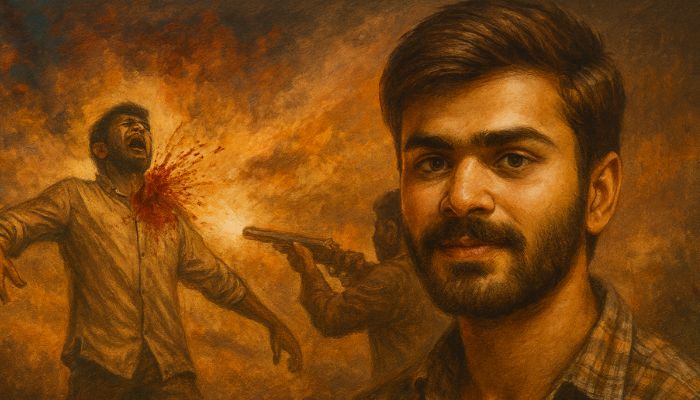
Amidst the disorder, Ram Gopal Mishra was forcibly caught and dragged inside Abdul Hamid’s house. According to the court documents, multiple eyewitnesses stated that the door was shut after he was pulled inside. Moments later, gunshots were heard from within the house. Several rounds were fired in quick succession, as per the witnesses. The court noted that there was no dispute that the firing took place from inside the premises and that Ram Gopal Mishra was shot at close range.
When Ram Gopal Mishra was eventually pulled out by his relatives, he was in a grievously injured condition. Notably, when Rajan and Kishan were trying to pull Ram Gopal out of Abdul Hamid’s house, two rounds were fired upon them as well. He was rushed to the district hospital at Bahraich. However, he succumbed to his injuries. The incident triggered widespread panic in the area. The court observed that the Maharajganj market descended into complete disorder. People fled the area. Homes and shops were shut. The atmosphere was described by witnesses as one of terror and fear.
The FIR in the case
The FIR in the matter was registered on the complaint of Harimilan Mishra, brother of Ram Gopal Mishra. He approached the police and lodged an official complaint detailing how his brother was dragged into Abdul Hamid’s house and shot dead. In his complaint, he named Hamid, his sons, and others as the assailants. He also mentioned that there were some persons present at the scene who were unknown to him.

During the trial, the defence repeatedly attempted to raise doubts over the timing of the FIR and claimed that it was “anti-timed”, calling it fabricated. However, the court rejected the argument, noting that Harimilan Mishra first took his injured brother to the hospital, which was a natural and expected response in such circumstances.
The court further took note of the fact that the incident had plunged the district into chaos. Internet services across Bahraich were suspended for several days. Additional police forces, including RAF and PAC, were deployed from outside the district. In such a situation, a delay in the formal registration of the FIR was not only plausible but inevitable.
The court also noted that the core allegations against the accused remained consistent throughout the investigation and trial. The defence failed to show any material contradiction or manipulation arising out of the alleged delay.
Who was Ram Gopal Mishra and why his death mattered to the court
While the judgment is primarily based on the facts of the case, it did not treat Ram Gopal Mishra as a mere statistic. During the sentencing phase, the court stated that Ram Gopal had been married only a few months prior to the incident. His sudden and violent death did not merely extinguish one life but shattered an entire family, leaving his young wife’s future irreversibly altered.
The court noted that Ram Gopal was unarmed and helpless when he was dragged inside the house. Whatever may have transpired outside during the chaos of the procession, the court emphasised that once he was inside the premises, the act of firing multiple rounds at close range crossed every conceivable boundary of proportionality, restraint, or lawful conduct.
Early defence narrative and references to videos
During the course of arguments, the defence tried to introduce an alternative narrative. They referred to videos purportedly showing Ram Gopal Mishra climbing onto a rooftop or tearing a flag during the chaos. These references were placed before the court as part of an attempt to suggest provocation or a different sequence of events.
However, the court was careful in its treatment of these claims. While the court noted that such arguments were raised, it stated that even if such acts were assumed for the sake of argument, they could not, in law or in reason, justify what followed. The court did not accept any narrative that sought to dilute responsibility for dragging Ram Gopal Mishra inside a house and subjecting him to repeated gunfire and extreme violence. The emphasis remained on the manner of killing and the level of brutality involved.
Eyewitness accounts, what the court accepted, and how the medical evidence exposed the brutality
During the trial, the prosecution examined a large number of witnesses to establish not only the identity of the assailants but also the manner in which Ram Gopal was killed. Substantial space in the judgment was devoted to analysing the testimonies of those eyewitnesses who were present during the Durga idol immersion procession and saw the violence unfolding on the day of the incident.
Harimilan, in his sworn testimony, informed the court that he, Ram Gopal , along with other relatives including Rajan and Kishan, went to Maharajganj market to watch the idol immersion. He categorically stated that Abdul Hamid, his sons Sarfaraz alias Rinku and Fahim, and others were present in front of their house when the procession reached there. He described how Ram Gopal was forcibly dragged inside the house.

He stated that once his brother was dragged inside, the door was shut, and he heard multiple rounds of gunfire from within. Due to the sudden firing and the panic created, he and others were unable to immediately intervene.
Rajan Mishra, Ram Gopal’s cousin, corroborated Harimilan Mishra’s testimony. He, along with others, later took Ram Gopal to the district hospital, where he was declared dead.
Abhishek Mishra, another eyewitness in the case, further strengthened the prosecution case. He told the court that he witnessed Ram Gopal being dragged from the procession and that multiple accused were involved in pulling him inside the house. He further stated that when Ram Gopal was brought out, he had visible gunshot injuries on the upper body and head.
Shashibhushan Awasthi, another eyewitness in the case, told the court how objections were raised and the DJ wire was pulled, leading to the confrontation. He also told the court about the terror that spread in the market. Importantly, he testified that the violence did not stop at firing alone and that the manner in which Ram Gopal Mishra was attacked indicated extreme cruelty.

The defence argued that all eyewitnesses were interested or partisan witnesses because they belonged to the same village or were related to the deceased. Relying on settled legal principles, the court held that relationship by itself does not render a witness unreliable. The court observed that in incidents occurring during public processions, it is natural that those present and affected would be relatives or acquaintances. What mattered was whether their testimonies were consistent, credible, and corroborated by independent evidence.
Post-mortem report – a body riddled with bullets
Perhaps the most damning part of the judgment was the medical evidence. The post-mortem report revealed a level of violence that the court repeatedly described as brutal, cruel, and shocking to the conscience.
According to the post-mortem findings, Ram Gopal’s body bore forty firearm entry wounds. These were not confined to one area but spread across vital parts of the body. The chest, neck, face, and upper limbs showed multiple entry wounds along with two exit wounds. The margins of the wounds showed blackening, which indicated that the shots were fired from close range. The court specifically noted that close-range firing eliminated any possibility of accidental or stray bullets.

The medical examination further revealed deep burn injuries on both toes. The court noted that the toes were burned to such an extent that the nails had come out. A lacerated wound was present above the eyebrow, caused by a blunt object. Internally, both lungs were found punctured, and the pleural cavities contained approximately 2.5 litres of blood and clots. The heart contained clotted blood. Death was caused by shock and haemorrhage resulting from the gunshot injuries. The court observed that the medical evidence completely demolished the defence narrative that Ram Gopal may have been shot once or accidentally during the chaos. The sheer number of entry wounds, the presence of close-range firing indicators, and the additional injuries established that the attack was deliberate, sustained, and intended to ensure death.
Defence arguments versus medical reality
One of the key defence arguments was that the post-mortem did not conclusively show injuries caused by a sword or sharp-edged weapon. The court, while dealing with this argument, said that the absence of certain types of injuries did not weaken the prosecution case, particularly when the cause of death was clearly related to the injuries caused by the firearm. The court further observed that even if some injuries were caused by blunt objects or burning, the overwhelming evidence of multiple gunshot wounds was sufficient to establish murder beyond reasonable doubt.
The court also addressed the defence claims that Ram Gopal had climbed onto a rooftop or interfered with a flag, leading to firing by an unknown person. The court stated that such arguments were speculative and unsupported by credible evidence. More importantly, the court held that even assuming chaos or provocation during the procession, nothing could explain or justify firing multiple rounds at close range at an unarmed individual.
Police investigation, encounter, recovery of murder weapon, and how the court reached the death penalty conclusion
Following the murder of Ram Gopal Mishra, the police swung into action immediately. The incident had not only triggered a criminal investigation but also a district-wide law and order emergency. Internet services were suspended, additional forces were called, and the district remained on edge for several days. Against this backdrop, the police launched an intensive search for the accused named in the FIR.
During the investigation, police teams received specific intelligence inputs indicating that some of the accused were attempting to flee towards the Nepal border. The police acted on the information, and multiple teams were formed, including the local police and SOG units, to nab the accused. On 17th October 2024, officers reached the area near an ice cream factory and an adjoining resting place. Four accused, including Abdul Hamid and his sons Sarfaraz, Fahim, and Talib, were apprehended.
During the interrogation, the accused told the police about the weapon used in the murder, which was a licensed 12-bore SBBL gun belonging to Abdul Hamid. It was hidden near a canal bridge. Based on the information, a recovery operation was planned.
When police took Sarfaraz and Talib to recover the weapon, they attempted to escape. They pushed police personnel, broke free, and fired upon the police team using the hidden firearm. The police retaliated in self-defence, and they sustained bullet injuries to their legs. From the location, the police recovered the gun, a fired cartridge stuck in the barrel, and a live cartridge.
The court noted that the forensic science laboratory later confirmed that the bullets recovered from the body of Ram Gopal Mishra had been fired from the same weapon. According to the judgment, this recovery directly connected the accused to the murder and eliminated any lingering doubt regarding the source of the gunfire.
Court’s assessment of unlawful assembly and common object
In the judgment, the court analysed whether the accused acted as part of an unlawful assembly and whether the murder was committed in furtherance of a common object. The court noted that objections to the procession, pulling the DJ wire, stone pelting, dragging Ram Gopal inside the house, firing multiple rounds, and subsequent attempts to flee together formed a continuous chain of events.
The court rejected the defence argument that the incident was a spontaneous outburst or an isolated act by one individual. It held that the evidence showed coordinated conduct and participation by several accused, even though the precise role of each differed.
Sentencing hearing and the question of ‘rarest of rare’
While sentencing the accused, the court held that the manner of killing demonstrated a “cold-blooded” intent to ensure death. The repeated firing at vital organs, the additional acts of cruelty, and the context in which the murder was committed led the court to conclude that Sarfaraz’s role crossed the threshold into the “rarest of rare” category and awarded him the death penalty.
While discussing the principles governing punishment, the court also referred to classical jurisprudential thought on the role of punishment in maintaining social order. The court cited Manusmriti to underline the idea that punishment is central to the preservation of justice and societal balance.
The court quoted the verse, “दण्ड शास्ति प्रजाः सर्वा दण्ड एवाभिरक्षति। दण्ड सुप्तेषु जागर्ति, दण्ड धर्म विदुर्वधा॥”, which means “Punishment governs all creatures; Punishment alone protects them; Punishment lies awake while all are asleep; the wise regard Punishment as Law itself”.

The court, citing the verse, observed that punishment disciplines society, protects the innocent, and acts as a deterrent even when people are inclined to transgress the law. The court noted that the concept of punishment, as articulated in Manusmriti, treats punishment not as vengeance but as an essential instrument of governance to prevent chaos, lawlessness, and moral collapse. In the context of the Bahraich violence, the court held that failure to impose proportionate punishment for such a brutal crime would undermine public faith in the justice system and embolden further acts of violence.
Death penalty, life sentences, and final directions
Accordingly, the court awarded the death penalty to Sarfaraz for the offence of murder, subject to confirmation by the Allahabad High Court. Abdul Hamid and several other accused were sentenced to life imprisonment along with additional terms of rigorous imprisonment and fines under various provisions of the Bharatiya Nyaya Sanhita and the Arms Act. Some accused were acquitted after the court found that the evidence against them did not meet the standard of proof beyond reasonable doubt.
The court directed that all sentences would run concurrently and issued orders for the preparation of warrants. In the case of the death sentence, the court ordered that the record be referred to the High Court for confirmation, as mandated by law.
Who got what sentence – death penalty, life terms, and rigorous imprisonment
Sarfaraz, along with the death penalty, was also awarded a total of eight years of rigorous imprisonment with a Rs 1,30,000 fine. Abdul Hamid was sentenced to life imprisonment with a Rs 1,81,000 fine. Life imprisonment was also awarded to Talib, Fahim, Saif Ali, Javed Khan, Mohammad Jishan, Shoaib Khan, Nankau, and Maruf Ali, with a fine of Rs 1,50,000. The court held that although their individual roles varied, their participation in the unlawful assembly that culminated in the murder stood proved beyond reasonable doubt.
Khursheed, Shakeel Ahmed, and Mohammad Afzal were acquitted, as the prosecution could not establish their role in the crime beyond reasonable doubt. The convicted individuals will remain in judicial custody under the applicable provisions until the Allahabad High Court confirms or commutes the sentence.
The judgment in Ram Gopal Mishra’s murder case serves as a stark reminder that provocation, even if claimed to be religious in nature, can never give anyone the right to take an extreme step such as murder. In its final conclusion, the court made it clear that even if Ram Gopal Mishra had removed or touched a religious flag, as alleged by the defence, such an act could never be treated as provocation for killing. The judgment stressed that the law provides clear legal remedies for any such act, not a licence for violent retaliation. By misusing a licensed firearm meant solely for self-defence, the accused crossed every legal boundary, turning a minor dispute into a brutal and unlawful killing.