As NASA gears up to return humans to the Moon, here’s all you need to know about the Artemis II mission
Around 50 years after the Apollo era, NASA is set to send humans to the Moon again and establish a sustained presence there under its ambitious initiative, the Artemis II Mission. Named after the Greek goddess of the Moon, and Apollo’s twin sister, the Artemis II program aims to send its four astronauts on their first flight aboard NASA’s Space Launch System (SLS) rocket and Orion spacecraft to the Moon. We are going—again! Artemis II is set to depart on its 10-day crewed flight around the Moon no earlier than Feb. 6, with plenty of activities scheduled at @NASA_Johnson around the launch.Find media accreditation information here: https://t.co/EmIkC9xNNw pic.twitter.com/KXh8TkE6ju— NASA (@NASA) January 13, 2026 The program involves collaborations with agencies like the European Space Agency (ESA) and the Canadian Space Agency. In addition, commercial partners like SpaceX have also been roped in for landing systems. Artemis II builds on the uncrewed test flights, particularly Artemis I in 2022, which successfully sent Orion around the Moon and back. What is Artemis II? Artemis II is the second mission in the Artemis program. It is the first crewed mission in the wider program, and the first-time humans will travel beyond low Earth orbit since Apollo 17 in 1972. This mission’s budget is estimated to be around $93 billion, although the exact figures could be higher. The Artemis II is a 10-day test flight that will send four astronauts, Reid Wiseman, Victor Glover, Christina Koch, and Jeremy Hansen, on a lunar flyby. The mission will involve orbiting the Moon without landing, before returning to Earth through a free-return trajectory using the Moon’s gravity to slingshot back to Earth. Official Artemis II crew poster released by NASA. The complete Artemis program comprises four missions: Artemis I, which was an uncrewed flight test of the Space Launch System and the Orion spacecraft around the Moon. Artemis II, which will be the first crewed flight test of the Space Launch System and the Orion spacecraft around the Moon. Artemis III, which will send the first humans to explore the region near the lunar South Pole. And, Artemis IV, which will debut humanity’s first lunar space station, a larger, more powerful version of the SLS rocket, and a new mobile launcher. What will the astronauts do during the mission? According to NASA, the main goals of the mission are to validate the Orion spacecraft’s life support systems, propulsion, and hardware in deep space with a human crew aboard. The objectives of the mission also include testing environmental controls like air and water recycling, in addition to conducting scientific observations from a unique vantage point farther from Earth than humans have been in over 50 years. “During an approximately 10-day mission set to launch in 2026, NASA astronauts Reid Wiseman, Victor Glover, and Christina Koch, and CSA (Canadian Space Agency) astronaut Jeremy Hansen will collect and store their saliva, don wrist monitors that track movement and sleep, and offer other essential data for NASA’s Human Research Program and other agency science teams,” a NASA article titled “Artemis II Crew to Advance Human Spaceflight Research”, reads. The four astronauts will record their observations via pictures and audio recordings during the Moon exploration mission. While NASA’s Lunar Reconnaissance Orbiter has been mapping and surveying the Moon for decades, Artemis II allows humans to evaluate the lunar surface from above. Since human eyes and brains are highly sensitive to subtle changes in colour, texture, and other surface characteristics, Astronauts having a first-hand observation of the lunar surface could “form the basis for future scientific investigations into the Moon’s geological history, the lunar environment, or new impact sites, NASA says. Another interesting aspect of the Artemis II mission is the integration of science flight control operations. The takeaways of these operations during Artemis II will pave the way for lunar science operations on future missions. Explaining what it is and how it will work, NASA says, “From their console in the flight control room in mission control, a science officer will consult with a team of scientists with expertise in impact cratering, volcanism, tectonism, and lunar ice, to provide real-time data analysis and guidance to the Artemis II crew in space. During the mission, the lunar science team will be located in mission control’s Science Evaluation Room at NASA’s Johnson Space Center in Houston.” Studies NASA researchers will conduct on the Artemis II Mission The study by NASA researchers on the Artemis II mission will include A Virtual Astronaut Tissue Analog Response or AVATAR investigation. This will use organ-on-a-chip devices, or organ chips, to study the effects of increased radiation and microgravity on human health. Another key study on the mission will be Artemis Research for Crew Hea
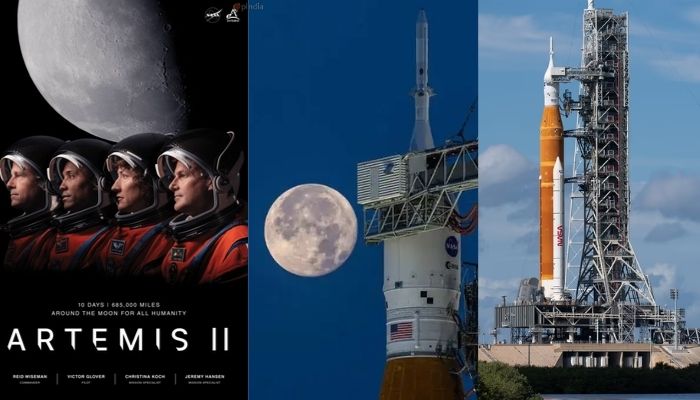

Around 50 years after the Apollo era, NASA is set to send humans to the Moon again and establish a sustained presence there under its ambitious initiative, the Artemis II Mission. Named after the Greek goddess of the Moon, and Apollo’s twin sister, the Artemis II program aims to send its four astronauts on their first flight aboard NASA’s Space Launch System (SLS) rocket and Orion spacecraft to the Moon.
We are going—again! Artemis II is set to depart on its 10-day crewed flight around the Moon no earlier than Feb. 6, with plenty of activities scheduled at @NASA_Johnson around the launch.
— NASA (@NASA) January 13, 2026
Find media accreditation information here: https://t.co/EmIkC9xNNw pic.twitter.com/KXh8TkE6ju
The program involves collaborations with agencies like the European Space Agency (ESA) and the Canadian Space Agency. In addition, commercial partners like SpaceX have also been roped in for landing systems.
Artemis II builds on the uncrewed test flights, particularly Artemis I in 2022, which successfully sent Orion around the Moon and back.
What is Artemis II?
Artemis II is the second mission in the Artemis program. It is the first crewed mission in the wider program, and the first-time humans will travel beyond low Earth orbit since Apollo 17 in 1972. This mission’s budget is estimated to be around $93 billion, although the exact figures could be higher. The Artemis II is a 10-day test flight that will send four astronauts, Reid Wiseman, Victor Glover, Christina Koch, and Jeremy Hansen, on a lunar flyby. The mission will involve orbiting the Moon without landing, before returning to Earth through a free-return trajectory using the Moon’s gravity to slingshot back to Earth.

The complete Artemis program comprises four missions: Artemis I, which was an uncrewed flight test of the Space Launch System and the Orion spacecraft around the Moon. Artemis II, which will be the first crewed flight test of the Space Launch System and the Orion spacecraft around the Moon. Artemis III, which will send the first humans to explore the region near the lunar South Pole. And, Artemis IV, which will debut humanity’s first lunar space station, a larger, more powerful version of the SLS rocket, and a new mobile launcher.
What will the astronauts do during the mission?
According to NASA, the main goals of the mission are to validate the Orion spacecraft’s life support systems, propulsion, and hardware in deep space with a human crew aboard. The objectives of the mission also include testing environmental controls like air and water recycling, in addition to conducting scientific observations from a unique vantage point farther from Earth than humans have been in over 50 years.
“During an approximately 10-day mission set to launch in 2026, NASA astronauts Reid Wiseman, Victor Glover, and Christina Koch, and CSA (Canadian Space Agency) astronaut Jeremy Hansen will collect and store their saliva, don wrist monitors that track movement and sleep, and offer other essential data for NASA’s Human Research Program and other agency science teams,” a NASA article titled “Artemis II Crew to Advance Human Spaceflight Research”, reads.
The four astronauts will record their observations via pictures and audio recordings during the Moon exploration mission. While NASA’s Lunar Reconnaissance Orbiter has been mapping and surveying the Moon for decades, Artemis II allows humans to evaluate the lunar surface from above. Since human eyes and brains are highly sensitive to subtle changes in colour, texture, and other surface characteristics, Astronauts having a first-hand observation of the lunar surface could “form the basis for future scientific investigations into the Moon’s geological history, the lunar environment, or new impact sites, NASA says.
Another interesting aspect of the Artemis II mission is the integration of science flight control operations. The takeaways of these operations during Artemis II will pave the way for lunar science operations on future missions.
Explaining what it is and how it will work, NASA says, “From their console in the flight control room in mission control, a science officer will consult with a team of scientists with expertise in impact cratering, volcanism, tectonism, and lunar ice, to provide real-time data analysis and guidance to the Artemis II crew in space. During the mission, the lunar science team will be located in mission control’s Science Evaluation Room at NASA’s Johnson Space Center in Houston.”
Studies NASA researchers will conduct on the Artemis II Mission
The study by NASA researchers on the Artemis II mission will include A Virtual Astronaut Tissue Analog Response or AVATAR investigation. This will use organ-on-a-chip devices, or organ chips, to study the effects of increased radiation and microgravity on human health.
Another key study on the mission will be Artemis Research for Crew Health & Readiness, or ARCHeR. Detailing what this study will cover, NASA says, “This study will measure astronauts’ well-being, activity, sleep patterns, and interactions during the Artemis campaign that will return astronauts to deep space and the Moon for the first time in over 50 years. These missions will launch in a new space vehicle, the Orion capsule, and journey deep into space, resulting in longer exposures to space hazards, including isolation, radiation, and more. Data will be collected using actigraphy and behavioral performance surveys before and after the mission. Actigraphy data will also be collected during the mission.”
NASA opines that this study will help understand the combined effect of space hazards on well-being and performance. ARCHeR will also be used to “develop protocols, interventions, and technologies that will enable humans to survive and thrive for future Moon and Mars missions.”
The mission will also involve studying radiation, and radiation sensors will be fitted inside the Orion capsule cells to collect information about radiation shielding functionality and organ-on-a-chip devices. These devices containing astronaut cells will study how deep space travel affects humans at a cellular level.
The NASA researchers will also conduct a study titled “Immune Biomarkers”. Under this, the researchers will explore how the immune system, and of the crew aboard, reacts to spaceflights.
Though not central to the Artemis II mission’s objectives, the program will include CubeSats. This will help improve the understanding of the space environment. NASA and four international space agencies have signed agreements to send CubeSats into space aboard the SLS rocket. The four space agencies sending their CubeSats include Argentina’s ATENEA, Korea Aerospace Administration, Saudi Arabia Space Agency, and the Germany Space Agency. While each country have their own diverse objectives, collecting data on radiation is a common objective.

Artemis II launch details
The Artemis II mission will launch from NASA’s Kennedy Space Centre in Florida using the American space agency’s most powerful rocket, the SLA Block 1. NASA is targeting a launch no earlier than 6th February 2026, with the launch window opening from the 5th to 11th February. The fully stacked SLS rocket and Orion spacecraft are scheduled to roll out to Launch Pad 39B starting from 17th January. This process could take up to 12 hours.
NASA is planning on rolling out the Artemis II rocket and spacecraft from the Vehicle Assembly Building to Launch Pad 39B at @NASAKennedy no earlier than Jan. 17. The four-mile journey will take up to 12 hours. pic.twitter.com/U4sAPzG5tJ
— NASA (@NASA) January 10, 2026
Following the rollout, the teams will conduct a wet dress rehearsal, which will involve fuelling and a countdown simulation, to assess readiness.

In the event that the February window is missed due to technical anomalies or adverse weather conditions, additional opportunities have been explored. These opportunities are scheduled for 6th-9th and 11th March, 5th-8th and 10th April, and will continue into April 2026, if needed.
As per NASA, the exact date of launch will depend on post-rehearsal evaluations of the spacecraft, ground systems, and crew preparedness. To stay on track for the program, NASA intends to proceed with the launch no later than April 2026.
The Artemis II crew
The Artemis II crew is an interesting blend of inclusivity and cooperation, as it includes the first woman, the first ‘person of colour’, and the first non-American to venture to the vicinity of the Moon. The four-person crew was announced in April 2023.
The Artemis II crew has Reid Wiseman as its Commander. Wiseman is a NASA astronaut selected in 2009. He is a former US Navy test pilot and fighter jet aviator. Wiseman has logged over 165 days in space and commanded ISS operations, including ISS Expedition 40/41 in 2014. During this mission, Wiseman and his crewmates conducted more than 300 scientific experiments.

The Artemis II mission will have NASA’s Victor Glover as the Pilot. Glover is the first Black astronaut assigned to a lunar mission. Glover was selected as an astronaut in 2013. He has been a US Navy aviator with combat experience. Glover has spent 168 days on ISS, wherein he conducted spacewalks and experiments. He was a part of the SpaceX Crew-1 to ISS in 2020-2021.

In the role of Mission Specialist 1, Christina Koch holds the record for the longest single spaceflight by a woman, spanning 328 days. She completed six spacewalks, including the first all-woman EVA

The Artemis II crew includes Canadian astronaut Jeremy Hansen as Mission Specialist 2. The astronaut from the Canadian Space Agency will be the first Canadian on a lunar mission. He has been a Royal Canadian Air Force colonel and fighter pilot.

Hansen was selected as an astronaut in 2013. After completing his Astronaut Candidate Training, Hansen has been part of various space programs by the CSA, ESA, and NASA, and will now be venturing around the Moon.