Ancient Four Occupations to modern Hukou divisions: Inside the Chinese caste system highlighted by Indian netizens in pushback against CCP’s anti-India propaganda
For many years, the Chinese Communist Party concealed its societal realities behind a ‘firewall’ and concocted hateful narratives about India’s social structure and caste system. However, Indians have memed their way into rattling the CCP’s propaganda fortress. Since the past few days, major social media platforms, particularly X (formerly, Twitter) and Instagram, have been flooded with Indian users posting ground-level visuals, threads, sarcastic commentary, videos and memes calling out the exploitative Chinese caste system. While in scholarly discourse in India, the Chinese caste system and its modern Hukou form are not lesser-known issues, Indians, in fact, know only the sanitised version of China’s caste system. However, Indian social media users decided to make this lesser-known societal truth about China globally known. The pursuit began gaining serious traction from around 11th June 2026 onwards with posts highlighting China’s ancient Four Occupations: Shi-Nong-Gong-Shang, as a hereditary hierarchy, and institutionalised discrimination within the modern Hukou household registration system, which traps millions of Chinese people in second-class status. Before delving into how and why Indians are after China’s societal realities, it is important to learn about the Chinese caste system, both historical and modern. From ‘Four Occupations’ to Hukou system: Caste system is not alien, rather entrenched in Chinese society for centuries The ‘Four Occupations’ system dates back to the Zhou dynasty, though formalised in later periods. It was an ideal social hierarchy under the emperor. Under this system, people were divided into four categories. At the top was the Shi (士) caste. This comprised scholars, gentry, officials, and the overall ruling elite. Shi were followed by Nong (农), who were peasants, farmers, the producers of food. Although respected in theory, they were deemed lower in practice. In third position was Gong (工). This category included artisans and craftsmen. The lowest in the hierarchy was the Shang (商) group. These included merchants and traders. They were viewed as profit-driven and less essential. In some eras, there was a bottom layer of Jianmin or “degraded people”. The emperor was above all these categories. It is argued by many pro-China elements outside China, and Chinese scholars, that this arrangement, though hierarchical and functional, was not identical to India’s Varna or Jati system. They contend that while the Varna system was strictly hereditary or purity-based, the ‘Four Occupations’ system was more vocational than hereditary. However, even the Varna system, in its original Vedic form, was not hereditary or birth-determined. While China’s ‘Shi-Nong-Gong-Shang’ hierarchy was based on occupation, Bharat’s Varna system was based on guna or qualities and karma or work. Brahmins, comprising Vedic priests, scholars and teachers, Kshatriyas comprising the ruling elite and warriors, Vaishyas, comprising merchants, farmers, traders, and finally, the Shudras, who were service providers. This system was based essentially on a division of labour and a social organisation wherein individual aptitude, qualities, duties and interests decided their Varna, not immutable birth. Varna was theoretically fluid and based essentially on personal conduct and aptitude. Many noted individuals rose to the status of Brahmins through merit and conduct, while in many cases, bad conduct would result in caste and reputational loss. None of it was based on birth. It is undeniably true that in later periods, the caste system became hereditary; the original system, just as China’s Four Occupations, was not birth-based. Social hierarchy and exclusion are not unique to India alone. Many countries have religion-based or occupation-based hierarchies that were either originally or, through corruption over time, took rigid and discriminatory forms. However, it is strictly in India’s context that social hierarchy and exclusion are raised to essentialise Hindu culture and religion. This is deliberately done to defame Hinduism and establish a norm that the Hindu religion and culture alone define Indian society and culture, even as India is home to diverse religions and cultures, which have their own separate hierarchies and related rivalries. Despite this, the Chinese propaganda factory cherry-picks convenient negatives of the Indian caste system, blends it with their exaggerated narratives to portray India as a feudal, divided and even ‘inferior’ country, unlike the imaginary ancient and present communist Chinese Utopia where everyone is ‘equal’. Hukou system: The de facto Chinese caste system While independent India has, through laws and societal reforms, achieved considerable success in eradicating caste discrimination, Communist China has adopted a highly rigid Hukou system. The origins of the hukou system date back to the Warring Kingdoms period (third ce
For many years, the Chinese Communist Party concealed its societal realities behind a ‘firewall’ and concocted hateful narratives about India’s social structure and caste system. However, Indians have memed their way into rattling the CCP’s propaganda fortress. Since the past few days, major social media platforms, particularly X (formerly, Twitter) and Instagram, have been flooded with Indian users posting ground-level visuals, threads, sarcastic commentary, videos and memes calling out the exploitative Chinese caste system.
While in scholarly discourse in India, the Chinese caste system and its modern Hukou form are not lesser-known issues, Indians, in fact, know only the sanitised version of China’s caste system. However, Indian social media users decided to make this lesser-known societal truth about China globally known.
The pursuit began gaining serious traction from around 11th June 2026 onwards with posts highlighting China’s ancient Four Occupations: Shi-Nong-Gong-Shang, as a hereditary hierarchy, and institutionalised discrimination within the modern Hukou household registration system, which traps millions of Chinese people in second-class status.
Before delving into how and why Indians are after China’s societal realities, it is important to learn about the Chinese caste system, both historical and modern.
From ‘Four Occupations’ to Hukou system: Caste system is not alien, rather entrenched in Chinese society for centuries
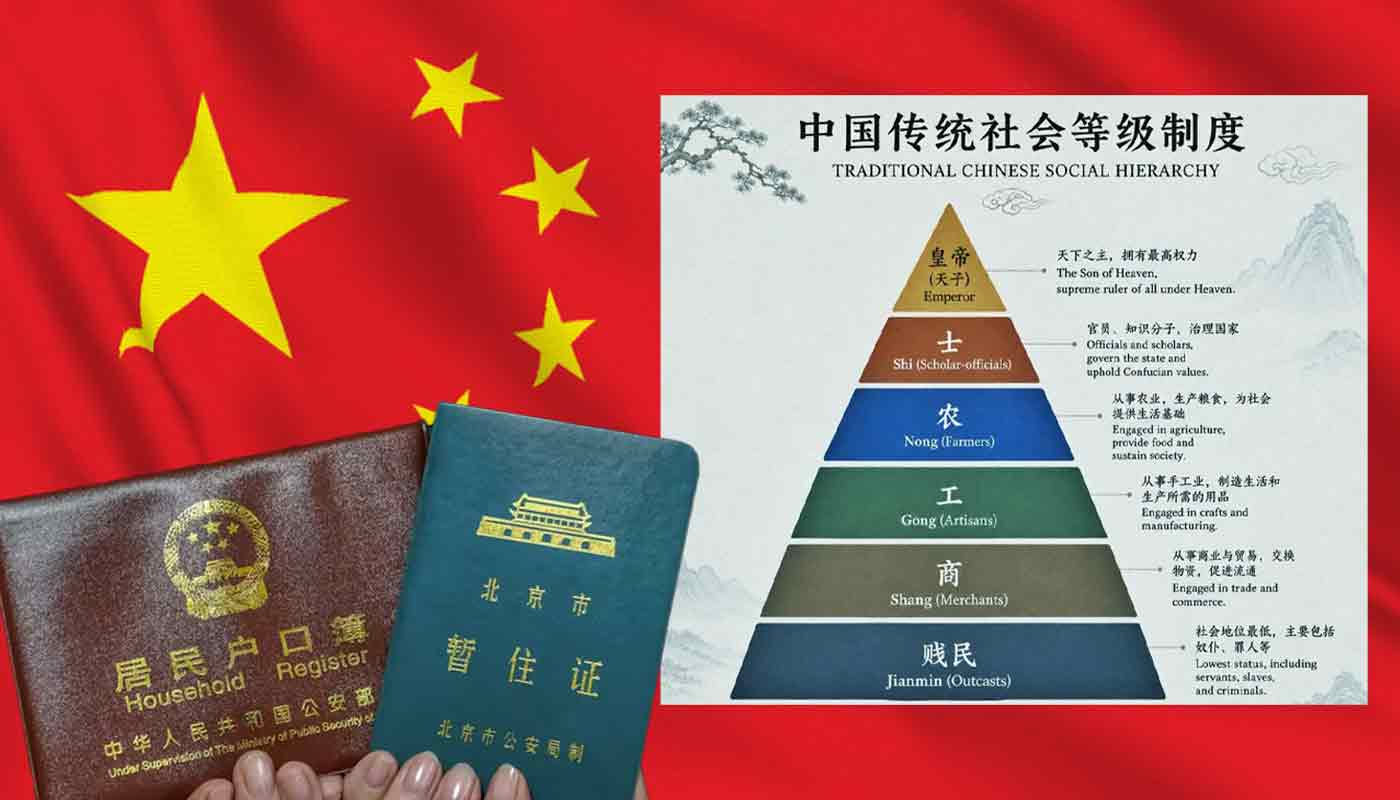
The ‘Four Occupations’ system dates back to the Zhou dynasty, though formalised in later periods. It was an ideal social hierarchy under the emperor. Under this system, people were divided into four categories.
At the top was the Shi (士) caste. This comprised scholars, gentry, officials, and the overall ruling elite.
Shi were followed by Nong (农), who were peasants, farmers, the producers of food. Although respected in theory, they were deemed lower in practice.
In third position was Gong (工). This category included artisans and craftsmen.
The lowest in the hierarchy was the Shang (商) group. These included merchants and traders. They were viewed as profit-driven and less essential.
In some eras, there was a bottom layer of Jianmin or “degraded people”. The emperor was above all these categories.
It is argued by many pro-China elements outside China, and Chinese scholars, that this arrangement, though hierarchical and functional, was not identical to India’s Varna or Jati system. They contend that while the Varna system was strictly hereditary or purity-based, the ‘Four Occupations’ system was more vocational than hereditary.
However, even the Varna system, in its original Vedic form, was not hereditary or birth-determined. While China’s ‘Shi-Nong-Gong-Shang’ hierarchy was based on occupation, Bharat’s Varna system was based on guna or qualities and karma or work.
Brahmins, comprising Vedic priests, scholars and teachers, Kshatriyas comprising the ruling elite and warriors, Vaishyas, comprising merchants, farmers, traders, and finally, the Shudras, who were service providers. This system was based essentially on a division of labour and a social organisation wherein individual aptitude, qualities, duties and interests decided their Varna, not immutable birth.
Varna was theoretically fluid and based essentially on personal conduct and aptitude. Many noted individuals rose to the status of Brahmins through merit and conduct, while in many cases, bad conduct would result in caste and reputational loss. None of it was based on birth.
It is undeniably true that in later periods, the caste system became hereditary; the original system, just as China’s Four Occupations, was not birth-based. Social hierarchy and exclusion are not unique to India alone. Many countries have religion-based or occupation-based hierarchies that were either originally or, through corruption over time, took rigid and discriminatory forms. However, it is strictly in India’s context that social hierarchy and exclusion are raised to essentialise Hindu culture and religion.
This is deliberately done to defame Hinduism and establish a norm that the Hindu religion and culture alone define Indian society and culture, even as India is home to diverse religions and cultures, which have their own separate hierarchies and related rivalries.
Despite this, the Chinese propaganda factory cherry-picks convenient negatives of the Indian caste system, blends it with their exaggerated narratives to portray India as a feudal, divided and even ‘inferior’ country, unlike the imaginary ancient and present communist Chinese Utopia where everyone is ‘equal’.
Hukou system: The de facto Chinese caste system
While independent India has, through laws and societal reforms, achieved considerable success in eradicating caste discrimination, Communist China has adopted a highly rigid Hukou system.
The origins of the hukou system date back to the Warring Kingdoms period (third century BC). Unlike India’s Varna system or ancient China’s Four Occupations, Hukou is not occupation-based; it divides people into groups according to birth-based privileges for some.
Hukou is a household registration regime introduced in its strictest form in 1958 after the Chinese Communist ‘revolution’. With this system, the CCP made it mandatory for every Chinese citizen to have a Hukou status by birth.
It divides people into two groups: Agricultural (rural) versus Non-Agricultural or urban. This is also linked to a specific location, like local or outsider. The Urban hukou holders enjoy privileged access to better public schools and colleges, subsidised healthcare and housing. Pensions and social welfare, as well as stable government or formal sector jobs. They are basically a privileged minority.
This system divides the Chinese populace into nongmin (rural citizens), with an agricultural hukou, and shimin (urban citizens), with a non-agricultural hukou.
The rural hukou holders, who form the majority, have to face systemic barriers. Several media reports and studies say that when the rural hukou holders migrate to cities for work, they usually get only temporary residence permits. The children of these rural hukou nongmin become left-behind children in villages, and face extra fees issues in urban schools.
In fact, there are separate unlicensed migrant schools outside the CCP-run state’s education system, reflecting how rural hukou are segregated from the socially and economically better and mainstream urban hukou and have very little access to public resources. These schools rely mainly on tuition fees to operate, have dilapidated buildings and are no match for the public schools in terms of facilities and quality of education.
Unable to get admission even in the migrant schools, the workers are sometimes forced to send their children back alone to their place of hukou for education. This essentially perpetuates a generational poor educational trajectory for rural hukou holders, while urban hukous have seen their educational levels improve generation by generation from school to universities.
In this ongoing decade alone, China’s capital, Beijing, has seen the closure and demolition of numerous migrant schools, further disconnecting rural hukou holders from education.
The only way for children of migrant workers to get admission to mainstream public schools is by providing the “five permits”. These include a labour contract and proof of local housing. However, obtaining urban hukou for a migrant worker is a near-impossible task. Since most of the migrant workers are employed in the informal economy and living in informal apartments, they cannot fulfil the requirements for obtaining an urban hukou.
In his notable book The Urbanization of People, sociologist Eli Friedman notes that, unlike discriminatory practices and social conditions in other regions, the Chinese Hukou system is “wholly and openly by state design, systematically creating a division among and within the predominantly Han population.”
In a study titled, Hukou and Urban-Rural Educational Inequality: Who Are Left Out?, Zheyu Zhao details the inequalities rural hukous face in the education sector.
“The educational system in China is rife with urban-rural inequalities, owing to the discriminatory effects of Hukou on educational resources and opportunities. In many cities, migrant students without local Hukous are excluded from the Nine-Year Compulsory Free Education [7]. Most state schools receive no state funding for migrant pupils, so they often claim to be full [8]. As a result, migrant students must either attend private institutions or return to the village linked to their Hukou status, where they can receive a free but bare-bones education,” the study reads.
Since migrant workers do the dangerous, dirtiest, and low-paid jobs in factories and construction, a social stigma is attached to them. They get lower wages compared to urban hukou for similar work, face hiring discrimination, and have limited access to full urban benefits. The same is the story of peasants (nongmin) and other rural hukou holders.
The Chinese Hukou system is equivalent to a birth-based discriminatory caste system, given the disparity in economic standing, social status, and access to public resources based on the birth of the urban and rural Hukous. The CCP has created a regime that has pushed a significant section of the population into perpetual precarity and destitution based on birth.
Clearly, China’s socialism-communism is confined to lip service and the CCP conveniently adopted not only the pre-Mao Hukou (Huji) system, which was originally based on where a person resided, but also made it even more rigid and discriminatory by making it birth-based, turning the residency status became inheritable.
From an economic point of view, the Hukou system helped China create a dual economy, with a large proportion of unskilled labour. With a birth-based and institutionalised exclusionary Hukou regime, the CCP achieved social stability and economic growth, thanks to the abundance of cheap labour, which it needed to perpetuate its authoritarian rule.
In fact, initially, the hukou inheritance was made matrilineal and not patrilineal. No, this was not a progressive move; rather, historian Professor Glen Peterson described it as the elimination of the opportunity for upwardly mobile fathers to bequeath urban hukou status to the offspring.
“By assigning hukou status through the maternal parent, the opportunity for upwardly mobile fathers to bequeath urban hukou status to their offspring was eliminated. … Hukou controls were the state’s primary mechanism for allocating – and denying – access to a wide range of state-supplied goods and services: schooling, food, housing, employment, consumer products, and other benefits. Following the great famine of 1959-61, moreover, China’s leaders came to regard a peasantry bound legally and permanently to the land as the most effective means of guaranteeing the country’s precarious food supply,” Peterson wrote in his book The Power of Words: Literacy and Revolution in South China, 1949-95.
It was only in 1998 that Hukou inheritance was made patrilineal.
In his noted work, Organizing Through Division and Exclusion: China’s Hukou System(2005), Dr Fei-Ling Wang, Professor at Sam Nunn School of International Affairs, described Hukou as a “control measure by dividing the population into small segments.”
“China’s imperial hukou system functioned as a quasi-institutional exclusion. In addition to the location-determined population immobility, there always lingered an inherited hukou categorisation of various noble clans, ordinary people (mainly peasants), and various low-class clans (slaves, floaters, untouchables such as paupers or prostitutes). In the last two dynasties (Ming and Qing), the legally equal ordinary people were categorised into four inherited hukou types: military, peasants, merchants, and handicraft workers. They had the same legal status but frequently different and adjustable treatment regarding tax burden and the right to participate in the imperial examinations, as well as the right to move. Several categories of low-class clans were further excluded. … Unlike the current PRC hukou system, however, the imperial hukou system formally excluded not the majority of the population but mainly the socially undesirable minority or fringe groups,” Wang wrote.
The CCP’s adoption and perpetuation of the birth-based Hukou system is rooted in the advice of traditional Chinese scholar Guo Tinglin, who said, “When the masses dwell in the villages, order prevails; when the masses flock to the cities, disorder prevails”. The Hukou regime in the People’s Republic of China is essentially a de facto caste or apartheid-like system, creating “two Chinas”.
The Hukou system is prevalent in China even now and has witnessed several reforms. However, despite the reforms, the core divide persists. The urban-rural gaps in income, education and opportunities also remain stark. The discrimination in labour markets and prejudiced social attitudes is now widely known.
Several studies indicate that the Mao-era Hukou locked peasants in place to feed cities and fund China’s industrialisation. The Great Leap Forward and Collectivisation further devastated rural China.
In fact, during the Cultural Revolution (1966-76), the CCP institutionalised hereditary discrimination via the “class label” system. Families were categorised on the basis of their pre-revolutionary wealth or political standing. Several studies detail how those who were During the Cultural Revolution (1966–1976), the Chinese Communist Party institutionalised hereditary discrimination through the “class label” system. Families were permanently categorised based on their pre-revolutionary wealth or political standing. Those designated as “class enemies” passed social and political stigmas onto their children, having their life chances heavily restricted.
Be it through the stigmatised “Five Black Categories” and the CCP-favoured “Five Red Categories” during the Cultural Revolution or the perpetual Hukou system, China has an opprobrious history of discrimination against its own people, be it for political view, or based on birth.
It would amount to intellectual dishonesty if the term caste is not used in the context of China’s birth-based discriminatory system. Caste is not an Indic term; the word finds its origin in the Spanish and Portuguese word “casta”, which means “race, lineage, breed, or kind”. Casta itself originated from the Latin castus, meaning “pure”. Evidently, the European origins of the term and its birth/lineage-based purity indicate that the Caste system, in some form or other, existed in Europe as well. However, in modern studies, “caste” has almost exclusively been used in the context of the Hindu varna/jati system.
Indians sarcastically call out ‘Chinese caste system’, CCP deploys mouthpiece Global Times for narrative control
In the last few days, Indian netizens have been dominating timelines across all major social media platforms with videos, memes, and sarcastic commentary on China’s historical and prevalent social hierarchies and related discrimination.
As Indians called out China’s birth-based urban-rural chasm, the CCP mouthpiece Global Times, notorious for peddling anti-India propaganda, published a defensive piece on “Indian netizens allege China has a ‘caste system’,”.
The Global Times cited Chinese ‘experts’ to dismiss the Indian pushback as “hilarious,” “ignorant of Chinese historical culture,” and classic “projection” or “coping.”
Apparently, the CCP is now rattled not only by state actors but also by ordinary Indians, who have punctured China’s carefully curated global image of a harmonious and meritocratic Communist Utopia. While some of the ‘Chinese caste system’ posts by Indian netizens are a genuine attempt at highlighting China’s very own birth-based hierarchical systems, the Global Times failed to read the Indian sarcasm.
For years, Chinese state media, bots, and influencers peddled half-truths, blatant lies and propaganda about India, Indians, and Indian society. From passing off videos of unhygienic street foods from Bangladesh and Pakistan as Indian on X, Facebook, Instagram, and TikTok, to highlighting the caste system with their own exaggerated narratives, CCP bots fuelled hatred against Indians online.
However, Indian social media users flipped the script. While the CCP is deploying its media mouthpiece and social media bots to ‘counter’ the Chinese caste system claims made by Indians, the Indian side of X has essentially played the CCP’s game of picking historical issues and peddling exaggerated narratives around it. Indian netizens, powered by 2.5 GB per day of internet, are not merely apprising the world of China’s discriminatory societal structure but are giving a blowback with a blend of facts, satire, and sarcasm, with a dash of mockery.
While ‘caste’ has become a keyword in the ongoing Indian social media campaign and Chinese reaction, this is not confined to just caste or discrimination. Indian social media users have managed to breach the ‘firewall’ and bring out visual elements, be it poverty clips, migrant stories, and similar ground stories, that never make their way beyond the official filters. It is hilarious that the CCP is rattled by decentralised, creative and motivated Indian netizens who are simply pushing back against Chinese propaganda in the CCP’s own style.