Supreme Court has got the SC-ST Act right, ‘in public view’ is an essential Constitutional filter that prevents false cases
Advocate Sahil Hussain Choudhury claimed in his article ‘No Room For Bystanders In A Constitution That Outlawed Untouchability’ published in LiveLaw on June 6, 2026, that the Supreme Court’s decision in Girija Kumari v. State (NCT of Delhi) reflects a “troubling dependence on visibility,” as if Indian anti-caste jurisprudence had gradually started to acknowledge caste humiliation only in public. His main argument is that the court’s interpretation reveals a constitutional flaw because the ‘public view’ requirement in Sections 3(1)(r) and (s) of the Scheduled Castes and the Scheduled Tribes (Prevention of Atrocities) Act, 1989 does not take into consideration the everyday, private manners in which caste functions, such as segregated utensils, denial of tenancy, and degrading usage of language inside homes. Because it confuses the purposefully determined scope of the statute with the more expansive goal of the Constitution and derives the incorrect inference from both, that argument demands a clear and precise response. Sahil Hussain Choudhury’s article in Live Law Sahil Hussain is correct in saying that caste does not exist solely through spectacle, it also functions through hidden enmity that seldom comes to light, silence, and private agreements. There is no reputable observer who disagrees with such social finding. It is not necessary to conclude that every domestic display of a caste language must be included by this specific regulation just because caste is acknowledged to pervade private life. Parliament took a clear legislative choice in drafting Sections 3(1)(r) and (s) to connect those specific offences to a public element, and courts are not free to read out that element simply because a commentator finds it inconvenient. Untouchability is completely prohibited by Article 17 of the Constitution and the SC/ST Act was never intended to address all private cases of this prohibition. It has particular components and is a targeted criminal statute. The Protection of Civil Rights Act, 1955, which addresses disabilities related to untouchability in private and religious settings, general criminal provisions under the Bharatiya Nyaya Sanhita for verbal intimidation, and civil litigation are all fully applicable in situations where those components are lacking. The court’s respect to what Parliament wrote is a fundamental requirement for anti caste constitutionalism, not a retreat from it. The Act’s Sections 3(1)(r) and 3(1)(s) only constitute offences when caste based intimidation or insult takes place ‘in any place within public view.’ That expression is not an after-the-fact judicial gloss. The 2018 amendment, which enhanced and restored arrest and investigation measures after a prior Supreme Court judgement had weakened them, left the ‘public view’ phrase completely unaltered. Parliament purposefully included it in the original Act. That was not an accident, but rather a deliberate omission. For almost twenty years, the conditions have been regularly upheld. In Swaran Singh v. State through Standing Counsel (2008), the court recognised a clear distinction which was insult that was visible from the road close to a house’s gate qualified as being within public view, but an insult that was hidden from public view inside a building did not. The bench reaffirmed in Hitesh Verma v. State of Uttarakhand (2020) that accusations made within a private residence without the presence of a member of the public cannot meet the statutory standard. These established concepts were applied to a new set of facts in the Gunjan judgement. The case Sahil Choudhury cited was a family dispute among schedule castes A dispute about property and lock in a Delhi home gave rise to the case. The complainant is a member of a Scheduled Caste community, as are at least two of the accused while the remaining accused are their wives. FIR No. 42/2021 claims that the accused used words like ‘chura,’ ‘chamar,’ and ‘harijan’ during the domestic quarrel. The court held that the specific statutory elements of Sections 3(1)(r) and 3(1)(s), namely, that the offence must have occurred in any place within public view, were not disclosed by the FIR or charge sheet on their face because no outside member of the public was present or capable of witnessing the incident, rather than denying the alleged use of offensive language. That quashing had nothing to do with the acceptability of language based on caste. It was determined that the particular criminal statute used did not apply to the facts as described. The complaint has access to ordinary criminal law, as general criminal provisions under the Bharatiya Nyaya Sanhita for verbal intimidation have not been smothered. Privacy cannot become optional in private spaces A direct challenge to the ‘public view’ requirement raises a problem that its advocates tend to ignore. If verbal offences inside a private home can result in special criminal liability regardless of w
Advocate Sahil Hussain Choudhury claimed in his article ‘No Room For Bystanders In A Constitution That Outlawed Untouchability’ published in LiveLaw on June 6, 2026, that the Supreme Court’s decision in Girija Kumari v. State (NCT of Delhi) reflects a “troubling dependence on visibility,” as if Indian anti-caste jurisprudence had gradually started to acknowledge caste humiliation only in public.
His main argument is that the court’s interpretation reveals a constitutional flaw because the ‘public view’ requirement in Sections 3(1)(r) and (s) of the Scheduled Castes and the Scheduled Tribes (Prevention of Atrocities) Act, 1989 does not take into consideration the everyday, private manners in which caste functions, such as segregated utensils, denial of tenancy, and degrading usage of language inside homes. Because it confuses the purposefully determined scope of the statute with the more expansive goal of the Constitution and derives the incorrect inference from both, that argument demands a clear and precise response.
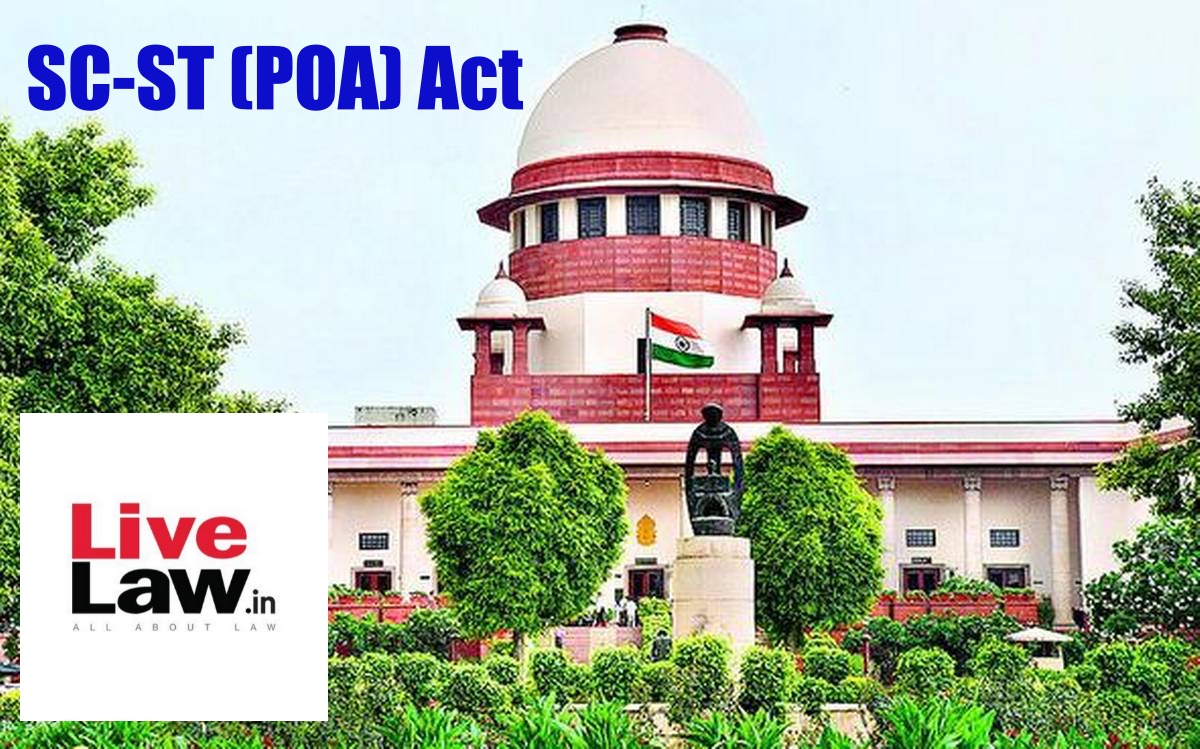
Sahil Hussain Choudhury’s article in Live Law
Sahil Hussain is correct in saying that caste does not exist solely through spectacle, it also functions through hidden enmity that seldom comes to light, silence, and private agreements. There is no reputable observer who disagrees with such social finding. It is not necessary to conclude that every domestic display of a caste language must be included by this specific regulation just because caste is acknowledged to pervade private life. Parliament took a clear legislative choice in drafting Sections 3(1)(r) and (s) to connect those specific offences to a public element, and courts are not free to read out that element simply because a commentator finds it inconvenient.
Untouchability is completely prohibited by Article 17 of the Constitution and the SC/ST Act was never intended to address all private cases of this prohibition. It has particular components and is a targeted criminal statute. The Protection of Civil Rights Act, 1955, which addresses disabilities related to untouchability in private and religious settings, general criminal provisions under the Bharatiya Nyaya Sanhita for verbal intimidation, and civil litigation are all fully applicable in situations where those components are lacking. The court’s respect to what Parliament wrote is a fundamental requirement for anti caste constitutionalism, not a retreat from it.
The Act’s Sections 3(1)(r) and 3(1)(s) only constitute offences when caste based intimidation or insult takes place ‘in any place within public view.’ That expression is not an after-the-fact judicial gloss. The 2018 amendment, which enhanced and restored arrest and investigation measures after a prior Supreme Court judgement had weakened them, left the ‘public view’ phrase completely unaltered. Parliament purposefully included it in the original Act. That was not an accident, but rather a deliberate omission.
For almost twenty years, the conditions have been regularly upheld. In Swaran Singh v. State through Standing Counsel (2008), the court recognised a clear distinction which was insult that was visible from the road close to a house’s gate qualified as being within public view, but an insult that was hidden from public view inside a building did not. The bench reaffirmed in Hitesh Verma v. State of Uttarakhand (2020) that accusations made within a private residence without the presence of a member of the public cannot meet the statutory standard. These established concepts were applied to a new set of facts in the Gunjan judgement.
The case Sahil Choudhury cited was a family dispute among schedule castes
A dispute about property and lock in a Delhi home gave rise to the case. The complainant is a member of a Scheduled Caste community, as are at least two of the accused while the remaining accused are their wives. FIR No. 42/2021 claims that the accused used words like ‘chura,’ ‘chamar,’ and ‘harijan’ during the domestic quarrel. The court held that the specific statutory elements of Sections 3(1)(r) and 3(1)(s), namely, that the offence must have occurred in any place within public view, were not disclosed by the FIR or charge sheet on their face because no outside member of the public was present or capable of witnessing the incident, rather than denying the alleged use of offensive language.
That quashing had nothing to do with the acceptability of language based on caste. It was determined that the particular criminal statute used did not apply to the facts as described. The complaint has access to ordinary criminal law, as general criminal provisions under the Bharatiya Nyaya Sanhita for verbal intimidation have not been smothered.
Privacy cannot become optional in private spaces
A direct challenge to the ‘public view’ requirement raises a problem that its advocates tend to ignore. If verbal offences inside a private home can result in special criminal liability regardless of who is present, the state effectively gains the authority to police domestic disputes based on one party’s subsequent complaint. In Justice K.S. Puttaswamy v. Union of India (2017), the Supreme Court’s nine-judge panel acknowledged that, in the absence of explicit legal authority, the house is the innermost sanctum of privacy, shielded from state interference. When the statutory anchor is eliminated, privacy is contingent upon who files the first and loudest complaints.
Property disputes between families already overburden India’s courts. Between 2020 and 2024, the National Commission for Scheduled Castes received over 47,000 complaints, with land and property conflicts and real atrocities ranking among the most frequent categories. Any domestic dispute that touches on caste identity could be turned into a major criminal case if the special criminal law is allowed to enter private homes unchecked on the grounds that caste terminology may have been used during a family conflict. This creates a risky motive structure. Similar to contract law, criminal law only works when all of its essential ingredients are clearly present.
When the accused and victims belong to the same community
The SC/ST Act was mainly designed to address power asymmetry, which is the public humiliation Scheduled Caste members endure at the hands of outsiders who use social hierarchy as a means of exclusion and degradation. The ‘public view’ filter prevents the special statute from being reduced to another weapon in regular civil property litigation, which is a fundamentally significant function that goes beyond simple legislative compliance when the complainant and the major accused are SC brothers.
The serious repercussions of a SC/ST Act registration, such as bail restrictions, social stigma, and the financial burden of protracted litigation, become available in disputes unrelated to caste-based oppression if an elevated criminal remedy can be triggered solely by one family member’s account of events inside a home without any supporting public aspect. The credibility of the Act, and hence its effectiveness in actual cases of public discrimination, is dependent on it not being habitually claimed when the requisite statutory ingredients are absent.
The question of consistent standards across communities
A more fundamental question that commentators have mostly avoided is raised by the current debate over whether the SC/ST Act’s reach should be expanded. If the Indian state takes seriously the idea that graded social discrimination within any community constitutes a public wrong, why does the Muslim and Christian communities, where caste like hierarchy operates with significant documented force, lack a dedicated legislative instrument?
This is not a justification for the SC/ST Act’s expansion. Both architecturally and constitutionally, the communities it names are linked to that statute, and it ought to stay that way. Instead, the argument is for legislative seriousness parity, if organised public humiliation based on birth ascribed status justifies a unique criminal statute in one community, then the lack of a comparable framework for two other significant communities is a policy gap that needs to be openly acknowledged.
There is substantial evidence. Muslims rank slightly above Scheduled Castes and Scheduled Tribes but below Hindu OBCs and other minorities on nearly all indicators of development, according to the Sachar Committee Report (2006), which was commissioned by the Prime Minister’s Office and presented in Parliament on November 30, 2006. Despite making up over 14% of the population, Muslims only hold 6.4% of government jobs. Crucially, though, the Sachar report did not completely break down by caste within Muslims.
The internal segregation is more obvious than the total numbers indicate. According to Uttar Pradesh’s empirical household survey data, the poverty rate for rural Muslim ‘lower castes’, who fall into the arzal category, is significant compared to Muslim OBCs and Muslim general. The problem of caste-based discrimination among the Muslim community has been recognised by the National Commission for Minorities, which has also suggested measures. Without a legal framework to address targeted humiliation or exclusion within that community, Biradari-based endogamy, occupational segregation, and social exclusion of the Pasmanda, who, according to their own organisations, make up about 80-85 per cent of India’s Muslim population, continue till date. Lower caste Muslims have been resisting not only the state but also predatory upper-class organisations and ulemas inside their own community, as Ali Anwar’s detailed account of the All India Pasmanda Muslim Mahaz shows. However, Parliament hasn’t passed any legislation that expressly addresses social prejudice against Muslims.
If anything, there is more detailed documentation of the condition in Christian communities. Despite making up about 65% of India’s approximately 20 million Catholic population, Catholics of the ‘lower castes’ are discriminated against in important ceremonies, leadership roles, and decision-making bodies. In a June 2021 letter to Pope Francis, the National Council of Dalit Christians accused the Catholic Bishops’ Conference of India of deliberately permitting both overt and covert forms of caste discrimination to continue in Tamil Nadu and Puducherry, including the systematic exclusion of Dalit clergy from leadership positions and segregated burial customs. The 2018 report by the Tamil Nadu Untouchability Eradication Front described practices such as separate churches, separate cemeteries, and the rejection of priestly appointments. It further claimed that church run hospitals, institutions, and schools hired only non-Dalit employees.
Fourteen people, including the father and brother of an upper-caste Christian woman, were found guilty by a Kerala court in 2018 of the honour killing of Dalit Christian Kevin Joseph, which occurred three days after he married her. In Indian society, caste transcends religion, according to government-appointed bodies, and Dalit Christians experience prejudice on two fronts at the same time. Once more, intra-Christian caste discrimination is not specifically addressed as a public evil by any statute.
Instead of amending the SC/ST Act, which must maintain its scope, text, and community specific design, two parallel, religion specific legislative instruments are required, one that addresses targeted humiliation and graded social discrimination in Muslim communities, with a focus on the exclusion of Pasmanda based on biradari, and another that addresses the same in Christian communities, with an emphasis on untouchability as it is practiced in churches, schools, and graveyards. Similar to how the SC/ST Act was adjusted to the historical circumstances of Hindu, Sikh, and Buddhist caste society, such statutes would need to be adjusted to the internal social structure of each community. The foundation of the constitution is simple, equal protection is required by Articles 14, 15, and 17, and this requirement does not stop at religious boundaries.
It would be more beneficial for those who support expanding the SC/ST Act to include private domestic disputes to focus their efforts on calling for the closure of this legislative gap. The weaker members of the Muslim and Christian communities have been waiting long enough for a solution that stands firmly on its own without borrowing someone else’s framework.
Conclusion
Statutes that are precisely defined, consistently applied, and rooted in legislative text provide historically underprivileged people with genuine protection, not judicial expansion that turns every private insult into a constitutional test case. Article 17 of the Constitution and anti caste jurisprudence are not weakened by the Gunjan judgement. It properly asserts that in order for special criminal provisions to maintain their practical efficacy and public legitimacy, they must preserve their unique legal ingredients.
The more important question raised by this case is whether India’s legislative framework is honest about who it protects and who it exposes. For example, there is no specific criminal statute for Pasmanda Muslims who are subject to biradari enforced exclusion, no specific criminal statute for Dalit Christians who are prohibited from participating in funeral rites within their own churches, and both communities have witnessed commission after commission document their situation without a single Parliament enacted response that is specifically tailored to their in-house community realities.
A truly anti-caste constitutionalism would demand religion-specific protective legislation for these communities on their own terms, not as an extension of a Hindu, Buddhist, Sikh framework, but as a parallel instrument rooted in each community’s own documented social hierarchy, while leaving the SC/ST Act exactly where Parliament placed it. A targeted, textually bounded statute whose credibility is entirely dependent on courts applying it as written, not as desired.