Supreme Court allows SC certificate for girl based on mother’s caste, despite ‘inter-caste’ marriage of parents: Why this is a problematic precedent
The Supreme Court of India has made a significant, rather bizarre, intervention in a case concerning a caste-certificate issuance for a girl born to an inter-caste marriage. On 8th December 2025, the apex court allowed issuance of a Scheduled Caste (SC) certificate for a minor girl from Puducherry, based solely on her mother’s “Adi Dravida” caste, overriding the father’s non-SC status. On Monday, the Supreme Court bench comprising CJI Surya Kant and Justice Joymalya Baghchi refused to entertain a plea challenging a Madras High Court order which directed the issuance of an SC caste certificate to the Puducherry girl based on her mother’s caste to ensure that her academic career does not suffer without it. The Supreme Court upheld the high court’s order, while leaving the broader legal questions unresolved, although the bench admitted that its decision would spark a debate. The Supreme Court upheld the High Court order, even as it is yet to adjudicate a bunch of petitions challenging the norm of children inheriting their father’s caste. “We are keeping the question of law open….With changing times, why should a caste certificate be not issued based on the mother’s caste?” the bench said. With the ruling allowing SC caste certificate issuance for children of a non-SC father and an SC mother, the Supreme Court has essentially set a precedent wherein children born in the marriage of a Scheduled Caste (SC) woman and an upper caste (UC) man and brought up in an upper caste family setting would be entitled to an SC certificate. In the present case, the mother, belonging to the Hindu Adi Dravida community, sought SC caste certificates from the Tehsildar for her three children, two daughters and a son. The SC woman argued that her non-SC husband has been residing with her parents, who belong to the Adi Dravida community. Notably, the ‘Adi Dravida’ caste is classified as a Scheduled Caste under presidential notification dated 5th March 1964 and 17th February 2002. These notifications state that an individual’s eligibility to obtain an SC caste certificate depends primarily on the father’s caste and residential status in the state or union territory’s jurisdiction. In accordance with the standard guidelines from the Union Home Ministry, the local officials rejected the woman’s application. Consequently, the woman moved the Madras High Court, which, in an interim order, directed the authorities to issue the SC certificate for the minor girl specifically, saying that denying the certificate to the girl would cause her academic hardship. Ultimately, the matter reached the Supreme Court, which dismissed the Puducherry administration’s appeal against the Madras High Court order and directed authorities to issue SC certificate for the SC woman’s daughter based on the mother’s caste alone. The Supreme Court contradicted its own previous rulings on the caste certificate issuance criteria The Supreme Court’s recent ruling marks a subtle but significant departure, rather, contradiction, from its previous ruling in a similar case wherein it decided that a father’s caste was the presumptive determinant of a child’s caste status. In the 2003 Punit Rai vs Dinesh Chaudhary case, a three-judge bench had ruled that in the absence of any statutory override, a child’s caste under Hindu law is inherited from the father. The court held that paternal lineage is followed for caste purposes and that the maternal lineage does not automatically confer the same status. However, in the 2012 ‘Rameshbhai Dabhai Naika vs State of Gujarat’ case, the Supreme Court took a rather flexible stance, stating that the caste of children born in inter-caste or in tribal and non-tribal marriages cannot be determined only by their father’s caste. The bench comprising justices Aftab Alam and Ranjana Prakash Desai ruled that while it may be presumed that the child belongs to the father’s caste, it is not conclusive or irrebuttable. “…by no means the presumption is conclusive or irrebuttable and it is open to the child of such marriage to lead evidence to show that he/she was brought up by the mother who belonged to the scheduled caste/scheduled tribe,” the court stated. Excerpt taken from the 2012 ‘Rameshbhai Dabhai Naika vs State of Gujarat’ ruling. (Source: India Kanoon) While in the 2012 ruling, the court took a fact-specific stance instead of issuing a blanket rule, in the current case involving a girl from Puducherry, the court bypassed the “father’s caste is child’s caste” presumption without inquiry. Unlike the 2012 case, the bench in the present case did not require or conduct an evidentiary probe into the girl’s upbringing or social treatment. The bench directly approved the issuance of a certificate based on the SC mother’s caste, citing “changing times” and academic needs. The court did not explicitly apply the rebuttable presumption framework. Although the court did not directly comment on the mother
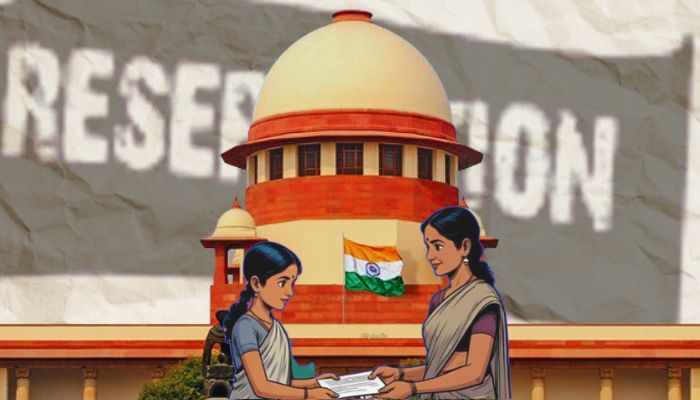

The Supreme Court of India has made a significant, rather bizarre, intervention in a case concerning a caste-certificate issuance for a girl born to an inter-caste marriage. On 8th December 2025, the apex court allowed issuance of a Scheduled Caste (SC) certificate for a minor girl from Puducherry, based solely on her mother’s “Adi Dravida” caste, overriding the father’s non-SC status.
On Monday, the Supreme Court bench comprising CJI Surya Kant and Justice Joymalya Baghchi refused to entertain a plea challenging a Madras High Court order which directed the issuance of an SC caste certificate to the Puducherry girl based on her mother’s caste to ensure that her academic career does not suffer without it. The Supreme Court upheld the high court’s order, while leaving the broader legal questions unresolved, although the bench admitted that its decision would spark a debate.
The Supreme Court upheld the High Court order, even as it is yet to adjudicate a bunch of petitions challenging the norm of children inheriting their father’s caste.
“We are keeping the question of law open….With changing times, why should a caste certificate be not issued based on the mother’s caste?” the bench said.
With the ruling allowing SC caste certificate issuance for children of a non-SC father and an SC mother, the Supreme Court has essentially set a precedent wherein children born in the marriage of a Scheduled Caste (SC) woman and an upper caste (UC) man and brought up in an upper caste family setting would be entitled to an SC certificate.
In the present case, the mother, belonging to the Hindu Adi Dravida community, sought SC caste certificates from the Tehsildar for her three children, two daughters and a son. The SC woman argued that her non-SC husband has been residing with her parents, who belong to the Adi Dravida community.
Notably, the ‘Adi Dravida’ caste is classified as a Scheduled Caste under presidential notification dated 5th March 1964 and 17th February 2002. These notifications state that an individual’s eligibility to obtain an SC caste certificate depends primarily on the father’s caste and residential status in the state or union territory’s jurisdiction.

In accordance with the standard guidelines from the Union Home Ministry, the local officials rejected the woman’s application. Consequently, the woman moved the Madras High Court, which, in an interim order, directed the authorities to issue the SC certificate for the minor girl specifically, saying that denying the certificate to the girl would cause her academic hardship.
Ultimately, the matter reached the Supreme Court, which dismissed the Puducherry administration’s appeal against the Madras High Court order and directed authorities to issue SC certificate for the SC woman’s daughter based on the mother’s caste alone.
The Supreme Court contradicted its own previous rulings on the caste certificate issuance criteria
The Supreme Court’s recent ruling marks a subtle but significant departure, rather, contradiction, from its previous ruling in a similar case wherein it decided that a father’s caste was the presumptive determinant of a child’s caste status.
In the 2003 Punit Rai vs Dinesh Chaudhary case, a three-judge bench had ruled that in the absence of any statutory override, a child’s caste under Hindu law is inherited from the father. The court held that paternal lineage is followed for caste purposes and that the maternal lineage does not automatically confer the same status.
However, in the 2012 ‘Rameshbhai Dabhai Naika vs State of Gujarat’ case, the Supreme Court took a rather flexible stance, stating that the caste of children born in inter-caste or in tribal and non-tribal marriages cannot be determined only by their father’s caste. The bench comprising justices Aftab Alam and Ranjana Prakash Desai ruled that while it may be presumed that the child belongs to the father’s caste, it is not conclusive or irrebuttable.
“…by no means the presumption is conclusive or irrebuttable and it is open to the child of such marriage to lead evidence to show that he/she was brought up by the mother who belonged to the scheduled caste/scheduled tribe,” the court stated.

While in the 2012 ruling, the court took a fact-specific stance instead of issuing a blanket rule, in the current case involving a girl from Puducherry, the court bypassed the “father’s caste is child’s caste” presumption without inquiry. Unlike the 2012 case, the bench in the present case did not require or conduct an evidentiary probe into the girl’s upbringing or social treatment.
The bench directly approved the issuance of a certificate based on the SC mother’s caste, citing “changing times” and academic needs. The court did not explicitly apply the rebuttable presumption framework. Although the court did not directly comment on the mother’s argument that her non-SC husband has been residing with his in-laws, the court, in a way validated that the point that if husband lives with wife’s parents after marriage instead of the wife moving into husband’s house, then the caste of children could be inherited from the mother even if they may have not essentially faced caste-based discrimination or deprivation.
The court elevated maternal lineage over traditional paternal determinant in the caste of children solely over the claim that “the girl’s academic future would be impacted negatively in the absence of an SC caste certificate.”
This raises the question of whether a caste certificate can be used as a means for better academic or job-related prospects by children born in inter-caste marriages where the father is non-SC or upper caste, even if the children have lived in an upper caste or non-discriminative environment most of their lives.
While the 2012 judgment already allowed flexibility, the 2025 ruling’s endorsement of maternal caste issuance, that too, without rigorous rebuttal, hints that with “changing times”, the Supreme Court is favouring a doctrinal pivot. However, this could trigger challenges to the paternal-lineage-for-caste tradition in reservation policies.
Even though the Supreme Court’s ruling in the present case grants immediate relief to the girl, it sets a precedent posing a risk to the integrity of reservation quotas. Reservations for SC/ST communities are mandated to address caste-based injustices and discrimination faced by the community members. The reservation benefits were tied to the father’s caste to ensure that only children demonstrably embedded in marginalised or disadvantaged communities qualify for quota benefits and to prevent dilution of the creamy layer.
If the court decides to allow maternal inheritance of caste without a thorough social inquiry, would it not be opening doors for several other inter-caste couples where the mother is SC, to claim caste-based benefits for their children, despite there not being genuine grounds like social discrimination or deprivation in jobs, etc? There have already been numerous cases wherein people forged fake caste certificates to avail caste benefits meant for reserved groups for jobs or college admissions. In some cases, it even turned out that individuals availing caste benefits for themselves and their children converted to another religion and yet continued to claim caste reservation benefits.
Opening up the maternal caste lineage window, without addressing the question of law, the court risks opening up doors for misuse of caste quotas and benefits.
There is also another problematic aspect to this case. If the caste of children can be based solely on the mother’s caste, or the caste of either parent, as per convenience, then what has been the point of the government and even the judiciary promoting inter-caste marriages?
The ‘Jamai Tola’ menace in Jharkhand, and how the Supreme Court ruling endorsing maternal caste lineage could legitimise caste quota misuse
The implicit legitimisation of maternal caste lineage may have alarming implications across the country, especially in border and tribal regions. It has been seen how non-indigenous and non-Hindus, including Muslim immigrants and Bangladeshi illegal settlers, in areas like Jharkhand’s Santhal Pargana division and West Bengal’s Jangal Mahal area, have systematically been misusing Scheduled Tribe (ST) benefits through marriages to tribal women. They are claiming ST caste status for their children by invoking the tribal mother’s caste.
झारखंड विशेषकर संताल क्षेत्र में आज अनेकों जमाई टोले तेजी से विकसित हो चुके हैं। बाहरी घुसपैठिए सुनियोजित तरीके से आदिवासियों की जमीनों पर क़ब्ज़ा कर रहे हैं, जिससे आदिवासी समाज अपने ही घर में बेघर और अल्पसंख्यक होने की कगार पर पहुंच गया है। राज्य सरकार के संरक्षण में स्थानीय… https://t.co/EWUYxu76wi
— Babulal Marandi (@yourBabulal) July 26, 2025
Last year, it was reported that Muslims in Jharkhand were marrying tribal women to buy land and contest elections in ST-reserved constituencies. These marriages after conversion to Islam are performed to contest elections. The term ‘Jamai Tola’ has been in common use in tribal areas in Santhal Pargana, referring to localities where non-ST males have married ST women and got ownership of land as ‘gift’ or donations by convincing the bride’s family. The marriages also aim to purchase land. The Jamai Tolas are essentially using marriage with ST women for electoral and financial benefits while also altering the demography of the tribal regions.
In October 2024, Asha Lakra, a member of the Scheduled Tribes Commission, submitted a 32-page report to the President, Jharkhand Governor and the Union Home Minister, highlighting the menace of Bangladeshi illegal infiltrators debt-trapping tribal families and then marrying their daughters in exchange for releasing them from the liability.
The report stated that Bangladeshi Muslim illegals marry non-Muslim tribal women, bring them into politics to grab power, land, valid documents like ration cards and Aadhaar cards. The situation has been particularly alarming in Jharkhand’s Santhal Pargana and Sahibganj, where there has been a massive influx of Bangladeshi Muslim infiltrators.
“In Sahibganj, tribal families are being entrapped by getting them into a debt trap by giving loans of Rs 5000, which gradually end up with a debt of over Rs 50,000 within a few months. In case of non-payment, Bangladeshi infiltrators demand that tribal families marry off their daughters to them against the debt. The Bangladeshi infiltrators are also grabbing tribal land through donation deeds (daan patra) obtained from the notary,” Asha Lakra said.
Bangladeshi illegals lure tribals with small loans that soon balloon into unpayable sums under a calculated strategy to eventually coerce marriage with their ST daughters as payment. The court validating maternal caste lineage for children would, in such marriages, allow children who, in reality, would be Muslim but ST on paper to secure reservations in education, jobs, and land rights, diluting benefits meant for genuine tribals, in a blatant erosion of tribal rights.
Notably, under the Santhal Pargana Tenancy (SPT) Act, local tribals cannot sell their land to anyone, and thus, the Bangladeshi Muslim infiltrators devised a loophole, Daan Patra. The Bangladeshi illegals forge fake documents and make tribals give them ‘Daan Patra’ or donation deeds for their land. This land is often misused for illegal activities.
A non-tribal contesting elections or purchasing land under the cover of a marriage to an ST woman or a non-SC/ST man availing reserved caste benefits defeats the very objectives of reservation. Neither a non-backward caste woman marrying a backward caste male, nor a non-backward caste male marrying a backward caste woman, nor subsequent recognition by the backward community as its member, should enable non-backward caste individuals to claim reservations.
With specific alterations, this pattern might be replicated across the country if maternal caste lineage is prioritised for reservation even in intercaste marriages, based on vague interventions citing ‘changing times’ or ‘academic imperative’. In tribal areas where Bangladeshi Muslim infiltrators are debt-trapping tribals for marriage with tribal girls, the Supreme Court ruling could inadvertently end up rewarding infiltration and loophole misuse, turning affirmative action into a weapon for demographic change rather than social justice or upliftment.
Several sections of converted Christians, and Muslims have already been demanding reservations, and the Supreme Court ruling allowing children born in inter-caste marriages where only the woman belongs to SC or ST group to obtain caste certificate and avail benefits, would encourage such marriages and misuse of reservation quotas. These concerns need to be addressed by the judiciary and the Central government.