Anti-Hindu DMK gathers INDI bloc partners to target Justice GR Swaminathan of Madras HC who gave Thiruparankundram order: How the ‘secular liberals’ attacks judiciary when orders are not in their favor
The traditional Karthigal Deepam ritual at Thiruparankundram is a practice older than political parties. It is even older than several structures on the hill. However, the Hindu traditional practice required the intervention of the Madras High Court just because the DMK government refused to allow the ceremonial lamp to be lit at the hilltop Deepathoon rejecting Dargah’s objections. It was a straightforward question of religious practice in Tamil Nadu. However, what happened after the court allowed the ceremony to happen at the hilltop has spiralled into a confrontation that touches the very core of India’s constitutional balance. The order passed by Justice GR Swaminathan of the Madurai Bench of the Madras High Court said that the Deepam must indeed be lit at the traditional location. It should have been a routine administrative compliance but has turned into a full-blown standoff between the justice system and the state government. Despite the clear order, the administration not only failed to carry it out but mounted a series of objections, procedural delays and barricading measures that actively prevented devotees from performing the ritual. A contempt petition had to be filed, and even after the court reiterated its instructions, the state refused to carry them out. The conflict dramatically escalated when the judiciary had to call for CISF protection to ensure that Hindu devotees could simply light a lamp. In a democratic setup, a court calling central security forces to protect Hindus is unimaginable but it happened in the DMK-ruled state. The issue is no longer a mere question of religious custom. It is a confrontation between an elected government and the judiciary it is constitutionally bound to respect. What has further intensified the controversy is the fact that Members of Parliament (MPs) belonging to the INDI Alliance have now submitted an impeachment notice against Justice Swaminathan himself. The judge’s crime, if it can be called that, was that he enforced a centuries-old tradition and insisted on compliance with judicial orders. The move has raised unprecedented concerns about political retribution against the judiciary and appears to confirm fears that certain opposition parties are willing to punish judges who refused to toe their ideological line. Notably, since the BJP-led NDA came to power for the third time in the centre, the opposition parties have become more restless and aggressive, consistently seeking methods to put strain on the constitutional and communal fabric of the country. INDI bloc impeachment plan and the threat it poses to judicial independence It did not take time for the administrative defiance to turn into political drama. MPs from the INDI Alliance have filed an impeachment motion against Justice GR Swaminathan. Their sights are trained on a judge whose only act was to uphold the law and protect a ritual from arbitrary interference. VIDEO | Delhi: DMK leader Kanimozhi submits an Impeachment Notice to Lok Sabha Speaker Om Birla, seeking the removal of Madras High Court Judge G R Swaminathan, after obtaining signatures from more than 120 MPs.Congress MP Priyanka Gandhi Vadra, Samajwadi Party chief Akhilesh… pic.twitter.com/yzn9gq2lio— Press Trust of India (@PTI_News) December 9, 2025 In constitutional terms, impeachment is intended to be an extraordinary measure used only in cases of grave misconduct. In the present case, there is neither misconduct nor any impropriety. The impeachment plan thus appears to be a punitive response against a judge who refused to accommodate political pressure and insisted on judicial compliance. The implications of the step taken by the INDI Bloc are severe. If political parties begin to deploy impeachment as a weapon to punish judges who deliver rulings they dislike, judicial independence itself becomes endangered. The threat alone can have a chilling effect on future benches. It is a method of intimidation dressed in the form of a constitutional provision. This impeachment effort does not exist in isolation. It sits atop decades of historical precedent where opposition parties, chiefly Congress and DMK-aligned groups, have deployed pressure, coercion or retribution against the judiciary whenever rulings conflicted with their political interests. The Madurai Deepam episode is simply the latest flashpoint that illuminates a disturbing pattern. A historical pattern of judicial intimidation resurfaced In 1973, the Congress government superseded judges and appointed Justice AN Ray as Chief Justice over the heads of three senior judges who had ruled against the Kerala government in the Kesavananda Bharati case. It is known as one of the darkest episodes in India’s judicial history. The government repeated the act in 1977 by superseding Justice HR Khanna, whose courageous dissent in the ADM Jabalpur case asserted that the right to life could not be suspended even during the Emergency. When MH Beg
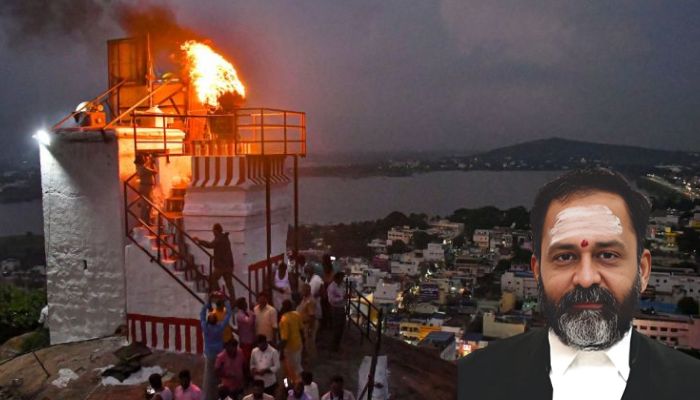

The traditional Karthigal Deepam ritual at Thiruparankundram is a practice older than political parties. It is even older than several structures on the hill. However, the Hindu traditional practice required the intervention of the Madras High Court just because the DMK government refused to allow the ceremonial lamp to be lit at the hilltop Deepathoon rejecting Dargah’s objections. It was a straightforward question of religious practice in Tamil Nadu. However, what happened after the court allowed the ceremony to happen at the hilltop has spiralled into a confrontation that touches the very core of India’s constitutional balance.
The order passed by Justice GR Swaminathan of the Madurai Bench of the Madras High Court said that the Deepam must indeed be lit at the traditional location. It should have been a routine administrative compliance but has turned into a full-blown standoff between the justice system and the state government.
Despite the clear order, the administration not only failed to carry it out but mounted a series of objections, procedural delays and barricading measures that actively prevented devotees from performing the ritual. A contempt petition had to be filed, and even after the court reiterated its instructions, the state refused to carry them out.
The conflict dramatically escalated when the judiciary had to call for CISF protection to ensure that Hindu devotees could simply light a lamp. In a democratic setup, a court calling central security forces to protect Hindus is unimaginable but it happened in the DMK-ruled state. The issue is no longer a mere question of religious custom. It is a confrontation between an elected government and the judiciary it is constitutionally bound to respect.
What has further intensified the controversy is the fact that Members of Parliament (MPs) belonging to the INDI Alliance have now submitted an impeachment notice against Justice Swaminathan himself. The judge’s crime, if it can be called that, was that he enforced a centuries-old tradition and insisted on compliance with judicial orders. The move has raised unprecedented concerns about political retribution against the judiciary and appears to confirm fears that certain opposition parties are willing to punish judges who refused to toe their ideological line.
Notably, since the BJP-led NDA came to power for the third time in the centre, the opposition parties have become more restless and aggressive, consistently seeking methods to put strain on the constitutional and communal fabric of the country.
INDI bloc impeachment plan and the threat it poses to judicial independence
It did not take time for the administrative defiance to turn into political drama. MPs from the INDI Alliance have filed an impeachment motion against Justice GR Swaminathan. Their sights are trained on a judge whose only act was to uphold the law and protect a ritual from arbitrary interference.
VIDEO | Delhi: DMK leader Kanimozhi submits an Impeachment Notice to Lok Sabha Speaker Om Birla, seeking the removal of Madras High Court Judge G R Swaminathan, after obtaining signatures from more than 120 MPs.
— Press Trust of India (@PTI_News) December 9, 2025
Congress MP Priyanka Gandhi Vadra, Samajwadi Party chief Akhilesh… pic.twitter.com/yzn9gq2lio
In constitutional terms, impeachment is intended to be an extraordinary measure used only in cases of grave misconduct. In the present case, there is neither misconduct nor any impropriety. The impeachment plan thus appears to be a punitive response against a judge who refused to accommodate political pressure and insisted on judicial compliance.
The implications of the step taken by the INDI Bloc are severe. If political parties begin to deploy impeachment as a weapon to punish judges who deliver rulings they dislike, judicial independence itself becomes endangered. The threat alone can have a chilling effect on future benches. It is a method of intimidation dressed in the form of a constitutional provision.
This impeachment effort does not exist in isolation. It sits atop decades of historical precedent where opposition parties, chiefly Congress and DMK-aligned groups, have deployed pressure, coercion or retribution against the judiciary whenever rulings conflicted with their political interests. The Madurai Deepam episode is simply the latest flashpoint that illuminates a disturbing pattern.
A historical pattern of judicial intimidation resurfaced
In 1973, the Congress government superseded judges and appointed Justice AN Ray as Chief Justice over the heads of three senior judges who had ruled against the Kerala government in the Kesavananda Bharati case. It is known as one of the darkest episodes in India’s judicial history.
The government repeated the act in 1977 by superseding Justice HR Khanna, whose courageous dissent in the ADM Jabalpur case asserted that the right to life could not be suspended even during the Emergency. When MH Beg was appointed as CJI superseding Justice HR Khanna, he resigned from his post. These events were not isolated accidents but ideologically driven manoeuvres that compromised judicial independence.
During the Emergency, the judiciary suffered further erosion when as many as 21 High Court judges were transferred without consent. These transfers were widely seen as efforts to discipline those who had shown independence and to reward those viewed as “committed” to the Indira Gandhi-led government’s agenda.
Then in 2018, several opposition parties attempted to impeach then CJI Dipak Misra over the Justice Loya case. The motion was rejected by the Rajya Sabha Chairperson for lack of merit. However, the purpose was clear, that is, to intimidate the judiciary at a moment when politically sensitive cases were before the court.
In 2023, TMC-affiliated lawyers physically blockaded the courtroom of Justice Rajasekhar Mantha and prevented him from conducting hearings after his ruling favoured the BJP. Derogatory posters were plastered across Kolkata calling him a “disgrace.”
Then in 2024, the opposition launched yet another attack on the judiciary by moving an impeachment motion against Allahabad High Court Judge Shekhar Kumar Yadav over his remarks at a VHP event. Signed by 55 MPs, the proposal accused him of “hate speech” and “communal bias”, conveniently ignoring that judges across the ideological aisle routinely make far more provocative statements without consequence.
The history is clear. The move to impeach Justice Swaminathan fits a well-established template. Once again, a judge who issued a ruling that displeased the political class finds himself at the receiving end of a coordinated offensive.
Court orders ignored as the standoff deepened – How the case intensified
The first major rupture occurred when the HR&CE department, controlled by the DMK government, refused permission for the Deepam to be lit at the hilltop. Devotees, forced into litigation, secured a clear High Court order that upheld the ritual’s continuity. The matter should have ended there.
However, the government treated the matter not as a civil question but as an adversarial battle. The state filed objections and raised procedural hurdles that delayed implementation of the High Court’s order. The administration insisted that the ritual posed some “undefined communal danger” just because there is an Islamic structure on the hill. The argument is untenable and reflected hostility not to tension but to Hindu worship itself.
When the first order was defied, the petitioners approached the court again through a contempt petition. The court repeated its instruction. However, the state failed to comply again. Officials on the ground erected barricades to prevent devotees from reaching the site and continued to maintain a posture of institutional defiance.
What made the matter worse was that the state decided to challenge not only the contempt proceedings before the Supreme Court but also the single-judge order before a Division Bench. Multiple appeals were based not on administrative feasibility but on a strategy of delay and resistance.
When the High Court called the CISF to directly intervene and protect devotees going to light the lamp, the state stopped the CISF at the foot of the hill. The confrontation between the devotees and state police turned violent. Devotees were stopped and pushed by the very state that was supposed to help in honouring the High Court’s directions.
DMK’s ideological hostility towards Hindu rituals expresses itself in governance
To fully understand the blow-up in Madurai, it is necessary to locate it within the DMK’s long-standing ideological posture. The party leadership has repeatedly displayed overt hostility towards Hindu practices and beliefs. Udhayanidhi Stalin’s infamous declaration that Sanatan Dharma must be eradicated like dengue or malaria was not a spontaneous slip but a written speech reviewed beforehand and delivered publicly.
A Raja extended the analogy to HIV and leprosy while referring to Hindu devotees in derogatory terms. Neither faced disciplinary action; both remain influential voices within the party.
These patterns of speech have parallel expressions in administrative decisions. During the Ram Mandir Pran Pratishtha, the Tamil Nadu government attempted to block livestreams of the ceremony across the state. Devotees watching the event inside a Chennai temple were booked under criminal charges, a move later struck down by the Supreme Court, which called the state’s conduct “atrocious.”
What happened at Thiruparankundram is thus not an aberration born of administrative confusion. It is part of a continuum in which Hindu rituals, symbols and practices are treated with suspicion or disdain, and where state machinery acts as an instrument to contain or curtail expressions of Hindu devotion.
A national moment of reckoning for judicial independence
The Karthigal Deepam ritual case now reflects a much larger national problem. On one side, there is the judiciary, which simply upheld an old ritual and protected devotees. On the other side, there is a government that ignored court orders, blocked the ritual and then supported moves to impeach the judge who insisted on compliance.
This is no longer about the lamp on a hill. It raises serious concerns about judicial independence, especially if impeachment is used to pressure judges. If such actions continue, future judges may hesitate to rule against powerful governments. It will weaken the basic promise of equal protection under the law. The DMK, with its decision to stop the ritual, has revealed a deeper attempt to undermine constitutional values.