27% properties on Umeed portal with less than 1% registration from Bengal: Why Waqf Boards failed to meet deadline upheld by SC, despite centre’s extensive help
The “Unified Waqf Management, Empowerment, Efficiency and Development Rules, 2025” were announced by the Modi government on 3rd July. Earlier on 8th April, a digital framework under the Waqf (Amendment) Act, 2025, was implemented for the management of Waqf properties through a centralised platform. The objective was to digitise records, enhance oversight, expedite audits and introduce transparency through different IDs. Nevertheless, only a little over a quarter of the properties have found their place on the website, even after the six-month period granted by the centre. According to data, just 2.16 lakh of the 8 lakh Waqf properties have been registered on the Umeed website as the window closed on 6th December in line with the Umeed Act, 1995. The platform was inaugurated by the Minister for Minority Affairs, Kiren Rijiju, on 6th June. The Ministry of Minority Affairs informed, “5,17,040 Waqf properties were initiated on the portal. 2,16,905 properties were approved by the designated approvers. 2,13,941 properties have been submitted by makers and remain in the pipeline as of the deadline. 10,869 properties stood rejected during verification.” UPDATE ON UMEED CENTRAL PORTAL | Deadline CompletedThe UMEED Central Portal for management of Waqf Properties in India, launched by Hon’ble Minister of Minority Affairs Shri Kiren Rijiju on 6 June 2025, officially closed for uploads on 6 December 2025 (Saturday), completing its… pic.twitter.com/orjVPaCRCr— Ministry of Minority Affairs (@MOMAIndia) December 7, 2025 The data suggested that Karnataka registered the most properties (81%) at 52,917. Jammu & Kashmir came second with 25,046 (77%) assets. Punjab recorded 24,969 (90%), and Gujarat listed 24,133 (61%) holdings. Uttar Pradesh was able to start the registration procedure for most properties at 86,345, as Maharashtra, Karnataka and Kerala followed with 62,939, 58,328 and 42,772, respectively. Only 789 (5%) Shia Waqf Board filings have been processed in Uttar Pradesh compared to 12,982 (11%) Sunni Waqf Board registrations. It is the sole state with distinct Waqf Boards for the two faiths, aside from Bihar. 11,391 properties were uploaded by Shia and Sunni Waqf boards in Bihar, as officials confirmed 100% completion of the registration process. Out of 36,700 Waqf properties, 17,971 (48%) had been registered in Maharashtra, and the number was 40,000 from 51,000 properties in Telangana. Arunachal Pradesh, Mizoram, Sikkim and Nagaland did not share details on the portal, while 681 properties from Assam, 393 from Manipur and 13 from Meghalaya had been published. Goa and Ladakh likewise reported no uploads. West Bengal is among the states with the lowest performance and registered only 716 assets out of 80,480 (0.89%). The All India Trinamool Congress (AITC or TMC) government had been refusing to enforce the Waqf (Amendment) Act for months until recently, when it issued instructions to share details about these assets to the online platform. Chief Minister Mamata Banerjee previously declared, “We won’t follow the act and have opposed it in the state legislative assembly. The state government has filed a case in the Supreme Court. The case is still on, and I won’t allow anybody to touch the Waqf properties,” at a rally in the Malda district. Waqf was also backed by the party’s Lok Sabha MP Kalyan Banerjee, who branded it a “core belief” and an “integral part” of Islam, during a discussion on the Waqf Amendment Bill, 2024. The party even fuelled protests to appease its Muslim vote bank in the state. Notably, the nation is home to 8.8 lakh Waqf properties. Uttar Pradesh leads with 2.4 lakh assets next to West Bengal (80,480), Punjab (75,511), Tamil Nadu (66,092) and Karnataka (65,242). The properties had to be registered in three steps: mutawallis completed the first phase, Waqf Board officials executed the second, and Waqf Board CEOs (Chief Executive Officers) accomplished the third. Ministry of Minority Affairs played a crucial role in aiding every step of the process The Ministry of Minority Affairs conveyed that it held ongoing training sessions and workshops with state/UT (Union Territory) Waqf Boards and Minority Departments to support this extensive national exercise. Additionally, a two-day Master Trainer Workshop was organised in Delhi to provide state/UT officials and Waqf Boards with practical instruction for the uploading procedure. Seven zonal meetings were conducted countrywide, and senior technical and administrative teams were assigned to various states. The ministry office also set up a dedicated helpline for technical assistance and prompt resolution of any problems that arose during the process. Secretary Dr Chandra Shekhar Kumar attended more than 20 review sessions since the portal’s debut, constantly directing, inspiring and keeping an eye on states and UTs to guarantee the timely and accurate posting of current Waqf property records. The ministry lau
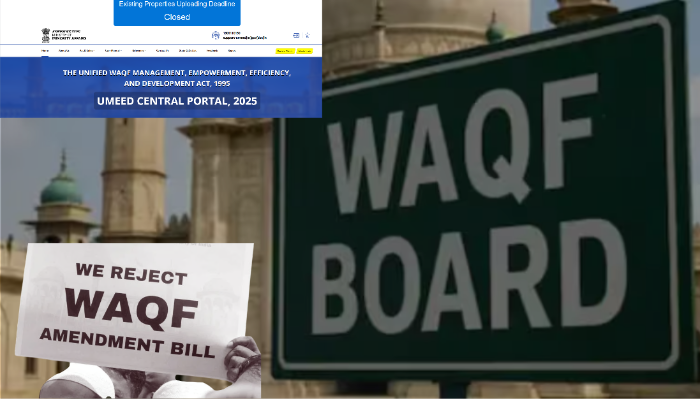

The “Unified Waqf Management, Empowerment, Efficiency and Development Rules, 2025” were announced by the Modi government on 3rd July. Earlier on 8th April, a digital framework under the Waqf (Amendment) Act, 2025, was implemented for the management of Waqf properties through a centralised platform. The objective was to digitise records, enhance oversight, expedite audits and introduce transparency through different IDs.
Nevertheless, only a little over a quarter of the properties have found their place on the website, even after the six-month period granted by the centre. According to data, just 2.16 lakh of the 8 lakh Waqf properties have been registered on the Umeed website as the window closed on 6th December in line with the Umeed Act, 1995. The platform was inaugurated by the Minister for Minority Affairs, Kiren Rijiju, on 6th June.
The Ministry of Minority Affairs informed, “5,17,040 Waqf properties were initiated on the portal. 2,16,905 properties were approved by the designated approvers. 2,13,941 properties have been submitted by makers and remain in the pipeline as of the deadline. 10,869 properties stood rejected during verification.”
UPDATE ON UMEED CENTRAL PORTAL | Deadline Completed
— Ministry of Minority Affairs (@MOMAIndia) December 7, 2025
The UMEED Central Portal for management of Waqf Properties in India, launched by Hon’ble Minister of Minority Affairs Shri Kiren Rijiju on 6 June 2025, officially closed for uploads on 6 December 2025 (Saturday), completing its… pic.twitter.com/orjVPaCRCr
The data suggested that Karnataka registered the most properties (81%) at 52,917. Jammu & Kashmir came second with 25,046 (77%) assets. Punjab recorded 24,969 (90%), and Gujarat listed 24,133 (61%) holdings. Uttar Pradesh was able to start the registration procedure for most properties at 86,345, as Maharashtra, Karnataka and Kerala followed with 62,939, 58,328 and 42,772, respectively.
Only 789 (5%) Shia Waqf Board filings have been processed in Uttar Pradesh compared to 12,982 (11%) Sunni Waqf Board registrations. It is the sole state with distinct Waqf Boards for the two faiths, aside from Bihar. 11,391 properties were uploaded by Shia and Sunni Waqf boards in Bihar, as officials confirmed 100% completion of the registration process.
Out of 36,700 Waqf properties, 17,971 (48%) had been registered in Maharashtra, and the number was 40,000 from 51,000 properties in Telangana.
Arunachal Pradesh, Mizoram, Sikkim and Nagaland did not share details on the portal, while 681 properties from Assam, 393 from Manipur and 13 from Meghalaya had been published. Goa and Ladakh likewise reported no uploads.
West Bengal is among the states with the lowest performance and registered only 716 assets out of 80,480 (0.89%). The All India Trinamool Congress (AITC or TMC) government had been refusing to enforce the Waqf (Amendment) Act for months until recently, when it issued instructions to share details about these assets to the online platform.
Chief Minister Mamata Banerjee previously declared, “We won’t follow the act and have opposed it in the state legislative assembly. The state government has filed a case in the Supreme Court. The case is still on, and I won’t allow anybody to touch the Waqf properties,” at a rally in the Malda district.
Waqf was also backed by the party’s Lok Sabha MP Kalyan Banerjee, who branded it a “core belief” and an “integral part” of Islam, during a discussion on the Waqf Amendment Bill, 2024. The party even fuelled protests to appease its Muslim vote bank in the state.
Notably, the nation is home to 8.8 lakh Waqf properties. Uttar Pradesh leads with 2.4 lakh assets next to West Bengal (80,480), Punjab (75,511), Tamil Nadu (66,092) and Karnataka (65,242). The properties had to be registered in three steps: mutawallis completed the first phase, Waqf Board officials executed the second, and Waqf Board CEOs (Chief Executive Officers) accomplished the third.
Ministry of Minority Affairs played a crucial role in aiding every step of the process
The Ministry of Minority Affairs conveyed that it held ongoing training sessions and workshops with state/UT (Union Territory) Waqf Boards and Minority Departments to support this extensive national exercise. Additionally, a two-day Master Trainer Workshop was organised in Delhi to provide state/UT officials and Waqf Boards with practical instruction for the uploading procedure.
Seven zonal meetings were conducted countrywide, and senior technical and administrative teams were assigned to various states. The ministry office also set up a dedicated helpline for technical assistance and prompt resolution of any problems that arose during the process.
Secretary Dr Chandra Shekhar Kumar attended more than 20 review sessions since the portal’s debut, constantly directing, inspiring and keeping an eye on states and UTs to guarantee the timely and accurate posting of current Waqf property records.
The ministry lauded, “The conclusion of this phase marks a significant milestone in bringing transparency, efficiency, and unified digital management to Waqf properties across India under the Umeed framework.”
It also highlighted that “in the final count, the momentum significantly accelerated as the deadline approached. Many review meetings, training workshops, and high-level interventions, even at the secretary level, injected renewed pace into the process, making the upload surge in the last hours.”
Supreme Court upheld the centre’s deadline
On 1st December, the Supreme Court had declined to extend the deadline for updating the information of registered Waqf properties, including “Waqf by user,” on the Umeed site in a significant victory for the centre. The petitioners claimed that technological issues prevented them from submitting the details on the platform, and it was also difficult to locate the Waqf property mutawallis (caretakers) who needed to update the information on the website.
The decision was pronounced by a bench of Justice Dipankar Datta and Justice Augustine George Masih. “Approach the tribunal. Let them decide on a case-by-case basis. We can’t rewrite the Waqf Act,” the court directed and asked, “The statute already provides a remedy. Avail it. Why should we interfere?”
The bench emphasised that it cannot intervene when parliament has predetermined a particular procedure to settle disagreements pertaining to the registration procedure. “If the time freezes (in the portal), you cannot be held responsible. If at all the tribunal allows you, your six months will be counted, and your application will be considered. You do not need permission. If difficulty arises, you can always file an application before us,” it remarked. The verdict triggered an abrupt increase in uploads.
No extension for Waqf registration
Now that the portal is closed, mutawallis who neglected to register their properties have to apply to the Waqf tribunal to request a six-month extension. The tribunal then must review each case before awarding more time, leading to a new round of paperwork. Kiren Rijiju also confirmed that the registration date would not be postponed.
He did, however, mention that those who tried but were unable to complete the registration would not face any consequences and could appeal to their state’s waqf tribunals.
Rijiju mentioned, “This is not an extension of the uploading deadline. Mutawallis who are unable to complete the registration process by 11:59:59 pm. on 6th December can approach the Waqf tribunal, which has the legal authority to grant an extension. I have repeatedly emphasised that any change in the legally mandated timeline is not possible, as it is bound by the law passed by parliament and upheld by the Supreme Court.”
He further stressed, “The Supreme Court was clear on its instructions that the date cannot be extended after the six-month deadline, but the tribunal has the authority to extend it further by up to six months. We try our best to give the maximum relief to our people, but some things are bound by law. Since the parliament has passed the Waqf Amendment Act, we cannot change the law.”
However, the minister assured that the centre would not apply any penalties or take stern action for the following three months, as a humanitarian and facilitating measure.
AIMPLB, Waqf Boards raise complaints
All India Muslim Personal Law Board (AIMPLB) spokesperson SQR Ilyas voiced, “After SC refused to extend the deadline of the portal, mutawallis across the country rushed to upload waqf properties. However, reports have been pouring in about technical glitches and that the portal is repeatedly crashing, slowing down and at times stopping entirely.” He further claimed that “it is almost impossible to upload details of lakhs of Waqf properties within such a short period.”
Furthermore, the board sent a letter to the Minister of State for Minority Affairs, George Kurian, requesting an urgent meeting to address the technological problems and requesting additional time.
The board’s general secretary, Maulana Muhammad Fazlur Rahim Mujaddidi, stated in the letter delivered by email and post that the upload timeframe was too short “due to the portal’s slow speed and other technical problems.” He alleged, “Though the board and various religious community organisations held workshops across the country and set up help desks, the sheer volume of work remains overwhelming.”
Syed Ali Zaidi, the Chairman of the Shia Central Waqf Board, mentioned that around 7,800 Waqf properties in Uttar Pradesh are recorded with the Shia Waqf Board. He stated that the portal is not operating effectively, and it would require three to six months to list all the necessary data, reported Dainik Bhaskar. Zeeshan Rizvi, the board’s CEO, insisted that only two or three properties and occasionally four can be uploaded on Umeed each day.
Waqf Boards and mutawallis of the properties similarly complained about multiple problems, including the portal glitching and crashing, the inability to locate documentation regarding properties that date back hundreds of years and the disparity in measurements utilised to measure land in distinct states.
On the other hand, officials from the Waqf Board announced that they are going to start filing demands for an extension to upload paperwork and register properties on the portal to Waqf tribunals in their respective states. A Uttar Pradesh Sunni Central Waqf Board member warned, “The tribunals in states where registrations are low will face a flurry of applications seeking extensions for the process.”
According to senior advocate Shariq Abbasi, properties that were not uploaded would have to be submitted to the tribunal. He added that the matter could be taken to the high court and even the apex court if the tribunal’s decision is not in Waqf’s favour. However, if no relief is obtained afterwards, the holdings might be subjected to government intervention.
Officials refute claims, outline facts
However, akin to the manner in which the aforementioned ministry indicated its support throughout the entire process, officials also reiterated the same. An officer noted, “We have deployed all resources, including technical staff, to handle the rush. If the Umeed portal has successfully handled over one lakh uploads in just the past 100 hours, how can its functionality be questioned on grounds of hanging or malfunctioning?”
He pointed out that for “nearly four months there were few uploads and now the sudden surge has created an unusually heavy load, prompting complaints that stem more from delayed action than from any flaw in the portal itself.”
The Umeed portal served as an extension of the efforts to address the nefarious practices within the Waqf Boards, which have encountered numerous allegations of corruption, misuse of authority and illegal occupation of public and private lands, among other concerns.
However, the reality is apparent. The Waqf Boards failed to register their properties on the portal. They were preoccupied with protesting the Waqf Amendment Act, driven by the insidious remarks of “secular parties,” leftist-liberal lobby and other Muslim leaders. The Supreme Court was also approched in an attempt to overturn the law passed by the Indian Parliament.
Nevertheless, the protests did not manage to exert pressure on the Modi government and the judiciary adhered to its constitutional responsibilities. As a result, the Waqf Boards did not obtain any relief from either side. The time allocated to them was voluntarily squandered either in agitating or refusing to comply with the law, despite a willing government ready to assist them at every stage to simply and aid the process.
Now, as their methods did not produce the expected outcomes, the boards had no alternative but to register their properties. However, this sudden influx just before the deadline impacted the portal. If the boards had commenced to fill their assets since June, this issue would not have arisen and any minor challenges that surfaced would have been resolved by the effective system established by the government.
Therefore, if anyone is to be held accountable for the present issues, it is the Waqf Boards that presently desire special consideration from the centre. Their actions have not only created additional issues for themselves but have also increased the workload for officials and administration as well.